 * Notes *
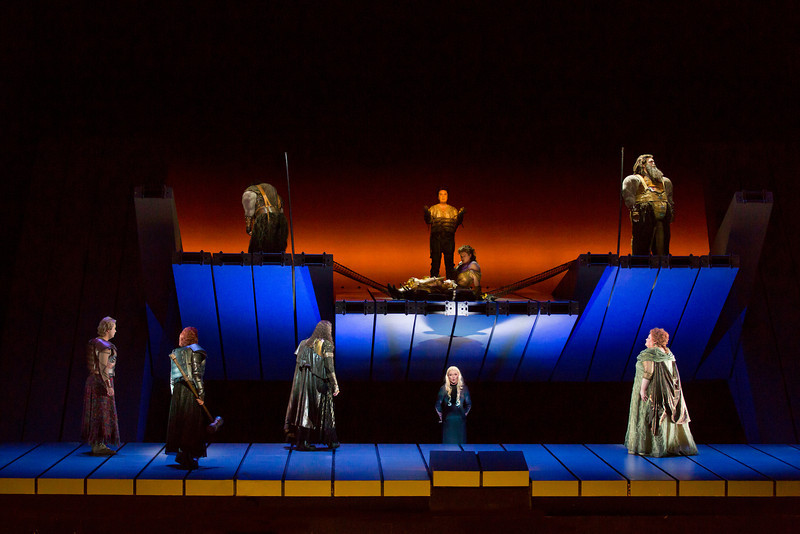
A second Ring cycle began with Das Rheingold (Scene 4 pictured left, photograph by Ken Howard/Metropolitan Opera) last night at the Met. Robert Lepage’s production involves a series of about 24 jointed panels that can be arranged in many different configurations. Known as “The Machine,” Carl Fillion’s set is not unlike a huge shape-shifting robot. The scene changes were certainly resolved in breathtaking ways. However, the main drawback is not that “The Machine” is slightly noisy, snapping here and there, but that it placed the singers awkwardly upstage or on terrifying rakes where they do not seem as able to project well. The lighting, designed by Etienne Boucher, is attractively simple. The video images, from Lionel Arnould, evoke nature and space. Only the rainbow bridge was busy, with its dancing strings of multicolored light. François St-Aubin’s costumes did not appear markedly different from the previous Ring production, traditional, perhaps taking on the aesthetic of comic book superheros in the armor of the Gods.
The orchestra sounded clear and secure under Fabio Luisi, and the tempi were moderate. The brass was clean. The singing was consistent around. Wendy Bryn Harmer was an incredibly hearty, bright Freia. Franz-Josef Selig (Fasolt) and Hans-Peter König (Fafner) turned out perfectly respectable performances. Adam Klein did not quite sparkle as Loge, but since he stepped in at the last moment for an ailing Stefan Margita, it is understandable. Patricia Bardon’s Erda had an ethereal quality that was appealing. Stephanie Blythe was a sympathetic Fricka, warm with the right amount of steeliness. Eric Owens impressed as Alberich, his renunciation of love in Scene 1 was poignant, and his curse in Scene 4 haunting. As Wotan, Bryn Terfel’s voice has a beautiful richness to it, but seemed a touch light at times.
* Tattling *
An usher attempted to seat a pair of latecomers in Family Circle after the music had started. Unfortunately one of their seats had been taken, and there was a flurry of whispered instructions. A watch alarm sounded at 9pm and 10pm. Some were having respiratory issues, loud nose blowing and sniffles were heard, as were the usual crinkles of cough drops being unwrapped.


 The Opera Tattler
Leave a comment