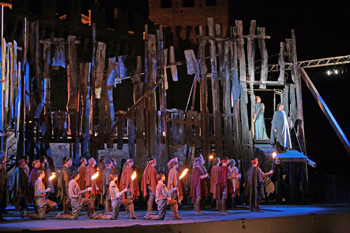
 A revival of Metropolitan Opera‘s Il Trovatore, seen in San Francisco last year, opened this evening. Here is the Unbiased Opinionator’s account of final dress rehearsal that occurred on October 21st. The Opera Tattler was quite surprised to hear that Patricia Racette was indisposed, as she is known for having vocal cords of steel. At the same time, one finds it difficult to imagine Racette in this role, especially since she is double cast with the incredible Sondra Radvanovsky.
* Notes *
The bare-knuckled, long-time film critic for the New Yorker, Pauline Kael, once wrote of the Marx Brothers’ “A Night at the Opera” that The Marx Brothers did to Il Trovatore what Il Trovatore deserved to have done to it. The plot line of the opera certainly requires of the listener not just a willing suspension of disbelief, but at times requires the listener unplug disbelief entirely, and to suppress outright laughter. My favorite howler is Manrico’s singing his mother to sleep just before she is to be burned at the stake.
In addition to its lemon of a plot, the opera contains long stretches of rather pedestrian music. Thus, the success or failure of the piece rest entirely on the quality of the performance. Thursday’s dress rehearsal was beset by many gremlins. Both Manrico and Azucena canceled due to illness, and the Leonora (Patricia Racette) was announced to be indisposed but, begging the audience’s indulgence, would perform as scheduled. So an entirely fair review of this show must await an actual performance after flu, allergy, and the unwillingness of certain singers to “waste their time” on the dress rehearsal of an opera season has passed. That said, enough of the performance remained intact for UO to make a few comments.
It is difficult to comment fairly on Patricia Racette’s Leonora in light of her announced indisposition. She marked many passages, but managed a full-voice account of her first act aria “Tacea la Notte,” which confirmed my doubt that the versatile, dramatically satisfying Racette could ever make a true Verdian. Her voice is simply too light to ride out the huge Verdi arches and to prevail in the large ensembles. Luckier opera-goers will have a chance to experience Sondra Radvanovsky’s portrayal later in the season. Again, an entirely fair review is simply not possible, given the circumstances.
The cover Azucena, Russian mezzo Elena Manistina, delivered a truly great performance, with a thrilling top, great sense of drama and a vocal combination of metal and warmth which are the hallmarks of a really fine singer. For this listener, the vocal and dramatic highlight of the afternoon was Azucena’s “Stride la Vampa,” which was sung so convincingly and with such dramatic menace that its inherent musical silliness was forgotten. On the other hand, Phillip Webb, the stand-in Manrico, showed potential, but is very green, and was probably very nervous. His “necktie tenor” delivery, numerous cracked notes, and ungainly and awkward acting revealed a promising singer much in need for further technical and dramatic training. Nonetheless, he delivered a sensitive “Ah si ben mio,” followed by a good High C at the end of the cabaletta “Di Quella Pira.” The Count di Luna, Serbian Zelkjo Luĉić, was dramatically strong, but his large voice had an unfortunate hootiness, which diminished his effectiveness throughout the afternoon, especially in his aria “Íl Balen del sul Sorriso.”
Conductor Marco Armiliato, a veteran in this repertory, found just the right pacing to avoid dissipating musical energy. The chorus was precise and powerful. Smaller roles, some taken from the chorus, were strong and confident. It is very instructive to hear an orchestra play when a singer is marking. One hears how light the orchestrations are in Verdi’s vocal accompaniments, and how unnecessary it is for a singer to yell to get over them.
As for the other aspects of the production, upon entering the house, one was confronted with a large painted panel (once called a fire curtain) in the style of Goya’s Disasters of War. The horrified faces depicted on the panel brought to mind my first reaction upon entering the Met’s tacky Belmont Room (or, as insiders call it, the “Boom Boom Room”).
Charles Edwards’ set design was stamped from the Met’s usual set of all-purpose templates. A large rotating wall alternately represented the royal residence of the Count di Luna, and then Manrico’s fortress. The ash grey, dreary background effectively set the tone for the darkness of the plot. David McVicar was the traffic cop, leaving the soloists to make stock gestures and the chorus piled up in the corner of the stage.
* Tattling *
One of the entertaining aspects of attending a Met dress rehearsal is the intermissions, where people sit on the floor in the red-carpeted foyers and instead of spending $4.50 for a lousy cappuccino, unpack thermoses of coffee and unwrap sandwiches brought from outside. Among Thursday’s audience was an entire class of grade school kids, who from up in the Family Circle listened in absolute silence, and who cheered loudly at the end of the show. Sitting out on the Balcony overlooking the Plaza during the intermission, I heard several of them talk excitedly about the performance and how cool the redesigned Lincoln Center fountain is. I felt that there is hope for opera’s future after all.


 The Opera Tattler
Leave a reply to Unbiased Opinionator Cancel reply