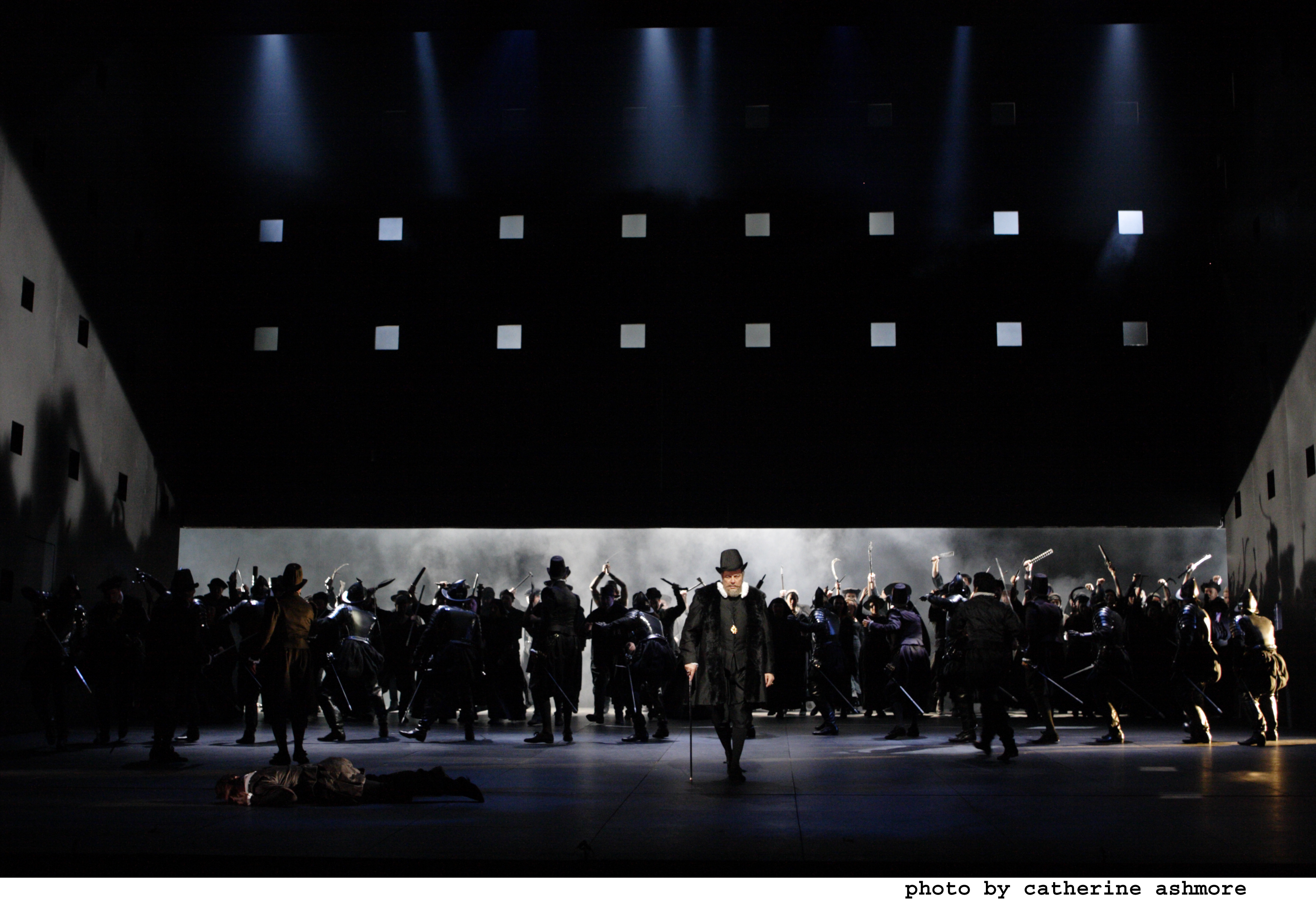
 Metropolitan Opera's Don Carlo, a co-production with the Royal Opera House, Covent Garden, and the Norwegian National Opera and Ballet, opened last night. What follows is the Unbiased Opinionator's account of the prima.
* Notes *
Very rarely does an opera with a 7:00 pm start time and midnight closing curtain, on a Monday night, rivet an audience into rapt silence. Absent Bayreuth-style, hour-long intermissions, the performance can be a grueling experience, for singers and audience alike. I am happy to report that the evening sped by –with compelling stage direction, impressive set design and above all, a very strong cast led by a conductor who knew what he wanted from the score and radiated both confident mastery and reverence and respect for the difficult tasks faced by the principals.
It would require a curmudgeon the likes of Wagner's Beckmesser to nit-pick the performance last evening, the season premiere of Don Carlo at the Met. The opera was performed in the five act version in Italian, not the original French version, and is loosely based on the Schiller play, reworked by the playwright François Joseph Méry (1798-1866). The libretto was completed by Camille de Locle after Méry's death.
Verdi spent over twenty years tweaking what is considered by many, and most definitely by this reviewer, as Verdi's magnum opus. Many of his revisions were undertaken after Aida and the Requiem, and Verdi's growth and mastery, acquired after composing Aida (an opera similar in scope and ambition to Don Carlo, where the private passions of individual players take place before an enormous historical back-drop) and the Requiem, which drew Verdi into the realm of the sacred, seem to culminate in the final version of Don Carlo, where personages of enormous political power struggle to reconcile their private loves, disappointments and sense of tragic doom with the crushing political burdens forced upon them by history.
The sets and costumes were in every way effective and impressive, no more so than in the monastery of St. Just, with its subterranean catacomb containing the sarcophagus of Charles the Fifth, and the striking set of the third act auto-da-fe with the Valladolid Cathedral cast in gold, the sky blood red, and a huge portrait of Christ in torment dominating stage left, which at the end of the Act becomes a transparency behind which we see the remains of heretics burned at the stake. All the horror of the Spanish Inquisition was felt here. Torture and death by fire were suggested, not imposed on the audience literally, which increased the sense of terror and mania underlying the Inquisition.
Roberto Alagna's performance of the title role, after initial dryness and forcing in his only aria "Io la Vidi," was impressive and moving. This role is thankless and in most performances only memorable if the tenor is not up to its demands. Don Carlo has but one real aria, and the role is extremely long and taxing. As the evening developed, Alagna become more convincing, with an powerful top and deeply felt expression.
To this reviewer, the musical and dramatic high point of the show was Ferruccio Furlanetto's rendition of the King's great aria "Ella Giammai M'amo." It would take an entire review in itself to explore the rich detail, the sonority and variety of vocal and expressive color Furlanetto was able to bring to this aria, perhaps the greatest aria for bass ever written by Verdi. The arching phrase "Amor per me non ha," greatly feared by basses, is repeated twice. In the first of two repetitions, this great artist succeeded in slimming his large voice into a slender, yet ringing, stream of sound. He did not allow himself to be rushed by the conductor, taking all the time he needed to properly breathe and prepare for each, ever more challenge phrase, but in no way diminishing the intensifying drama of this scena. In the reprise of the difficult phrase mentioned above, he opened up with a massive, engulfing sound that was overwhelming in its emotional intensity, as the King, possessing all the political might of the world, mourns his wife's lack of love and his solitude.
Marilyn Horne, a great Eboli in her day, correctly describes the this role as actually requiring three singers; one with the flexibility of the Veil Song, one for the enraged Eboli, rejected by Carlo in their in the first scene of Act III, and one who can pull out all the stops for the virtuosic showpiece "O Don Fatale." The mezzo Anna Smirnova was really only truly suited to the last of these challenges: her Veil Song was labored and lacked subtlety. However, her powerful, dark vocalism and marvelous high B in her Third Act aria were breathtaking. Marina Poplavskaya's Elizabeth was sung with great beauty and a sublime fil de voce- the ability to thread a high note into a spinning pianissimo. Unfortunately, she was overburdened by the challenges of this long evening, and her final aria "Tu Che la Vanita" was effortful, with a forced top and limited emotional impact. Simon Keenlyside, who performed an admirable Hamlet last year at the Met in Ambrose Thomas' opera, was a fine dramatic presence, but seemed a bit out of his depth vocally. He was often overpowered by the orchestra, and his aria "Per me Giunto," where he pledges his life to saving beleaguered Flanders and declaring his loyalty and bond of love to Carlo, was weak.
The great stage veteran, Eric Halfvarson, a memorable Hagen in Götterdämmerung, captured impressively the ancient, blind yet all-powerful and menacing Grand Inquisitor. At this stage in his long career, Halfvarson's voice tends to spread and wobble at climactic moments, but this is a mere cavil – so effective and blood-chilling was his delivery and presence. His cardinal red robe, the only color in the darkness of Phillip's chamber, was a blood-shot reminder of his fanatical pursuit of heretics and the horror of burning at the stake of his victims. In the great confrontational duet between the King and the Inquisitor, I had the sense that phrases were not given an opportunity to resonate, but rather were precipitously jammed together by the conductor, which diminished somewhat the impact of this tremendous scene. Secondary roles were well sung, especially by Lalya Claire (in her Met debut s the Elizabeth's page Tebaldo) and the Celestial Voice (Jennifer Check), who is given the daunting tasking of performing a short, very high and exposed angelic line at the end of the Act III. She met this challenge with courage, and sang from a position high in the auditorium balconies, not on or behind the stage. The Friar (Alexei Tonvitsky, in his Met debut) was imposing. A special mention should be made of the 6 Flemish Deputies, who sing in unison in the Act III auto da fe, imploring King Philip for relief for the Flemish people. The blend was perfect, resulting in the sense of one voice pleading, yet dignified.
There were too many marvels emanating from the pit to describe them all. The horn section, playing in unison at the beginning of Act IV was perfect in its somber sonority. I had the occasion to hear this performance from two positions, one in the front row of the Grand Tier, where the orchestra seemed overloud, since its sound projects upward while the singers' voices tend to project directionally forward into the hall. A seat in Orchestra Row Z, just under the parterre boxes, gave a better sense of balance, and my initial impression that conductor Yannick Nézet-Séquin was insensitive to the singers was corrected when I heard the performance in this horizontal acoustic plane.
* Tattling *
As this was the opening Gala Performance of Don Carlo, the audience was especially glamorous and well-dressed. Disruptions by cellphones and yakking were minimal, and people remained after the performance long enough to render a loud and fitting approval of the evening's performance, which will remain in my memory as one of the best I have heard at the Met.


 The Opera Tattler
Leave a reply to ev9d9 Cancel reply