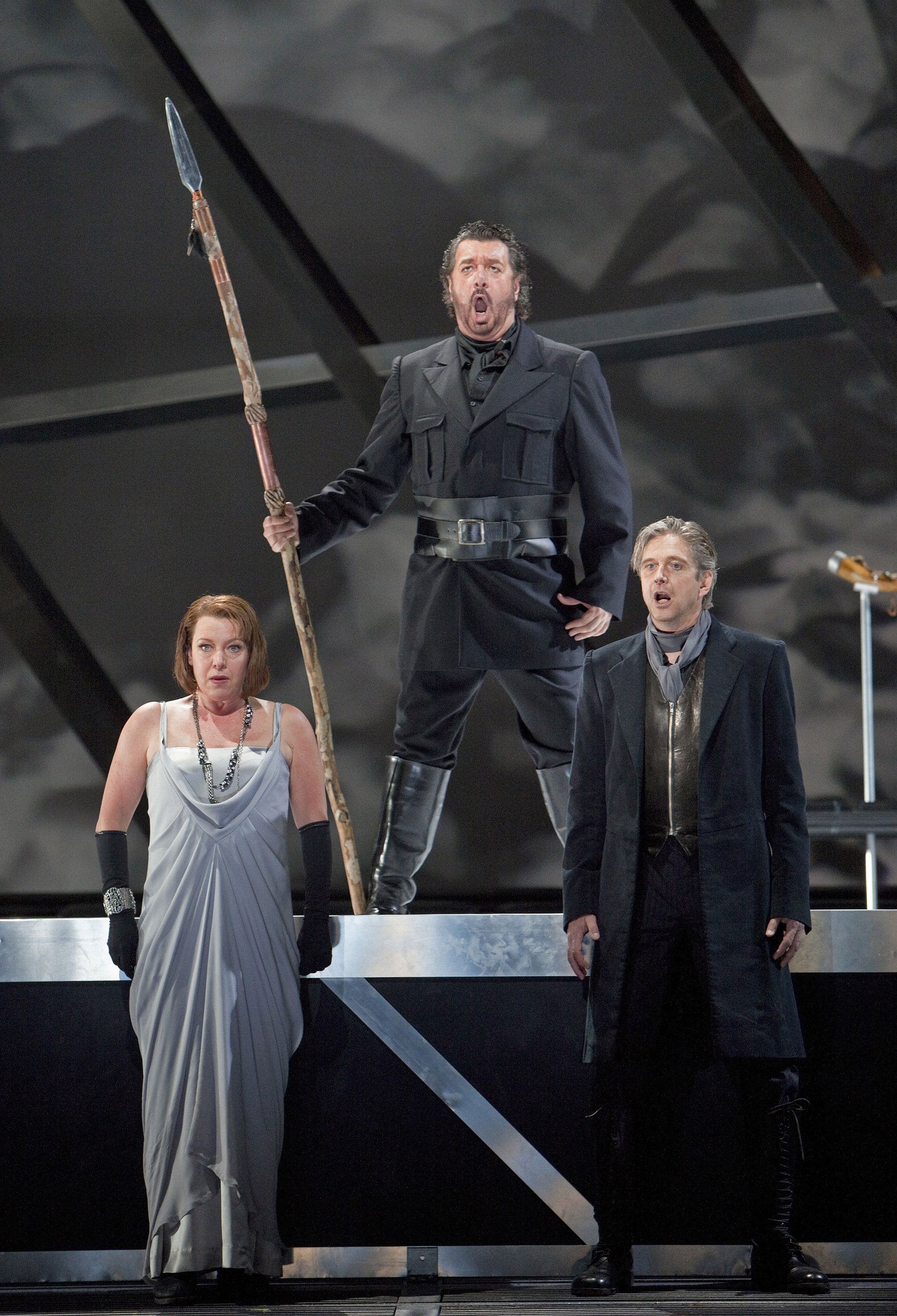
Sfopera-goetterdaemmerung-act2-trio * Notes * 
Cycle 1 of Der Ring des Nibelungen at San Francisco Opera concluded with Götterdämmerung (final scene of Act II pictured left, photo by Cory Weaver) yesterday evening. Francesca Zambello's production went more smoothly than at the prima earlier this month. The final scene had more impact, and Brünnhilde's torch did not go out before she lit the funeral pyre. Hagen's exit to dispose of Gunther's corpse in Act III read better from the orchestra level, but it was still unclear why he simply turns upstage and waits motionless whilst Brünnhilde and Gutrune interact just before this. There were a lot of laughs for the beginning of Act II, as Hagen watches television on the lowered scrim. There were also giggles for the Rheinmaidens, they sort recycling at the top of Act III, and this mundane task is apparently very amusing. Perhaps these gags were entertaining, but the audience response interrupted the music.

Jan Hartley's projections could be pretty. The clouds, flames, and birch forest all were attractive enough. At other times, the layered images did not look like anything at all, as it was difficult to pull apart what exactly was being shown. The motion of the projections could be clunky. The set changes were quiet, but the plastic trash bags used at both the beginning and end of Act III were not. Michael Yeargan's sets looked modern and sleek, and Mark McCullough's lighting design showed them to their best advantage. The costumes, by Catherine Zuber, were consistent and pushed the narrative forward. Gutrune's wardrobe was elegant, and the colors were used artfully. Brünnhilde's awkward gown revealed her lack of comfort in the world of the Gibichungs.

The playing under Maestro Donald Runnicles was expressive and vibrant. Though some of the brass was shaky in Act I, the playing improved, and Act III was very moving. The clarinet and bass clarinet were particularly good, as were the strings. The chorus also was wonderful to hear, even though the male chorus was not exactly together in Act III. The Rheintöchter (Stacey Tappan, Lauren McNeese, and Renée Tatum) were charming, but the Norns (Ronnita Miller, Daveda Karanas, and Heidi Melton) were even more impressive. Karanas' scene as Waltraute was vivid both vocally and dramatically. Gordon Hawkins (Alberich) sounded hearty. Melissa Citro (Gutrune) was squeaky, but one had no trouble hearing her.

Gerd Grochowski's diction as Gunther was clear, his voice also has good volume. It was less easy to discern which words Andrea Silvestrelli was singing as Hagen, but his rich, deep voice is seems to have no bottom. Ian Storey (Siegfried) sounded warm but a bit flat in both the Prologue and Act I, and his voice completely gave out in Act II. San Francisco Opera's General Director came out to beg our indulgence before Act III. Storey was treated during the second intermission and agreed to sing up until the end. Nina Stemme (Brünnhilde) also had trouble in the Prologue, screaming her last note. Nonetheless, the rest of the performance went better for her, and the Immolation Scene was otherworldly.

* Tattling * 
The audience in the orchestra spoke a little bit, but there was a lot of electronic noise. A watch alarm beeped 20 times and someone's mobile phone rang. Snoring was also noted.

Zambello was reportedly booed from the balcony.

Posted in , , , , ,

15 responses to “SF Opera’s Götterdämmerung Cycle 1”

  1. Zeno Avatar

    I can confirm that Zambello was loudly booed from the balcony. An anti-Zambello claque burst out into loud hoots the moment she appeared onstage. The detractors were sitting near me but saved their disdain for the production till the end, which was very polite of them. No grumbling, muttering, or going tsk-tsk during the actual performance.

    Like

  2. The Opera Tattler Avatar

    Thanks for the confirmation, I could not hear this from where I was on the orchestra level, where no one booed, as far as I could tell.

    Like

  3. RFA Avatar
    RFA

    I found the immolation scene, and the moments that followed extremely moving. Fortunately, the silent tears streaming down my face from the combination of the beautiful music being played and the dramatic action unfolding across the stage did not disturb my fellow row-mates on the orchestra level. My hearty applause went out to the Ring team for SF Opera’s extraordinary effort on this bravura afternoon and I probably would have throttled the booing thugs if they had been next to me (or at least stepped on their tennis shoes, at the very least!).

    Like

  4. The Opera Tattler Avatar

    I wonder if Zambello could hear the booing. There was a lot of cheering as well.

    Like

  5. Lieto Fine Avatar

    I’m surprised she was only booed and not lynched. Am I the only one who thinks that this Ring was bad? Creatively low and pretty sub standard in the singing department bar Stemme and one or two others?

    Like

  6. Florentia Scott Avatar
    Florentia Scott

    I thought that Gotterdammerung was magnificent and the best of the four. Stemme was brilliant. She is the best Brunnhilde I’ve ever seen. She only screamed the high notes two or three time in the entire cycle. I don’t remember her doing it in Gotterdammerung, unless it was deliberate for effect, and it it was so appropriate that it didn’t seem out of place to me.
    When the curtain fell on the drama and then rose again with just her standing there for curtain call the entire theatre erupted in loud applause and everyone that I could see, including me, lept to their feet.
    If there was any booing I didn’t hear it because all around me people were screaming applause.
    I loved Sylvestrelli as Hagen. I adore his voice – it is so deep and rich and musical. Although the orchestra throughout the cycle seemed to delight in drowning out lead singers, it couldn’t get the best of Sylvestrelli. I would love to see him get a crack at Wotan some time. I would surely go if I hear of that happening.
    Generally the orchestra seemed better controlled during Gotterdammerung than it had in the previous three instalments. Or else the singers had better projection.
    Storey sang beautifully in Act III after his treatment. Before that he had trouble making himself heard, but that has been a problem throughout this cycle and I believe, myself, that the orchestra director is at fault for letting the orchestra overpower several key singers, as I’ve said before. I think this was the greatest flaw of this cycle.
    My favorite performers in this cycle were Cangelosi as Mime, Magrita as Loge, Stemme unquestionably the best Brunnhilde – I can’t repeat this often enough – Sylvestrelli as Fasolt and Hunding, Jovanovich as Sigmund. I also liked Melissa Citro as Gutrune and Elizabeth Bishop as Fricka.
    I have heard quite a bit of grumbling from traditionalists and purists about the sets and the stage direction. Some of it seemed to be the usual “why aren’t the costumes and sets mimicking someone’s idea of what the Medieval Age looked like” lament. Personally, I would get pretty bored if every Ring cycle I went to had the same kind of costumes and sets. I enjoy it when people take risks and do something different. Contemporary settings and costumes, for me, reinforce that this is a timeless story that could be set in any age. I like the sets and the costumes. The opening scene of Act III of Die Walkure was beautifully done. I did find some of the choreography and staging rather clunky and puerile, particularly in Das Rheingold. I suppose the silly antics of the gods were meant to reinforce the idea that they are foolish and trivial, however I think Zambello took that a bit too far. There was too much going on that distracted from the main action without adding anything of interest.
    Throughout the cycle, there seemed to be quite a bit of pointless walking around in circles, and walking on and off stage – instances too numerous to mention. Sometimes less is more.
    I couldn’t figure out why Sigmund and Sieglinde in Die Walkure were standing so far away from each other throughout their scenes. It kind of made the chemistry stilted, for me. Also Sieglinde’s constant fawning over Hunding, seemed a bit too genuine, given that she is supposed to despise and fear him.
    All in all, I enjoyed the cycle and am glad that everything pulled together so well in Gotterdammerung.
    As in every production, some glorious performances, some less remarkable, a few things that bugged me, but I enjoyed it tremendously.
    Well done!

    Like

  7. Lürkhild Avatar
    Lürkhild

    Given my druthers, I’d usually ruther see a traditionalist production; my second choice would be something minimalist a la Wieland Wagner. However, I loved most of this, and think that Zambello has succeeded where Chereau did not. Chereau was, for all intents and purposes, a punk kid when he was asked to direct the Ring at Bayreuth; by his own admission, he was also completely unfamiliar with the work. So he latched on to the Shavian interpretation of the Ring as a cautionary tale about the dangers of industrial capitalism, and reduced the whole thing to a simple allegory.
    Zambello, of course, is also working the perils-of-capitalism angle, but appears to understand that the Ring cannot be boiled down to that. She has done a good job of showing an entire world, and a coherent one, which (to my mind) is necessary for a production of the Ring to succeed. I particularly liked the willingness to find visual beauty in unlikely places, such as the freeway overpass in Act II of Walküre. (The next time you’re stuck at MacArthur BART after a rainstorm, cue the brass mentally…)
    For the most part, Zambello also has good instincts for knowing how much is too much when reimagining some of the characters. Tbh, I could have done without Froh lolling all over the sacks of gold; I also had some reservations about Freia’s apparent Stockholm syndrome. However, I noticed that Froh was just a tad too affectionate with her later. So no wonder Fasolt looked like an improvement to this particular Freia.
    Hunding’s house in Walküre told you everything you need to know about his background — the grandparents moved out West courtesy of the Homestead Act, took the good china (and great-grandpa’s Civil War sword) with them, and things have gone downhill ever since. I think Zambello had to walk a fine line with this character, and pulled it off: in a traditional production, Hunding represents the established social order; here, he’s a socially marginal figure, an example of conservatism gone nuts. One reviewer complained that his chaining Siegmund to the tree was out of character. This would be true if we were dealing with Migration Age Seen Through a Romantic Lens Hunding, but it’s exactly what Sovereign Citizen Tax Protester Hunding would do.
    Gutrune was also delightful — she was like the apparent sorority ditz you knew in college, the one you thought you were going to loathe, but who turned out in the end to have more character than some of your more intellectual friends.
    It didn’t bother me that there was some physical distance between Siegmund and Sieglinde, and Siegfried and Brünnhilde, during the love scenes. That struck me as a visual reminder that their time together is going to be short, and that larger forces are going to keep them apart. Also, when Brünnhilde wakes up, she does a great deal of reflecting and coming to terms with her own past. Those thoughts are deeply private, and the stagings that have Siegfried crowding her during those monologues have always struck me as a bit emotionally off.
    I found the scene with the Rhine maidens in Götterdämmerung a little too hard to look at. The idea didn’t bother me — it makes perfect sense that the river’s guardian spirits would be trying to clean the place up — but the juxtaposition of very realistic trash and the flat, abstract mountain/riverbank sets didn’t provide that sense of unexpected beauty amidst ugliness that was so effective in the rest of the cycle. That’s the only place, imho, where the Big Statement really fights with the music, and drags the production down to Chereau level.
    The lunar eclipse during Siegfried’s funeral march was a little obvious, but on the other hand, both the Elder Edda and, iirc, the Nibelungenlied compare Sigurth/Siegfried to the moon. (And, of course, the moon is masculine in Germanic languages, and the sun feminine.) So, obvious or not, it was well-grounded. I mention this, because Zambello has taken some heat for being obvious, or playing it safe. I see the more conservative aspects of the staging as respect for both Wagner and his sources. I don’t agree with every adjustment she has made, but I don’t think she was just messing with things for the hell of it.
    As for the singing, someone like Stemme comes along every fifty years or so. The rest of the cast was fine — in fact, given that so many of them were singing these roles for the first time, they were remarkably good overall. Some of the leads need time to grow into the parts, but I believe they will. Except for the underpowered voice, Jay Hunter Morris was remarkable — he has a lot of finesse, and his singing is unusually accurate. Right now, it seems to take him all of Act I to warm up, but he was already producing more volume on Friday than he did in the premiere a few weeks ago. If that voice gets bigger, I predict he’ll be in great demand.
    @Florentia Scott — the conducting frequently bugged me, too, and I don’t think it was representative of what Donald Runnicles can do. When he’s good, he’s very good. I expect the balance issues will get ironed out in the next cycle.
    Someone elsewhere — was it Lieto Fine? — mentioned the audience laughing at inappropriate times. I didn’t altogether like that, either. However, that’s still the sign of an engaged audience. San Francisco, at least, is in the middle of what you could call a historical shift in who goes to the opera. I went to the HD broadcast of the Met’s Walküre in the Westfield Mall in SF a couple weeks ago, and the audience there looked and acted much more like the opera audiences I remember from 20-30 years ago. Mostly gray, and very decorous — no one talked, laughed at odd moments, or rustled candy wrappers, unlike many of the folks attending live opera in SF these days. I suspect the crowd at the multiplex consisted largely of the rank-and-file, middle-class opera-goers who stopped attending so frequently when ticket prices shot up in the nineties. I partly blame the dot com boom for that — the SFO must have realized they could get away with charging double, because there was a lot more money floating around then. And some things, once they go up, never go down again. It’s understandable, in a way, as they’ve been having financial trouble for a long time, but I think that that move alienated a lot of their traditional audience. (I, for example, looked at those ticket prices, and — in my coarse American way — thought WTF???)
    It is also my impression that sales dropped off when Pamela Rosenberg was running the show, as she figured the way to sell tickets was to make everything as lewd and crude as possible. (She didn’t realize that people who want that sort of thing know that they can get it on the Internet for free.) David Gockley has done a much better job of bringing people in — he’s reached out to the large potential audience that didn’t necessarily grow up with this stuff. I say good for him — it would be a lousy day for SF if the opera company went belly-up. If this particular American audience acts a lot like Italian audiences did in the 1700s, well, I can live with that. Alles ist nach seiner Art…

    Like

  8. Lürkhild Avatar
    Lürkhild

    @The Opera Tattler. …And thanks for printing my ramblings, despite the length. Don’t wish to be a threadhögg.

    Like

  9. Lilacrobin Avatar
    Lilacrobin

    Lürkhild, an astute and heartfelt review of our “Ring”.
    There’s not much I can add to this except, I loved the concept of Hundig chaining Siegmund to the Ash Tree with a dog collar. When I saw the very first rehearsal eons ago last year, and they used a REAL chain, as opposed to the softer one they now use, “poor” Chris Ventris could scarcely be heard above all the clanking” he made….. still, when the two hounds ran out on stage in the next act, I was STUNNED…it was a thrilling and horrifically scary moment…and for me (at least) immediately connected the chaining to the tree. What a visual effect!
    Now, with the softer *chain
    , one hears Siegmund’s palintive cry for a Sword. One of the STRONGEST moments in “Walkure”.
    I still have a problem with Freia’s Stockholm Sybdrome” in “Rheingold”…..but after all the *atrocites I have seen in other “Rings”, (this is my 7th – and that includes two in Bayreuth)and as a fellow lover of tradition, Cesca’s Ring is my second most beloved….my first being SF’s 1985 glorious, traditional Ring.(Check out some of the “You Tube” videos from then.)
    We won’t even discuss La Rosenberg – except to say that she DID bring Nina Stemme here (8?) years ago to sing Senta in “Fliegender Hollander”….. once again, I was at theat first rehearsal….and when she sang her first note of “Senta’s Ballad”….the hairs on my neck stood up…. I knew I was in the prescence of a great singer. Nina has lived up to – and exceeded all my expectations….she IS a wonder….and soon to be a legend. (And how cool for our generation to have a legend!)
    I could go on….but we are hogging all of our beloved “OT’s” space….so I say, be proud and enjoy what you have experienced! Oh, one final thing, leaving the OH after the end of Cycle 1, the bus was FILLED with Out-of-Towners…..all, commenting with enthusiam about what they had just witnessed….and often, breaking out into singing the various Leitmotifs. plus I had it via a reliabele source the Opera Shop is selling well….many thousand of $$$$ daily. I think we will come out ahead…. perhaps not by much financially, but by millions artistically and esthetically. Kudos to Cesca, Michael, “the real Donald*, La Stemme, the cast, the chorus and……sigh..the amazing Orchestra!
    Guess I added a lot…. a-ha-ha!
    ♥ Robin ♥

    Like

  10. richard pietrowicz Avatar
    richard pietrowicz

    Zambello…boorish. Saw better trash mesage from Michael Recycle at Bush Gardens with kids in 70’s. And did Grane parachute in in Walkure? Arrogant, poorly sung but for Loge and our favorite Valkyrie who did fail to reach notes at times.
    What is this about delivering dated personal political messages? The is sheer arrogance! And where does one find deer in a garbage dump? How about the bag ladies with the garbage bags?
    Why do we have to be educated about the environment or the superiority of women who need to clean up the mess men make? Can’t we over the course of the decades have arrived at some conclusion on these issues ourselves?
    Heavens! (Of Valhallas). Can’t we just go to a Cycle and make up our own minds about Wagner’s story and philosophy? Or just enjoy the music and love story?
    Messsage to Zambello, et al. The Ring is about the triumph of self sacrifice and love over greed and ambition (power). It’s not about recycling or going bra-less.

    Like

  11. The Opera Tattler Avatar

    No, I don’t think you are alone. There were a lot of cliches used, especially that last device with the kid. Stemme was the standout, but compared to the other Rings I’ve heard (and I only listen to live music for the most part), I thought the cast was good.

    Like

  12. The Opera Tattler Avatar

    Definitely agree with you on Stemme, and feel lucky to have heard her in her first complete Ring cycle.
    It didn’t bother me that Zambello chose this concept, but I didn’t find it very enlightening either.

    Like

  13. The Opera Tattler Avatar

    Thanks for your comments! You’ve made a lot of good points. That very realistic trash consists of plastic bottles used by the San Francisco Opera staff, by the way.

    Like

  14. The Opera Tattler Avatar

    Zambello is trying to make the epic accessible. I don’t know that it works for me personally, but I do think it is an interesting attempt.

    Like

  15. David Lasson Avatar

    The burgeoning though abortive relationship between Fasolt and Freia seems believable considering the other men in her life: a couple of ineffectual and foppish brothers, and a brother-in-law whose real estate deal includes using her as chattel. Is it any wonder that Freia should fall for someone who really cares for her? (If you doubt that Fasolt cares for her, just listen to his music, especially whenever he sings her name.) Zambello’s choice here is sound—only she doesn’t go far enough with it: it would have been better had Freia remained saddened and pensive as she walks up the gangplank instead of whooping it up with the other arrogant dandies. She could have gazed longingly back to where Fasolt was felled, before being pulled along by her brothers; maybe she even could have run back and planted a sapling or something. Alright: the part about the sapling was a joke, but the mutual attraction worked for me—even without considering whatever Freia may have heard about guys with really big feet.

    Like

Leave a reply to The Opera Tattler Cancel reply