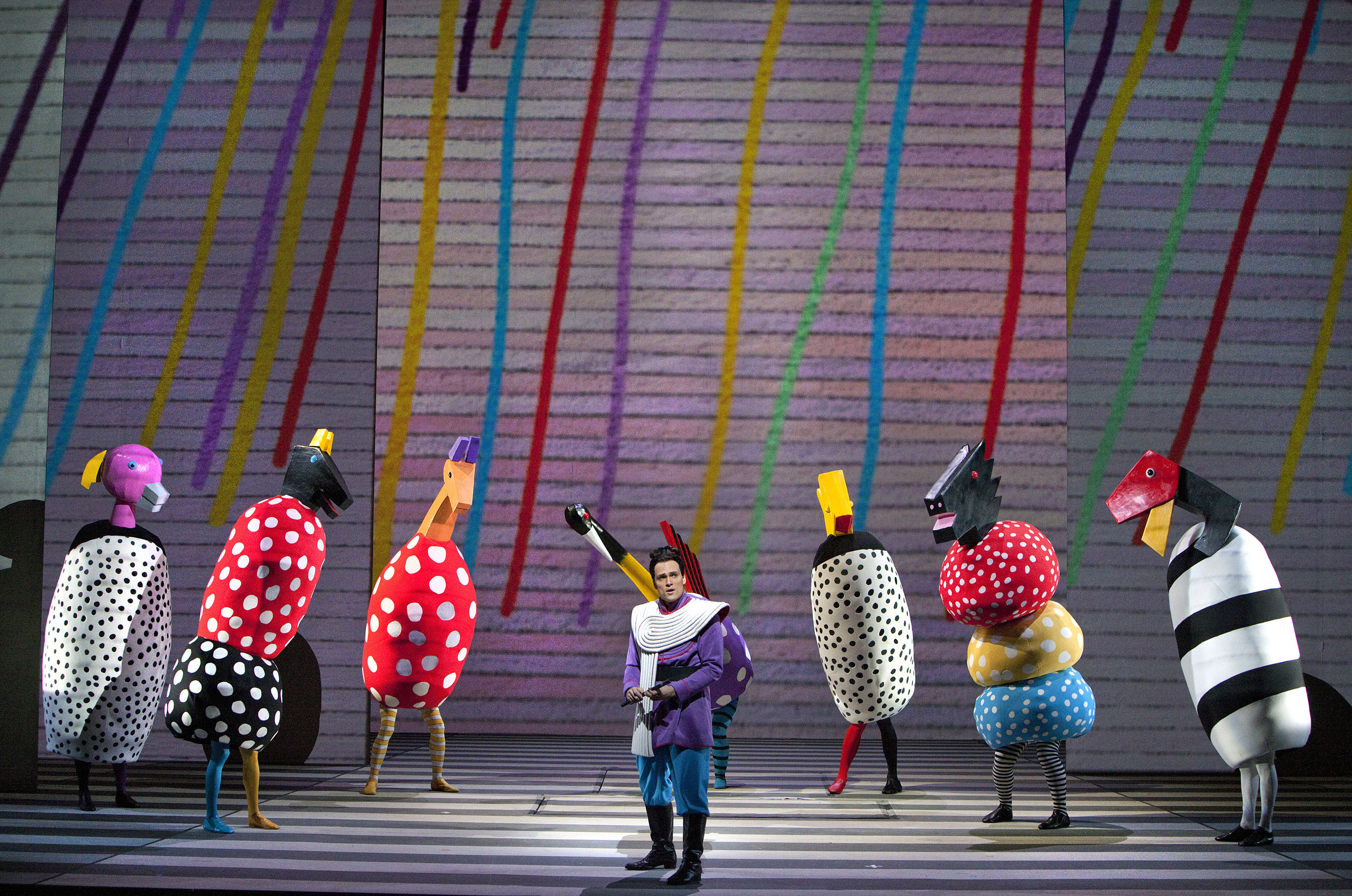
Sf-opera-magic-flute-act-i-scene3-2012* Notes * 
The Magic Flute (Alek Shrader as Tamino and the animals of the woods in Act I Scene 3 pictured left, photograph by Cory Weaver) opened at San Francisco Opera Wednesday night. The new production, from artist Jun Kaneko, is an utter delight. Kaneko’s use of bright colors and whimsical shapes is charming. The video projection of his designs are integrated with both the music and Harry Silverstein’s direction. The lighting, designed by Paul Pyant, helped unify the production into a coherent whole.

Conductor Rory Macdonald chose some fleet tempi at times, but for the most part the orchestra sounded taut and together. Mozart left the brass exposed, which was not always to the advantage of those instruments. The chorus did a fine job, and the last scene of Act I was particularly beautiful.

Greg Fedderly made for a very funny Monostatos and Nadine Sierra was a winsome Papagena. The three ladies, Melody Moore, Lauren McNeese, and Renée Tatum, played nicely off each other. Kristinn Sigmundsson (Sarastro) was imposing. As Pamina, Heidi Stober sounded warm and strong. Alek Shrader (Tamino) was ill, but still sang respectably. Nathan Gunn’s light baritone was adequate for Papageno, and his acting skills served him well. Albina Shagimuratova shone as Queen of the Night.

The performances are in English, which is much more sensible than when San Francisco Opera did The Abduction from the Seraglio with sung German and spoken English back in 2009. I did notice that the Three Ladies used “fare thee well” as opposed to Pamina and Tamino, who sang “fare you well.” Probably makes more sense to just go with the latter, given that the dialogue references drag, carb requirements, and other contemporary concepts.

* Tattling * 
Renée Tatum tripped in Act I, but recovered quickly, without losing her cool.

The woman in Row R Seat 8 on the orchestra level whispered loudly, but did manage to keep quiet when hushed. Some one in Row S fought with cellophane for several minutes of the second act.

Posted in , , , ,

6 responses to “Magic Flute Opening at SF Opera”

  1. Upstairs tenor Avatar
    Upstairs tenor

    I’m surprised you didn’t mention the livliest event of act two. Just after David Pittsinger as the speaker uttered a command for silence, someone dropped a glass or a bottle with a resounding shatter that rang through the otherwise silent house.
    You can’t make this stuff up.

    Like

  2. The Opera Tattler Avatar

    That was so funny. Thanks for reminding me!

    Like

  3. Ruth Robertson Avatar
    Ruth Robertson

    I loved that the audience twittered at this, getting in the spirit of the whole faux pas!

    Like

  4. Vajra Avatar

    I cannot recall having such a good time at the “Magic Flute” as I did on opening night of this production. The production was absolutely delightful, and I think the singers, especially Shagimuratova as Queen of the Night. I love it when it all comes together as it did in this production.
    The women behind me were chatting in stage whispers but stopped when I turned and glared. I still don’t understand why people go to opera, theater, or movies when their gaol is to talk…

    Like

  5. Roberto Avatar
    Roberto

    I was listening to one of these Met broadcasts not too long ago and there was a debate during the intermission about the most difficult language in opera. Katia Mattila not surprisingly answered Czech. I don’t remember what the other singers responded. I was rooting for someone to answer English. But nobody said that. Probably the singers are more concerned to sing in a language that nobody knows (including them) than in a language that the audience speaks. Since I have very limited knowledge of most languages in the operatic repertoire, listening to an opera sung in English gives me a rare opportunity to judge the singer’s ability to be understood (at least by me). In the case of this “Magic Flute”, when most singers are American – great American singers, I should say – the bar is even higher. In overall, I could get most of the lines with a few exceptions. I will come back to that later.
    “Magic Flute” is one of the few Mozart operas that I prefer the romantic, slower approach. I like the Karajan recording from the earlier 80s, mostly because of the voices (Francisco Araiza, Edith Mathis, etc…) . Only 10-15 ago I understood that Mozart intended a much faster tempos. I listened to a handful of historically accurate “Magic Flutes’ and welcomed most of them (although not to become my reference). So I am very familiar with the faster (or historically accurate) Mozart tempos. While the slower approach boosts the Romantic elements (mystery, anguish, sorrow), the faster tempos makes the opera lighter, comical and it flows better.
    I don’t think that I’ve heard a faster “Magic Flute” than Rory Macdonald. He is a quite young and talented conductor and he is establishing himself in a successful international career. But I had a sense that his tempos demanded too much from the singers. The Three Ladies, for example, sometimes could hardly find a room to breathe. I also had a problem understanding their words when I forced myself to not pay attention to the subtitles. It would surprise me if I wouldn’t have the same problem if they were fluent in German and singing in the original language of the opera. Besides that, they were fine.
    Alex Shrader was a very good light tenor for Tamino (nowadays we hardly see bigger voices in Mozart). Shrader sang with passion and he is a good actor. He made me feel that the part is easy (which is not). Nathan Gunn was another light voice and he also made me feel that Papageno is easy (it is not). Greg Fedderly has a beautiful voice for Monostatos (he sang the same role here a few years ago on that Peter Hall production). If it weren’t for the subtitles, I would have no idea what he was singing (would I have the same problem with a German singer singing in German?). All these male singers are quite athletic and used their body effectively for their acting.
    Heidi Stobber was the biggest star of the night. She sings here every once in a while and she consistently amazes me. The Pamina aria was extremely moving. My only remark is that she tends to be a little bit excessive sometimes. On the fire scene, for example, she increased the amplitude of her voice during the “miiiiiiii” of “Tamiiiiiiiino”. I think that a diminishing legato is more appropriated, opposite to what she did.
    Albina Shagimuratova is everything that anyone wishes for the Queen of the Night. She has the sharp voice that the role requires. If she had been a little bit higher on one or two Fs, she would have been perfect.
    Kristinn Sigmundsson is an interesting singer. From what I remember of his Baron Ochs, his voice could get comfortably lower to what I heard from Sarastro yesterday. His costumes were quite heavy and probably uncomfortable.
    A special mention to the Isis and Osiris chorus. One of the most beautiful redemption of that piece that I’ve ever heard.
    This “Magic Flute” has a very strong cast, stunning set design and it is rare and true delight to say that an opera director deserved his paycheck and treated the audience with respect. All elements are in place in a tasteful manner.

    Like

Leave a comment