 * Notes *
The world premiere of John Adams' Antony and Cleopatra (Act II Scene 3 pictured, photograph by Cory Weaver) at San Francisco Opera featured powerful voices and lushly textured music. The piece has a certain glittery yet dark quality to it, and the production leaned into that, to be sure.
The libretto for this work was by the composer, but based mostly on the play by Shakespeare with flourishes from classical texts by Plutarch, Virgil, and others. This was more successful dramatically than other libretti of Adams' recent operas, but perhaps there were fewer chances for the weird but charming outbursts about pigs or chocolate cake.
The orchestra sounded splendid, Maestra Eun Sun Kim has precision with dynamism. The orchestration has two harps which very much called to mind Wagner to me, especially near the end of Act I. I was also quite taken by the use of celesta (or bell piano), which I could hear very clearly up in the back balcony. Somehow it didn't remind me of the Sugar Plum Fairy at all, and I look forward to hearing the opera again to focus in on this and the cimbalom, which I immediately responded to, as I was obsessed with dulcimers as an adolescent. The chorus also sounded great, very much together and full.
The singing was strong, there were quite a lot of characters, but they were all distinct. It was lovely to hear mezzo-soprano Elizabeth Deshong as Octavia, sister of Caesar. Her voice is wonderfully rich and deep. I also really liked mezzo-soprano Taylor Raven as Charmian, Cleopatra's attendant, who radiated calm reasonableness in contrast to Cleopatra's wild rages.
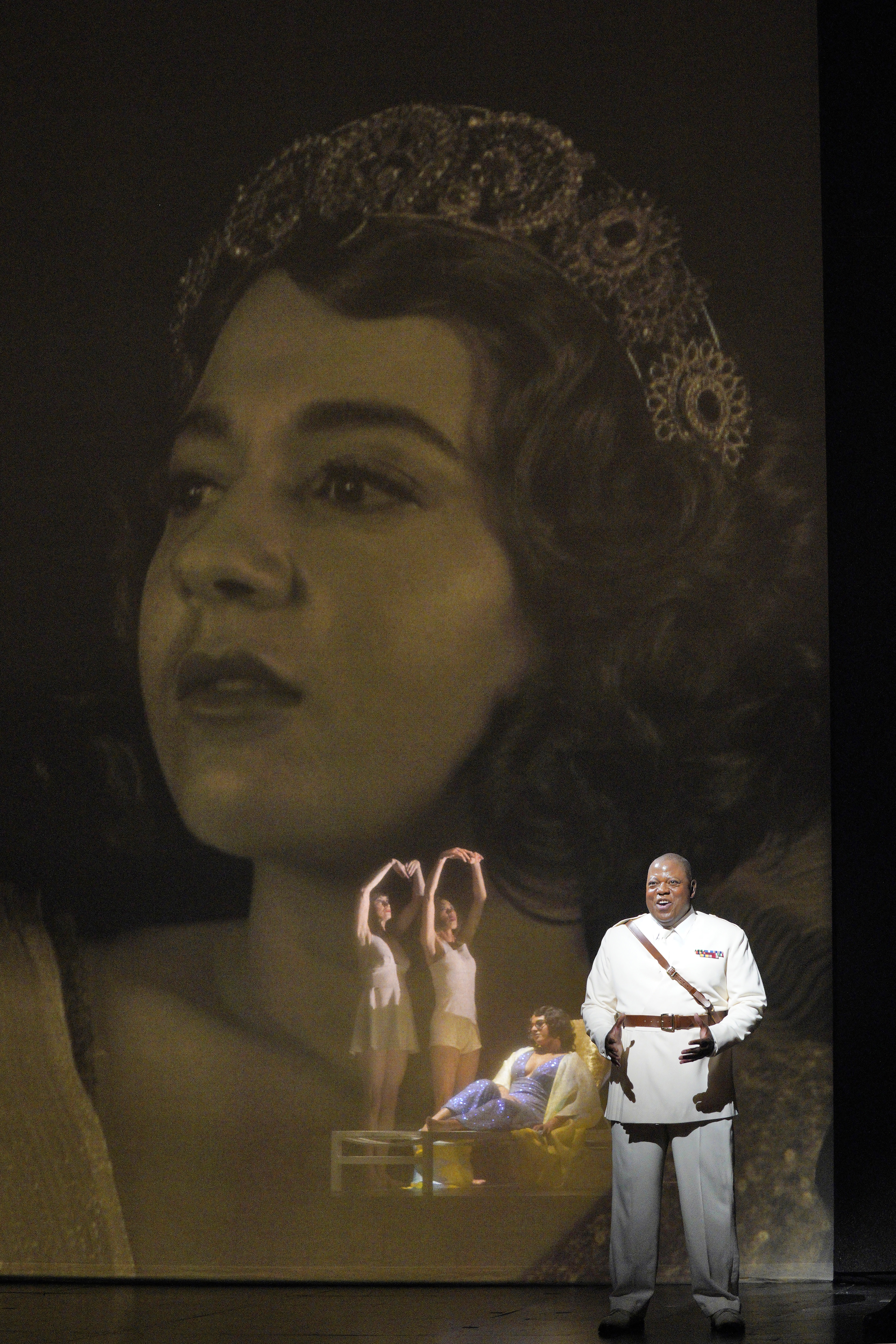 The most evocative aria for me was in Act I Scene 2, "Age cannot wither her, no custom stale her infinite variety" sung by Antony's lieutenant Enobarbus. Bass-baritone Alfred Walker details the appeal of Cleopatra in front of a scrim with projections of the character, as she lounges upstage (pictured, photograph by Cory Weaver). Walker is sympathetic and his voice effectively conveys how alluring and magnetic Cleopatra is.
The three principal singers were also quite vigorous. Tenor Paul Appleby is an unctuous Caesar, his voice is very bright and pretty. At times his sound may have lacked heft, but I think it might have had to do with the staging, he was dampened by being upstage and boxed in by scenery in Act II Scene 2, for instance.
Bass-baritone Gerald Finley makes for a charismatic leading man, singing Antony with much sweetness. But best of all was soprano Amina Edris as Cleopatra, her voice has an intense vitality to it, and she was downright frightening when it was called for, implacable and domineering.
The production, directed by Elkhanah Pulitzer, is stylish and stark. The scene changes are seamless, there were many moving stage elements that could hide and reveal different settings. The projections were elegant, often black and white, and employed thoughtfully.
* Tattling *
I had a ticket for the very last row of the opera house, but since standing room is back, I decided to stand near the center aisle, especially since the performance was not sold out and it was easier to see from that vantage point without anyone directly in front of me.
I was asked if this was my first John Adams opera, which I was so amused by, I could hardly respond. It was clear that the pandemic has made my social skills even worse. Otherwise, the audience around me was quiet and respectful, though there might have been some inappropriate giggling when Eros, follower of Antony, stabbed himself in Act II Scene 3.
My 8-year-old child loves Nixon in China, and I had thought maybe I could bring him to hear this. His review of Doctor Atomic (not a very child-appropriate work, we only heard the first 15 minutes) was that it sounded "like Nixon in China but bad and noisy," so I was curious if the music here would be something he would be interested in. The themes of Antony and Cleopatra seem a little too adult for a third grader though.


 The Opera Tattler
Leave a reply to Chad Owens Cancel reply