* Tattling *
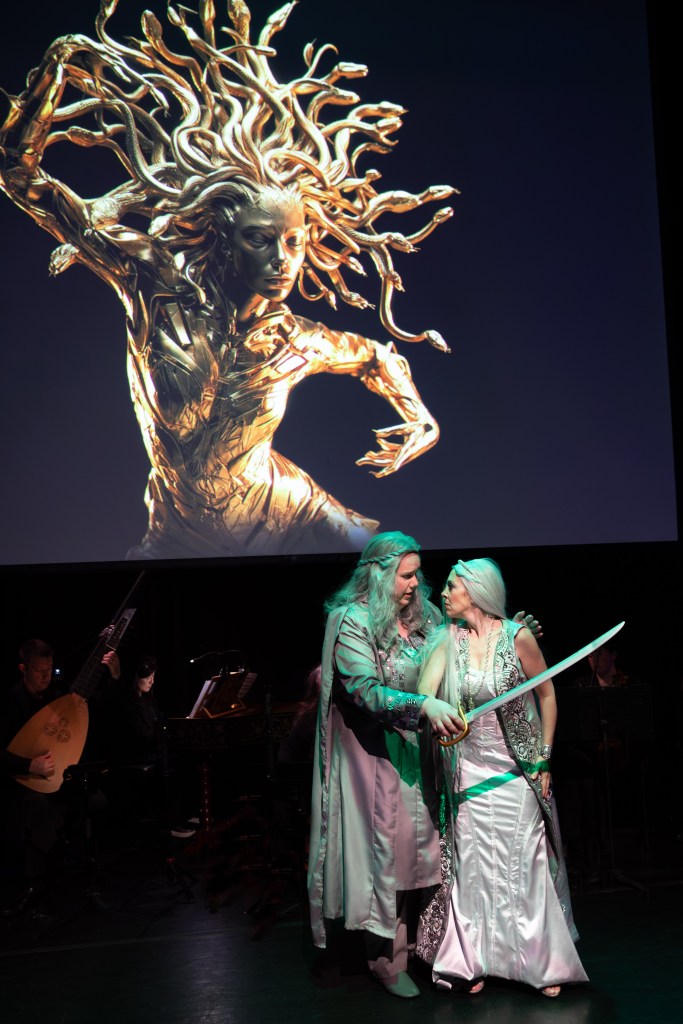
I was meant to go to Ars Minerva’s production of Andromeda (pictured, photograph by Valentina Sadiul) at the Creativity Theater in San Francisco, but was waylaid in Mountain View after a fender bender.
Thankfully my faithful opera companion Terence Shek was able to make it to the performance and wrote up some notes for us.
* Notes *
This neglected opera has great music, and the singers were uniformly excellent. This performance ran a little over two hours including the intermission, so it is relatively short. The action is clear — for a Baroque opera – with only one plot line concerning how the lovers Andromeda and Perseo overcome the obstacle of Andromeda’s unwanted arranged marriage to Agenore. The music is beautiful throughout and conveys the emotions of the characters well.
The cast all sang securely and every character had a distinct personality. Soprano Aura Veruni in the title role has a steady, solid voice and sang expressively. One did not need supertitles to understand her performance. She also has some of the loveliest music in the show. At the end of the first half, she walked upstage and sat among the musicians for her wistful aria about a caged nightingale. In the second half she has a wonderful extended love duet with Perseo, and the opera culminates with her dream aria accompanied by the theorbo and a viola da gamba, played gracefully by Adam Cockerham and Gretchen Claassen.
Contralto Sara Couden was a politely noble Perseo and sang long coloratura phrases with ease. She also has great low notes. At times her heroic character was amusingly bashful.
Mezzo-soprano Kindra Scharich has a robust and hearty voice. She is convincing as Cassiopea, and was particularly effective in her anger-filled aria in the second half. Tenor Sidney Ragland sang King Cefeo with clarity, a certain weightiness, and warmth, while tenor Maxwell Ary was comical as the haughty, yet hapless Argenore. His voice is clean and focused.
The orchestra was a small band of six musicians including conductor JungHae Kim on the harpsichord though I couldn’t notice her doing any obvious leading, and I don’t think I ever saw her hands leave the keyboard. Given how all the musicians were in a row at the back of the stage, behind the singers, I was impressed by how synchronized the whole performance was.
In lieu of a set there were 3 tall screens across the back of the stage. Mostly they displayed what looked like AI-generated images broadly hinting at locations, though we also saw creepy images of a girl’s cartoonish head and a lithe, dancing Medusa all of gold. There was also an incongruous image of the Parthenon sitting atop a steep cliff surrounded by water.
The right screen went dark for several seconds at one point during the 1st half. A downside of the technology is that glitches are very noticeable.
Otherwise, the stage was bare, apart from a stool and two benches. Small flowers, a mirror, and a sword were among the minimal props used. The cast all wore silvery robe-like costumes and wigs with long hair. A running gag involving Agenor’s habit of flipping his long locks over his shoulder.
The opera ends with a ridiculously blatant chorus praising the work’s patron, the Holy Roman Emperor Charles VI. Bob Ryan was sitting in the front row, and at this point Ms. Couden went up and shook his hand while the rest of the cast addressed the chorus to him. I guess we all knew that Bob was really an emperor from whom all good things flow!


Leave a Reply