General Director Plácido Domingo will not renew his contract with Washington National Opera, which expires on June 30, 2011.
Press Release [PDF] | Official Site
Reviews of Performances and their Audiences
General Director Plácido Domingo will not renew his contract with Washington National Opera, which expires on June 30, 2011.
Press Release [PDF] | Official Site
 * Notes *
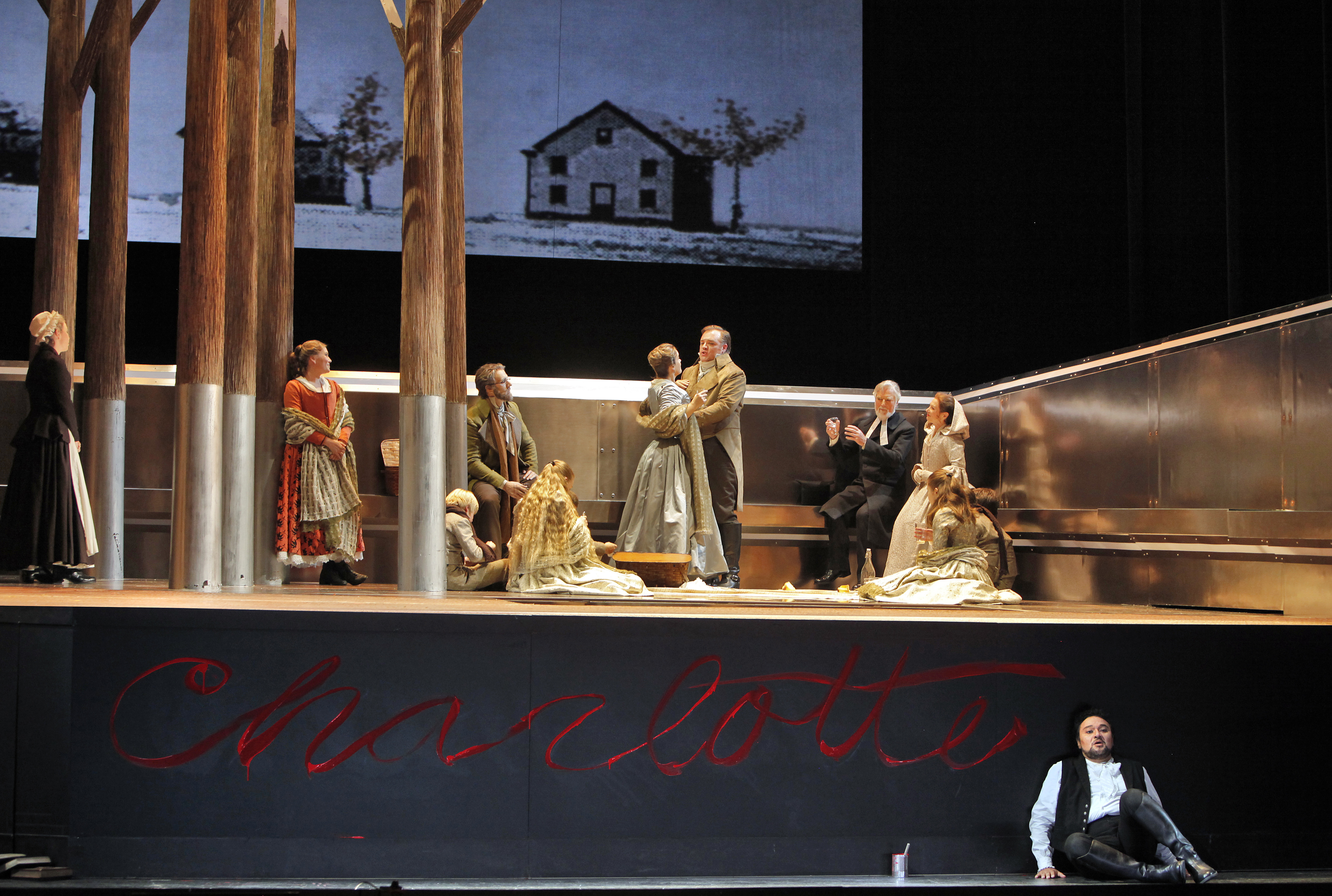
The San Francisco Opera's penultimate performance of Werther this season was held yesterday evening. From balcony standing room, the balances between the singers and the orchestra were better. Emmanuel Villaume did keep the orchestra together, the sound was gleaming and rich. The chorus of children was also lovely.
It was apparent that all the singers have such beautiful voices, from Susannah Biller in the tiny role of Kätchen, to the title role sung by Ramón Vargas. Perhaps both Vargas and Alice Coote (Charlotte) are more compelling in other repertoire, however they nonetheless were very pleasant to hear.
The set does look rather different from the balcony, many of the projections are lost, but one can see the shadows of the tree branches on the ground in the last scene. The many staircases are also more evident from above. The production is definitely weird and does not follow Goethe's text in a literal sense. This said, I did find the whole thing strangely attractive. Perhaps because I do not care for this novella in the first place, the departures from it did not bother me.
* Tattling *
The balcony looked fairly full, but I was offered a seat more than once. Unfortunately, since there were empty seats, the audience felt comfortable getting up and moving over during the Act III overture. There was some talking and watch alarms. The most disruptive moments were when people unwrapped their candies during key points in the music. No matter how quiet one tries to be, cellophane always seems to be very loud, and doing this slowly just drags out the noise over a longer period of time. I was especially annoyed when this happened during the Letter Aria.
Production Web Site | Photo Gallery
Performance Reviews: AP | Bloomberg | FT.com | The Globe and Mail | Guardian | LA Times | Montreal Gazette | NY Times | Reuters | Wall Street Journal | Telegraph | Toronto Star
 * Notes *
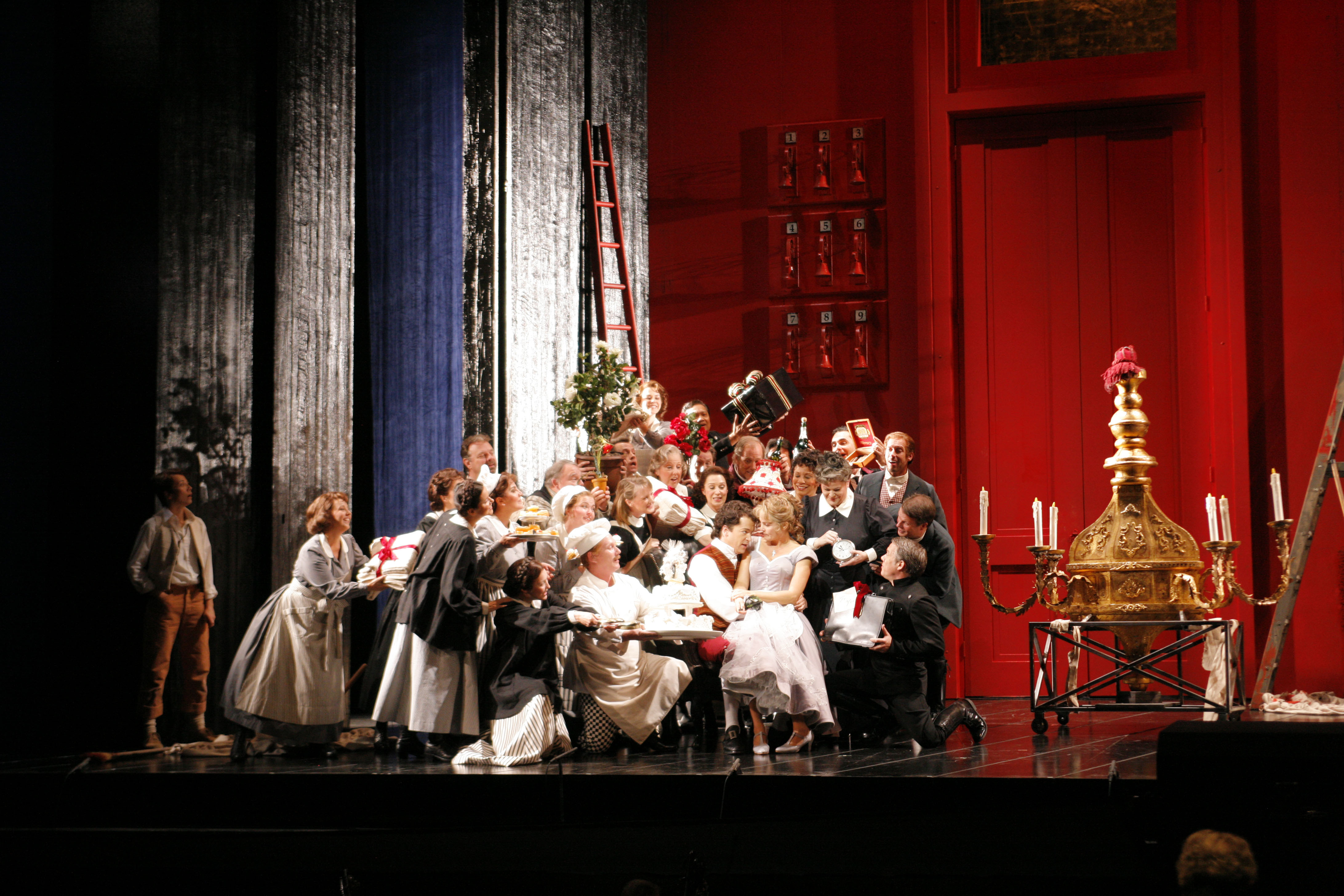
A revival of Le Nozze di Figaro at LA Opera opened this afternoon. Plácido Domingo kept the orchestra at a good clip, though not exactly brisk, the tempi were comfortable. There were many synchronization problems with singers and the orchestra. The bridesmaid duet in Act III went especially awry, either the singers were out of tune, or the brass was. The chorus held together, however, and the character roles were all perfectly fine. Daniel Montenegro was all but unrecognizable as an elderly Don Curzio, Philip Cokorinos seemed suitably confused as Antonio. Valentina Fleer made for a girlish Barbarina, and her “L’ho perduta, me meschina” was lovely and mournful. Christopher Gillett (Don Basilio) was reedy and unctous, Alessandro Guerzoni (Doctor Bartolo) was stuffy and silly, and Ronnita Nicole Miller (Marcellina) was sassy and a touch too youthful.
Renata Pokupic was winsome as Cherubino, breathlessly enamored. Her “Non so più cosa son” was slightly quiet, but her “Voi che sapete” was clear. In contrast, Martina Serafin sounded loud and full as the Countess and her “Dove sono i bei momenti” lacked a sense of yearning. She could overpower the other singers, but did rein in her volume in “Sull’aria…Che soave zeffiretto.” Bo Skovhus was delightful as the Count, his voice is warm but not too heavy. Marlis Petersen was sweet and airy as Susanna, but always audible and her Figaro, Daniel Okulitch, sounded robust and facile.
The production was odd, Ian Judge’s direction involved a lot of pacing and reclining. The big dance number in Act III was a hybrid of flamenco and lindy hop that was funny and well-excuted, but it did not really tie together with the rest of the choreography. Some of the costumes were Rococo and some of them looked very fifties. Tim Goodchild’s set made for seamless set changes, and looked clean and pretty until the last act. For some reason, this last scene has a wide open stage, so that timing for the ensembles was compromised, as there is nowhere to stand without being seen. Then there was a haunted house in the background with a giant moon, completely at odds with the sleek elegance of the other scenery. At least the spectacle ended with onstage fireworks.
* Tattling *
The audience talked, but at least people were quiet when hushed. Watch alarms were heard at each hour. A cellular phone rang three times during Act I starting from when Figaro says “Chi suona? La Contessa.”
The production garnered much laughter at inappropriate moments, sometimes simply because of the timing of the supertitles. I, for one, laughed very hard at the fireworks.
I had the good fortune to be invited backstage after the performance, and was able to deliver a commissioned cupcake pirate painting.
 Mezzo-soprano Dolora Zajick was presented the Merola Distinguished Alumni award this evening at a reception in the Wattis Room of Davies Hall. The 5 past recipients of this award include baritone Thomas Hampson, Maestro Patrick Summers, and sopranos Ruth Ann Swenson, Carol Vaness, and Deborah Voigt. Zajick is currently singing Amneris in San Francisco Opera's Aida.
Press Release [PDF] | Merola's Official Site
Production Web Site | Photo Gallery
Performance Reviews: Los Angeles Times | The Opera Tattler | Out West Arts | San Francisco Chronicle | Wall Street Journal | Washington Post
 * Notes *
The Los Angeles Opera 2010-2011 season opened with the world premiere of Daniel Catán's Il Postino. The music is lush and ornate, has soaring lyrical lines, and is pretty enough to not scare those wary of new music. Though the action takes place in Italy, and the title is Italian, the libretto is in Spanish. This was amusing, a sort of inversion of famous operas like Carmen or Il Barbiere. Neruda's poetry is used in the text, especially the poem "Mañana XXVII."
The set and costumes, both designed by Riccardo Hernandez, likewise were attractive. The tiled turquoise and cobalt floor was especially stunning, though one imagines the effect is better from the balcony than the orchestra. Jennifer Tipton's lighting designed featured many spotlights, and the those projections by Philip Bussmann that were visible in the balcony involved many words and water.
Grant Gershon conducted the orchestra, the sound was full, the brass blurred. The onstage banda was charming, and the accordion was particularly wonderful. The chorus sounded lovely in Act III, this was one of the most moving parts of the piece. The clear standout in the smaller roles was Gabriel Lautaro Osuna (Mario's father), who sang a gorgeous a cappella aria in the wedding scene of Act II. The music here was poignant.
Nancy Fabiola Herrera was hilarious as Donna Rosa, Beatrice's suspicious and protective aunt. Her warm voice betrayed no strain. In contrast, Cristina Gallardo-Domâs trembled her way through Matilde Neruda, and the Act II duet with Plácido Domingo (Pablo Neruda) was not flattering to her. Amanda Squitieri (Beatrice Russo) was icy and piercing, at first perhaps a bit shrill, but she sounded strong in the last act.
Charles Castronovo was winsome in the title role, he projected the earnest, often abashed nature of Mario Ruoppolo clearly. Though he has a very pleasing sound, vocally he could not compete with Domingo. The latter sang with vigor and youth, despite having not sung in the final dress rehearsal because of a sore throat.
* Tattling *
The audience was better behaved than usual. There was some speaking and unwrapping of cough drops during the music. A few watch alarms were also heard. The worst noise seemed to come from the lighting booth at the very back of the house.
The crowd at the stage door after the performance was formidable. One person was heard to joke that he had could not believe someone made an opera of Kevin Costner's post-apocalyptic film. A pair of immodest girls in revealing gowns were seen congratulating tenor Daniel Montenegro (1st Thug).
 * Notes *
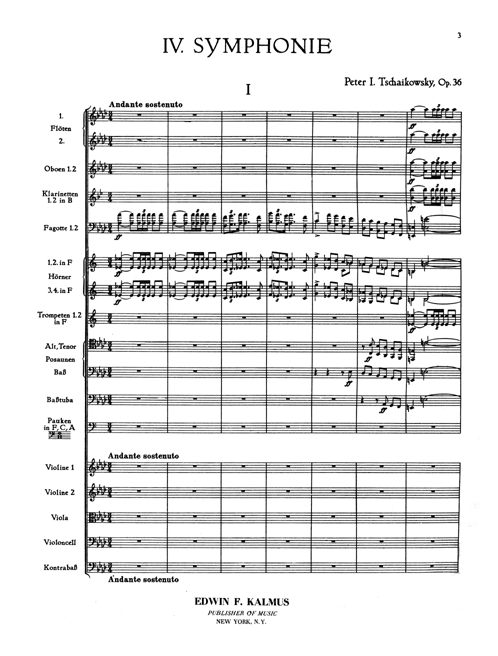
San Francisco Symphony and Michael Tilson Thomas returned to Davies Hall with a program of Lou Harrison, Copland, and Tchaikovsky last night. Harrison's rather orientalist A Parade was cheerful and shimmery. The duet between the concertmaster and principal violist was particularly lovely. This was followed by two Copland pieces, the first, Quiet City, featured English horn and trumpet. Playing the former, Russ DeLuna had a pleasant, mellow sound. Playing the latter, Mark Inouye sounded sweet. Copland's Organ Symphony did not engage me, though organist Paul Jacobs played beautifully. After the intermission we heard Tchaikovsky's Symphony No. 4 in F minor. The oboe was gorgeous in the Andantino in modo di canzona. The Scherzo was charming, the strings did a great job with the pizzicato ostinato. The brass was powerful and only had one vulnerable moment in the Finale.
* Tattling *
There was some whispering during Wednesday's performance in San Francisco. The regular watch alarms were heard a the hour. We were asked to be especially quiet during the Organ Symphony, as it was recorded. Even still, someone on the left side of the Orchestra Level managed to drop something during this music, and was glared at by the indignant patrons in Row R.
Production Web Site | Press Photographs
Interviews of de Niese: The Opera Tattler | SFCV | SFist
Performance Reviews: Not For Fun Only | The Opera Tattler | San Francisco Chronicle | SFCV | San Francisco Examiner
 * Notes *
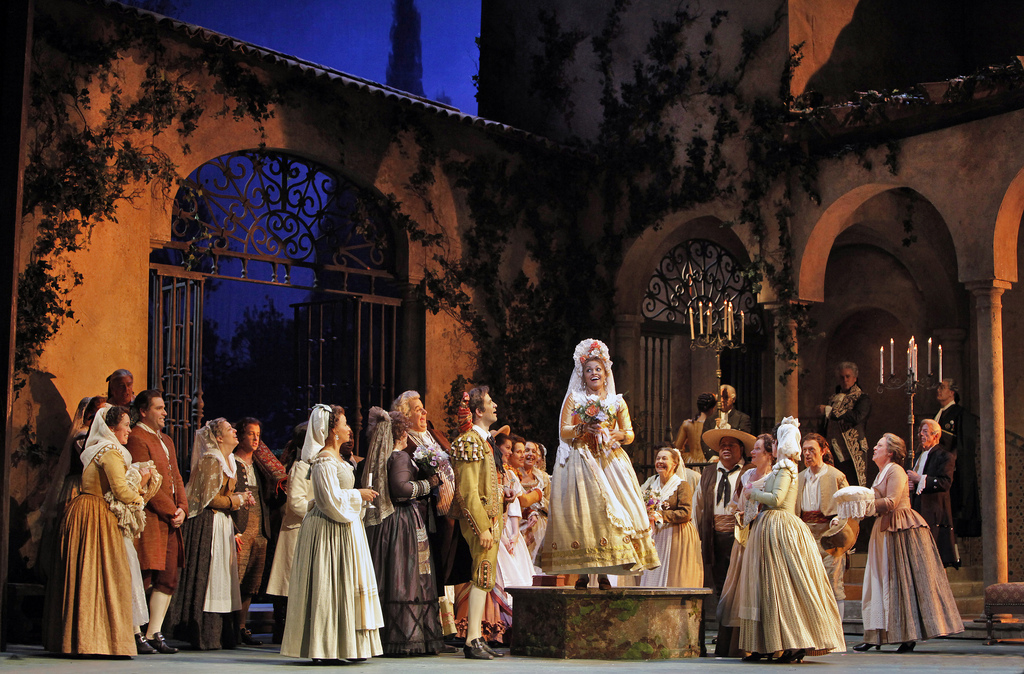
The most recent revival of Le Nozze di Figaro opened last night at San Francisco Opera. Zack Brown's Goya-inspired set is nearly thirty years old, but is perfectly serviceable. Though the scene changes are awkward between acts, everything does look quite nice. The direction from John Copley is thoughtful, he handled the chorus especially deftly. The motivation for every movement was apparent.
Maestro Luisotti conducted the 42 musicians of the reduced orchestra, and played the fortepiano. The sound was verdant. The strings and woodwinds sparkled, and the brass was pleasant but hazy. The tempi were fast, and there was never a dull moment.
The cast was uniformly impressive, both in singing and acting. The chorus sounded particularly pure and clear in Acts I and IV. Adler Sara Gartland had a promising debut as Barbarina, her aria that starts Act IV went well. Robert MacNeil made the most of Don Curzio and was funny. Likewise, Bojan Kneževiċ sounded great as a rather wild-eyed Antonio. John Del Carlo (Doctor Bartolo), Greg Fedderly (Don Basilio), and Catherine Cook (Marcellina) were spirited and had perfect comic timing.
Michèle Losier (Cherubino) did not win me over in her first aria, her voice had a hysterical edge to it instead of sounding breathlessly youthful. Her "Voi che sapete" was pretty, and she does look convincingly boyish. In the title role, Luca Pisaroni started off slowly and lacked punch. By "Non più andrai" he did sound lovely, and looked comfortable on stage. Pisaroni's voice has taken more weight since we last heard him as Masetto in 2007. Danielle de Niese made for a sweet but sassy Susanna. Her "Deh, vieni, non tardar" seemed effortless. Lucas Meachem and Ellie Dehn were both strong as the Count and Countess. Meachem was warm and vibrant. Dehn can sound perfectly brilliant, and there was only the slightest roughness in "Dove sono i bei momenti."
* Tattling *
Before the performance I had the pleasure introducing Axel Feldheim to Adler Leah Crocetto, the cover for the Countess, in the press room. We found we were seated in the same row as Adler David Lomelí, who got an introduction as well.
There was light talking during the music. Some audience members did not heed the request to remain seated during the brief pauses between acts. At least one person even made a telephone call during the first one. A watch alarm was heard during "L'ho perduta, me meschina."
John Copley was awarded the San Francisco Opera Medal by David Gockley after the performance. Copley told an anecdote about Marilyn Horne being picked up at SFO. He also expressed his pleasure of being placed on the "diva list," as many renowned divas have received the aforementioned award.
 The Opera Tattler
Leave a comment