• Zipangu * Notes * 
    Edwin Outwater is conducting San Francisco Symphony in a program of Gounod, Duncan Sheik, Claude Vivier, and Poulenc this week. Gounod's rather swirly Ballet Music from Faust sounded lovely, especially the woodwinds during the Danse antique (Allegretto). Duncan Sheik's Song Suite from Whisper House, arranged by Simon Hale, involved two amplified vocalists (including the composer himself) and an electric guitar. The singers were easy to hear, even a bit too loud, but the guitar and the harmonium seemed lost under the heavy orchestration. The horns sounded clear at the end of "Earthbound Starlight."

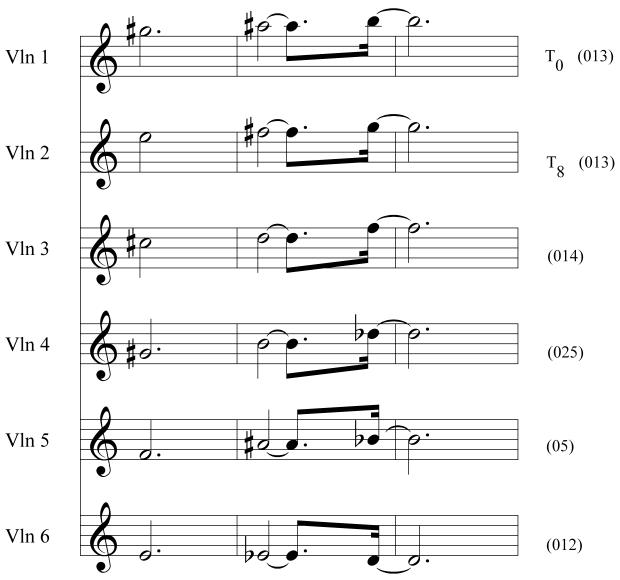
    Outwater introduced Vivier's Zipangu, explaining what the word meant and the eerie, jarring sounds to come. The small string orchestra played the unsettling piece with precision. The rest of the orchestra returned for Suite from Les Biches, which sounded jaunty and lush.

    * Tattling * 
    Perhaps it was because there were so few people in attendance that the Center Terrace ticket holders were reseated. The elderly couple next to me in Loge P where extremely amusing. They must have been somewhat deaf, for they spoke at full volume during the music. In the middle of Gounod the male half of the couple said "It's very famous music" and his companion did not comprehend him and asked "Huh?" rather loudly. They did not seem to enjoy the Sheik at all, and I moved to the orchestra level after intermission, so I did not get to hear how they felt about the second two pieces.
    Leave a comment

  • Keith Cerny will be the next general director of Dallas Opera, starting May 24, 2010.

    Press Release [PDF] | Official Site

    Leave a comment

  • Allen-perriello * Notes * 
    Pianist Allen Perriello gave his Schwabacher Debut Recital last Sunday evening. The rather daunting program consisted of all 44 songs from Hugo Wolf's Spanisches Liederbuch. The lieder were performed in five groups by soprano Susannah Biller and baritone Austin Kness, who, for the most part, switched off each song one after another. Perriello was quite personable, introducing each of the sections, and explaining that since the songs were not part of a cycle, they were grouped by theme and their order had been determined by the performers rather than Wolf, Geibel, or Hense. Perriello's playing was supportive and he never overwhelmed the singers. The constrasts of mood and volume in the different pieces came through clearly. Biller started off slightly cold but sounded more expressive in "Weint nicht, ihr Äugelein," the sixth song of the evening. The third group of songs may have suited her voice best. She had a few slightly harsh and fragile moments, but certainly shows promise. Austin Kness sounded warm and lovely, he only pushed his voice too much a few times.

    * Tattling * 
    The audience whispered, but was fairly attentive. Biller lost her hair ornament between the first and second group of songs.

    Leave a comment

  • September 9-21 2010: Yvonne, Princess de Bourgogne
    September 21 2010: Così fan tutte (Concert Version)
    October 26- November 11 2010: Kát'a Kabanová 
    December 10-31 2010: La Bohème
    January 27- February 20 2011: Parsifal 
    March 13-30 2011: La Finta Giardiniera
    April 10-16 2011: Hanjo
    April 26-30 2011: Nabucco
    April 27-29 2011: Intolleranza 1960
    May 3-11 2011: Matsukaze
    June 11-30 2011: Les Huguenots

    De Munt (La Monnaie) has quite an eclectic season in store, with 3 contemporary operas, some rarities, and some standard fare. One can read more about De Munt's season on Summer is Coming In.

    Official Site | 2010-2011 Season

    Leave a comment

  • Hamlet-keenlyside * Notes * 
    This new production of Thomas' Hamlet had a third performance at the Metropolitan Opera last night. The set, designed by Christian Fenouillat, was pretty much just two large curved walls arranged in different orientations to suggest the changes of scene. For the most part this worked splendidly, and though the set creaked a little, it was not too distracting. I was not entirely convinced by Act IV, Ophélie's mad scene seemed to take place in a decrepit ballroom. Evidently, is space was supposed to be her apartment, but it is simply very difficult for me to imagine this scene indoors.

    The orchestra sounded lovely under Louis Langrée. The clarinet solo at the beginning of Act IV was particularly beautiful. As for singing, the chorus sounded together and quite fine. Toby Spence sounded youthful and fresh as Laërte. James Morris was a shaky Claudius, but this did not seem inappropriate for the role. Jennifer Larmore looked gorgeous as Gertrude, but she gasped more than a few times in the first half of the opera, her breathing was far too audible. She did sound better as the night wore on. Marlis Petersen took over the role of Ophélie for Natalie Dessay, who withdrew due to illness. Petersen does not seem to know what to do with her arms, and at times looked rather awkward. She has a pretty, flexible voice, with only the slightest trace of rawness that appeared in her demanding mad scene. Her duet with Simon Keenlyside in Act I Scene 2 duet was stunning. Keenlyside's Hamlet was persuasive, both in his physicality and compelling singing.

    * Tattling * 
    People talked during singing, and naturally whenever the orchestra played alone. Watch alarms were heard at 9pm and 11pm. One woman at the back of the Family Circle seemed to be unwrapping a sandwich for much of Act II. At least she had the good sense to leave after intermission, and her companion offered me her seat, which I respectfully declined.

    Some audience members tittered when Keenlyside threw himself against one of the walls at the end of Act III, just before the ghost singings "Souviens-toi…mais épargne ta mère!"

    Leave a comment

  • The-nose-william-kentridge * Notes * 
    The fifth performance of Shostakovich's The Nose at the Metropolitan Opera was last night. Wiliam Kentridge's production is utter spectacle, the absurdist whimsy suits the music and the plot. At times, the animated projections were a bit dizzying, but overall they came off very well. There were times when the singers were placed awfully far upstage, and were, as a result, difficult to hear. The Nose himself appeared as a projection and live, the choreography was sprightly and amusing.

    The orchestra sounded clear under Valery Gergiev. The cast was uniformly strong as far as both acting and singing. Claudia Waite was convincingly shrewish as the barber's wife, and Erin Morley sounded especially beautiful in the scene at Kazan Cathedral. Gordon Gietz was ridiculous as one could want for the Nose, and Andrei Popov screeched hilariously as the Police Inspector. As our protagonist Kovalyov, Paulo Szot was extremely funny. One did not have to know any Russian to understand what was going on, yet pantomime was still avoided.

    * Tattling * 
    There was some dialogue that was translated in projections that were not visible to everyone in the house and were not part of the Met titles. This caused certain members of the audience to talk. There was some applause as the orchestra played by itself in Act I Scene 6.

    Also, it should be mentioned that somehow our friend Herr Feldheim made sure the Tattler had at least one Manhattan-based blogger to greet her at this performance.

    Leave a comment

  • Mariinsky-theater * Notes * 
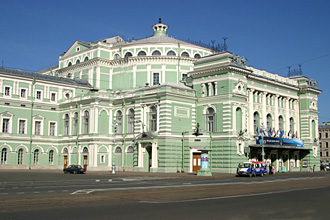
    Valery Gergiev and the Mariinsky Orchestra performed two concerts as part of San Francisco Symphony's Great Performers Series last Sunday and Monday. The second performance began with the Royal Hunt and Storm from Act IV of Berlioz's Les Troyens. The first horn was particularly lovely, producing a smooth, milky sound, though the second horn came off slightly tinny. The musicians were very together. This was followed by Rachmaninoff's third piano concerto with soloist Denis Matsuev, a marvel of technique, without a trace of mawkishness. Unfortunately, his playing left me seasick, but the audience seemed to enjoy his playing, and he obliged by giving a music box of an encore.

    After the intermission came Shostakovich's Symphony No. 15. The work is both mocking and unnerving, which came through clearly. The quotation from Rossini's William Tell Overture garnered laughter, but the allusions to The Ring and Tristan und Isolde were more disturbing. The soloists were all strong, especially the cellist. Only the trumpet sounded slightly vulnerable. The encore was a piece by Anatoly Lyadov, which required the addition of contrabassoon and bass clarinet.

    * Tattling * 
    At least three cellular phones rang throughout the performance. There was also some talking. There were protests against Gergiev on both Monday and Sunday, though somehow I missed this in the crowd swarming into Davies Hall.

    Leave a comment

  • Ian-bostridge * Notes * 
    Tenor Ian Bostridge is currently finishing a US recital tour with pianist Julius Drake. As part of this, Bostridge sang Schubert's Winterreise in Berkeley last Sunday, and it was clear he has a fine rapport with his accompanist. Both Bostridge and Drake were quite intent on the work at hand, rapt even, and there was an almost alarming intensity to their performance. Bostridge's evocative voice has heft and resonance throughout his range. One never doubted his commitment to both the Schubert's song cycle nor his translucent interpretation of it. Drake's dramatic playing was never dull, but he never failed to support the singer either.

    * Tattling * 
    One could not help notice that some ticket holders attending the Sunday matinée might have been put off by the seriousness of the performance, not to mention the lack of intermission. I was also surprised that an usher was assigned tickets in the middle of the row I was seated in, and she actually spoke during the music to try to get to her spot. The person at the end of the row refused to get up for her, and she was forced to take a more accessible empty seat.

    Leave a comment

  • Dawn-upshaw * Notes * 
    Last night pianist Emanuel Ax and soprano Dawn Upshaw performed a recital as part of San Francisco Symphony's Great Performers Series. The evening started with a selection of Chopin's Polish Songs, Opus 74. Upshaw sounded warm and clear, she was never upstaged by Ax, who stayed with Chopin in the following Four Marzurkas, Opus 41. The playing was lively. They came back to a few more Polish Songs, the spare "Nie ma czego trzeba" (Sorrow) was particularly fine.

    In contrast, Stephen Prutsman's Piano Lessons was rather wry, set to the poems of Billy Collins. This marked the West Coast premiere of this SFS co-commission of the work, hot on the heels of the American premiere on Thursday at Carnegie Hall.

    After the intermission Ax played Chopin's Two Nocturnes, Opus 27. The performance was brilliant, with perfect dynamic control. Dawn Upshaw returned for twelve Schumann songs, her voice had a wonderful ease and lightness as she sang. The encore was Hugo Wolf's "Er ist's" and Upshaw mentioned that it was just the 150th anniversary of the composer's birth.

    * Tattling * 
    There was electronic noise during the second Chopin song, "Smutna rzeka." Someone in Row K of the orchestra level was scolded for unwrapping a cough drop between two songs, and people were hushed for clapping between pieces. Otherwise, the audience seemed silent and respectful.

    Leave a comment

  • * Notes *
    San Francisco Opera's Annual Meeting for 2010 was held yesterday afternoon, over in Zellerbach Rehearsal Hall A at the Symphony. Board of Directors President George H. Hume, General Director David Gockley, and CFO Michael Simpson gave reports as usual. Again, this year the outlook was on the gloomy side, though the endowment has recovered since last time. On the other hand, 50% of all donations to SF Opera come from just 19 people, a precarious situation to say the least. Full subscriptions continue to decline, there is an accumulated deficit, and many cuts were made.
    Plans afoot to solve the various problems include recapitalization, reconfiguring of the opera schedule, reducing fixed costs, investment in facilities, and building the endowment.

    Gregory Henkel, Director of Artistic Administration at San Francisco Opera, also addressed us. He spoke about the joys and challenges of casting for the company, and about how splendidly the Merolini and Adlers did at the Met auditions.

    Five Adlers performed, sopranos Leah Crocetto and Sara Gartland, mezzo soprano Maya Lahyani, countertenor Ryan Belongie, and pianist Tamara Sanikidze. Lahyani sang "Va, laisse couler mes larmes" from Werther with great beauty. Belongie sang Arsamene's aria "Sì, la voglio," from Serse. His transitions between the different parts of his voice were flawless. Gartland's "Deh vieni, non tardar" was very pretty. Crocetto and Lahyani gave a heartrending performance of "Scuoti quella fronda di ciliegio."

    * Tattling *
    I was particularly ill-behaved at this meeting, for one thing, I was at least 5 minutes late, as the BART train ahead of mine was having mechanical issues. Secondly, I answered the survey that we were to fill out in my own deadly earnest yet entirely silly manner. I hope the person who has to read that gets a good laugh. Two cellular phones rang at different points whilst people were speaking.

    In other news, we may well have Fleming, Radvanovsky, and Hampson to look forward to in coming seasons.

    Leave a comment