• Sdoperanabucco * Notes *
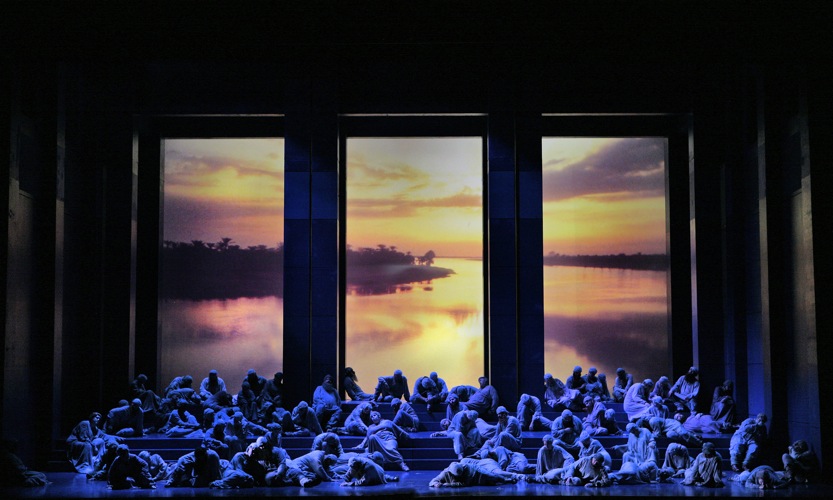
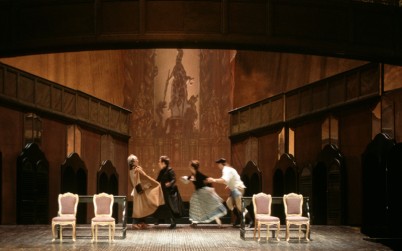
    The opening of Nabucco this season at San Diego Opera was last night. The production was directed by Lofti Mansouri, the former General Director in San Francisco, and was as expected, nothing wild or crazy or new. Micahel Yeargan's set stayed essentially the same throughout the performance, though the backdrops were switched out for the different scenes. Something about the geometry about the projections used looked dated, but transitions were clear and straightforward.

    Edoardo Müller had a good handle on the orchestra, for the most part they were together and the volume was robust without overwhelming the singers. The brass was competent, only a few mistakes were heard. The first cello solo was a bit severe, but sounded less grating over time. The chorus shone from the beginning, and "Va, pensiero" from Act III, Scene 2 was moving.

    Mezzo-soprano Susana Poretsky was both harsh and shrill to begin with as Fenena. She managed to sound very pretty at times though. Raymond Aceto's creakiness worked excellently for Zaccaria, the High Priest of Jerusalem. He could have been somewhat stronger in the very end, but sang proficiently otherwise. Arthur Shen (Ishmaele) had a bright, pleasing sound, but lacked heft. He was, at least, not difficult to hear. As Abigaille, Sylvie Valayre strained for her top notes, and could only reach some of them by wavering quite a lot. She did have her more comely moments, especially in "Anch'io dischiuso un giorno," and she acted with conviction. Richard Paul Fink sang with occasional tentativeness, and perhaps a want of beauty, but overall he does have a fine, vigorous voice. Considering he stepped in at the last-minute, one can hardly complain, and the emotions of the character came through believably in his singing.

    * Tattling * 
    The audience spoke more than one would like, especially when reading the verses from Jeremiah projected onto the scrim before acts. There was no electronic noise, no mobile phone rings, and no watch alarms.

    At the second intermission a person in a tuxedo was overheard to say "Did you get a load of that one over in that number with her big fake titties hanging out. She's got to be in her fifties and it's been a long time since she could've pulled that off." I leave it to the reader to make out exactly what such a comment or what elicited it indicates, if anything.
    Leave a Reply

  • September 11-26 2010: Anna Karenina
    November 13-28 2010: Tosca
    February 12-27 2011: Il Barbiere di Siviglia
    April 23- May 8 2011: La Bohème

    Season Announcement | Official Site

    Leave a Reply

  • Agrippina-unter-den-linden * Notes *
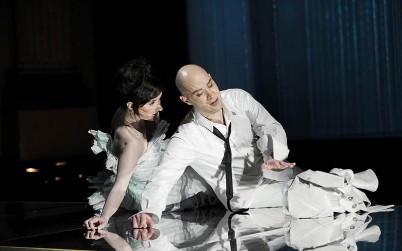
    The final performance this season of Agrippina at Staatsoper Unter den Linden was last Sunday. Vincent Boussard's production was Regietheater at its silliest, involving layers of iridescent beaded curtains, bowler hats, umbrellas, and a pair of giant beach balls filled with helium. Guido Levi's lighting did look wonderful with all the beads and other reflective surfaces on the ground. The Christian Lacroix costumes were elegant and flattering. For the most part it was all very entertaining, though the simulated oral sex in Act II was not particularly tasteful.

    René Jacobs had the orchestra sounding lively, perhaps a bit hazy at first, but otherwise fairly crisp. The singing was satisfactory, no one stood out except for Bejun Mehta as Ottone. His volume and control are admirable. Jennifer Rivera (Nerone) did some impressive acrobatics on the floor as others sang, she too as a pretty voice. Marcos Fink sounded warm and hearty as Claudio. Alexandrina Pendatchanska was a bit shrill and piercing in the title role, but perhaps this suits the ruthlessness of this character.

    * Tattling * 
    The audience this evening had a higher percentage of Germans than foreigners than the night before. They did not live up to the stereotypes we hold of Prussians as being efficient and proper. For one thing, some of them had trouble being on time to this sold-out show, and were not discrete about entering the hall. Secondly, they could not stop talking, even though they were repeatedly hushed. They even seemed somewhat sheepish when asked to be quiet, but nonetheless, this would wear off and they would start talking again.

    Leave a Reply

  • Figaro-unter-den-linden * Notes *
    The Saturday performance of Le Nozze di Figaro at Staatsoper Unter den Linden was utterly delightful. The production was simple, but cunning, and the scene changes happened fluidly. Herbert Kapplmüller's set was descriptive without being too elaborate, and Yoshi'o Yabara's costumes were in keeping with it.

    The orchestra sounded pleasant under Frank Beermann, though there were some synchronization problems between the playing and singing. There were more than a few horn mistakes, but most of these were drowned out by the strings. The cast was very even, and the singing lovely. The weakest was Ulrike Helzel (Cherubino), who looked the role, but lacked sweetness, especially in her higher range. Alexander Vinogradov was funny and sympathetic as Figaro, and Sylvia Schwartz (Susanna) was likewise. Arttu Kataja was a brash, swaggering Count, and Anna Samuil also did well as the Countess, her intonation was fine and she had some very pretty moments.

    * Tattling * 
    The audience spoke during much of the performance, and watch alarms rang at each hour. I was overwhelmed by the heavily perfumed woman who sat next to me in Tier 3, Right Middle Row 4 Seat 19. After the intermission, her date switched seats with her, and perhaps he did not enjoy her fragrance either, as he angled himself toward me.

    After the show, we were convinced to go on a tour of the opera house with our Belgian friends. The hour-long tour gave us a bit of history about the opera house and took us from the Königsloge, past the dressing rooms, back stage, into the Dienstloge, and all the way back to the Apollo-Saal. It was impressive to be able to stand on the stage and to preview the set for Agrippina, which we saw the next day.

    Leave a Reply

  • Scholl2010 * Notes *
    The second performance of Giulio Cesare at Salle Pleyel came together better than the first. Les Arts Florissants sounded more cohesive. The concertmaster did not break any strings this time, and her intonation was more accurate, but her playing for "Se in fiorito ameno prato" was still screechy and not beautiful. The horn soloist still hit many unpleasant notes in "Va tacito e nascosto" but her mistakes were less grating than on Tuesday. However, the three horns in the March of the last scene were awful, and were laughed at by various audience members.

    The singing was consistent, the cast is extraordinary. Philippe Jaroussky (Sesto) and Nathalie Stutzmann (Cornelia) were definitely at their best in their duet at the end of Act I. Cecilia Bartoli was delicate and sweet in "Vadoro pupille." She also sang "Piangero la sorte mia" exquistely. Andreas Scholl seemed less tense than before, his voice came out more, though he was difficult to hear during "Al lampo dell' armi." He did cough twice during the concert. Scholl sang "Dall'ondoso periglio…Aure, deh, per pietà" with particular elegance.

    * Tattling * 
    The clapping did not start as early as it had on Tuesday, and people even managed to applaud after the music was done. The audience whispered a little, and there were two very noisy watch alarms on separate occasions. There was a medical emergency in the center terrace during "Da tempeste il legno infranto." As Cecilia Bartoli sang, an older woman lost consciousness, perhaps she fainted or had a seizure. The people around her checked her pulse and tried shaking her awake, but had to fetch medical help. The woman was able to walk out of the hall, but there was a noticeable pause between Cleopatra's aria and the recitative between Cornelia and Sesto that followed.

    Leave a Reply

  • Facade-opera-bastille * Notes *
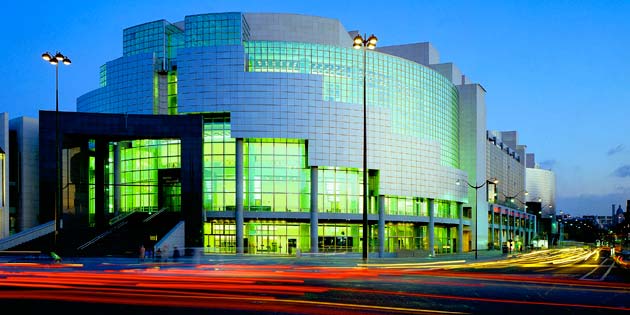
    Standing room at Opéra national de Paris is a fairly organized affair. I arrived at Opéra Bastille at around 4:30pm, asked where the standing room line was from the person at the information counter by the box office, and was directed to the main door. Outside near the gift shop door were four people, and it was clear they were the opera-goers I was looking for. After a few minutes some ladies also showed up and started organizing us by number. A sheet of paper was folded into 32 pieces, numbered, and cut into slips. I was given number 5, and then most everyone went their separate ways to get out of the cold, just leaving a few people to distribute numbers as they arrived.

    The other opera standees were concerned by my lack of gloves, and after an hour I was encouraged to sit inside the gift shop to wait. Evidently, the time they open the doors varies from day to day. At around 6:15pm the 24 of us all got into line and were herded into the building to the two standing room ticket machines in the lobby. We went up two at a time, told the person supervising us if we wanted one or two places, and paid using coins or credit cards.

    The standing places are not numbered, but there did not seem to be a mad dash for the best spots along the railing. As at the Met, there are layers of railings on the orchestra level. In Paris, however, the ushers are extremely helpful in finding standees seats. After the first intermission of Don Carlo I was given a seat in the middle of the rear orchestra, and was asked to climb over seat to take it.

    Leave a Reply

  • Opera-bastille * Notes *
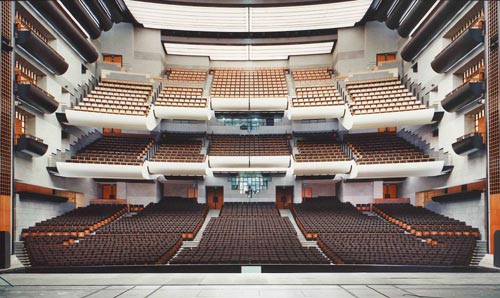
    The opening of Don Carlo at Opéra national de Paris was a bit slapdash. Graham Vick's production had some attractive elements, but lost a lot of tension in the drama because of how slow scene changes were. This was not helped by the two intermissions for four acts. Tobias Hoheisel's costumes were ostentatious in contrast to his rather sedate set, but these were pulled together by the lighting, designed by Matthew Richardson.

    The orchestra was not bad under Carlo Rizzi, the cello solo in Act III was great, for instance. The brass was harsh, but only had a few bad notes, especially during the fanfares in Act II. All the singing was solid, however, including the chorus. Luciana D'Intino (Eboli) sang her first aria rather robustly, and she produces a full tone when she is singing all out. Sometimes she was a bit thin, perhaps it has to do with the different parts of her voice. Sondra Radvanovsky sounded both icy and sweet as Elisabetta, her "Non pianger, mia compagna" in Act I, Scene 2 was especially lovely.

    Ludovic Tézier did well as Rodrigo, his "Dio, che nell'alma infondere" with Stefano Secco (Don Carlo) was very fine. At other times he was overwhelmed by the orchestra, but really turned it out for "Per me giunto è il di supreme" at the end. Secco had enough volume for the most part, though he was difficult to hear in a few places, notably in the last act, when the staging required that he stand upstage, away from Elisabetta. At first, Giacomo Prestia was lackluster as Felipe II, sounding pitchy. However, his "Ella giammai m'amò" was appropriately woeful, yet imposing.

    * Tattling * 
    The audience was a little restless, and there was a bit of whispering. Someone rustled cellophane and was admonished twice before she ceased her discourteous behavior.

    Leave a Reply

  • Palais-garnier * Notes *
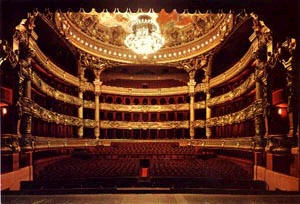
    Wednesday's performance of Idomeneo at Palais Garnier had some beautiful singing. Tamar Iveri's Elettra could be strident and hysterical, without being ugly. Isabel Bayrakdarian (Ilia) does have quite a bit of vibrato at times, but her voice is pretty. Vesselina Kasarova certainly looked the role of Idamante, but her wobbly gasping was distracting. At least this was not the case in all of her arias. Charles Workman was wonderful as Idomeneo, his warm, sweet voice has a lovely resonance.

    The orchestra did not sound particularly together and did not seem to mind the conductor, Philippe Hui. Given that he was filling in for Emmanuelle Haïm, who recently withdrew from these performances, it was a bit mean of the audience to boo him so vehemently. The horns were especially out of tune.

    As for Luc Bondy's production, as far as I could tell, it seemed rather dull. It was a sort of minimalist naturalism as far as set. For example, the beach in Act II looked strewn with paper, orange peels, and random trash. This was not exactly indicative of a horrible sea monster that was wreaking havoc on the Cretans. The set was also loud, people thumped up and down the rake all evening long. The costuming was inexplicable, the time period was unclear and the styles were not becoming on the female cast. Ilia's dress was very unflattering, and I have never seen Bayrakdarian look so matronly.

    * Tattling * 
    The audience was silent, though we were in a box, so it was hard to gauge. The applause seemed a bit tepid.

    Leave a Reply

  • Cecilia * Notes *
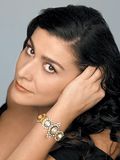
    The Tuesday opening of Giulio Cesare at Salle Pleyel was stunning. For one thing, most of the singing was breathtaking. Both low voices were lovely, these being Andreas Wolf (Curio) and Umberto Chiummo (Achilla). The latter enunciated particularly well, and his aria "Se a me non sei crudele" was strong. Rachid Ben Abdeslam seemed quite excited to be on stage as Nireno, as did Christophe Dumaux as Tolomeo. Dumaux is such a clown, perhaps a touch too much for the villain in an unstaged concert version of this work. On the other hand, our tragic Sesto, Philippe Jaroussky, was pitch-perfect. His voice is bright, warm, and light, gleaming above the orchestra. Nathalie Stutzmann (Cornelia) was a fine foil, her voice seemed bottomless.

    In the title role, Andreas Scholl, started off quietly, and was overwhelmed by the orchestra at more than one point. His voice warmed up after the night wore on, and the second half went more smoothly than the first. Scholl did crack on one note near the end of "Dall'ondoso periglio…Aure, deh, per pietà," though he sang the rest sublimely. Cecilia Bartoli sang with beauty, she was coy when pretending to be Lidia, and imperious as Cleopatra. There were a few times when Bartoli had too much vibrato, and this wobbling had an unpleasant quality to it. However, overall the singers were wonderful.

    Les Arts Florissants had a few mishaps. William Christie did keep the musicians together and his tempi seemed appropriate. In general the playing was clear and fine. However, the concertmaster broke her E string in Act I, and it took a long time for everything to get back in place. It was interesting to watch how she traded her violin with her stand mate, someone from behind passed up a good E string, and the stand mate restrung the concertmaster's violin, trying to get it in tune without disrupting the music. Unfortunately, some of the violin solos were out of tune and squeaky, though this is understandable, given the circumstances. The horn soloist also had some intonation issues, she hit a score of sour notes in "Va tacito e nascosto."

    * Tattling * 
    The audience was quiet, though the men behind me in the second balcony did talk during the first chorus, were hushed, and snorted derisively at the suggestion that they should be silent. Nonetheless, they did not speak again during the music. The clapping was vehement, and although we were asked to not applaud after each number, somehow our enthusiasm got the better of us. It was a shame that some of us could not wait until after the orchestra stopped playing to cheer and clap.

    Leave a Reply

  • Barenboim_copyright_monikarittershaus * Notes *
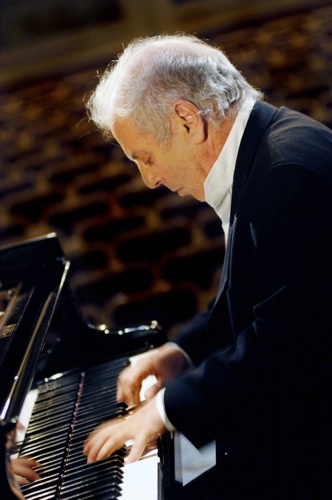
    Last weekend the Staatskapelle Berlin performed all five of Beethoven piano concertos paired with works by Arnold Schönberg at Salle Pleyel. Friday night started off with Beethoven's Piano Concerto No. 1 in C Major, a cheerful, almost Mozartian piece. Daniel Barenboim played straightforwardly, without any bravado. The woodwinds had a certain whimpering quality, and the strings were fine. The Schönberg was Fünf Orchesterstücke (5 Pieces for Orchestra), which was played with exuberance. This was followed by the fourth piano concerto of Beethoven, played with great vigor with emphasis on the wonderful sense of salvation in this piece.

    The second evening gave us Beethoven's Piano Concerto No. 2 in B-flat Major and No. 3 in C minor. Barenboim played solidly, making only a few mistakes, and the orchestra kept pace. The Adagio of No. 2 had a beautiful longing in it, and the Rondo (Molto allegro) a certain irrepressibleness. In No. 3, the brass had a slightly hazy sound, but were not ostentatious. The Schönberg was Variations for Orchestra was played well, though I found it somewhat waxen in comparison to the Beethoven.

    The final afternoon performance included the famous Piano Concerto No. 5 in E-flat Major. Barenboim and the orchestra played with vim and playfulness. Schönberg's rather romantic Pelleas und Melisande followed.

    * Tattling * 
    The audience was very good on Friday, from where we were only a bit of snoring was noted during Schönberg. Saturday's audience was less good, there was a cellphone ring during the second piano concerto. Worst of all was Sunday, when the couple next to us in the orchestra seats V 150 and 152 could not stop talking, whispering, and making out. It was actually pretty funny. However, a woman in the center terrace insisted on taking flash photographs of the orchestra, and was roundly scolded in French by Barenboim himself before Schönberg. She was unabashed and unrepentant, and she continued photographing him after the performance, even using flash a few times.

    Leave a Reply