Baritone Thomas Hampson has an iPhone application in conjunction with his "Song of America" project.
The Opera Tattler
Reviews of Performances and their Audiences
-
* Notes *
Today's Day at Merola was certainly educational. The event began with a lunch in the opera house, and some members of the Opera Standees Association were kind enough to share a table with me. Bass-baritone Yohan Yi joined us and good-naturedly spoke about working with Dawn Upshaw at Bard College's Graduate Vocal Arts Program and his upcoming stint in the Domingo-Thornton Young Artists Program. After eating I managed to introduce myself to soprano Kate Crist and contralto Suzanne Hendrix. Charmingly, Kate explained that I was the one who called Suzanne "disturbing," and I explained I meant it in the best possible way and was quite taken with her performance.It was quite difficult to decide which of the events to choose, but I started off by listening to Sheri Greenawald's vocal master class, accompanied by Stephanie Rhodes. Maya Lahyani sang the Letter Aria from Werther, Ryan Belongie sang "Ombra mai fu" from Serse, and Evan Boyer sang "Quand la flamme de l'amour" from La jolie fille de Perth. They each sang very beautifully, but Belongie was particularly striking, and it was interesting to hear how he pictured the setting of the aria.
Mark Morash's general rep master class focused attention on the accompanist, Miaomiao Wang, who played fluidly. Susannah Biller sang "Caro nome" from Rigoletto, and Morash said many funny things about teenaged girls such as Gilda. The best quote, perhaps, involved how only 16 year-old girls are allowed to breathe in the middle of words. Yohan Yi sang a lovely rendition of Ravel's "Chanson à boire," which we learnt was supposed to be in the score for Georg Pabst's 1933 film Don Quichotte. Kate Crist sang the Strauss lied "Cacilie" with power.
For the second half of the day, I decided simply to go to the rehearsal of L'Amico Fritz. At first they worked on the last few scenes of the opera, and it was remarkable how effective pianist Tamara Sanikidze's playing was. Conductor Warren Jones gave us an impromptu lecture on the opera as the rehearsal space was set up for Act I. The opera is set in the Jewish community of Alsace-Lorraine during 1892, and was popular up until the 1920s. The last time SF Opera produced this opera was in 1974.
For the next two hours we heard the first run-through for this group of young people. Tamara held up well, she and Jones even sang at certain points. Susannah Biller, Aleksey Bogdanov, Yohan Yi, Eleazar Rodríguez, Maya Lahyani, Sara Gartland, and Nathaniel Peake all sounded promising.
* Tattling *
I became horribly lost at the War Memorial Opera House, as I tried to get to the Chorus Room by stairs rather than the elevator. Unfortunately, I managed to take two stairwells that both lead me to the Media Suite rather than where I wanted to be. Thankfully I got to the right room in time. Later, at the rehearsal, I situated myself perhaps a bit too close to Warren Jones and could feel the air move as he conducted.Leave a Reply
-
Robert Brill will replace Michael Yeargan as the scenic designer for Moby-Dick, which opens in Dallas on April 30, 2010.
Leave a Reply
-
 * Notes *
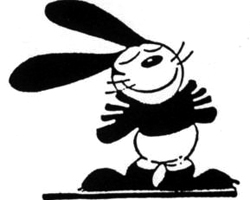
The 14th San Francisco Silent Film Festival happened last weekend at the Castro Theatre. I attended three of the programs: Amazing Tales from the Archives, Oswald the Lucky Rabbit, and La Chute de la maison Usher. The first program featured the newly-restored Screen Snapshots: 7th Series, a short film The Actor's Children (1910), a trailer for the lost film Polly of the Follies (1922), fragments from a trailer for Happiness Ahead (1928), fragments from a lost Ramon Navarro film, and the short film How the Hungry Man was Fed (1911). Anne Smatla, Joe Lindner, and Heather Olson spoke. Stephen Horne's playing was impressive, especially when he played flute and piano during the Navarro fragments.The second program involved 8 Oswald the Lucky Rabbit shorts from 1927-1928, with Leonard Maltin and Leslie Iwerks speaking. The character is quite cheeky and Donald Sosin's sound effects were very funny. The drawing of these cartoons is charmingly energetic.
Before Epstein's La Chute de la maison Usher, they screened the Avante-garde American short The Fall of the House of Usher (1928). It was a bit difficult to follow the story line of the latter, and the words that floated on screen, such as "beat" and "crack" were pretty absurd.
Epstein's film was pretty to look at, though the house at hand seemed to be inordinately drafty. I would have preferred it if they had not had a spoken translation of the French text, which was particularly silly when the card simply read "Usher."
* Tattling *
The audiences were all very well-behaved and enthused, though there was some inappropriate tittering during La Chute de la maison Usher. The lines to get into the theatre were quite long, and formed well in advance of the screenings.Leave a Reply
-
 * Notes *
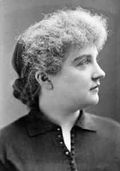
The Ballad of Baby Doe opened at Berkeley Opera last Saturday. Jonathan Khuner's production, with sets and projections from Jeremy Knight, is sweetly simple. The video art included some rather silly red curtains that would fall after the many scenes, and there seemed to be a glitch near the end, but otherwise they were effective. The use of Leda and the Swan as a painting in one of the scenes was an interesting choice.The orchestra, again lead by Jonathan Khuner, had some roughness, the brass in particular had some intonation problems. The opera features quite a lot of singers, including a chorus and some ensembles. Everyone did quite well and was generally together. Jillian Khuner had some lovely, delicate moments as Baby Doe, but she does have quite a lot of vibrato, and can sound shrill. Torlef Borsting was robust as Horace Tabor, though not terribly nuanced until the last scene. Lisa Houston was convincing as Augusta Tabor, the coldness, bitterness, and even tenderness of the character came through.
As for the music itself, Douglas Moore did compose some pretty, likable music. However, his ensembles were a bit too transparent, basically he would have one person sing a line, then another, yet another, and then have the quartet sing all together. Overall, the effect was droll, and the performance very cute. One must commend Berkeley Opera for having innovative programming.
* Tattling *
The audience was fairly quiet, but one did hear some talking. Lots of photographs were taken, and mobile phones, while silent, were clearly in use during the performance.Leave a Reply
-
* Notes *
Tonight’s Schwabacher Summer Concert was splendid. Kate Crist and Gregory Carroll impressed in Act II Scene 2 of Der Fliegende Holländer. Crist's warm voice has some rough edges but can be quite arresting. Carroll could not match her heft and volume but has a sweet, strong voice nonetheless. Ryan Belongie and Susannah Biller sang Act III, Scene 1 of Orfeo ed Euridice beautifully. Suzanne Hendrix was completely disturbing as Baba in the Act II excerpt taken from The Medium.Act II, Scene 7 of L'Italiana di Algeri was charming, Margaret Gawrysiak's voice has a dark beauty, though she did not sing perfectly cleanly. Yohan Yi was hilarious as Mustafa, his movements were spot on, but his enunciation could have been clearer. The ensemble at the end of the scene was a little off from the music. The last act of La Bohème was heartwrenching, both Brian Jagde (Rodolfo) and Lori Guilbeau (Mimì) were compelling vocally.
* Tattling *
The props consisted of 11 chairs, a sofa, 3 tables, and a trunk; they were used, however, to good effect. The evening began with a possibly staged cellular phone ring, and the conductor, Mark Morash, commented "You might want to turn that off." There was a fair amount of talking, especially during the beginning of the Gluck. Someone's crutches fell during the duet between Mimì and Rodolfo, and someone's watch alarm sounded at 10pm, just at the end of La Bohème.Leave a Reply
-
Michael Sumuel will replace Evan Boyer as Taddeo in the excerpts of L'Italiana in Algeri they are doing for this year's Schwabacher Concert.
Leave a Reply
-
Last Sunday's performance of La Traviata concluded the 2008-2009 season at San Francisco Opera. Elizabeth Futral was at her best, her high E-flat was strong, though she was still somewhat shrill. Charles Castronovo sounded absolutely lovely, he did not seem quiet compared to Futral. Edwin Outwater had the orchestra under control, never overwhelming the singers. The inappropriate laughter in Act III happened again.
Looking back, the first cast had a very loud but lovely Anna Netrebko paired poorly with a rather quiet Charles Castronovo, a more balanced pairing with Elizabeth Futral and David Lomelí in the second cast, and the fine performance from Ailyn Pérez and Charles Castronovo on July 1st.
The Summer part of the season was quite popular, at least one of the Tosca performances, five of the Traviata ones with Netrebko, and all six shows of Porgy and Bess sold out. The staging of Tosca was dull, and the principals lacked chemistry, but there was some beautiful singing. Porgy and Bess had a strong cast and the production really came together.
The house was quieter as far as backstage noise is concerned, though there were still some moments when the microphones did make high-pitched sounds, though not as constantly as before. The Tosca simulcast did very well, about 27,000 people attended at AT&T Park. The SF Opera podcast continues not to be updated, and SF Opera does not have a Twitter account, though the Merola Program does.
The audience was fairly good this year. People were able to keep their mobile phones off, but not their watch alarms. There was quite a lot of talking during Porgy and Bess, but everyone was rather quiet for Netrebko.
Again, not a lot of absurdity this Summer, though perhaps the silliness of the Fall makes up for it. My own opera attendance was, in fact, rather significantly down from last year. The Opera Tattler attended 11 of 23 performances, which is the least I've attended the SF Opera over the last five summers. However, I was surprised how much I liked Porgy and Bess, and earlier in the season, Die Tote Stadt.
Leave a Reply
-
 * Notes *
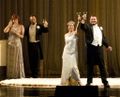
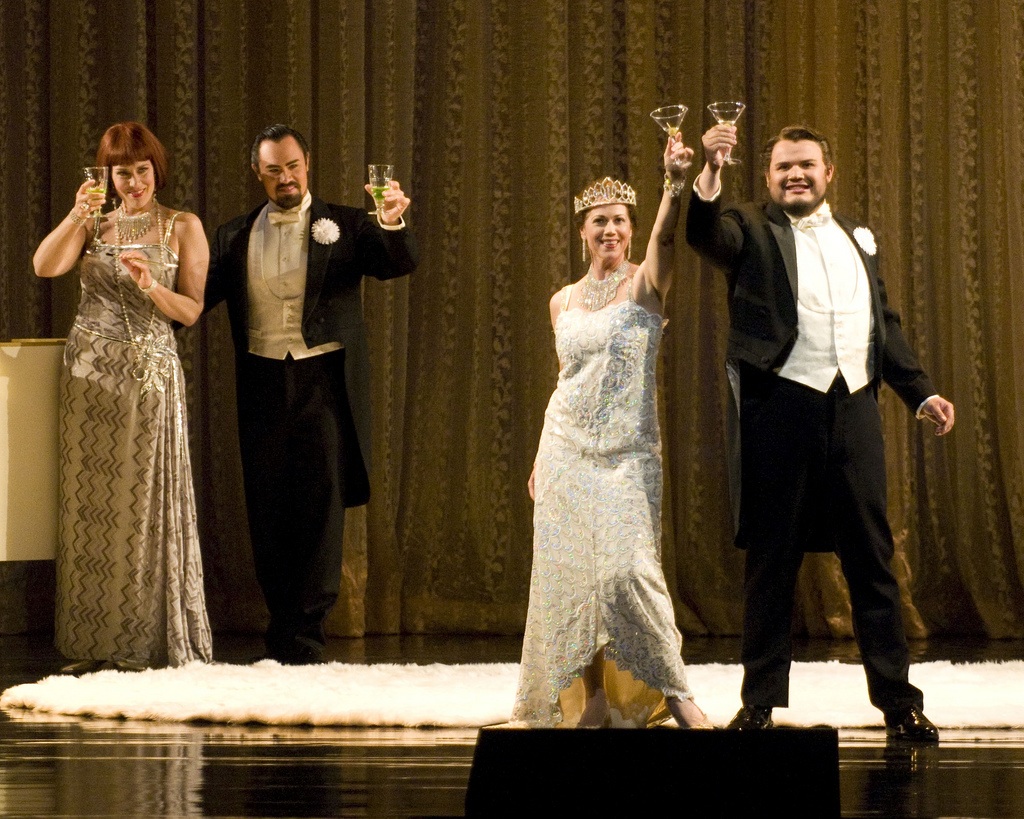
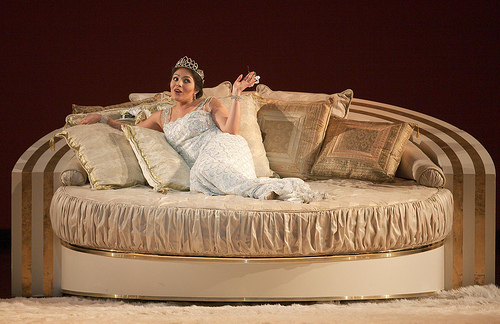
Thursday's B cast performance of La Traviata at San Francisco Opera marked the end of Donald Runnicles' tenure as Music Director. Elizabeth Futral still sounded shrill in Act I, but improved as the night wore on. David Lomelí seemed restrained, but sang beautifully, especially at the beginning of Act II. Stephen Powell's Germont, was consistent, his voice is warm and pleasant.Futral definitely looked best in the Jazz Age costumes. In this performance she did not kick her shoes off for "Sempre Libera," and Lomelí carried her to the bed at the end of that act. She also had an actual letter in Act III, which wasn't the case with Netrebko or Perez, if memory serves. Powell's choreography was different than Croft's, Powell did not embrace Futral at all, and he did not enter with open arms at the end of Act II Scene 1.
* Tattling *
The people in Box V talked during the quiet parts of the music. Otherwise, there were some watch alarms, but nothing else terribly noisy. There was less laughter than usual, though there was some giggling when Annina says "Quest'oggi, è vero? Vi sentite meglio?" in Act III.Many bouquets were laid on the conductor's music stand and many more thrown on the stage during the ovation. Maestro Runnicles threw a couple bouquets up to his daughters in Box A.
Leave a Reply
-
 * Notes *
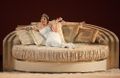
Ailyn Pérez's turn at Violetta in San Francisco Opera's La Traviata yesterday night was impressive. She was a better match for Charles Castronovo (Alfredo) and did not overwhelm him, he did not seem nearly as quiet. Pérez had an appealing vulnerability, her performance was nuanced, and her high notes were never shrill. She had a few gasps here and there, but her breathing was generally under control. Castronovo sang with great sensitivity, he was a bit underpowered at the top of the Brindisi, but was otherwise fine. Dwayne Croft (Germont) still rushed a little, but sounded less strained than during opening night. The supporting cast sounded lovely as well, particularly Andrew Bidlack as Gastone and Renée Tatum as Annina. The chorus might have been the slightest bit off from the orchestra a few times, but continued to sound very pretty.It was interesting to note the differences in staging. Pérez did not hang her legs out of the fancy car for her entrance, nor did she pull Castronovo into her bed at the end of Act I. Her costume for the first half of Act II was not a dressing gown, but a velvet dress with lace trim. She did not provoke inappropriate laughter as Netrebko and Futral did, despite the inane super-titles, perhaps because her performance was more engaging somehow.
* Tattling *
There was almost no electronic noise in balcony standing room, a few hearing aid noises or stray microphones for OperaVision were heard. There was a little whispering.The Orpheus Group was given a pre-performance tour of the Media Suite. There are eight robotic cameras in the house that are controlled backstage, as well as two fixed ones. Video editing is even done during the performance. We were taken to the stage just before curtain and were greeted by Castronovo himself.
Leave a Reply


Leave a Reply