Production Web Site | Press Release [PDF]
Singers: Hope Briggs | Noah Stewart | Scott Bearden
Reviews: The Opera Tattler | The Reverberate Hills | Iron Tongue of Midnight | Contra Costa Times | Saturday Matinee | San Francisco Chronicle
Reviews of Performances and their Audiences
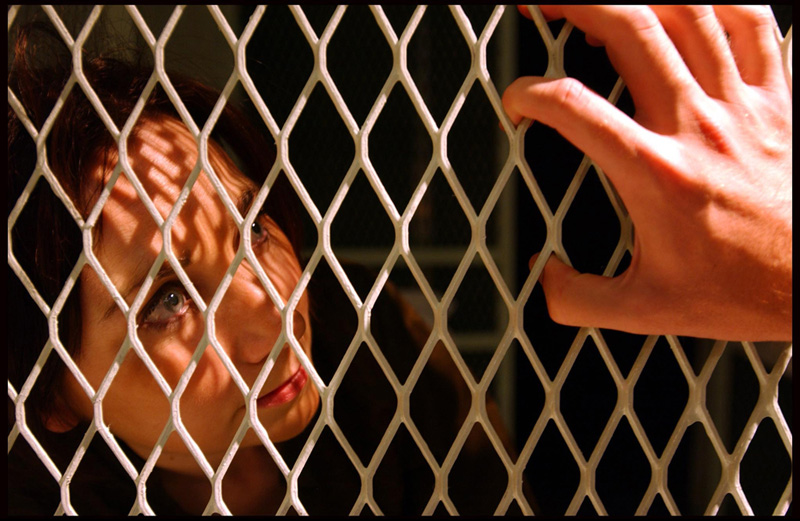 Composer Keith Burstein declared bankruptcy after running up legal fees of £67,000. Burstein attempted to sue the London Evening Standard because of an unfavorable review of his opera Manifest Destiny (Soprano Bernadette Lord as Leila pictured left in a production photo).
Having read Veronica Lee’s 142-word review from August 15, 2005 (it is in the PDF below), I did not get the impression that Burstein is terrorist sympathizer. It does not, however, sound like the opera was success. Compare this to the BBC review, which says the work “does not induce rousing emotion.” The Telegraph commented that the “political message is banal and fatally one-sided.” In all fairness, there were also some very positive reviews from EdinburghGuide.com and The British Theater Guide.
Official Keith Burstein Site | Official Production Site for Manifest Destiny | Burstein v Associated Newspapers [PDF] | Independent Article | Guardian UK Article
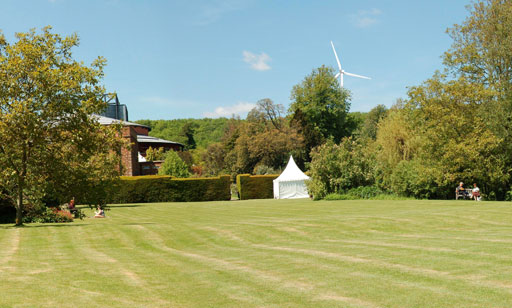 Wind-powered opera is forthcoming, as Secretary of State for Communities and Local Government Hazel Blears has approved Glyndebourne’s wind turbine.
Press Statement | Official Site | Article in the Guardian UK
 * Notes *
Festival Opera, the third largest opera company in the Bay Area, opened the 2008 season with Il Trovatore yesterday at the Hofmann Theatre. Giulio Cesare Perrone's production is straightforward, his set design is simple but evocative, only small changes are made for the different scenes. The only obvious weak point was in Act I Scene 4, when Leonora mistakes Di Luna for Manrico. Everyone was quite visible during the scene, so in Act I Scene 5 (pictured above, photo by Robert Shomler), when Leonora realizes she was wrong and sings "Ah, dalle tenebre tratta in errore io fui," one must work hard at suspending disbelief. Naturally, this was not helped by the fact that the Count di Luna, Scott Bearden (on the right), could hardly look more distinct from Noah Stewart (on the left) as Manrico. So when the supertitles flashed something like "the darkness deceived me," the audience tittered, and the woman next to me commented that "it must have been very dark."
The period costumes from Susanna Douthit were attractive, though I was confused by the gypsies at first, for some of them looked like normal citizens of Berkeley on any given day. I thought the gypsies were dressed in contemporary clothing, but after a second look, I realized it was because just a few of the women's exposed hairstyles looked fairly modern. Likewise Azucena could have been in a tribal belly dance troupe, particularly because of the designs painted on her face.
Michael Morgan conducted at a good clip, and the orchestra sounded fine. There were a few strange notes from the French horn, but only near the beginning. There were times when the chorus was not quite with the orchestra, undoubtedly this will improve with time. The anvils were played by choristers, and they were not all exactly on the beat. The organ in Act III Scene 2 sounded rather canned, it came out of the speakers, one of which sputtered for half a second.
In the smaller roles, tenor Alexander Taite (Ruiz) and mezzo-soprano Jessica Mariko Deardorff (Ines) both sang well and fit the look of their parts. Kirk Eichelberger had a rather big-voiced Ferrando, at least for this space, his bass is somewhat gravelly but not unpleasant. Mezzo Patrice Houston had some deep, lovely tones as Azucena, but she could also be rather terrifying. Her breathing was noticeable and some of her pitches were not convincing, but for the most part she did well. Scott Bearden was slightly off key in his Act II Scene 2 aria "Il balen del suo sorriso," but his voice has good heft and warmth.
I was most interested in soprano Hope Briggs (Leonora), as she was to sing Donna Anna last summer at San Francisco Opera, but was, to her dismay, replaced by Elza Van den Heever at the last moment. Briggs started off with a distinctly nasal sound, her voice strong, strident, and muscular. A couple of her arpeggios were strained, but for the most part, she sang well. She was moving in her last scene, fully convincing as the self-sacrificing heroine.
In the title role, former Adler Fellow Noah Stewart had a great deal of vibrato for his first high notes off stage. He also seemed to run out of breath at the end of the famous "Di quella pira." Otherwise Stewart sang admirably, he was plaintive in "Sconto col sangue mio," this has a bone-chilling beauty. Stewart will be covering at the Met next season, certainly he is one to watch.
* Tattling *
I was dreadfully late as I find Walnut Creek difficult to navigate. Although I have been to the Lesher Center for the Arts before and it is only half a mile south of the Walnut Creek Bart station, I still managed to become lost. In my flustered state, there was a bit of a mix up at the box office, so I only took my seat at 8:00pm exactly.
The orchestra level looked very full, but the audience was fairly polite. The talking was limited to the aforementioned scene, whispering was at a minimum and not during the singing. No watch alarms were noted, but unfortunately, there was a phone ring at the beginning of Act IV. At least it was during the recicative. During the quieter moments, some speaking was audible from the lighting booth, though this was less disruptive during the second half of the performance.
Many of the usual suspects attended this performance, and afterwards I cornered Merolino apprentice coach Allen Perriello during the reception. Albert Herring, which opens next Friday, sounds like it is going well. Noah Stewart and Hope Briggs were inundated with fans and supporters, but I did manage to speak briefly with the former.
Teatro Colón, which was closed in 2006 and was supposed to be ready in 2008, is to reopen in 2010.
Robert LePage’s production of The Rake’s Progress is currently at Covent Garden. The reviews seem mixed, Rupert Christiansen found the production dull, but Warwick Thompson found it magical. I should have liked to hear John Relyea sing Nick Shadow, as I found James Morris a bit boring in that role last year.
Richard Morrison’s Review in the Times Online | Evening Standard | The Stage | musicOMH.com | MusicalCriticism.com | The Telegraph | Bloomberg | Metro | Hugh Canning’s Review in the Times Online
John McWhorter makes an argument for translated operas in this New York Sun article. Personally, I don’t particularly like supertitles either, especially ones in English for operas in English, but I do like hearing operas in the original language. To be fair, I do have the advantage of having studied German, Latin, and Spanish, though sometimes this does mean I become distracted by exactly how words have been rendered into English. There are also times when the titles are funny when the libretto is not, or when the ordering of the punchline in the titles is paced such that the audience laughs before the line has been sung. On the other hand, there is something appealing about operas translated into English, for instance, Pocket Opera does a fine job of this.
I recently learned that the Met titles are sometimes in languages other than English, since they are individual screens one can change the language option. I’ve never used the titles before, which was probably very foolish for something like War and Peace. Just the thought of Doctor Atomic in German makes me giddy, too bad this production overlaps with the San Francisco Opera season.
NY Sun Article | John McWhorter at the Manhattan Institute | Met Titles
* Notes *
The inaugural indoor Schwabacher Summer Concert occurred yesterday at the Herbst Theatre. YoungJoo An began the evening by singing Tonio’s “Si puo?” from Pagliacci. The baritone burst out behind the side door curtains in a most absurd manner. His tone was full and pleasant though his vibrato was a bit out of control at times.
Next up were Ben Wager and Nathaniel Peake as Le Comte des Grieux and Le Chevalier des Grieux in Act II Scene 2 of Manon. For a bass Wager is surprisingly reedy, and tenor Peake has a light, bright voice. Soprano Leah Crocetto (Manon) has lots of vibrato, but is able to maintain good intonation. Her voice is both pretty and piercing.
Before the intermission came the end of Act II Scene 1 of La Traviata with YoungJoo An as Germont and Nathaniel Peake as Alfredo. An did not quite have enough heft for “Di Provenza il mar,” and he was off key a few times, but his voice certainly has appeal as well.
The second half of the evening consisted of Don Pasquale‘s second act. René Barbara was appealing as Ernesto, though his last note in “Cercherò lontana terra” was rather strained. Ben Wager was perfectly untuous in the title role and David W. Pershall was an amusing Dr. Malatesta. Leah Crocetto shone as Norina, she was delightful.
* Tattling *
The audience was somewhat sparse, and mostly well-behaved. No watch alarms or mobile phones rang, though there was a bit too much talking aloud during the recicative of Don Pasquale.
Apprentice coach Eileen Downey said hello to us before the show, letting us know that the organ music in Manon was just her on a keyboard. We also conversed with soprano Joélle Harvey at intermission, evidently they just finished staging Act I of Don Giovanni for Merola. Cedric of SFist introduced himself at intermission as well.
During this performance, current Merolino Eugene Chan was making his debut at LA Philharmonic in “Carmina Burana.”
William Friedkin will direct An Inconvenient Truth, the opera, which is to open on May 11, 2011 at La Scala.
This week’s The Economist has an article on Peter Gelb‘s simulcasts. San Francisco Opera and the Royal Opera House are also mentioned.
I especially like these two sentences from the article:
Opera purists are not at all happy about Mr Gelb’s foray into cinemas. They argue that opera was made to be seen live in opera houses and they worry that cinemacasts will hasten the demise of an ailing art form.
I believe I know a good many individuals who might like to claim the title “opera purist,” and yet I have not heard this sort of thing from anyone. The Met simulcasts are enjoyable, but I hardly think anyone who would normally go to the opera house would go to one in lieu of a real performance. Opera in movie theaters is a supplement rather than a replacement for opera in real life.


Leave a Reply