• Sfoperaintheballpark San Francisco Opera is presenting a free simulcast of Lucia di Lammermoor at AT&T Park tonight, as one may know because of the billboard in Emeryville or the various banners in San Francisco. Kip Cranna will be receiving his San Francisco Opera Medal before the performance, which features Natalie Dessay in the title role. One may register in advance and print out tickets. Ticket holders are allowed in at 6:30pm at Lefty O'Doul Gate, and others may enter at 7pm at the Willie Mays Plaza Entrance. It should be amusing, when else are hot dogs, the outdoors, and opera combined? Unfortunately, I will miss this event, as Beethoven's 7th beats bel canto opera hands down in the world of the Opera Tattler.

    Register in Advance | Press Release [PDF] | Map of AT&T Park

    Leave a Reply

  • Photo * Notes *
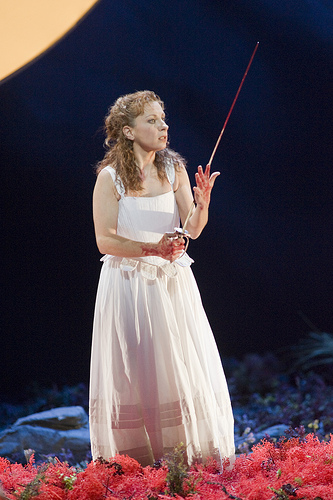
    Natalie Dessay had her long awaited debut at San Francisco Opera last night in the opening of Lucia di Lammermoor. Her voice has a marvelous incandescent quality, but also has a hard edge that borders on vulgar. Her movements are light and her acting is strong. She was completely convincing in her mad scene, and the use of
    glass harmonica rather than flute here certainly was effective.

    Tenor Giuseppe Filianoti's debut was less impressive, though at least he looked fine paired with Dessay, as she is rather petite. His portrayal of Edgardo started off fairly well, his voice bright and reedy, though with a certain whining quality. The famous Act II sextet was his strongest moment, sounding particularly good with Gabriele Viviani (Enrico). However, he was nearly shrieking in Act III, "Fra poco a me ricovero" was not good. Viviani made for a threatening villain, his voice is not especially beautiful but is serviceable enough. Though his diction was precise, his intonation was not, which was clear in the duet "Se tradirmi tu potrai." Oren Gradus faired better as Raimondo, his light but warm tones were lovely.

    As for the smaller roles, Cybele-Teresa Gouverneur (Alisa) did not distinguish herself. Her little shaky voice was hysterical at first, and inaudible in the sextet. Matthew O'Neill (Normanno) sounded fine, though he was a hair off from the orchestra at one point. Andrew Bidlack was a restrained and suitably stiff Arturo, and sang well in the sextet.

    The chorus was excellent, though they were a bit fast near the end, or else the orchestra was somewhat slow. They were not, in any case, exactly together. The orchestra did sound crisp and in tune under debuting conductor Jean-Yves Ossonce.

    Other production teams could really learn a thing or two from director Graham Vick and designer Paul Brown. The set was gloriously quiet, and only made one cracking noise between the second and third scenes of the last act, and this was when there was no music to interrupt. Despite the silence of the set, the visual impact was utterly stunning. The gloomy elegance of the moving walls, the storm scene, and Lucia's entrance in the mad scene using a platform covered with heather (Calluna vulgaris) painted red were all gorgeous. Some of the effects with shadows were too much like caricature, they reminded me a bit of Kara Walker's work sans the incisive political commentary.

    * Tattling *
    The War Memorial looked quite full, and no rush tickets were available. Standing room was crowded, and is bound to become even more so. I'm sure this is the production that brings in so many people that there will be fainting in standing room, hopefully it will distract them so I can hear Ariodante in peace.

    I only heard one mobile phone ring, and it sounded like it was coming from outside the hall, in the lobby. There were no watch alarms heard in the orchestra, and I didn't notice anyone talking.

    Dr. Marcia Green's amusing pre-opera talk focused on the music of Lucia in film, of course bringing up The Fifth Element and the blue alien diva.

    Leave a Reply

  • The Wagner Society of Northern California held a Das Rheingold symposium on June 14, 2008, which was declared Wagner Society of Northern California Day at San Francisco Opera. The first talk, entitled "From Iceland to Valhalla: What do the medieval Icelandic sources of Das Rheingold really say?," was from Dr. John Lindow of UC Berkeley. His first slide was of Sir William Jones and he went on to show how the Indo-European languages are related, and why the 80-85% of Wagner's sources for the Ring are from Iceland. He admited that Wagner was the reason he became interested in Scandinavian studies. Das Nibelungenlied was discussed, as were the Poetic and Prose Eddas, along with the Völsunga Saga. Of particular interest was a comparison of Old Norse gods with the characters of Das Rheingold. Lindow associated Frigg/Fricka with Venus and Friday, rather than Freyja/Freia, as the former's name is cognate with Old Saxon fri "beloved lady" and Icelandic frjá "to love." Freyja/Freia comes from the word for "lady," but since she is fertility goddess, she is also tied to love.

    The second talk, Dr. Thomas Grey's "Leitmotive, from Ring to film and Back," focused on the Wagner's Ring compared to the Lord of the Rings films. Grey is not convinced that Howard Shore's music is much like Wagner's, but is rather more like the score for Gone with the Wind. He also found Tolkien's motivation for writing his work rather different than Wagner's. But certainly there are commonalities, as both Wagner and Tolkien used the Völsunga Saga as a source.

    The third talk was the most awaited, as it came from the New York City Opera dramaturg, Cori Ellison. Her "Valhalla, the American Dream" discussed the reasons behind the "American Ring." Her claim that North Americans do not know Norse myth certainly rang true. She went on to describe the current production at SF Opera and the themes the production team were focused on, these being nature, love, and women. It seems that the team were interested in making the Ring a cautionary tale. Ellison went on to talk about Fricka, how she is considered an unsympathetic character, and how Wagner's relationship with his first wife Minna informed the goddess' portrayal. Much of what she said can be read in Rudolph Sabor's Richard Wagner Der Ring des Nibelungen: A Companion, specfically pages 25, 88-89, and 93-94. Unfortunately, I missed some of Ellison's talk as I had two coughing fits, and did not want to subject people to the noise, so left the room. Ironically the coughing was due to having a cough drop (I was worried I would cough) but I happened to be allergic to the one that was offered by the Wagner Society.

    "Das Rheingold: Wagner, Shakespeare and Tragicomedy" was an entertaining talk by Dr. Simon Williams of UC Santa Barbara. Williams described a 2001 Robert Carsen production of Das Rheingold at Köln Opera, particularly noting how Loge stole golden apples, and latter gave them to Wotan so he could go to Nibelheim without any trouble. This production revealed the tragicomedic nature of Das Rheingold to Williams, and he believes it is the only successful one in the 19th century as far as opera is concerned.

    Leave a Reply

  • The Wiener Staatsoper canceled a ballet performance on June 29, the day of the Euro 2008 Final. Apparently the opera house has been uncharacteristically empty.


    IHT Article| Wiener Staatsoper

    Leave a Reply

  • Production Web Site | Press Release with Photographs | World of Opera


    Singers: Susan Graham | Ruth Ann Swenson | Sonia Prina | Verónica Cangemi | Richard Croft | Eric Owens | Andrew Bidlack


    Previews: San Francisco Examiner | Panel Discussion | Dress Rehearsal


    Reviews of Previous Performances of this Production: Santa Fe Opera (1987) | City Opera (1999) | San Diego (2002)


    Reviews of San Francisco Opera’s 2008 Performances: The Opera Tattler | The Rehearsal Studio | MikeOpera | Contra Costa Times | San Francisco Chronicle | Opera Warhorses | SFCV.org | BayAreaReporter | San Jose Mercury News | Christina Waters | Zauberwelt | Out West Arts | SFist | Kinderkuchen for the FBI | Exotic and Irrational Entertainment | Prima la musica, poi le parole | Civic Center | Not for Fun Only

    Leave a Reply

  • Deborah-voigt Voigt returns to Covent Garden tonight in the title role of Ariadne auf Naxos.

    AP Article | Deborah Voigt Official Site | Production Site | YouTube

    Leave a Reply

  • Ariodante, Photo by Terrence McCarthy * Notes *
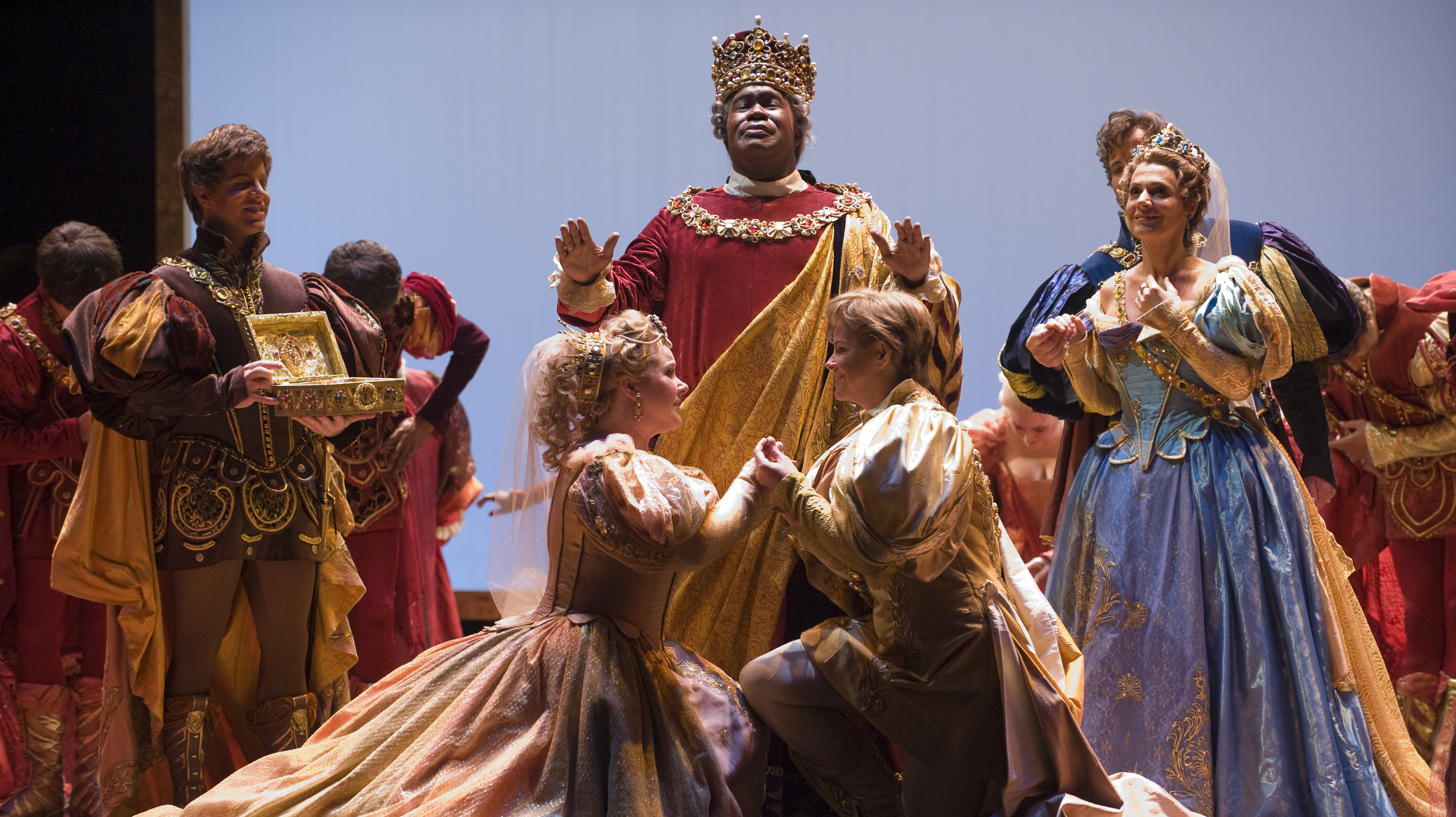
    Today's matinée performance of Ariodante was the San Francisco Opera premiere of Händel's 33rd opera, which was first performed at Covent Garden in 1735. John Copley's production is slightly busy, there is a lot of movement to offset the supposed statis of the libretto. For the most part this was not distracting, though certain singers were noticeably quieter when they were made to move upstage during their arias. The sets, by John Conklin, are elegant and feature a large upstage frame, which alternately has different backdrops and props in it. The effect is often like a gigantic diorama. Some of the classical sculptures or architecture of the set were at odds with the Michael Stennett's sumptuous costumes, which had a more Baroque Venetian look, as they were based on the paintings of Giovanni Battista Tiepolo. There were also several walls painted to look like marble that moved around to change the scenes, and this was visually excellent, though occasionally noisy. The choreography of Kenneth von Heidecke was innocuous enough, and was well-executed. Duane Schuler's lighting was complementary to the backdrops, the one of clouds and blue sky almost looked as if was pulsating, so vivid were the colors. The production made no overt reference to Scotland, though this is where the libretto is set.

    Patrick Summers could never be accused of conducting in a sluggish manner, some of his tempi were brutally fast. There was a sour note in the brass section during "Voli colla sua tromba la fama," and a horn was off during the sinfonia at the end of Act I. However, the most beautiful moment of the opera was Ariodante's aria "Scherza infida" in Act II, and this was in no small part due to the orchestra. Susan Graham was incredible in the title role, her tone pure and bright. Graham was able to sing the same words over and over without being boring in the least, coloring the notes in an array of shades. She also looked dashing, her statuesque height is to her advantage in this role. Ruth Ann Swenson was lovely as Ginevra, her creamy voice showed little strain, though she was off from the orchestra for a few seconds in Act I. Sonia Prina had a promising debut as the villain Polinesso, her voice has a good heft and a richness, though she did have moments of difficulty. Her second aria in Act I ("Spero per voi") was particularly fine. She looked exceedingly boyish, though she is not tall. Verónica Cangemi (Dalinda) certainly had her work cut out for her, given how great the other female singers were. At her best Cangemi has a nice voice, clear and cold, with sufficient volume. At her worst she sounded ragged and a bit shrill, but this was rare.

    Richard Croft was strong as Lurcanio, very sweet, though not terribly nuanced. Andrew Bidlack (Odoardo) acted well and was not overly loud, as some young singers can be. Eric Owens looked regal as the King of Scotland, his voice is not opulent and is slightly quiet. He was completely convincing in his heartbreaking Act II aria, "Invida Sorte Avara." It was passionate without being sentimental. As far as I could tell, Anders Froehlich did not sing in the role of Polinesso's squire, but he was menacing in his movement. The chorus was superb as usual, and ended the opera just wonderfully.

    * Tattling *
    In the last 5 minutes of Peter Susskind's opera talk, an elderly fellow with a cane insisted that he sit in the third row of the orchestra, despite the fact that the only free seat was not on the aisle, and the three people had to stand up to let him through. 30 seconds after the talk ended, this man turned to me and stated that I was in his seat. I told him I was getting up, though did not mention I was only waiting for the pair next to me to leave, as I hardly wanted to step over them. One of the ladies explained that orchestra seating was open for the lecture, to which he retorted "Well, it's not the lecture now." After a trip to the powder room, I returned to the third row to check just which seat it was, and the man was not in C 105 where I had been sitting. I am unsure why he took the trouble to bully me out of his seat, but I suppose he must be a subscriber to the M, N series and it probably took him years to get to that particular spot.

    David Gockley has recorded a new message played before the performances. It does not mention turning off electronic devices, and I noticed there was a cellular phone ring during the da capo of Dalinda's first aria. There were no watch alarms on the hour, at least. Stage directions were audible before Polinesso's aria in Act II. The supertitles were apparently arch, for the audience laughed at them more than once.

    To my disappointment the most absurd visual element was removed from the production. At the dress rehearsal there was an over-sized sculpture of a horse's head resting on the right side of the upstage frame during Ginevra's Act II mad scene. It did not read well, as the ear and mane were not visible, and at first I thought it was a frog or perhaps a hippopotamus. Then as Ginevra grew more frenzied, a second horse head was lowered from the ceiling. I did not find this much sillier than the colossal Venus head that has a strange forehead that appears in Act III or the extremely large Corinthian capital that also shows up in that space.
    Leave a Reply

  • * Program *
    “Per me giunto” from Don Carlo
    Young Joo An, baritone and Allen Perriello, piano

    “Sgombra è la sacra selva” from Norma
    Natasha Flores, mezzo-soprano and Alan Hamilton, piano

    “La donna è mobile” from Rigoletto
    Nathaniel Peake, tenor and Dennis Doubin, piano

    “Tu che di gel sei cinta” from Turandot
    Rena Harms, soprano and Carl Pantle, piano

    “Chi il bel sogno di Doretta” from La Rondine
    Amanda Majeski, soprano and Eileen Downey, piano

    * Notes *
    Pianist Warren Jones gave a master class for the Merola Opera Program yesterday. He gave amusing introductions to each piece. With each person he went over various weaknesses, including pitch, diction, and posture. Jones sang much more than one would expect, his voice is quite nice. It was very interesting when Jones went over portato, telling the singers they should ask a string player to demonstrate when they have a chance. His comparison of German to Italian was also entertaining, comparing the pronunciation of “alles” to “tutti.” With German one takes each sound one by one, but with Italian one makes the consonants within the vowels. His advised the apprentice coaches to attend to their first three fingers while accompanying singers, rather than their pinkies, as solo pianists do. It was impressive how quickly Jones was able to get results from the singers and pianists.

    * Tattling *
    Mr. Jones is rather witty, he was especially funny when he told one singer “you have to whack them on the head with fabulousness.” When he was demonstrating how to sing “s” in Italian and then made the singer at hand repeat it, he asked someone to tell him if the sounds could be heard in the back. When the person responded in the affirmative and added that Jones’ “s” was louder, he quipped “It always is because I’m tasteless.”

    Leave a Reply

  • Copleysinging * Notes *
    If the final dress rehearsal of Ariodante last night was any indication, I will likely go to as many performances of it as possible. The cast is strong, of course Susan Graham and Ruth Ann Swenson are wonderful, but debuting Sonia Prina, Veronica Cangemi, and Richard Croft are not disappointing either.

    The orchestra sounded pretty good, the brass section was slightly rough at times, but not as much as in the premiere of Das Rheingold. Patrick Summers took the tempi quite fast. The style of playing was appropriate for the type of music at hand.

    The production certainly looks like it is from the 80s, which can be pleasantly absurd, but more discussion on that after the opening, which is, incidentally, Sunday, June 15th.

    * Tattling *
    Before the rehearsal a person behind me insisted that if "the terrorists" decided to bomb the War Memorial Opera House, it would be no great loss, as it is, in his opinion, the worst opera house in the United States as far as acoustics and comfort are concerned. He was also adamant that the duets in Ariodante are very unusual for Baroque opera and he repeated this statement in between acts. It made me think of the duets in Rodelinda and Giulio Cesare, which was just confusing because those earlier works than Ariodante, since Senesino was singing those and Giovanni Carestini sang in the latter.

    Yesterday was director John Copley's 75th birthday, and after the bows we sang "Happy Birthday." I've now sung with Ruth Ann Swenson and Susan Graham, which is probably not going to happen again.

    Leave a Reply