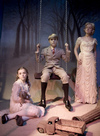
• AsherfischAsher Fisch has been appointed the new Principal Guest Conductor of Seattle Opera. He debuted at there in 2003 with Parsifal last season and returns on August 16, 2008 to conduct the International Wagner Competition.

    Press Release [PDF] | The New Israeli Opera | Biography

    Leave a Reply

  • Die Zauberfloete Animals, Photo by Terrence McCarthy* Notes *
    Peter Hall's 1992 production of Die Zauberflöte opened at San Francisco Opera last Saturday. It certainly was odd to see all of Gerald Scarfe's funny designs again, for this production was my first at
    Los Angeles Opera, and I did not enjoy it particularly then, as I was even crankier in my youth. The cartoon aesthetic is at times grating, particularly the ridiculous faux East Asian meets Star Wars costumes, beards, and Playmobil hair on the chorus. The hybrid animals in Act I Scene 15 are charming, but it might have been nice if they had moved more with the music. The feather-covered costumes are excellent for Papageno and Papagena, as are the spooky contours of the Queen of the Night's gown. The Dea Ex Machina entrance of the Queen of the Night in Act I is both effective and striking, and generally the staging is good, visually the scenes change nicely and without much fuss.

    The cast is certainly the best I have heard sing Die Zauberflöte. Piotr Beczala is nearly perfect in the role of Tamino, his volume is good and his vibrato in control. There were times when he spoke that I had a difficult time discerning the German, but his diction in his singing is clear. I was disappointed that Rebecca Evans took ill and canceled as Pamina, but Dina Kuznetsova is admirable in the role. She  has slightly more vibrato than I enjoy, and her German diction is not crisp, but otherwise she turned out a fine performance. Christopher Maltman makes a hilarious Papageno, his diction is precise and his voice warm. Erika Miklósa hit every note as the Queen of the Night, and never sounded as if she were straining terribly. She was somewhat quiet in her first aria, perhaps because she was suspended upstage from the ceiling. Bass Georg Zeppenfeld lower notes as Sarastro are quiet, but otherwise he acted and sang well. Many of the other roles were filled with Adlers, Elza van den Heever, Kendall Gladen, and Katharine Tier were adorable as the Three Ladies, sprightly and not shrill in the least. I actually liked Rhoslyn Jones as Papagena, her vibrato did not drive me crazy and her voice was not noticeably louder than Maltman's. I was disappointed by the Three Boys, they were not exactly together, but perhaps that will be worked out in time.

    * Tattling *
    There were quite a lot of people on the orchestra level, standing room looked full, though Row ZZ was not. There were some whispers, but it was only in Row ZZ that people actually seemed to speak aloud, despite repeated hushings.

    The scene changes were, at times, audible. There seemed to be a frightful amount of crashing behind lowered screens.

    The use of a green costume for Monostatos side-stepped the racial stereotype, and "grün" replaced "schwarz" in the text.

    Leave a Reply

  • Turnofthescrew * Notes *
    Late in September, Oakland Opera Theater was forced to move from their location on Broadway at 2nd Street to 3rd Street at Martin Luther King Junior Way. Nonetheless, the company presented Benjamin Britten’s The Turn of the Screw (1954) from October 5 to 14. The production was set in Louisiana instead of England, which was lost on me until I read the description later. I had wondered why Mama Grouse had pronounced the voiced dental fricative /ð/ as plosive [d]. Had I read Henry James’ novella, I would have noted that this character is called Mrs. Grose in the text.

    The singing was solid. Anja Strauss turned out a fine performance as the Governess, though I was afraid her eyes might pop out of her head by the end, her voice is clear and pretty. Her diction in English was nearly perfect, only her way of saying "of" with a voiceless rather than a voiced fricative, betrayed her origins. It was a bit difficult to tell how exactly Gerald Seminatore and Marta Johansen were as the ghosts Quint and Miss Jessel, as they sang from offstage, but they seemed good though not terribly distinctive. Seminatore’s voice cracked slightly as the Prologue. Lori Willis was convincing as Mama Grouse, though she must be rather young, she was able to pull off playing the old housekeeper well. Brooks Fisher and Madelaine Matej were a creepy pair as the children Miles and Flora, Fisher’s voice is lovely but quiet, Matej seemed slightly off key at a few points, but her volume was good.

    The orchestra only requires an ensemble of thirteen, which suits the small scale of the Oakland Opera Theater. Deirdre McClure conducted, and everything seemed to go well. Because there was no pit, the orchestra was seated stage right. It made the balance between singers and orchestra off, but it was quite easy to hear the singers because of this.

    The opera is about 2 hours long and is divided into a prologue and sixteen scenes. I found the music tiresomely unlyrical, and unlike Billy Budd, the libretto has no entertaining lines. I was taken with the use of nursery rhymes such as "Tom, Tom, the Piper’s Son" and "Lavender’s Blue." My favorite was the homonym aria "Malo, Malo" sung by Miles.

    The production was of a higher quality than I have seen from Oakland Opera Theater in the past. The costumes did not look like they were leftover Halloween costumes, in fact, everyone looked pretty smart. The stage had a piece that rotated, so the many scenes could be easily changed. Most of the furniture looked appropriate, though some of the pictures on the walls looked a little shoddy. There were some simple aerial acrobatics done by the ghosts, but the singers were kept offstage and the acting left to the performance artists from The Starlings Trapeze Duo.

    I found the insertion of the Mammy Caricature in the guise of Mama Grouse disquieting. One one hand, it is good to see non-whites on stage, particularly when they are as talented as Lori Willis. On the other hand, this ugly stereotype was not delved into, so the usage smacks of tokenism and cultural appropriation. 

    Overall, I was mostly engaged by the spectacle aspect of the opera, rather than the music or the drama. It was difficult to feel sympathetic to the plight of the Governess, she is not fleshed out as a character, and even less still for the children, who are just frightening. I am not sure if this is because of the libretto, the music, the production, or my own ignorance. I was, however, impressed by Oakland Opera Theater’s tenacity, and hope to see them thrive their new space.

    * Tattling *
    The house was not full last Thursday night, there were a few rows that had no one in them at all. Even still I was nearly falling out of my front aisle seat, as the narrow chairs were zip-tied together and someone chose to sit next to me. The performance started with the ringing of a telephone, which was not intended. Otherwise, people did whisper a little, but this was minor and not distracting.

    Leave a Reply

  • Dwayne Croft, photo by Terrence McCarthy* Notes *
    Appomattox had its world premiere last Friday. I must confess I do not enjoy contemporary music, in fact, I am not overfond of many operas after Fidelio. This is ridiculous, given that this encompasses Verdi, Wagner, and Puccini. Setting that aside, I found Appomattox rather less challenging than Doctor Atomic, Le Grand Macabre, or Saint François d'Assise. I even got the chorus of Jimmie Lee stuck in my head after the final dress rehearsal, and noted that this was the only part that garnered applause during the music.

    As for singing, I thought it was something of a shame that all the lead female roles were filled with Adler Fellows. It is not that they are not good or have poor voices, but they do lack experience. Particularly with Julia Dent Grant, the role is prominent and may have been better with someone with more control of her voice. Rhoslyn Jones, who sings this role, has a big voice with lots of vibrato. Her voice is pleasing in her middle range. I remember her quite clearly as Frasquita in Carmen last season, so she is, at least, consistent and distinct. On the other hand, it was difficult to tell that is was Elza van den Heever in the role of Mary Custis Lee, the role did not show off how pretty her voice can be. Her Southern accent was not as prominent as it could have been, at times she dropped it. Ji Young Yang's accent as Julia Agnes Lee was certainly not Southern, her alveolar approximant /ɹ/,had a certain lateral quality.  Yang's voice is otherwise bright and very pretty. Heidi Melton sang well as Mary Todd Lincoln, though her voice is a bit harsh in the higher range too. Her acting was strong. Kendall Gladen was the only mezzo, as Elizabeth Keckley, and she sounded lovely, though she was quieter than Melton, with whom she sang.

    Dwayne Croft was excellent as Robert E. Lee, his voice is sweet and he carried himself in a suitably dignified manner. There were a couple of times that his voice was overwhelmed but the orchestra, but I suspect this is partially because I was in orchestra standing room, where quieter voices sometimes get lost. Andrew Shore was slightly less appealing as Ulysses S. Grant, but his American accent was clear and he was always audible. He sang a duet with Julia Dent Grant in Act I Scene 3 that was particularly moving. For the other male roles, tenor and Adler Noah Stewart stood out as T. Morris Chester, his acting was stirring and his voice carried well.

    * Tattling *
    Sara Jobin did not seem comfortable giving the opera talk, she looked at her watch many times. The conductor did sing parts of the opera, since there were no recordings for her to play, and that was absolutely charming. The orchestra and boxes looked full, though I heard the attendance up in the balcony was sparser. There was a little whispering, but for the most part everyone was respectful and quiet. The work received a standing ovation.

    Leave a Reply

  • * Notes *
    The final dress rehearsal of Appomattox was last night. On the whole, I found the music, libretto, and production rather dark and a bit heavy-handed. The music, unsurprisingly, is reiterative and the singing style more declamatory than lyrical. There are no soaring high notes, but this does keep the text clear, at least when the balance between orchestra and singers was right. The two male leads are both baritones, but their voices are distinct enough from each other. The soprano role of Julia Dent Grant is significant, she begins the piece a cappella, there is no overture at all, and she ends the opera along with a women's chorus.

    The choral parts are lovely, especially the Civil War era "Tenting on the Old Camp Ground" at the end of Act I Scene 1, the black Union soldiers singing in Act I Scene 4, and the song concerning Jimmie Lee Jackson in Act II.   

    The set has a modern sensibility, lots of metal and such, but with period furniture and costumes. There were disturbing visual elements such as the cart full of amputated body parts in the Prologue and dead horses hanging from the ceiling in Act I Scene 4 and the Epilogue.

    Though Act I is completely set in April 1865, Act II is interspersed with scenes in the from Reconstruction, the Selma to Montgomery marches, and a present day first-person account of the Mississippi civil rights worker murders. Though it is true that the ramifications of the American Civil War exist even now, these jarring direct links provided by the libretto are somewhat preachy and disconcerting.

    I have not a few impressions on the singing thus far, but will wait until after the opening to solidify my opinions.

    * Tattling *
    There were several groups of students at this performance and they were somewhat loud and had to be hushed several times. For the most part they were quiet after that except during Edgar Ray Killen's aria at the end of Act II. The opera has ten instances of American English's most troublesome racial slur, more than half of which are in the aforementioned aria.

    Baritone Thomas Hampson, who just sang in "Das Lied von der Erde" last week at San Francisco Symphony, was in attendance, as was Amy Tan, whose book The Bonesetter's Daughter is to be premiered as an opera next year.   

    Leave a Reply

  • AppomattoxKip Cranna moderated a panel discussion on Appomattox yesterday evening. The panelists included composer Philip Glass, librettist Christopher Hampton, conductor Dennis Russell Davies, director Robert Woodruff, baritone Dwayne Croft (Robert E. Lee), and baritone Andrew Shore (Ulysses S. Grant). Each person was asked about how he became part of this world premiere. We learnt that Christopher Hampton knew little about the American Civil War; that Dennis Russell Davies sent Philip Glass a recording of the "Tenting Tonight," which was included in the opera; that there were two baritones as leads to make it easier for the words to be understood; and that the two baritones were distinguished by a major second.

    Leave a Reply

  • Philipglass* Notes *
    The word icon is from Greek εἰκών meaning "image."

    Last night, Philip Glass was interviewed by David Gockley at the Interview with an Icon donor event. The first half of the interview was devoted to Glass' life, working at his father's record store as a child; going to Peabody, University of Chicago, and Julliard; studying with Nadia Boulanger and Ravi Shankar; his operas Einstein on the Beach, Satyagraha, and Akhnaten; and his work in film. The second half had to do with Appomattox, which opens this Friday in a world premiere. Among the details discussed were the librettist Christopher Hampton and the conductor Dennis Russell Davies, both of whom are having their San Francisco Opera debuts with Appomattox. This latest opera has two baritones as leads, Dwayne Croft as Robert E. Lee and Andrew Shore as Ulysses S. Grant. Apparently the costumes are period, the sets minimalistic, and the opera covers not only the Civil War, but comes up to the present day.

    * Tattling *
    The venue was moved from the opera house to Herbst Theatre, and they did not open the doors until ten minutes before the event. Philip Glass mumbled a great deal, and mistakenly said "Los Angeles" for "San Francisco" at one point, and David Gockley kicked him. Gockley had a cold and also took one of his shoes off during the interview. The audience, however, was very well-behaved.

    This interview will probably be made into a podcast.

    Leave a Reply

  • Petra Maria Schnitzer, photo by Terrence McCarthy* Notes *
    Graham Vick’s production of Tannhäuser opened at San Francisco Opera yesterday. Designed by Paul Brown, this co-production with Dallas Opera strikes an elusive balance, it is neither cloyingly traditional nor starkly contemporary. The bacchanalia is one of the weaker points, Ron Howell’s choreography here looks to be inspired by Graham and West African dance, but somehow is vulgar, more so than same scene in the recent
    Los Angeles Opera offering earlier this year. However, the rest of the choreography is solid and works well with the lighting, designed by Adam Silverman. The entrance of the men’s chorus in Act I was particularly beautiful with the light streaming in through the windows one side and the singers emerging from the glow. The pacing of the staging was excellent, there was enough action but it was not superfluous.

    Runnicles conducted well, the orchestra was together and the tempi were brisk. I was quite worried that Peter Seiffert (Tannhäuser) and his vibrato would annoy me all evening, but he sounded better in this space. Perhaps the Dorothy Chandler is less forgiving, but Seiffert sounded warmer than I remembered, though he did wobble a great deal. Petra Lang was not the most alluring Venus, her shrill voice and her unflattering bed sheet costume were both less than ideal. I had liked hearing James Rutherford at Opera in the Park, but as Wolfram I found his voice lacks heft. On the other hand, Ji Young Yang sounded just as bright as the Shepherd as she had in Golden Gate Park. Her control is imperfect, at times she shrieked a bit. Petra Maria Schnitzer was good, she seemed better matched in this production than in Los Angeles, her voice did not stand out quite as much.

    * Tattling *
    The San Francisco audience for Wagner tends to be rather quiet, though I did hear, albeit very faintly, a watch alarm. I commend the audience for not applauding for the horse with the hunting party. Such restraint! In standing room man inserted himself next to my companion and the person to her left, he interrupted our conversation to mention the "X-rated" production in Los Angeles. He repeatedly rubbed his arm during the performance and muttered a few times, but this was pretty minor as I could not discern what he was saying. He probably found a seat after Act I, for we did not see him after the first intermission.

    Leave a Reply

  • Rembrandt_2* Notes*
    San Francisco Opera opened the 2007-2008 season with Samson et Dalila on September 7th. This 1980 production, by Nicolas Joël, was last revived in
    2001. Douglas W. Schmidt’s sets look dated from close up, they are a bit flat and at odd angles. The costumes also have suffered in the 27 years since Carrie Robbins designed them. They look like the Alma-Tadema paintings they were inspired by, but every piece of cloth used seemed to have a pattern on it. It looked like the chitons were made of leftover fabric for Easter dresses. However, from the back of the orchestra everything does look lovely, and this time around they managed to get the scrim working properly, it did not get caught on anything in the three performances I have seen.

    Olga Borodina’s voice is a bit rougher than I remembered, it has some harsh edges when she sang in the higher range at full-volume. She was still a rather sultry Dalila. Clifton Forbis was not inspiring as Samson, his voice was strained but otherwise passionless. In contrast, Juha Uusitalo (High Priest of Dagon) has a beautiful voice, and sings with much more ease. Disappointingly Oren Gradus did not quite have the lower range for the Old Hebrew. I was pleasantly surprised by the Abimélech, Eric Jordan, and curious to hear him in a more challenging role.

    * Tattling *
    I saw the final dress rehearsal during a corporate event and found it curious that Forbis did not sing full out, as he needed to save his voice for the opening. Borodina also saved her voice somewhat, but did sing audibly.

    Everyone was all aflutter for the opening, two couples in standing room tried their best to block me out of my spot and could not be silent. They were repeatedly hushed. It was a good night for looking at fancy dresses and obvious plastic surgery. The flowers on the boxes were a bit naff this year, large squares of pink roses, lots of rose garlands, and random bits of greenery.

    I was pleased to note that for the third performance, the scrim was not lowered until after the music ended for Act I, so that the audience, good monkeys that they are, refrained from clapping over the orchestra.

    Leave a Reply

  • June 6-22 2008: The Rape of Lucretia
    June 28- August 9 2008: West Side Story
    July 5- August 10 2008: Susannah

    Press Release | Season Overview

    Leave a Reply