• BsosaulThe Bavarian State Opera premiered a production of Händel's oratorio Saul just last week. The performance yesterday evening was the third one, and David Daniels had taken ill with bronchitis the day before and was unable to sing. This caused a great deal of scrambling, since the countertenor was to sing the alto part of David, and Saul is hardly standard repertoire. Apparently they were doing this during Die Walküre's hideously long intermissions. They were able to convince Brian Asawa, who was on his way home to San Francisco having sung Saul as an oratorio in Dortmund, Bochum, and Wuppertal, to sing in Munich. Unfortunately, since Saul is not an opera, Asawa could not be expected to act the part. Instead, they had him sing from the orchestra pit while an actor, Markus Koch, was on stage, mouthing the words when necessary. The effect was surreal.

    The oratorio itself was very grand. Less showy and frivolous than the Händel operas I have seen, and the chorus is used beautifully. Hardly any of his oratorios are performed besides The Messiah, so even though this production was done as an opera, it wasn't so bad.

    Ivor Bolton seemed to conduct much better than usual, the orchestra felt actually together. The instrumentation included a baroque harp, organ, carillon, harpsichord, chitarrone, and viola da gamba.

    The singing was throughly good. Bass Alastair Miles, while not very distinctive, did perfectly well as Saul. Soprano Rebecca Evans as Merab had a bit of a rough start, but her voice is gorgeous. Soprano Rosemary Joshua was fine as Michal, though I prefered her singing Mozart. Brian Asawa's voice most impressive, not a touch gravelly like Daniels, and Asawa did not seem to be working nearly as hard at all.

    The staging was fairly dull, somewhat of a relief after all the nonsense lately for the Ring-cycle. The stage was set up as a church, we are looking at it from the front, we would be at the altar. The chorus was dressed in a Baroque manner for the first two acts, all in white for the first, and all in black for the second. In Act III they were dressed all in modern black clothing, which they stripped off at the end to reveal colorful clothing as they waved flags emblazoned with the image of David Daniels. The principal singers were dressed in contemporary clothing the entire time, men in suits, women in evening gowns. The choreography was not particularly inspired, more or less sensible, or at least, human.

    Leave a Reply

  • Aldenwalkuere1David Alden's new production of Die Walküre premiered yesterday afternoon at the Bavarian State Opera. Musically, the performance was excellent, Zubin Mehta conducted well, as usual, and the singing was good. Tenor Peter Seiffert and soprano Waltraud Meier were outstanding as the Wälsungen, so the first act was stunning. Bass-baritone John Tomlinson was once again impressive as Wotan, his voice is powerful, warm, and beautiful. Significantly less affecting was soprano Gabriele Schnaut as Brünnhilde, she seemed to have difficulty singing while doing the choreography. Her voice, though sufficiently loud, had a little catch to it, and at times it sounded like it could shatter at any moment.

    The production seemed to have a few major themes, these being: throwing objects or humans whenever possible, walls with strange magnetic properties that attract human bodies, inappropriate response to stimuli, domestic violence, and war. Act I starts us off in a room down stage, the floor is linoleum tile, the walls are flowered wallpaper, there is a hot pink refrigerator in the stage left corner, the rest of the furniture includes vinyl covered metal chairs and a kitchen table. Sieglinde, dressed as a house wife circa 1940, is sitting on a chair in the center. Siegmund enters from the left, wearing a black leather trench-coat. Sieglinde brings him water and mead from the lovely pink fridge, which of course, makes the audience titter. Hunding comes in and turns on the lights, including a kitschy illuminated depiction of a watery paradise. The act more or less precedes in this manner, the outside is revealed by the wall itself crumbling so that there is a human sized hole in it. The Wälsungen run off together, the wall gives way and swings open, Siegmund picks Sieglinde up and pushes her against the wall as they precede to maniacally dry hump each other. Lovely. This is followed by a 50 minute intermission as they set up for the next act.

    Act II uses the same walls stripped of their wallpaper. Brünnhilde is dressed as Der Blaue Engel era Dietrich, and has a whip. She is standing at the top of the wall, as a bunch of soldier corpses move synchronically to her whip cracking. To her left is an oversized model of a camouflage-painted war plane. Eventually she comes down to earth where Wotan is, and this is when it starts to get actually bad. Brünnhilde does absurd movements with her top hat as a prop to the music. It is as if she has either Tourette's syndrome or Huntington's Disease, although the movements are timed to the music, they do not make any sense with them. Utter mockery. Her horse is a metal desk which is pushed about by a dark winged figure. Fricka is a well-dressed lady with a grey fox over one shoulder. She, of course, hurls it at the ground, along with her purse, as she tries to convince Wotan to let her punish Siegmund. There is wrestling and rolling on the ground between the two. When the scene finally changes Siegmund and Sieglinde gingerly move across something meant to look like a dilapidated several-story apartment complex, complete with an abandoned blue tiled bathroom and sorry-looking toilet. Sieglinde carefully collapses against the wall, again, and the scenery moves all about. Brünnhilde appears and heroes wearing gas masks come out bringing black leather armchairs which they sit in as they read newspapers. At some point they lean over the chairs and make suggestive hip thrusts for no apparent reason. Hunding, Wotan, and Fricka appear, Siegmund is killed, Brünnhilde defiantly strips herself of coat, hat, and gloves and sits in a chair facing her father. Hunding is killed, Wotan threatens Brünnhilde from his armchair across from her, the act ends, there is a significant amount of booing from the audience. I was shocked, since the audience is usually extremely excited about applauding. But when the singers came out, they were applauded as usual. This is followed by an hour long intermission as they set up for the final act. During the intermission, I gather that the audience did not mind first act's staging, but the second act was too much.

    Act III has a huge fan suspended from above, which rotates throughout the rest of the performance. There are the walls again, some of the Walküren are up on top of the wall, some are below in an office area with many metal desks. They are dressed as soldiers, in gray wool with little gray hats. They have air traffic controller torches and at some point they use them to tell the audience, or perhaps Wagner, to fuck off. Then they take out white vinyl aprons with red crosses emblazoned on them and nurse hats, they change into red pumps. For the rest of the act they will dance about in a flippant and inappropriate manner. The war plane from Act II flies down to earth, and Wotan appears, filled with wrath. Brünnhilde is punished, and Wotan conjures up fire, which appears in the guise of a man in a fire proof suit, set afire. The dark winged figure rolls Brünnhilde away on a metal desk. The music ends and it is completely silent for a whole 30 seconds before a chorus of booing commences. The singers come out, and there is applause, the conductor comes out, the whole orchestra appears on stage, and the applause is thunderous. As soon as David Alden and his ilk come out, there is loud booing, countered with some polite applause and a group of 2 or 3 folks screaming "Bravo" over and over. The people on stage just continue bowing, flowers are brought out for the female singers.

    The audience was more well-behaved than usual, there was less chatter. But, naturally, a cell-phone rang, though quite far from me.

    Leave a Reply

  • Bsorheingold4My friends, I have made a disturbing discovery of late. After some years of listening to operas, I finally went to hear a Wagner opera, Das Rheingold, last Wednesday. The music was sublime. In general, I do not like music past Beethoven, and my favorite opera composer is undoubtedly Mozart. So I was surprised I found Das Rheingold engaging. The lack of recitative was nice, the lack of chorus was a bit odd. I enjoy Wagner's use of percussion.

    Zubin Mehta conducted admirably, the orchestra and singers seemed more synchronized than usual at any rate. The singing was consistent, John Tomlinson was especially good Wotan and Franz-Josef Kapellmann as Alberich also had a strong voice. The Rhine maidens (Margarita De Arellano, Ann-Katrin Naidu, and Hana Minutillo) were a bit shrill taken apart, but sounded just lovely together.

    The production was by the late Herbert Wernicke, and he was in charge of the staging and costumes as well. The stage was a theatre, the seats raked, boxes in the back, Corinthian columns stage left to suggest the outside architecture of the building. The stage looks more or less the same throughout the four scenes, which made the transitions exceedingly smooth, and there was no intermission. The main part of the stage, where most of the singing happened, was a platform of 18 feet just downstage.

    The Rhine was suggested by an aquarium, complete with three goldfish, in the opening scene. Alberich would try to catch the fish when actually trying to catch the Rhine maidens, who staggered about around him in high heels and sequined evening gowns. When he steals the Rhine gold, he actually puts his left foot in the aquarium. There is an audience on stage, people in evening dress, and Erda is in the box to the left, with a large book. Erda stays there throughout, until she sings in Scene IV. The costumes throughout the production is more or less contemporary, only Erda has a costume that is somewhat theatrical, a black satin dress with a full skirt and an elaborate glittery head dress.

    Scene II was the only one that took any time at all to set up, because they had to put the Greco-Roman styled model of Valhalla on to the seats near the back. The audience is gone, except for Erda. I was very confused that Valhalla involved a peristyle. But I realized later that Valhalla was actually a model of the Nationaltheater, where the opera itself took place. The furniture of the Gods exactly matched the decor of the opera house as well, white painted wood with pink velvet.

    Scene III used a screen on which they projected black and white footage of mines, and later a dragon and a toad. Also, a ladder was placed in the center from which Wotan and Loge make their descent into Nibelheim. The audience has returned, and while Mime talks to the Gods, Alberich steals jewelry from the audience members.

    Scene IV is just like Scene II, with the audience gone again. As the Gods go to Valhalla, various moving men take the furnishings up, including paintings of opera singers and busts of composers. The screen comes back down again and footage of opera goers entering the Nationaltheater is played. The symbolism is quite obvious.

    Leave a Reply

  • BsorosenkavalierThe only reason I went to hear Richard Strauss’s Der Rosenkavalier at the Bavarian State Opera was because Felicity Lott and Angelika Kirchschlager were singing. Good thing I didn’t go to hear Walter Fink, for he fell ill and his part was sung by Artur Korn. I am not fond of R. Strauss, though I was surprised by his Ariadne. Der Rosenkavalier has some much more modern elements that I did not enjoy, such as grinding noise maker and wind chime sounds. Sometimes the music was high-flown and melodramatic, sometimes simply noise, sometimes charmingly waltzy with a hysterical edge.

    The set was the most beautiful I have ever seen. It was as if they had stolen a couple of rooms out of the Wittelbach residences. The Rococo splendor of the first two acts was highly impressive. Act I was in the Feldmarschallin’s bedroom, and the walls were covered with painted scenes, the room was all pale green, ivory, and gold, with beautiful carved doors in the center. The floor was covered with a light green carpet, with ivory flowers at the edges. Act II was in a receptional hall within the Faninal residence, and it was light blue, ivory, and gold, with all manner of elaborate cupids and garlands decorating the walls, which also had cabinets filled with porcelain. The center doors were glass, revealing a staircase in the background. The floor was painted to look like a yellowish marble. Act III looked like the set to La Boheme.

    The costumes were just as beautiful as the set. The choreography was pretty good, Kirchschlager as a good presence and a clear boyishness perfect for Octavian. Lott moves elegantly as the Feldmarschallin. Korn played the unctous Baron quite well also. The worst choreography was when Octavian brings the rose to Sophie, he enters through the center doors, and she faces away from him toward the audience, face expectant, leaning forward with arms out as if ready to take flight. This was awkward and ugly. She also stamped her feet a lot.

    As for the singing, Lott’s clear, cold soprano was quite nice with Kirchschlager’s warmer, mezzo tones. Bass Korn wasn’t bad, but his timing seemed somewhat off. Soprano Heidi Grant Murphy made a good Sophie, her sweet voice sounds young, though almost a bratty whine at times. Her voice was a little quiet, especially in contrast to her maid’s. Also, tenor Eduardo Villa was back in an opera playing a singer once again. We last saw him in Die Fledermaus as an opera singer. His voice is exceptionally pretty.

    I should mention this production had two small dogs in it, in Act II, handled by one Manolito Mario Franz. They were very well behaved. Bravi!

    Leave a Reply

  • BsolenozzeLe nozze di Figaro at the Bayerische Staatsoper has been the best production of a Mozart opera I have seen to date there. Too bad two cellular phones rang during the performance. How difficult can it be to remember to turn a noisy electronic item while at a performance?

    As soon as the curtain when up, one could tell this was a Dorn/Rose staging, since the scene change curtain was painted much in the manner of their curtain in Così. The stage consisted of one room with with white canvas walls and three doorways. In Act I the light blue doors were off their hinges, in Act II they were set right, in Act III there were dark blue doors, and in Act IV there were no doors. The furnishings were typical Rococo-style, and the floor was covered with various painted designs to look like carpet until the last act, when it was replaced by one large plain white sheet with two smaller sheets as furnishings. Dieter Dorn and Jürgen Rose returned to the silly device of having the singers hide under the sheets and crawl around under them. At least Figaro did not go through the wall as Guglielmo did in Così, though the former was illuminated through the canvas wall as he eavesdropped on Susanna’s "Deh vieni."

    The costumes were very much like what one always sees in Mozart operas, and were pretty. The only glaring error was perhaps putting Magdalena Kozená in knickers that were perhaps too close fitting, as she was to be the boy Cherubino, and has very adorable girl-thighs that were only exaggerated by the beige trousers.

    The choreography was not too bad, the dance-like steps that were interspersed worked quite well. Amanda Roocroft was especially good with movement, she was a sassy Countess. However, they had trouble with Cherubino, making him too childish. Though in the scene when he escapes the Count, they have Cherubino jump into the orchestra pit, and this comes off very well.

    Ivor Bolton’s conducting was not impressive, one never feels that he has full control.

    The singing was of high-caliber, it was too bad the prompter was over on the side and there were a few problems with synchronicity. Peter Mattei was an impressive Almaviva, his voice is very sweet. The Swedish baritone is of an imposing height, he must be 6’4”. On the other hand, the two British sopranos, Amanda Roocroft and Rosemary Joshua, cannot be much more than 5′ tall each. They both have lovely voices, and nicely distinct from one another. Roocroft (Countess Almaviva) has a pretty voice that is slightly cold and thin but not too quiet, whereas Joshua (Susanna), whose voice is also pretty, is warmer in tone and more flexible. The latter was especially impressive and angelic in the aforementioned "Deh vieni." The bass John Relyea was a charming Figaro, but also quite tall, and thus looks somewhat silly in knee breeches. Relyea’s voice was as impressive as it was in Cenerentola: warm, clear, good volume. His diction is also very precise, the accents are all neatly on the correct syllables. Magdalena Kozená is no Kirchschlager, but was an adequate Cherubino. Kozená’s voice is like an angel’s, but very light.

    Leave a Reply

  • Due to a scheduling mishap, La Cenerentola and Angelika Kirchschlager’s recital of Lieder von Franz Schubert on one evening. The opera started at 5pm and ended at 8:15pm, the recital began at 8pm but was only 5 minutes away by taxi. Nonetheless, the first half of the Lieder were missed. Straining to listen in the hallway, but it was not quiet enough.

    The second viewing of La Cenerentola only confirmed my great love for this particular production. Due credit must be given Grischa Asagaroff, who directed, since Jean-Pierre Ponnelle, who headed up the staging, set, and costumes, died in 1988. The singing of all the principals again was quite good, the choreography was perfect, and this time Martin Gantner was well enough to run. I feel it is also only fair to say the title role is quite difficult, for coloratura contralto, and that Antonacci did an admirable job.

    On the program for mezzo-soprano Kirchschlager were the following Schubertlieder:
    An Sylvia
    Im Frühling
    Das Rosenband
    Du bist die Ruh
    Bei Dir
    Der Tod und das Mädchen
    Schwestergruß
    13. Psalm
    Die junge Nonne
    Die Allmacht
    Ellens Gesänge Nr. 1- 3
    Das Heimweh
    Florio
    Heimliches Lieben
    Die Liebende schreibt
    Geheimes
    Versunken

    Kirchschlager’s voice is clear and warm, without the slightest darkness whatsoever. She has very good control and precise enunciation.

    Leave a Reply

  • CenerentolaThis evening's performance of Rossini's La Cenerentola at the Bayerische Staatsoper seemed to be fraught with various issues. Petia Petrova, the mezzo set to sing the title role, was indisposed, and Anna Caterina Antonacci sang in her stead. Baritone Martin Gantner had hurt his foot recently, and was unable to run about as the choreography dictated.

    Nonetheless, the performance came off rather well. Myron Romanul conducted the reduced orchestra well enough. The evil stepsisters, Clorinda and Tisbe, were both acted very well by sopranos Julia Rempe and Helena Jungwirth. Jungwirth's voice is even more quiet and shrill than Rempe's, but the role is small. Likewise, Bruno Pratico was a hilarious Don Magnifico, but his voice did not have much volume. The audience, of course, absolutely adored him. Martin Gantner seemed just fine as Dandini, I would have never guessed he was hurt, except for the announcement. His voice sounded better in Così as Guglielmo, but it is probably because of the part not the singing. Juan José Lopera had a sweet tenor good for the part of Don Ramiro, but he was a touch low on volume. Anna Caterina Antonacci's voice certainly was pretty compared to the sopranos, but she lacks control which lead to a few intonation problems. Her voice certainly was not one that felt effortless and free. The bass John Relyea as Alidoro was most impressive, his voice was both warm and clear, with excellent volume.

    The set was charming, involving trompe l'oeil on curtains or panel in white and black. The effect was slightly Edward Gorey. There were essentially two sets, the Don Magifico household and the palace. Set changes happened behind various curtains and were more or less flawless. There was rain in Act II, Scene 7, as Ramiro and Dandini approach Don Magnifico's house for a second time. The scene was pretty and there was a chorus member walking a black poodle, which made the audience gasp.

    The choreography was highly artificial, but very much with the music and suitable for the singers. Julia Rempe was especially amusing in the first scene when she is en pointe trying out ballet moves with little success.

    The costumes were extremely pretty, gauzy and ribboned and Rococo. Jean-Pierre Ponnelle had a clear vision of what he wanted for staging, set, and costumes, and this was utterly apparent.

    I had never seen a Rossini opera before, only heard a recording of Tancredi with Ewa Podles and Sumi Jo. Everyone knows a little bit of Guillaume Tell and Il barbiere di Siviglia, I suppose. The music was nice, very light and sweet. I liked "Una volta c'era un Re."

    Leave a Reply

  • BsoaidaThe Ides of March performance of Verdi’s Aida had a stunningly hideous staging. This production premiered the 19. January 1996, and was acclaimed by critics as "striking."

    John Fiore conducted adequately, the orchestra was together with the singers for the most part. There were horns playing onstage at one point, and they did not have issues with synchronization, as in Don Giovanni.

    David Pountney’s staging was a bit busy, even without elephants and pyramids. So much was going on, especially in the first two acts, the sheer number of bodies was utterly confusing. Especially strange were the people who crawled on the ground, swathed a bit like mummies in white linen, they were like maggots and occasionally they bumped heads by accident.

    Robert Israel’s set consisted of a few walls set in triangles, each one pulled on and off stage by supernumeraries. They looked like construction sites for hyper-modern German buildings, with metal pipes here and there, a segmented glass wall, and so forth. There were a few large images incorporated in some of these, two of a brown-skinned person’s nose and cheeks, one of a woman’s very white thighs, another of a woman’s white hands at her neck. They would lower various objects as well, including a dried tree, some stage lights, a huge boat-shaped stone, and another stone that looked like a ruin.

    The costumes by Dunya Ramicová were simple, sheaths and mantels in white, black, and various blues and greens. Though Amneris did wear dark red during the first two acts, in contrast to Aida in sage green the entire time.

    Nils Christe’s choreography was overwrought. They used 6 dancers in various scenes in the first half, these dressed in unitards, dancing in modern technique, lots of squat-like plies, contraction, but with some more balletic movements as well. The dancers were solid and silent, if they were to reveal something about the opera, this was largely unsuccessful. Also, the choreography for the singers was not particularly good. Having Amneris spin around with joy after her engagement with Radamès is just silly.

    The singing was fairly good. Baritone Giovanni Meoni stood in for Alexandru Agache as Amonasro, and was perfectly fine in the part. Tenor Stephen O’Mara was a fine Radamès, though his voice was not distinctive. In contrast, Irina Mishura, the mezzo-soprano who sang Amneris, had a dark, rich voice. Soprano Norma Fantini was nice enough in the title role, she was especially good in Act III’s "O patria mia." Her voice thins out at the top, but her volume and control seemed good.

    Leave a Reply

  • BsogiovanniThe Bayeriche Staatsoper's production of Don Giovanni had excellent singers but a disappointing staging. Thus far, all the productions of Mozart operas there have been fairly ugly visually, although the production teams have all been different.

    Ivor Bolton's conducting was not impressive, the orchestra was not exactly together during the overture, and the singers and the orchestra seemed off from each other from time to time. Perhaps there was no souffleur? I did not see one, but the stage was raked, so maybe the singers were to follow the conductor. During Act I, Scene 20, when Don Giovanni has a ball in order to seduce Zerlina, there were masked musicians onstage in three separate groups. This produced some unintentional dissonance, more a fault of the staging than the conductor.

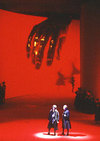
    Nicholas Hytner's staging and Bob Crowley's sets were somewhat baffling. The stage was raked, not steeply, with walls left and right, which had various compartments that would open to be windows or chambers. There were two scrims, one normal and one near the middle which was in two pieces cut diagonally that came together in the middle. These scrims, which I suppose are not technically scrims since they weren't translucent (they were opaque red) served to make the scene changes flawless. The whole stage was red, perhaps the scrims were like valves, and it was meant to be some abstruse symbol of the human heart. This would not explain the huge golden statues of hands, one appearing in Act I Scene 16 when Zerlina sings "Batti, batti, o bel Masetto" and the other in the aforementioned ball scene. We never return to this image in Act II, rendering whatever impact it was to have rather toothless.

    The other major motif was the rood. Four little spirits all in white held crosses and would appear here and there, they were particularly disorienting when they surrounded the Commendatore's body.

    What was most annoying was the finale, they had Don Giovanni gone entirely mad, hair a mess and barefoot, stumbling and drunk, eating his dinner with his hands on the floor. If he is out of his mind, how is his punishment just? Also, having him costumed so almost made him look Christ-like, hair down, in a plain white shirt, and wrapped in a red blanket. This image, though beautiful, makes no sense.

    I must say though, they did a wonderful job with the statue of the Commendatore, the costume was very good and the scene in the graveyard was marvelous. The Commendatore's grave was his likeness on a horse, and this was surprisingly convincing.

    Act II, Scene 15, when the statue comes to dinner was fairly effective. The Commendatore on foot was followed by the Grim Reaper astride a white horse. This could have easily been kitsch, but it worked very well.

    The costumes, also by Bob Crowley, were all in strong colors, mostly black and red, except for statues and spirits. They were typical Rococo, though the principal sopranos all had flame-shaped, zigzagged borders in contrasting fabric at their hems. Masetto's dark green and black costume was particularly reminiscent of Frans Hals.

    As for the singing, it was exceptional. Sopranos Brigitt Hahn and Aga Mikolaj were fine as Donnas Anna and Elvira, respectively. They both had passionate, fiery voices, and I have never heard two sopranos that sounded better together. Julia Rempe was much better as Zerlina than as Blonde in Entführung. Her voice is not full, it has something of an ugly edge, but she sang much better in this, one could actually hear her most of the time, and her intonation was better, perhaps since she didn't have to get that high A all the time as Zerlina. Her voice was definitely distinct from the other two sopranos, which isn't a bad thing.

    Robert Saccà is a solid tenor, his voice was good for Don Ottavio, as it was for Belmonte in Entführung. Bass Maurizio Muraro has a strong voice, good diction, and acting ability to boot. Bass Taras Konoshchenko did not strike me one way or another, he could project better than Rempe. Bass Franz-Josef Selig, on the other hand, was distinctively good as the Commendatore, suitably stately and terrifying.

    Bo Skovhus was incredible in the title role. Not only does he cut a dashing figure as the unrepentant rake, his voice is simply charming, light, and very suitable for the part. I remember him being similarly good as Count Almaviva in Le Nozze at SFO in 1997.

    On a completely personal note, and I commend the reader for getting this far, I left my shawl in the opera house, couldn't find it and was told to wait at the stage entrance for someone to bring it down. This is where all the die-hard opera coots are, waiting for the performers to come out. It was utterly bizarre to see the singers offstage in street clothes, shaking people's hands and autographing programs. I was too bashful to say anything, I just stood there wide-eyed and blushing, no doubt.

    Also, the Balkon (balcony) part of the audience appears to be quieter than the the Ränge (the 3 tiers above the balcony level) or the Parkett (floor).

    Leave a Reply

  • BsocosiIt was asserted to me that Hemingway’s novel Across the River and Into the Trees was less bad than Da Ponte’s libretto to Così fan Tutte. I find it a very bizarre comparison, but find myself unable to judge any opera libretti against actual literature. Voltaire put this best: Anything too stupid to be spoken is sung.

    In the last week, I have seen the Bavarian State Opera’s production of Così fan Tutte twice, on the 16th and the 19th. I’m terribly fond of Mozart’s music, and Così is quite charming. Peter Schneider conducted admirably, as is expected of him, I’ve heard him conduct Mozart before at the SF Opera.

    Dieter Dorn’s set was again a bit given to clean lines, this time reminiscent of Bauhaus furniture. The set consisted of a raised platform covered with a white sheet downstage with six white walls, three on each side of the stage. Various other walls were added for other scenes, and the furnishings were of varnished light wood and not Bauhaus at all. Maybe the metal IKEA chairs from Don Carlo might have been a better match. Upstage was a lowered area with glass doors in the center and an olive tree stage left. There was a curtain towards the downstage area, painted with the same scene, so when they changed the sets they could simply draw the curtain. With eight scene changes but only two acts, this was an effective way of making the transitions smooth.

    Jürgen Rose’s staging was not as nice as his work in Don Carlo. It seemed too artificial at times, having people climb unseen ladders behind the side walls and sing from there or having Dorabella put a chair on a table and climb up on this as she is singing the aria Smanie implacabili che m’agitate. Most irksome was the choreography in Act I Scene 2, when the four principal singers do a pinwheel as Guglielmo and Ferrando take their leave of Fiordiligi and Dorabella and directly after this the Chorus walks on stage singing Bella vita militar falling down just after they sing "Io sparar di schioppi e bombe" (the firing of muskets and bombs). Interestingly, it wasn’t the case that the choreography was too difficult for the singers, the six main characters were played by artists who were very good with movement.

    Rose’s costumes, however, were better. I was dubious about Fiordiligi and Dorabella being in midriff baring undershirts and petticoats until the last scene in Act I, since it seems highly unlikely they would receive Don Alfonso dressed this way. But for the most part, the costumes were fine. Guglielmo and Ferrando in their "Albanian" costumes were very funny, an orientalist nightmare of Middle Eastern and East Asian styles combined that was only acceptable because they are playing Italians playing at being Albanians. The "Albanian" chorus was dressed as if they had raided their linen closets, wearing tablecloths and sheets.

    As for the singers themselves, the cast was quite consistent. The weakest, perhaps, was the tenor Jeremy Ovenden as Ferrando. His voice was just a touch quiet, but I could not detect this from the center of second tier, it was only when I was a bit on the left of the third tier that he seemed quiet. Or it could be that he was having a bad day on Wednesday, it is hard to tell.

    Thomas Allen was better as Don Alfonso than Eisenstein in Die Fledermaus, his bass is better than his baritone, as far as vocal projection is concerned. Baritone Martin Gantner was a charming Guglielmo, his voice was well suited to the part.

    Of the three sopranos, Julie Kaufmann had the warmest and most powerful voice. Her part, Despina, was the easiest vocally though. Sophie Koch played the fickle Dorabella very well, her soprano is dark, and I’m not surprised that she also sings Cherubino in Le Nozze. Amanda Roocroft was an adequate Fiordiligi, her voice is cold but not shrill. Koch and Roocroft both had very pretty voices, and were also quite pretty to look at, perhaps the prettiest two sopranos I’ve seen in an opera for awhile.

    Leave a Reply