• Sfopera-cenerentola-ball-2014Production Web Site | SF Opera's Blog

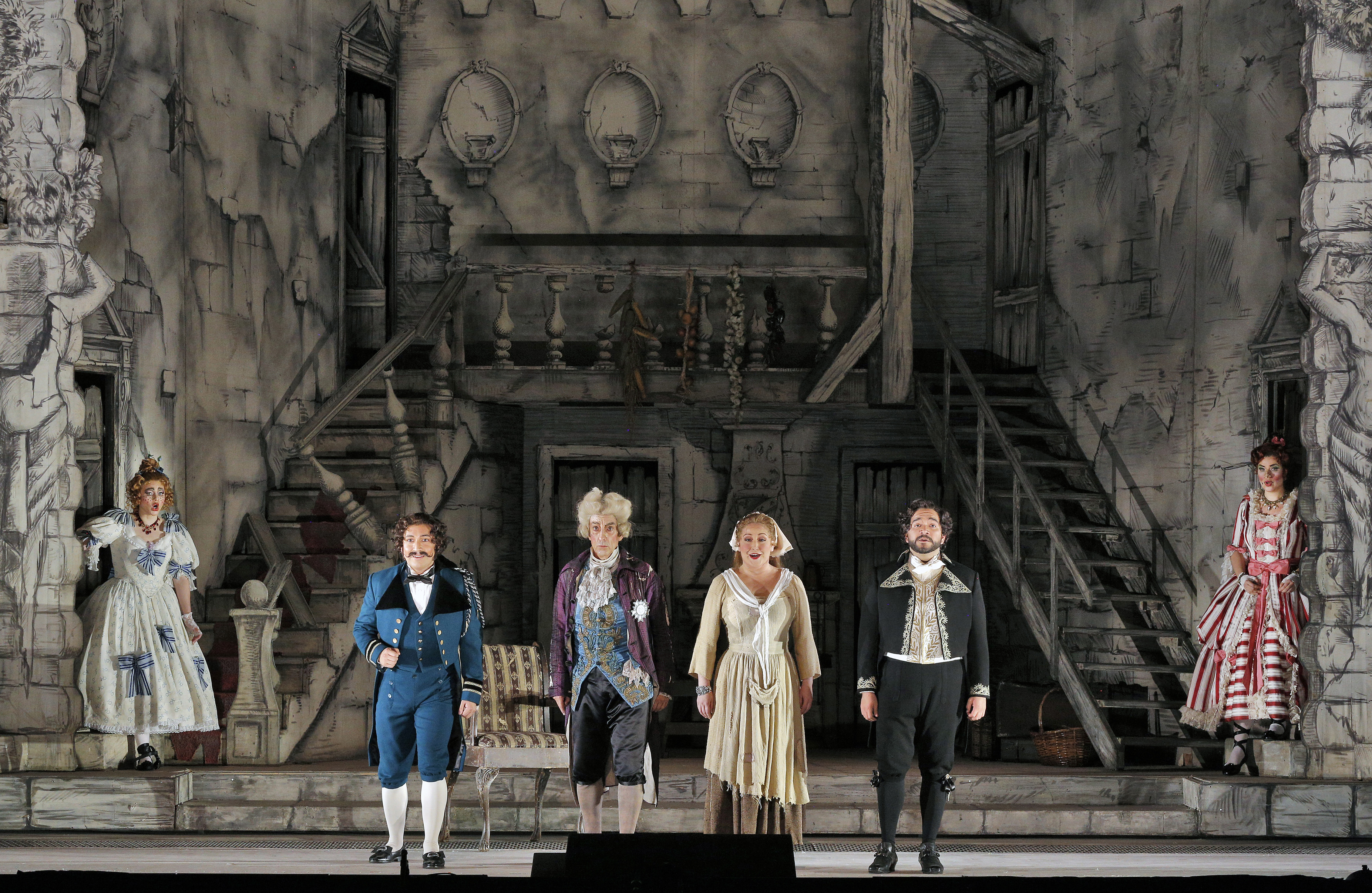
    Reviewers found San Francisco Opera's La Cenerentola (Act I Prince's Ball pictured left, photograph by Cory Weaver) enjoyable.

    Reviews: San Francisco Chronicle | San Francisco Classical Voice | San Jose Mercury News

    Leave a comment

  • MacB_0032a* Notes *
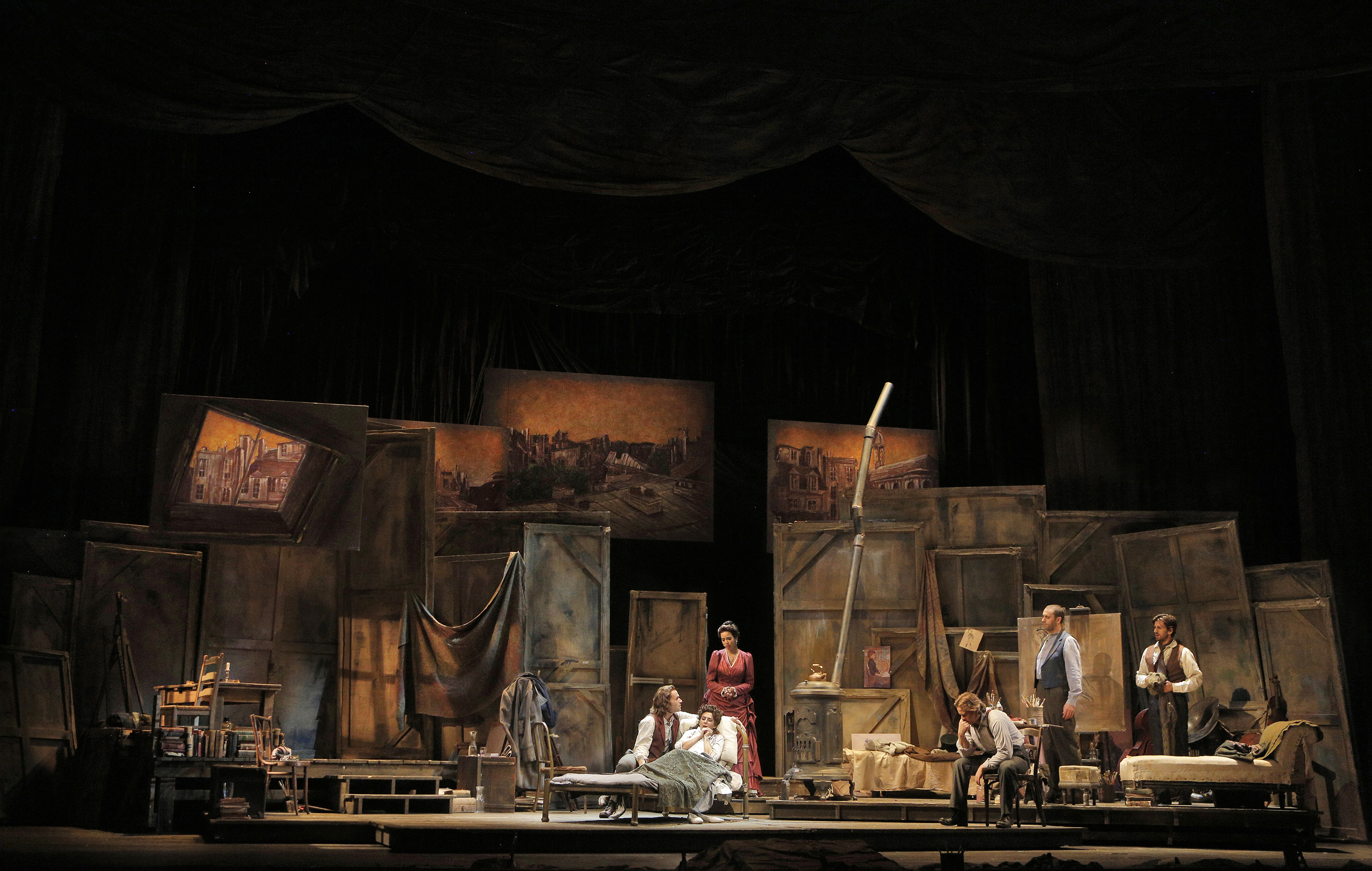
    A revival of Lady Macbeth of Mtsensk opened at the Metropolitan Opera last night. Graham Vick’s 1994 production is humorous and makes quite good use of space, despite being essentially constrained to one room (pictured left, photograph by Ken Howard). Though there was much going on at all times, the staging enhanced the piece, rather than detracting from it. The brides wielding vacuum cleaners in Act I and the disco ball of Act III were particularly entertaining.

    Maestro James Conlon conducted the Met Orchestra to fine effect. The playing was intense yet polished. There were beautiful contributions from the bassoon, English horn, and bass clarinet. The brass sounded imposing. Likewise the chorus sounded together and formidable.

    Soprano Eva-Maria Westbroek is a fiery Katerina Lvovna Ismailov, radiating strength, but able to sound desperate and ultimately despairing. Brandon Jovanovich convinced as Sergei. His voice is both powerful and lovely. Raymond Very’s voice contrasted nicely with Jovanovich’s. His Zinoviy Borisovich Izmailov was bungling without being a complete buffoon. Anatoli Kotscherga made for a sinister Boris Timofeyevich Izmailov, his voice entirely suiting the role.

    * Tattling *
    We sat in a part of the dress circle that was not especially crowded. At least one watch alarm and one mobile telephone rang during the second half of the opera.

    Leave a comment

  • Kling_1463a* Notes * 
    A sixth Metropolitan Opera performance of John Adams' The Death of Klinghoffer (Act II, Scene 2 pictured left, photograph by Ken Howard) was held last Saturday. There were a handful of protesters with signs reading "Shame on Peter Gelb Met Opera" and so forth. The opera itself is not particularly contentious, if anything, it is a mild, mournful piece. The characters are shown as rather human, and of course there was a choice line from Leon Klinghoffer regretting his hatlessness. One imagines that this production might not be as well-attended were it not for the vehemence of the demonstrators.

    The orchestra had a graceful clarity under the baton of David Robertson. The strings were particularly lucid, as were the woodwinds. The Met chorus also sounded strong and cohesive.

    The principal singers all seemed suited to their roles. It was a joy to hear former Adler Fellows Sean Pannikar (Molqi) and Maya Lahyani (Palestinian Woman). Bass-baritone Aubrey Allicock had a strikingly disturbing aria as Mamoud in Act I, Scene 2. Baritone Paulo Szot made for an appropriately conflicted Captain. Baritone Alan Opie (Leon Klinghoffer) sang his finale aria with gravitas. Mezzo-soprano Michaela Martens was poignant as Marilyn Klinghoffer, her voice is rich and full.

    Tom Morris' production makes use of projected text and historical photographs. The text is somewhat burdensome, and the photographs less so. The effect of the bright sun in Act II is haunting. The dancing, choreographed by Arthur Pita, is impressive, especially in the case of Jesse Kovarsky (Omar).

    * Tattling * 
    I repeatedly hushed the woman behind me in Family Circle, as she spoke during the quietest parts of the music at the beginning of Act I. She informed me that she was reading the projected text that she could see to the two blind women she was with, and I sheepishly apologized at intermission.

    I moved down to the right side of the last row of the Grand Tier to sit with some friends. A young composer seated near us may have spoken quite a lot during the music, but it was difficult muster annoyance at this, having already been so mortified by my own previous behavior.

    Leave a comment

  • Brian Asawa010Brian Asawa (pictured left) recently released a recording entitled “Spirits of the Air” with mezzo-soprano Diana Tash. The Merola Program is hosting a CD release celebration on November 7, 2014, honoring both singers, who are to attend and be interviewed.

    How did you get your start in opera and how did you discover that you were a countertenor?
    I was always very interested in music. I took piano lessons on and off since the age of 5. I sang in my elementary school chorus. In junior high school I took up cello and played in the junior high school orchestra. In high school I took up trombone and played in the award winning jazz band and award winning marching band at Venice High School in Los Angeles.

    I attended UC Santa Cruz as a piano major, but my passion was singing. I sang in both the Chamber Singers and Concert Choir. My choral director and mentor gave me my first solo as a countertenor after I discovered my strong falsetto voice. I transferred to UCLA and focused entirely on my countertenor voice, graduated with a BA, then began a Master’s degree at USC in Early Music, but left the program when I won the Met Auditions to start my career. The Met win was followed with my life changing participation in San Francisco Opera Center’s Merola and Adler Fellowship programs, which provided me with musical, language, movement coachings, as well as performance opportunities that I never could have found elsewhere.

    Regarding my early stages in opera, my first mentor was John Hall, the opera workshop director at UCLA. I performed in several productions there. At USC, I studied Baroque opera and performed arias with lutenist and early music specialist James Tyler and his Early Music Ensemble.

    The first time I heard you sing was in Bayerische Staatsoper‘s Saul because David Daniels was indisposed. Does this sort of thing happen often as there are relatively few countertenors?
    Countertenors used to be few and far between, especially in the United States, but now they is more supply of countertenors than demand. Countertenors like Jeffrey Gall, Derek Lee Ragin, Drew Minter, and myself brought the vocal category to the forefront in the US in the late 80’s early 90’s.

    Regarding singers that are sick and unable to perform and replaced, it happens all the time. This is why singers in Europe are at such a huge advantage over American singers. Most European travel times are a two-hour flight or less. Jumping in for ailing singers is very common, especially in the winter.

    I was at the right place at the right time. I just happened to be in Germany doing a concert tour in Baroque pitch of Handel’s Saul, the last show in Wuppertal, when I got a call from my manager, saying I wasn’t flying home to SF, but rather going to Munich to step in for David Daniels, who was ailing from bronchitis. There was no time to learn the staging, but I was able to quickly learn an aria which was cut from the concert tour version, and I had to sing the whole role up a half step.

    It was crazy! I sang the part on the side of the stage, and the stage manager acted the part on stage. This is the best we could do. Singers are not robots. We get sick too, and the intelligent singers cancel, and the not so intelligent go on, and sometimes to catastrophic results. We don’t have the luxury and assurance of pulling out our instruments from cases, or just opening a lid. No matter what instrumentalists say, they don’t have the same stress that singers do. Many pianists or violinists have gone on with colds and even the flu because they can unless they are deathly ill. I have had numerous arguments with instrumentalists about this topic, but their instruments are not living in their throats.

    Your repertoire includes many Händel operas, but you have also worked with contemporary composers such as Peter Eötvös and Daron Hagen. How do these roles compare?
    Certainly the technical demands of contemporary opera are much different than Baroque opera. And more specifically, each role within Baroque and contemporary works presents different technical challenges. I found the roles of my lifetime in Peter Eotvös’ Tri Sestri (The Three Sisters) as Masha, and in Georg Ligeti’s Le Grand Macabre as Prince Go-Go.

    Baroque opera is more exposed and technically challenging with fast coloratura arias, as well as slow, legato arias, often with long lines, requiring endless breath support. Contemporary opera often requires more vocal colors and heft, and the ability to count!

    How was singing it working with West Edge Opera on Hagen’s Vera of Las Vegas?
    It was great fun. A professional drag artist was hired to teach me how to walk in high heels, and move like a drag performer. The make-up and wig alone took about 90 minutes to apply. Technically it was challenging to sing, because the role was written for a male soprano, and since I am a male alto, the aria was transposed a minor third down, making the role feel like there were two different tessituras.

    How did the CD Spirits of the Air come together?
    My duet partner Diana Tash and I met in Los Angeles Opera‘s 1995 production of Handel’s Xerxes. We performed together at San Diego Opera in 2005 and were in different productions there the following season. I invited Diana to join me in a few benefit recitals for my church. We then performed in a duo recital at the Colburn School of Music in 2011. Subsequently we decided to do an all Baroque program, which we performed in San Francisco, Los Angeles, and Guadalajara. We recorded this with our continuo team and released it this month on LML Music.

    What are your favorite operas?
    My favorite operas are Elektra (I saw Gwyneth Jones in the title role blow the roof off of SF Opera in 1991), Xerxes, Giulio Cesare, Mitridate, Ascanio in Alba, Madama Butterfly, and L’incoronazione di Poppea.

    Who do you look up to as far as musicians are concerned?
    A partial list of singers that I admire are Mirella Freni, Leontyne Price, Pavarotti, Edita Gruberova, Carol Vaness, Domingo, Emma Kirkby, Lorraine Hunt Lieberson, Janet Baker, Marilyn Horne, Natalie Dessay, Jennifer Larmore, Jochen Kowalski, Reneè Fleming, Cecilia Bartoli, John Tomlinson, and Joyce di Donato.

    As for conductors, I admire Sir Colin Davis, Sir Neville Marriner, Esa Pekka Salonen, Emmanuelle Häim, Ivor Bolton, and Gustav Dudamel.

    We in the Bay Area were so sorry to lose your aunt Ruth Asawa, the amazing sculptor and arts education activist last year. Was she an influence for you?
    She was such a generous woman. When I was young, we used to come up and visit her from LA, and she would keep us entertained with all kinds of arts and crafts activities, trips to museums, and even a lecture with Buckminister Fuller, a close friend of hers. She always was so gracious and showed such humility with regard to her gifts as an artist. When I started performing in my later years, she was so supportive and always came to my performances. She even came all the way to Mexico City for the Domingo Competition.

    What are the challenges for opera singers in our age of social media and live high definition broadcasts?
    With social media everything is instant. When people attend performances, they are tweeting and Facebooking at the intermissions about how everyone is singing, who the standouts are, how the conductor is conducting, how the orchestra sounds, and what the production is like. I have to say, it is refreshing that the audience has to put their devices away for classical performances! We are so attached and addicted to our phones, laptops, tablets that it’s nice to see a forced break imposed, if even for a few hours.

    I must say there are more benefits to the arts rather than challenges with regard to social media and the advancements of technology. Performances of operas and concerts are reaching so many more people than ever before through hi def performances. Musicians are now able to promote and publicize themselves so much more effectively than before the advent of social media. Luckily, there are very few incidences of cyberbullying amongst musicians. Most musicians seem very supportive of one another on social media. Sometimes fans can play favorites or be unnecessarily rude or critical, but one takes the good and ignores the bad.

    Do you have a theory on why some many opera fans are also baseball fans?
    It seems like opera fans are into many different types of sports. I personally love watching tennis and gymnastics, women’s volleyball, and cheerleading. However, I know a lot of SF Opera chorus members who are completely obsessed with the SF Giants. On the topic of baseball, my father used to take me to LA Dodger games when I was a kid. I was probably more into the spectacle of being there, the chanting and singing, the Dodger dogs, and ice cream than the actual game!

    Leave a comment

  • Solis-headshotEfraín Solís (pictured left) will sing Dandini in San Francisco Opera's Cenerentola, which runs from November 9 to 26, 2014. He replaces Fabio Capitanucci, who has withdrawn for health reasons.

    Production Web Site | Press Release

    Leave a comment

  • La-opera-dido-2014* Notes * 
    Los Angeles Opera presented a double bill of Dido and Aeneas (Paula Murrihy and Liam Bonner in the title roles pictured left, photograph by Craig Matthew) and Bluebeard’s Castle last night. The juxtaposition of these two works is pleasantly odd. Conducted by Steven Sloane, the orchestra could have sounded slightly crisper in the first piece, but the lushness of playing for the second piece suited its atmospheric score.

    Director Barrie Kosky’s production is from Frankfurt Opera, and certainly looks it. The set is attractively minimal, a pleated wall and long bench rather far downstage for the Purcell, and a rotating slanted circular platform for the Bartók. The use of lighting and choreography rather than video projections is welcome.

    Kosky certainly did not lack for ideas, though some were unsettling, especially in the first offering. Countertenors are employed as the Sorceress and Witches, and it is disconcerting that all three happen to be bearded African American men in unflattering gowns, while the protagonist is a trim, blond white woman. Dido stayed on stage for the last chorus and gasped as all the singers and orchestra members left the pit one by one. This is, of course, opposed to the text of Dido’s last aria but certainly commands attention.

    The singing for Dido and Aeneas was good. The chorus sounded sprightly. G. Thomas Allen (First Witch) sounded warm. John Holiday’s countertenor is also rather resonant, and he made for a disturbing Sorceress. Kateryna Kasper sang Belinda with much clarity. Liam Bonner was a prettily reedy Aeneas. Paula Murrihy sang Dido with conviction. Her voice is lucid and beautiful.

    The staging of Bluebeard is a similar mixture of concrete and abstract depictions. We see blood, tears, gold, and foliage, all referred to in the libretto. There are not, however, any actual doors. Instead three identically suited men show up at different points and all sorts of theatrics ensue. It is impressive how much glitter pours from one man’s sleeves for the third door. All three men drip water from their jackets as a representation of the lake of tears behind the sixth door. All rather imaginative, but the movements for the two principals required a great deal of physicality, and seemed a lot to ask for as the piece has serious vocal demands as well.

    Robert Hayward was a plaintive Bluebeard. There were brief moments when he was difficult to hear given the volume of the orchestra and how he was facing as the stage turned. Claudia Mahnke makes for a sympathetic Judith. Her voice is strong and piercing without being harsh.

    * Tattling * 
    I was shamefully late for the performance, but was seated during “Ah! Belinda, I am prest with torment.”

    Leave a comment

  • Sf-opera-tosca-actiii1-2014* Notes * 
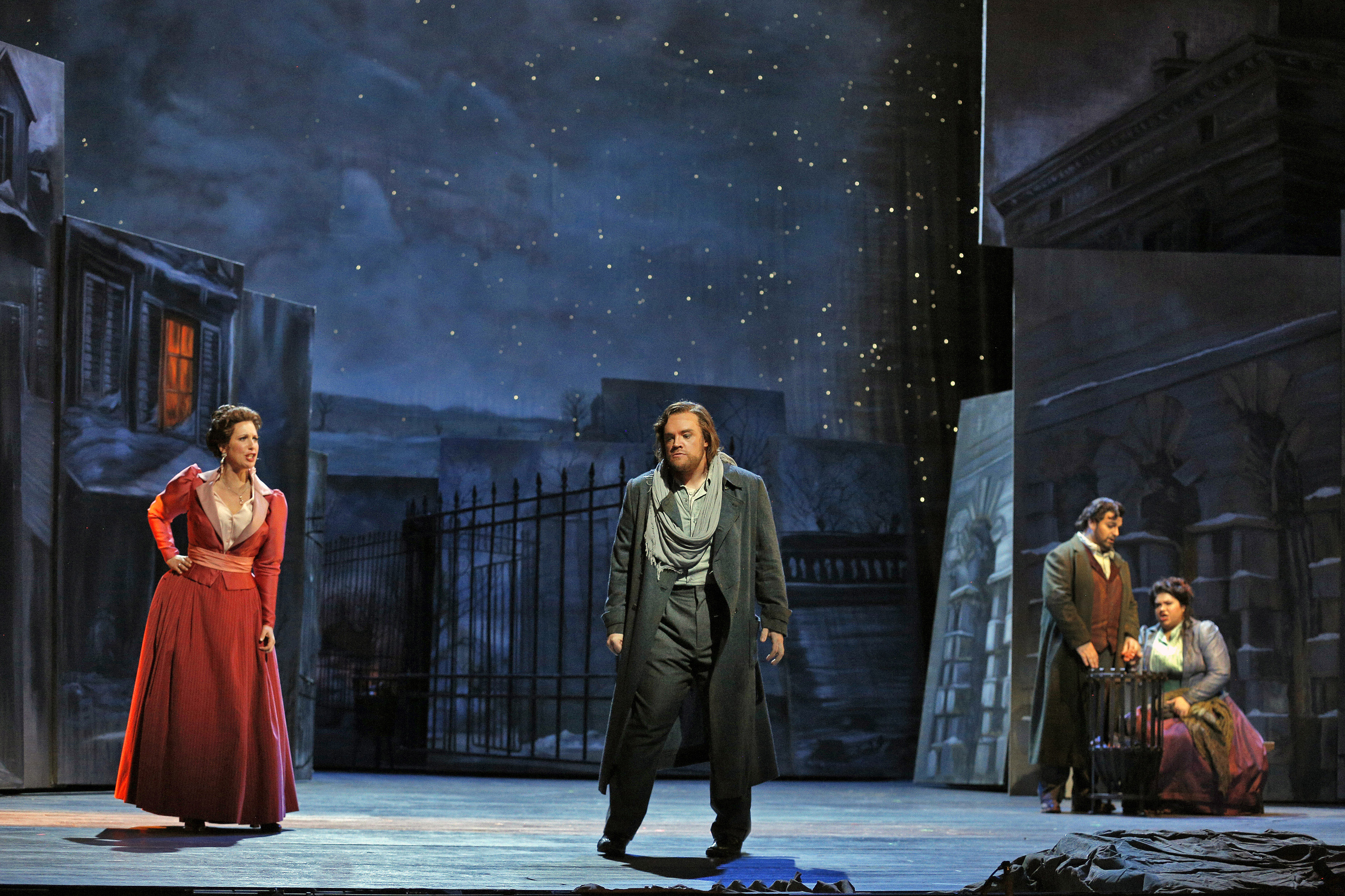
    Another revival of Tosca (Brian Jagde as Cavaradossi and Mark Delavan as Scarpia in Act III pictured left, photograph by Cory Weaver) opened last night at San Francisco Opera. Lianna Haroutounian had a fine debut on the War Memorial stage as Floria Tosca. She clearly has an emotional connection to the role and this was palpable even from the very back of the house. Her singing is passionate and her voice has strength yet can be sweet. Cavaradossi suits Brian Jagde, and his gleaming voice was a good match for Haroutounian. On the other hand, Mark Delavan seemed somewhat shaky, especially at first. His Scarpia is certainly gritty and cruel.

    The rest of the cast was quite good. Dale Travis is always funny as the Sacristan and Joel Sorensen mincing yet threatening as Spoletta. Adlers Efraín Solís (Sciarrone) and Hadleigh Adams (Jailer) also sang well.

    Riccardo Frizza conducted a rapid orchestra that had a lovely transparency of sound. The clarinets and bassoons were particularly wonderful in Act II. The harp sounded clear throughout the performance, as did the strings.

    The opera house seemed full and the audience was enthused. This time-honored production, directed by Jose Maria Condemi, is a crowd-pleaser.

    * Tattling * 
    The audience was mostly quiet, but there was a man in the back of the balcony who had to make sure the people around him knew to pay attention to "Vissi d'arte" and "E lucevan le stelle."

    Leave a comment

  • 051014
    Julie warns Magnolia that it is not easy to stop loving someone in Act I, Scene 2 of Show Boat. Queenie, Joe, and some members of the chorus join in on the song.

    Details of Painting | Performance Review of Show Boat

    Leave a comment

  • Sf-opera-partenope-actiii-2014Production Web Site | SF Opera's Blog

    Reviewers found San Francisco Opera's Partenope (Act III pictured left, photograph by Cory Weaver) delightful.

    Reviews: San Francisco Chronicle | San Francisco Classical Voice | San Francisco Examiner | San Jose Mercury News

    Leave a comment

  •  Sfopera-partenope-acti-2014* Notes * 
    Christopher Alden’s delightfully humorous production of Partenope opened at San Francisco Opera last night. The stylish set (Act I pictured left, photograph by Cory Weaver), designed by Andrew Lieberman, was enhanced by Adam Silverman’s lighting. Costume designer Jon Morrell did a wonderful job evoking 1920s Paris and Man Ray. The staging matches the absurdity of the plot rather well, embracing silliness with use of bananas, dancing, and hand shadow puppetry. It was refreshing to see something a little less sedate than the other offerings of the 2014-2015 season so far.

    The reduced orchestra of only 39 musicians sounded fresh and vital under Maestro Julian Wachner. The horns had a rough start but in the end managed to sound sublime. The continuo was played beautifully by the conductor and Peter Grunberg on harpsichord, cellist David Kadarauch, and theorbist Michael Leopold.

    The most of the singers employed much physicality in their performances. Philippe Sly danced foppishly and sang with warm effortlessness. His outrageous costume in Act III involved a puffy pink flowered gown, red evening gloves, and a Pickelhaube festooned with bananas. Anthony Roth Costanzo was an endearing Armindo who managed to sing his first aria (“Voglio dire al mio tesoro”) while falling down or hanging on to stairs. He also tap danced during “Ma quai note di mesti lamenti” in Act III. The clarity of his voice came through despite all these antics.  Alek Shrader’s tenor sounded robust, and as Emilio he put on a hand puppet show that was amusing and engaging.

    * Tattling * 
    Our neighbors in Box I introduced themselves and shared a chocolate strawberry with us. There was a confrontation between a man at the back of Box H with a woman who showed up in the middle of Act II. He suggested that she did not have a ticket for Seat 4 and mentioned she had not been there for the first third of the performance.

    Leave a comment