• Show-Boat-Chicago-Lyric-Morris-Robinson

    * Notes *
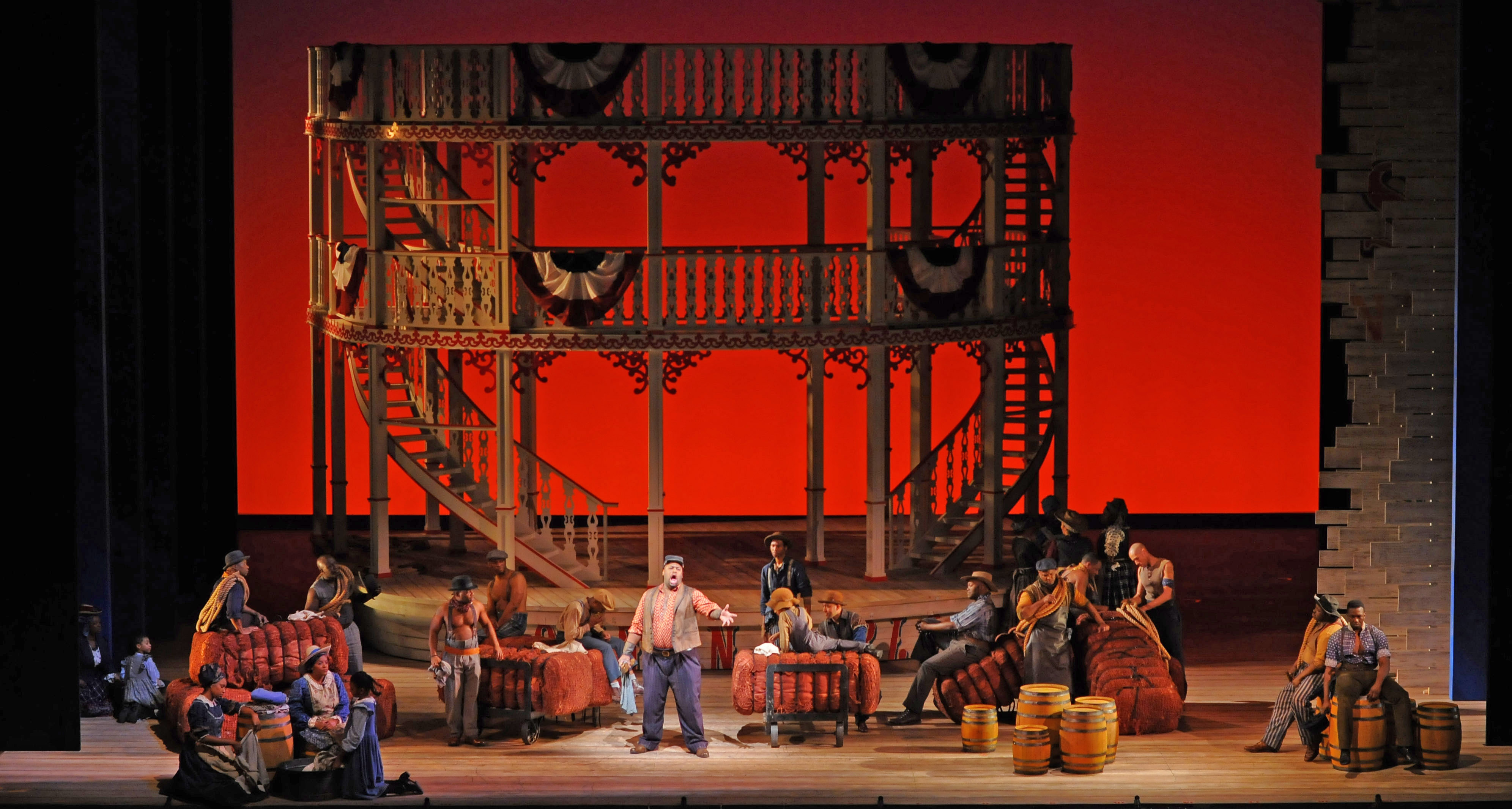
    A new production of Show Boat (Act I, Scene 1 pictured left, photograph by Robert Kusel/Lyric Opera of Chicago) opened at Lyric Opera of Chicago last month. The Friday matinée performance was an utter delight from top to bottom. Director Francesca Zambello is at her best in this co-production with Lyric, San Francisco Opera, Washington National Opera, and Houston Grand Opera. The humanity of the characters is clear and compelling. Peter J. Davison’s set is not overly ornate, move cleanly, and work well with Mark McCullough’s characteristically elegant lighting. The costumes, by Paul Tazewell, often make use of a pleasing contrast of red, white, and turquoise. The dancing, choreographed by Michele Lynch, is charming.

    The straightforward music sounded effortless as far as the orchestra was concerned, conducted here by John DeMain. The chorus was robust, as were the principals. Cindy Gold and Ross Lehman were entertaining as Parthy and Captain Andy. Alyson Cambridge made for a striking Julie, with her incisive, but never shrill voice. Angela Renée Simpson sang Queenie with beauty and feeling. Morris Robinson was most impressive as Joe, his music is perhaps the most famous in this particular work, and he sang “Ol’ Man River” with warmth and beauty. Ashley Brown was an adorable Magnolia, she chirped sweetly. Nathan Gunn turned out a believable Ravenal, the lightness of his voice having an appeal in this role.

    * Tattling *
    The house was full of seniors and children, which meant there were watch alarms at the hours and a lot of fidgeting. The family in Upper Balcony Row Q Seats 10-16 could not stay still, one of the sons kept running across the aisle and the other would occasionally stand up as he was unable to see the stage from his seat.
    Leave a Reply

  • Meet-the-adlers-2012

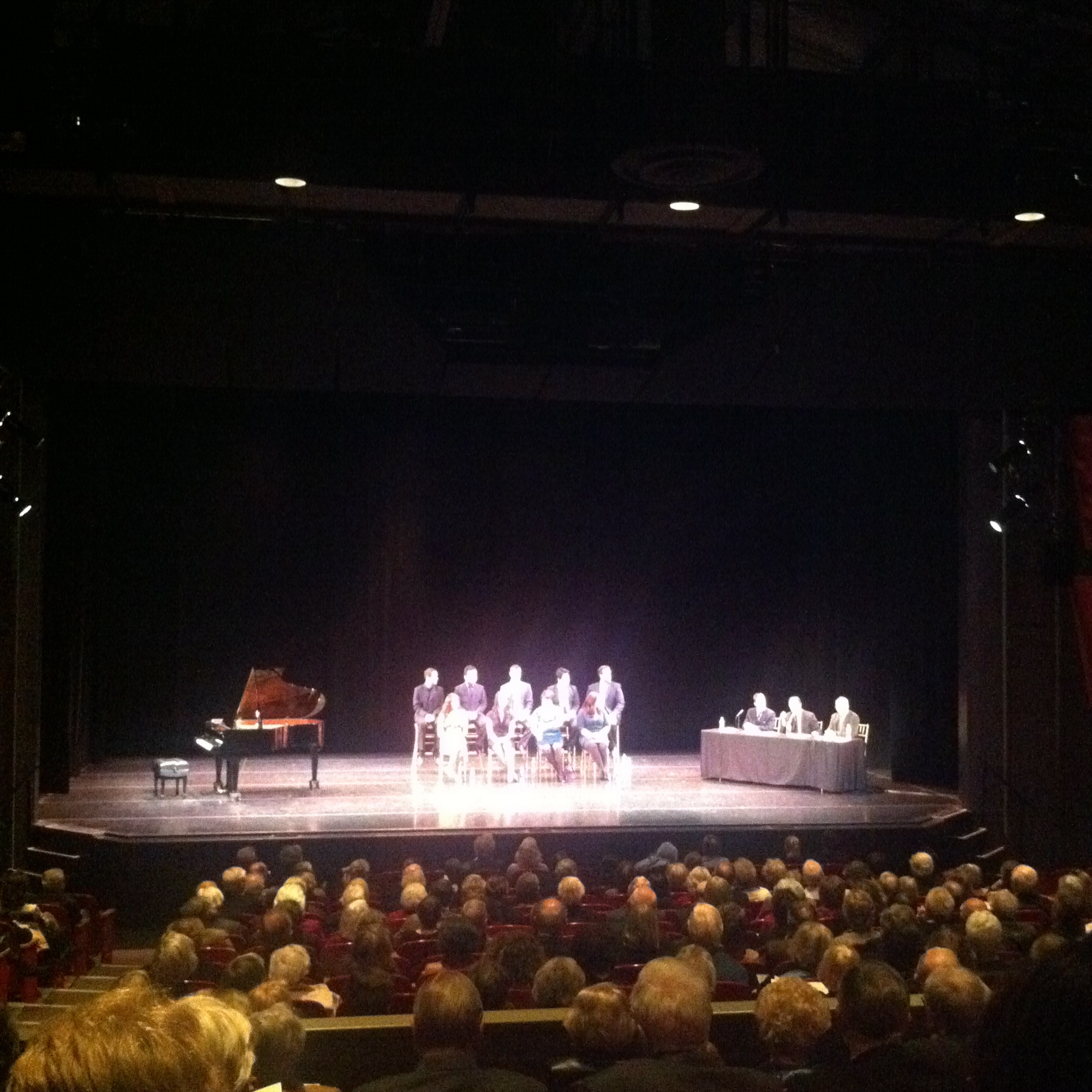
    Last night, nine of ten Adler Fellows for 2012 were interviewed by Director of Music Administration Kip Cranna, San Francisco Opera Center Director of Musical Studies Mark Morash, and Director of Artistic Adminstration Gregory Henkel, at Cowell Theater at Fort Mason. We learnt that pianist and apprentice coach David Hanlon was off to Houston to music direct HGOco‘s The Bricklayer, a more than valid excuse for missing this event. The other apprentice coach, Robert Mollicone, aspires to conduct.

    Marina Boudart Harris has only been singing soprano for twenty months. Nadine Sierra was somewhat ill, but earlier this year had sung Gilda in Florida Grand Opera’s production of Rigoletto to great acclaim. Renée Rapier had her professional debut late last year at LA Opera’s Roméo et Juliette when the person whom she was covering withdrew from the production. She is to cover Joyce DiDonato in I Capuleti e i Montecchi this fall. Laura Krumm just covered DiDonato in Jake Heggie’s song cycle about Camille Claudel. Krumm also sings in Love/Hate at ODC this April. Joo Won Kang is a baseball fan. Brian Jadge was covering Don José in French, whilst singing it in English in Carmen for Families. Ryan Kuster is to singing three roles from Don Giovanni in two months at LA Phil and WolfTrap. Ao Li relates to the title character of Le Nozze di Figaro because he is “smart.” Li delivered some of the English dialogue of Carmen for Families, and it was rather hilarious. 

    The interviews were interspersed with selections from Così fan tutte, Les pêcheurs de perles, Mignon, and Don Carlo. Mollicone gamely accompanied all of the pieces. “È lui! desso, l’infante…Dio, che nell’alma infondere” with Jadge, Li, and Kang was perhaps most impressive.

    Leave a Reply

  • Today Lyric Opera announced the world premiere of Bel Canto, by composer Jimmy López and librettist Nilo Cruz. The work is based on the novel by Ann Patchett will be performed in the 2015-16 season. The conductor will be Sir Andrew Davis and the director Stephen Wadsworth. The opera has been commissioned as part of Lyric's Renée Fleming Initiative.

    Press Release | Official Site

    Leave a Reply

  • 12_Orpheus_eb_140

    * Notes * 
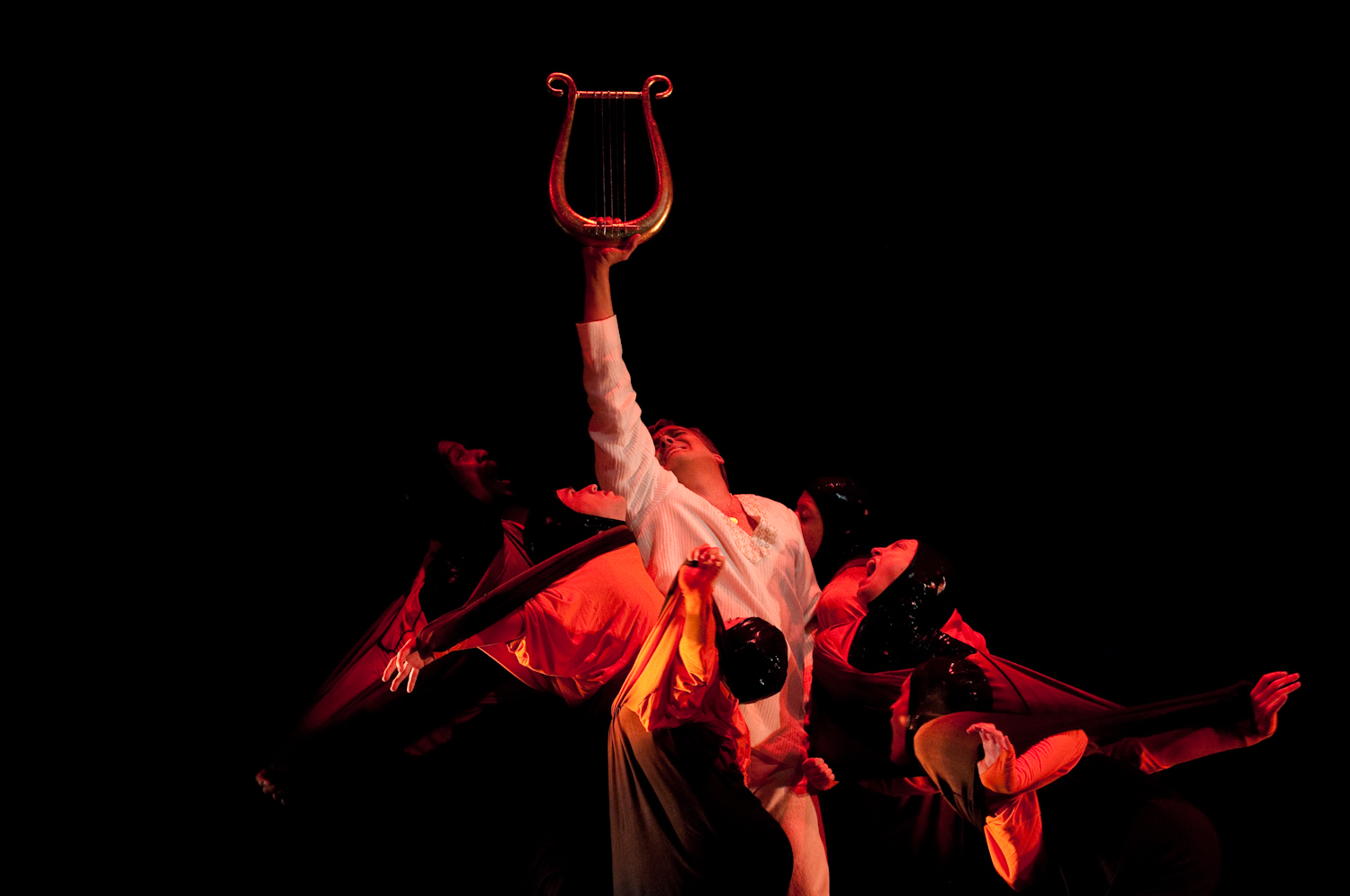
    Orphée et Eurydice (William Burden as Orphée with the Furies pictured left, photograph by Elise Bakketun) opened at Seattle Opera on last night. Jose Maria Condemi's production provided a series of entertaining moments that did not quite cohere, but did not get in the way of the music. Phillip Lienau's set is clean, and the scene changes were smooth and quiet, enhanced by Connie Yun's lighting. The costumes, from Heidi Zamora, had a loose, relaxed look. Yannis Adoniou's choreography was dull, for example, the first ballet consisted of three dancers falling to the floor in unison and the third one was a pantomime foreshadowing the plot. The second ballet was silliest, the 7 dancers were Furies who drew their shirts over their heads. It seemed an untoward combination of Martha Graham's Lamentation (1930) and Merce Cunningham's Antic Meet (1958).

    Conductor Gary Thor Wedow kept the orchestra moving, occasionally a bit a head of the singers. There were 2 or 3 minor intonation errors, but for the most part the orchestra had a nice, clear sound. The chorus sang well.

    The principals were uniformly strong. Julianne Gearhart looked like she was on her way to Black Rock City as an Amore outfitted with pink ruffles, fairy wings, tall shiny boots, and a glittering cruiser. Her voice has a breathless, girlish quality to it. Davinia Rodríguez's voice is more piercing, and her Eurydice was convincing. Rodríguez pushed a little hard on some of the high notes at the beginning of Act II, Scene 2, but otherwise sounded fine. William Burden made for an incredible Orphée. His voice is sweet and bright, and his singing was quite moving. His "J'ai perdu mon Eurydice" was exquisite.

    * Tattling * 
    Someone unwrapped something in cellophane during the overture. There was some whispering, particularly when no one was singing. No electronic noise was noted. I laughed a great deal during the second ballet, and tried to keep this as silent as possible.

    Leave a Reply

  • September 24 2012- February 8 2013: L'Elisir d'Amore
    September 26 2012- January 10 2013: Turandot
    September 28 2012- March 1 2013: Carmen
    September 29 2012- January 24 2013: Il Trovatore
    October 9 2012- March 30 2013: Otello
    October 23- November 17 2012: The Tempest
    October 29- November 17 2012: Le Nozze di Figaro
    November 8- December 14 2012: Un Ballo in Maschera
    November 16- December 10 2012: La Clemenza di Tito
    November 23- December 28 2012: Aida
    November 28- December 20 2012: Don Giovanni
    December 13 2012- January 5 2013: Les Troyens
    December 18 2012- January 5 2013: The Barber of Seville
    December 31 2012- January 26 2013: Maria Stuarda
    January 11-26 2013: La Rondine
    January 17- February 5 2013: Le Comte Ory
    January 28- May 1 2013: Rigoletto
    February 15- March 8 2013: Parsifal
    February 22- March 16 2013: Don Carlo
    March 4-22 2013: Francesca di Rimini
    March 14- April 6 2013: La Traviata
    March 21- April 5 2013: Faust
    April 4- May 10 2013: Giulio Cesare
    April 6- May 4 2013: Das Rheingold
    April 13- May 6 2013: Die Walküre
    April 20- May 8 2013: Siegfried
    April 23- May 11 2013: Götterdämmerung
    May 4-11 2013: Dialogues des Carmélites

    The Met announced the 2012-2013 season today. The 7 new productions are L'Elisir d'Amore, Thomas Adès' The Tempest, Un Ballo in Maschera, Maria Stuarda, Rigoletto, Parsifal, and Giulio Cesare.

    Online 2012-2013 Brochure | Official Site

    Leave a Reply

  • Simon-boccanegra-la-opera

    * Notes *
    The third performance of Simon Boccanegra (Act I Scene 2 pictured left, photograph by Robert Millard) at Los Angeles Opera on Sunday was quite good. The production originates from the Royal Opera House, Covent Garden, and is directed here by Elijah Moshinsky. Michael Yeargan's set is sleek, and Duane Schuler's lighting did help frame the many scenes. The late Peter J. Hall's costumes are lavish and are a fine counterpoint for the relative simplicity of set.

    The tempi taken by Maestro James Conlon were brisk, and occasionally the orchestra seemed somewhat rushed. The brass was fairly clean, there were no obvious sour notes. The chorus was not always right on top of the beat, but sang with passion.

    The singing was solid. Stefano Secco (Gabriele) was uncharacteristically fervent, perhaps being broadcast live and sharing the stage with Plácido Domingo (Simon Boccanegra) brought out the best in the former. Domingo sounded rather like a tenor in the title role, his voice is, of course, just so resonant and beautiful. Some of his lower notes were not particularly rich. Ana María Martínez made for an ethereal yet girlish Amelia. Paolo Gavanelli made for a convincing Paolo, his voice is sumptuous. Vitalij Kowaljow (Fiesco) also has a weighty sound, and seems bottomless.

    * Tattling * 
    Watch alarms were heard at 3pm and 5 pm. A mobile phone rang in the middle of Act II from the Loge. The audience talked during the scene changes. A woman in Row E Seat 53 was especially loud, commenting that Domingo sounded "the same" as he always does as he was singing, and making other accurate but unhelpful comments to her husband in 54 and friend in 55.

    During a pause, this friend mentioned that "in San Francisco we would have had five intermissions already" and that concessions must generate much income for that opera. An odd statement, given that this production has been performed in San Francisco twice (in 2001 and 2008), both times in two acts with one intermission. One will also note that Patina provides food and beverage for LA Opera and SF Opera.

    Leave a Reply

  • Jay-hunter-morris-moby-dick-au

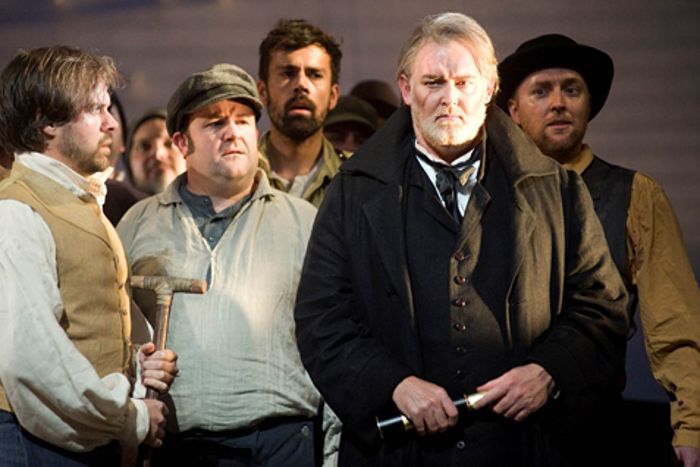
    Jay Hunter Morris (pictured left in the State Opera of South Australia's production of Moby-Dick) will replace Ben Heppner as Captain Ahab in the San Diego Opera's Moby-Dick on Tuesday, February 21, 2012. Heppner is ill. Morris had been originally scheduled for the San Diego performances, but withdrew to sing Siegfried in the Metropolitan Opera's Götterdämmerung last month.

    Moby-Dick at San Diego Opera | San Diego Opera's Press Releases

    Leave a Reply

  • Moby-dick-san-diego-opera

    * Notes * 
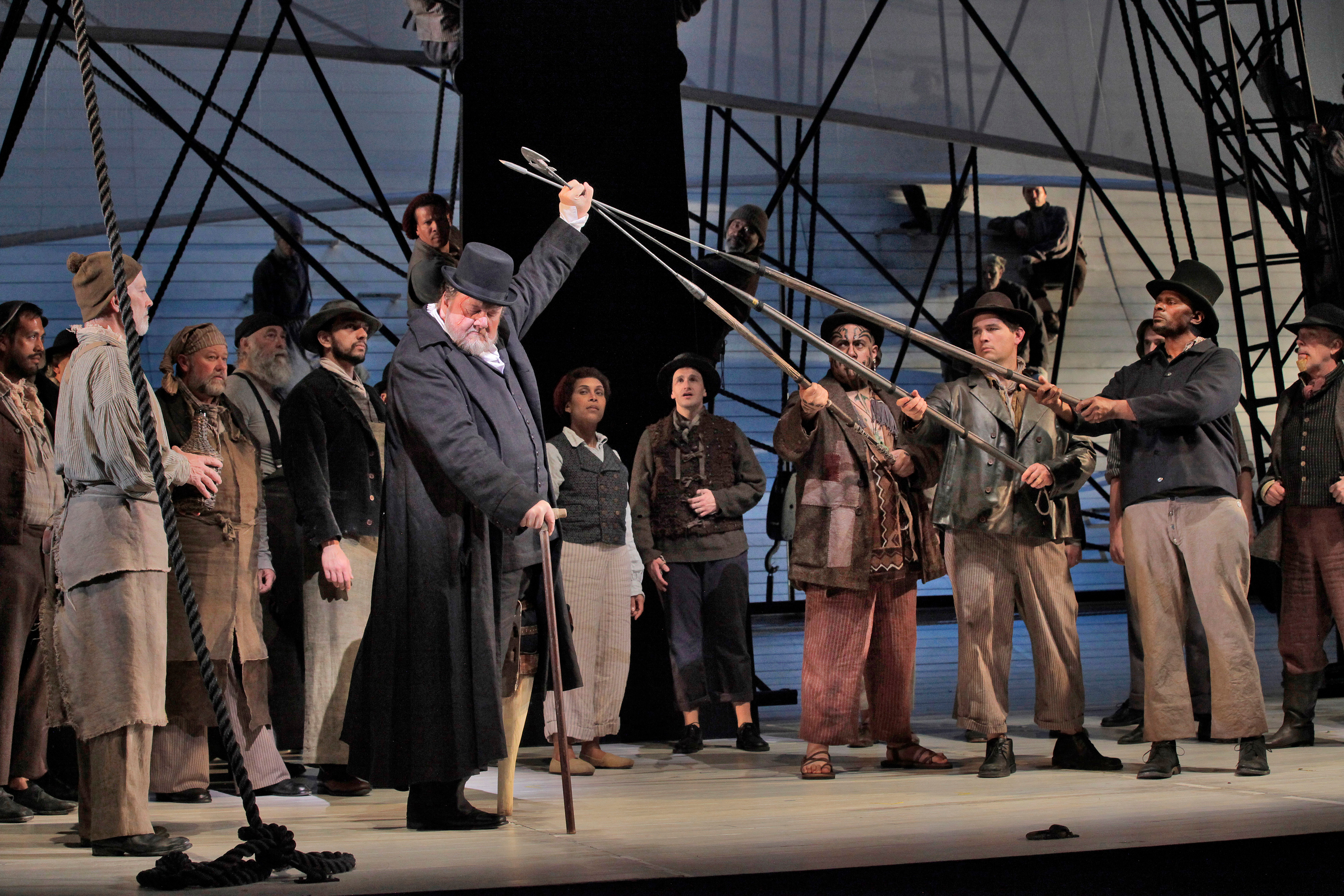
    The West Coast premiere of Jake Heggie‘s Moby-Dick (Act I pictured left, photograph by Ken Howard) was given by San Diego Opera last night. This production was first seen two years ago at Dallas Opera, and has also had runs at the State Opera of South Australia in Adelaide and Calgary Opera. The opening performance in San Diego was impressive. Gene Scheer‘s libretto is paced well, skillfully arranged and rather more spare than Melville’s novel. Heggie’s music is also adroit, the ensembles and choruses sounded particularly lovely. Robert Brill’s sets are cleverly enhanced by lighting designed by Donald Holder (revived here by Gavin Swift) and projections designed by Elaine J. McCarthy (revived here by Shawn Boyle). Only a couple of the visuals were awkward, specifically the flying harpoon ropes and splintering whale boats. However, director Leonard Foglia pulled together this opera as a coherent, vital work, without being mawkish.

    The orchestra was lead by Joseph Mechavich, who also conducted this opera in Calgary. The 63 musicians crowded in the pit produced a lot of sound, occasionally overwhelming the singers. The chorus seemed at ease with the music, and the dancing in the second half of Act I was surprisingly good. The rest of the singing was likewise fine, Robert Orth (Stubb) had a hearty duet in Act I with Talise Trevigne (Pip). Trevigne’s subsequent aria when lost at sea was splendid and as the highest voice in the opera, was both striking and haunting. Jonathan Boyd was the wide-eyed Greenhorn, he seemed momentarily strained in the beginning of Act I, but sang nicely for the rest of the evening. Jonathan Lemalu sang Queequeg with a certain dry quality, his duets with Boyd were balanced. Morgan Smith portrayed Starbuck beautifully, with sensitivity and humaneness. Ben Heppner made a grimly determined Captain Ahab, the effort in his voice seemed tangible, which was effective for this role.

    * Tattling * 
    A cellular phone rang on the right side of the orchestra level during Act I. There was a lot of talking between a child in Row P Seat 46 and her guardian in Seat 44, but they were silent after being hushed. The child must have switched seats with someone, as she did not return for the second half. There was also much talking during Pip’s aria in Act I from the couple in Row N Seats 42 and 44, rather unfortunate given how beautiful it was, and how lightly orchestrated.

    Leave a Reply

  • Merola-behind-the-scenes-2012

    * Program *
    Rachmaninoff’s Prelude Op. 23 No. 5
    Robert Mollicone, piano

    Richard Rodgers’ “My Funny Valentine”
    David Hanlon, piano

    The end of Act I Scene 2 from Dead Man Walking
    Laura Krumm, mezzo-soprano and David Hanlon, piano

    “Il core vi dono” from Così fan tutte
    Laura Krumm, mezzo-soprano, Ao Li, baritone, and Robert Mollicone, piano

    “Avant de quitter ces lieux” from Faust
    Ao Li, baritone and Robert Mollicone, piano

    David Hanlon’s “Bang Kiss Kiss Bang”
    Robert Mollicone and David Hanlon, piano

    * Notes *
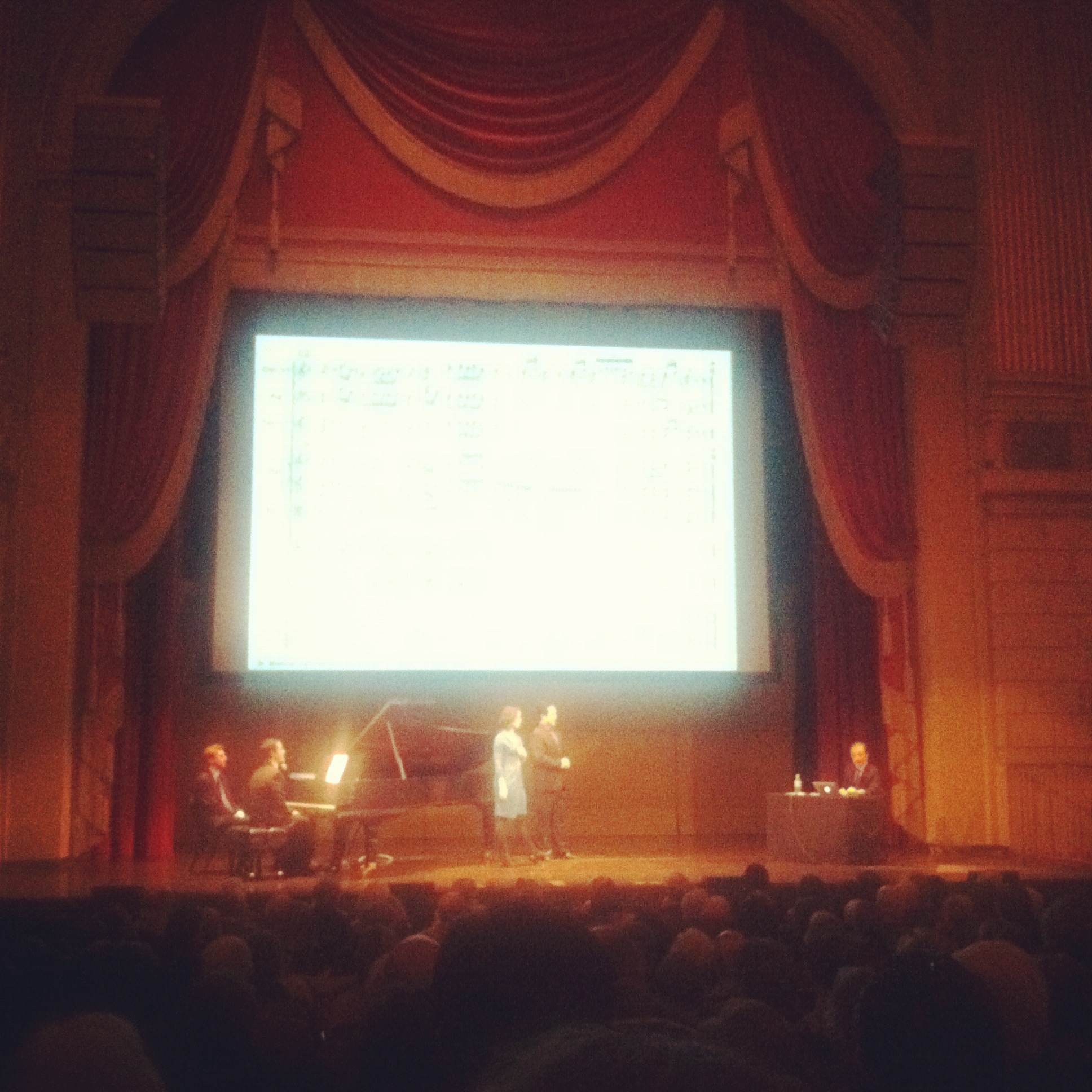
    Mark Morash, the San Francisco Opera Center Director of Musical Studies, held an event on Thursday focusing on the collaborative pianists in the Merola Opera and Adler Fellowship programs. Current Adler Fellows David Hanlon and Robert Mollicone spoke about how they came to the collaborative arts and auditioned for Merola. Both pianists played solo pieces, Mollicone chose the more conventional Rachmaninoff, and Hanlon improvised a version of “My Funny Valentine.” Hanlon coached Laura Krumm through the end of Act II, Scene 2 from Dead Man Walking with a projection of the music on a screen behind them so we could follow along. Ao Li joined Krumm for a duet from Così fan tutte. Li sang Valentin’s aria “Avant de quitter ces lieux”, as Mollicone played the piece transposed down a step to accommodate his voice. Both pianists played a piece for 4 hands composed by Hanlon as the finale.

    * Tattling *
    The event started slightly late, as traffic was rather heavy coming into San Francisco, due to President Obama being in town for a speech at the Nob Hill Masonic Center.

    Leave a Reply

  • Marco Pannucio, Susannah Biller, Julienne Walker, Jason Detwiler

    * Notes *
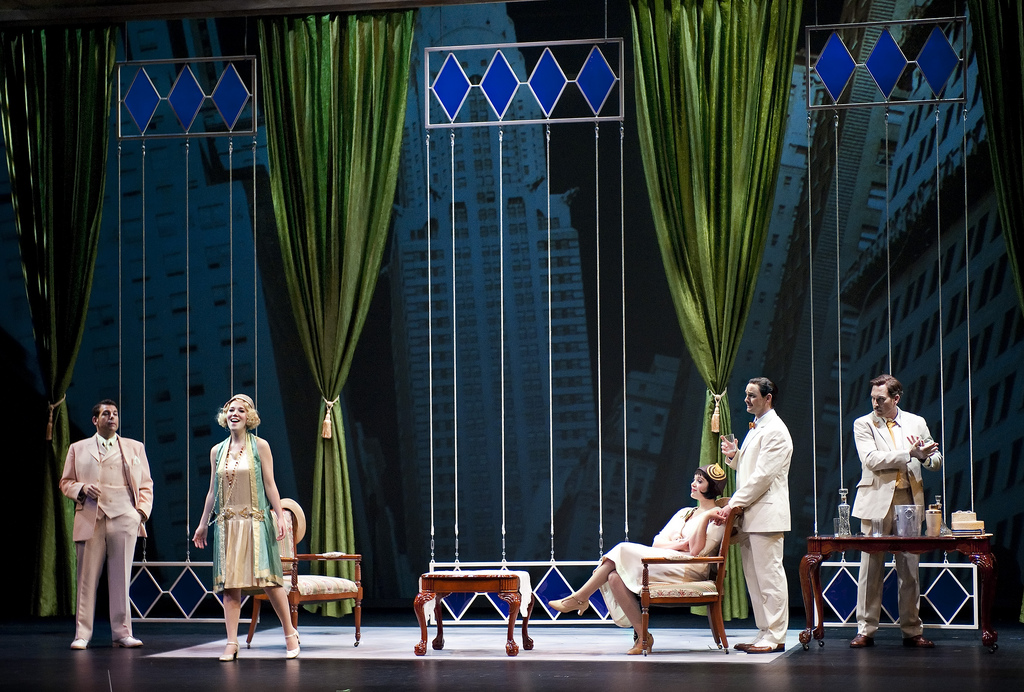
    A chamber version of John Harbison's The Great Gatsby (Act II, Scene 3 with Marco Pannucio, Susannah Biller, Julienne Walker, Jason Detwiler, and Daniel Snyder pictured right; photograph by Steve DiBartolomeo) from Ensemble Parallèle opened last night at the Yerba Buena Center for the Arts in San Francisco. The ambitious reorchestration was undertaken by composer Jacques Desjardins, using 30 musicians instead of 80, and will be presented at the Aspen Music Festival this August. The opera has been cut down to 2 hours and 10 minutes, but does not seem rushed or undescriptive.

    The music is rather difficult, and conductor Nicole Paiement had kept everyone together, at least for the most part. Director Brian Staufenbiel put forth a bold production, employing much videography and period dance. The many scene changes were smooth, and there were only a few odd moments, notably between Act I Scenes 1 and 2, and in Act II Scenes 5 and 6. One can appreciate how challenging it is to put forth this familiar story that has been visually represented in more than one film. Matthew Antaky's set is stylish, but at times the singers seemed rather far upstage, and this effected how well they could be heard.

    The cast is strong, featuring those who can both act and sing. The diction was all perfectly comprehensible. Mark Robinson and Carrie Zhang had some of the simpler, lyrical music as Radio/Band and Tango Singers. Erin Neff and Bojan Knežević made fine contributions as Myrtle and George Wilson. Knežević was terrifying yet sympathetic when Myrtle is killed. Julienne Walker (Jordan Baker) was a good foil for Susannah Biller (Daisy Buchanan), physically and vocally. Jason Dewiler made for a likeable Nick Carraway, ever patient as he observed. Daniel Snyder (Tom Buchanan) sounded a bit choked in the first half of the opera, but seemed in better voice after the intermission. In the title role, Marco Pannucio gave a heartfelt, but somewhat strained, performance. Susannah Biller sparkled as Daisy Buchanan, her bright sound had a certain lovely ease to it.

    * Tattling * 
    The woman in Row E Seat 106 arrived only a few minutes before curtain, and had to step over us to leave the hall after the opera's second scene. She returned between Act I Scenes 3 and 4, squeezing by and speaking to her date during the orchestral interlude.

    Some men behind Row J of the Orchestra Right section talked loudly during Gatsby's final aria, and someone had to ask them to be quiet.

    Leave a Reply