• Grimaud, Helene 4x4 * Notes * 
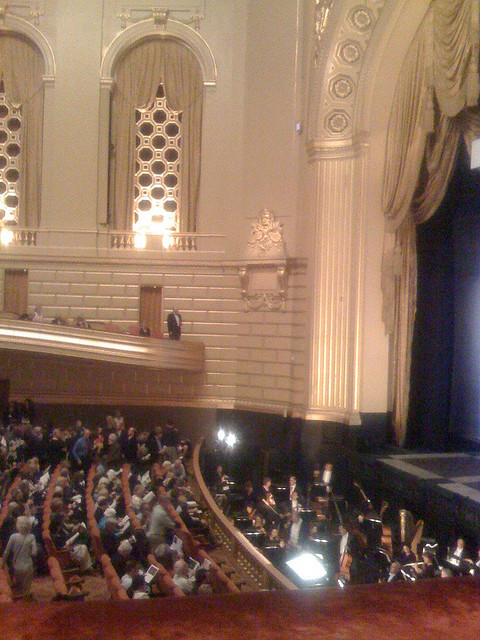
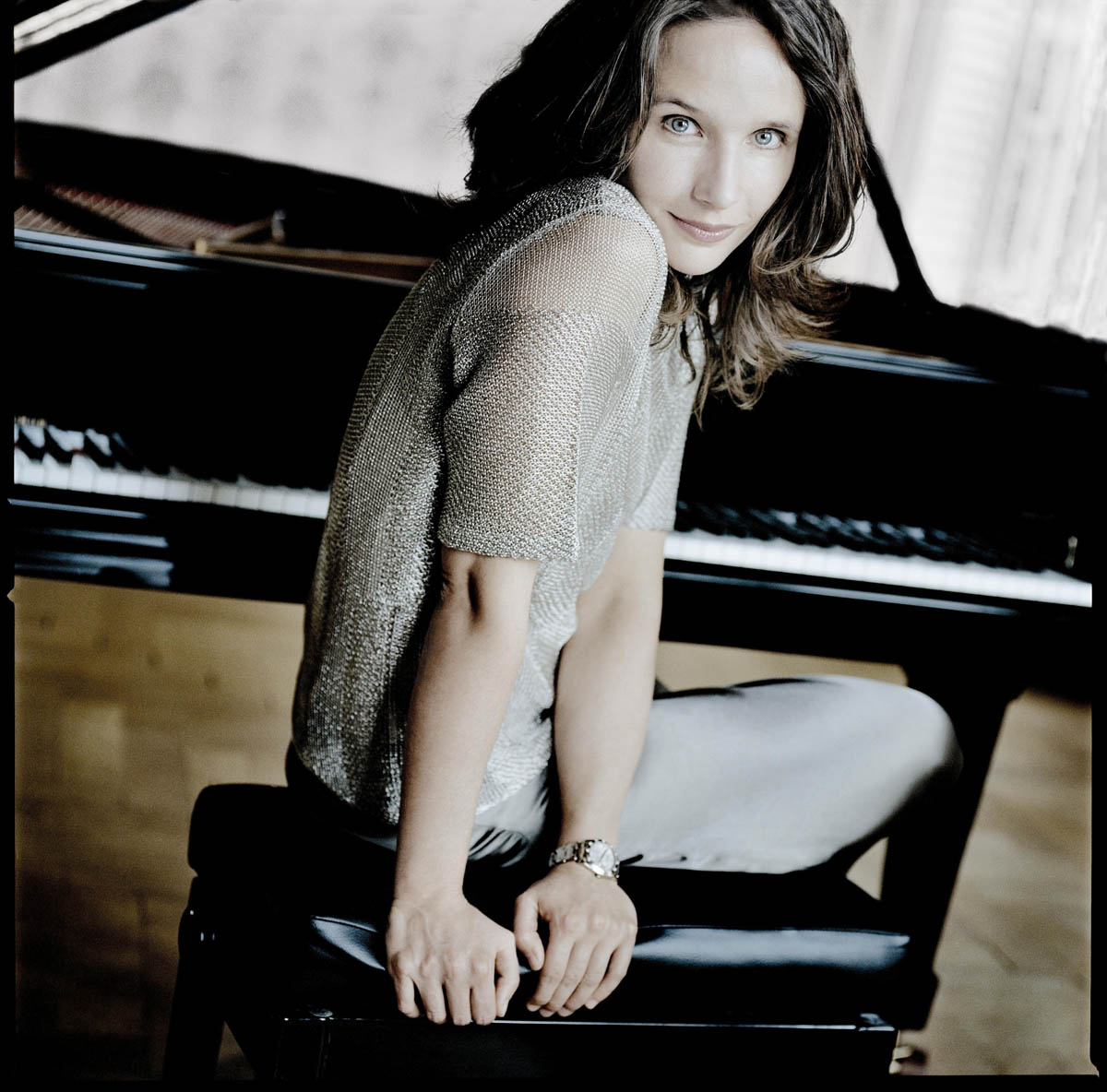
    Kirill Karabits made a promising conducting debut at San Francisco Symphony this week in a program of Silvestrov's Elegie, Schumann's Piano Concerto, and Rachmaninoff's Symphonic Dances. Last night's performance began with the piece by Silvestrov, scored for string orchestra. The small ensemble played with grace and the work was rather pretty. Next came the Schumann, the pianist Hélène Grimaud was perhaps ungainly, but perfectly precise and never boring. She listened to the orchestra but sounded quite distinct from the other instruments. The Rachmaninoff dances were fluid and adroit. The trumpets and trombones were clean but slightly harsh. The woodwinds were particularly beautiful.

    * Tattling * 
    The audience on the orchestra level was exceedingly well-behaved for the first half of the performance, especially when Grimaud was playing. Almost no one left during intermission, but light talking was noted during Rachmaninoff, and more than one person fell asleep.

    Leave a comment

  • July 30- August 20 2011: Porgy and Bess
    October 15-29 2011: Carmen
    January 14-28 2012: Attila
    February 25- March 10 2012: Orpheus and Eurydice

    May 5-19 2012: Madama Butterfly

    There are five operas scheduled for next season at Seattle Opera and again we have 3 conductors returning and 2 debuts. John DeMain conducts Gershwin, Carlo Montanaro conducts Verdi, and Gary Thor Wedow conducts Gluck. Pier Giorgio Morandi and Julian Kovatchev have their first performances in Seattle, conducting Carmen and Butterfly respectively. As for singers, Joseph Calleja is Don José, William Burden Orpheus, John Relyea Attila, and Patricia Racette is Butterfly. I am especially curious about José Maria Condemi's production of the Gluck opera.

    2011-2012 Official Site | Subscription Information

    Leave a comment

  • Greg-Weber Greg Weber was just appointed Director of Production at San Francisco Opera and starts on February 1, 2011. Mr. Weber left his post as managing director of the Geva Theatre Center last July. He succeeds Drew Landmesser, who is returning to Lyric Opera of Chicago.

    Press Release | San Francisco Opera

    Leave a comment

  • Met-fanciulla1 Metropolitan Opera‘s current production of La Fanciulla del Westmarks the 100th anniversary of the opera’s world premiere. The Unbiased Opinionator attended the performance last Tuesday.

    * Notes * 
    The genesis of the La Fanciulla del Westis well known. Puccini, in New York to supervise the Met premiere of Madama Butterfly, saw David Belasco’s play The Girl of the Golden West, and caught what he later called the “California Disease.” The result — after several years of struggling with librettists (Carlo Zangarini and his successor Guelfo Civinini), and after a period of unproductive depression following an extra-marital affair and the suicide of his mistress — was one of Puccini’s most musically enigmatic, elusive and psychologically insightful operas.

    The central personality of the story, Minnie, reveals herself as a woman both homesick for and ashamed of her humble origins. Over her inner vulnerability she has constructed a steely shell, ever ready with a shotgun to protect herself and the gold entrusted to her for safekeeping by her ragtag group of miners. Her character is complex and contradictory, yet believable. The only female character in the opera (with the exception of the cameo role of the native Indian Wowkle), she is the surrogate mother and to and schoolmistress of a colorful collection of California Gold Rush gold-diggers.

    The success of the opera rests entirely on the shoulders of Minnie, her love interest Dick Johnson and the sheriff Jack Rance. If any of the three legs of this dramatic tripod is weak, the opera fails. Unfortunately, the experience of this reviewer on December 14th was that of an utter failure, especially on the vocal front. With the exception of Marcello Giordani’s powerfully and expressively sung Dick Johnson, the efforts of the protagonists were woefully inadequate.

    To my great regret, the prime responsibility for the failure of the evening rests with Deborah Voigt’s Minnie, which was consistently under pitch, lacking in color and marred by a weak top, with most high notes either approximated or lunged at. Having heard this artist at her peak, prior to gastric bypass surgery, when she possessed a dramatic soprano voice of astounding power and beauty, her current vocal condition is especially sad. In consideration of her statement that she underwent the surgery not for cosmetic reasons, but literally in order to save her life after a struggle with morbid obesity, an attitude of understanding and charity has to be brought to a review of her efforts. However, it is irresponsible of Management to continue to cast this artist in dramatic roles which completely exceed her current vocal state. In Ms. Voigt’s favor was an obvious affinity for the character of Minnie and some fine acting, especially in Act II.

    Lucio Gallo’s Jack Rance was marred by clichéd, stiff, operatic gesturing and a strangled top. As noted above, Marcello Giordani’s Dick Johnson, an outlaw whose encounter with Minnie both humanizes him and converts him from his renegade criminality, was very impressive and consistent, with an exciting top and a vocal delivery blessed with a variety of color and expression. Only his signature aria, “Ch’ella Mi Creda,” (in which, facing execution, he asks his henchmen to spare Minnie knowledge of his fate, but rather to let her believe that he is enjoying a life of freedom far away from the harsh life of the Sierra Nevada), was flawed by curiously broken phrasing and pitch problems.

    The numerous supporting roles, especially Dwayne Croft’s Sonora, and Tony Stevenson’s Nick, were strong, well-acted and well sung, and avoided the dangers of cartoonish over-playing. Conductor Nicola Luisotti displayed total mastery over the many challenges of the score. To create a sense of seamless flow in Puccini s music, with its constant tempo changes, syncopations and difficult vocal and instrument cues, is deceptively, in fact enormously, difficult. Fanciulla, in particular, presents many challenges, not the least of which is Puccini’s delaying of the musical resolution of phrases with ambiguous tonalities. complex harmonic structures and deceptive cadences, counterbalanced by melodic material of luminous beauty, none more so than the finale, “Addio, mia dolce terra, addio mia California,” which never fails to grip the listener with its haunting sadness.

    Luisotti brought a natural affinity to the music and molded the Met orchestra into a fine ensemble, the orchestra in Fanciulla being, as in much of Wagner, a character unto itself. One hopes that he will be a frequent guest at the Metropolitan.

    The production, dating from 1993, is conventional and mostly effective. A particularly beautiful touch was the stream of light that entered into Minnie’s cabin at the end of Act II, underscoring her feeling of wholeness and redemption as she gives in to her love of Dick Johnson.

    * Tattling * 
    There were many empty seats in the hall, but the audience was mercifully quiet and attentive.

    Leave a comment

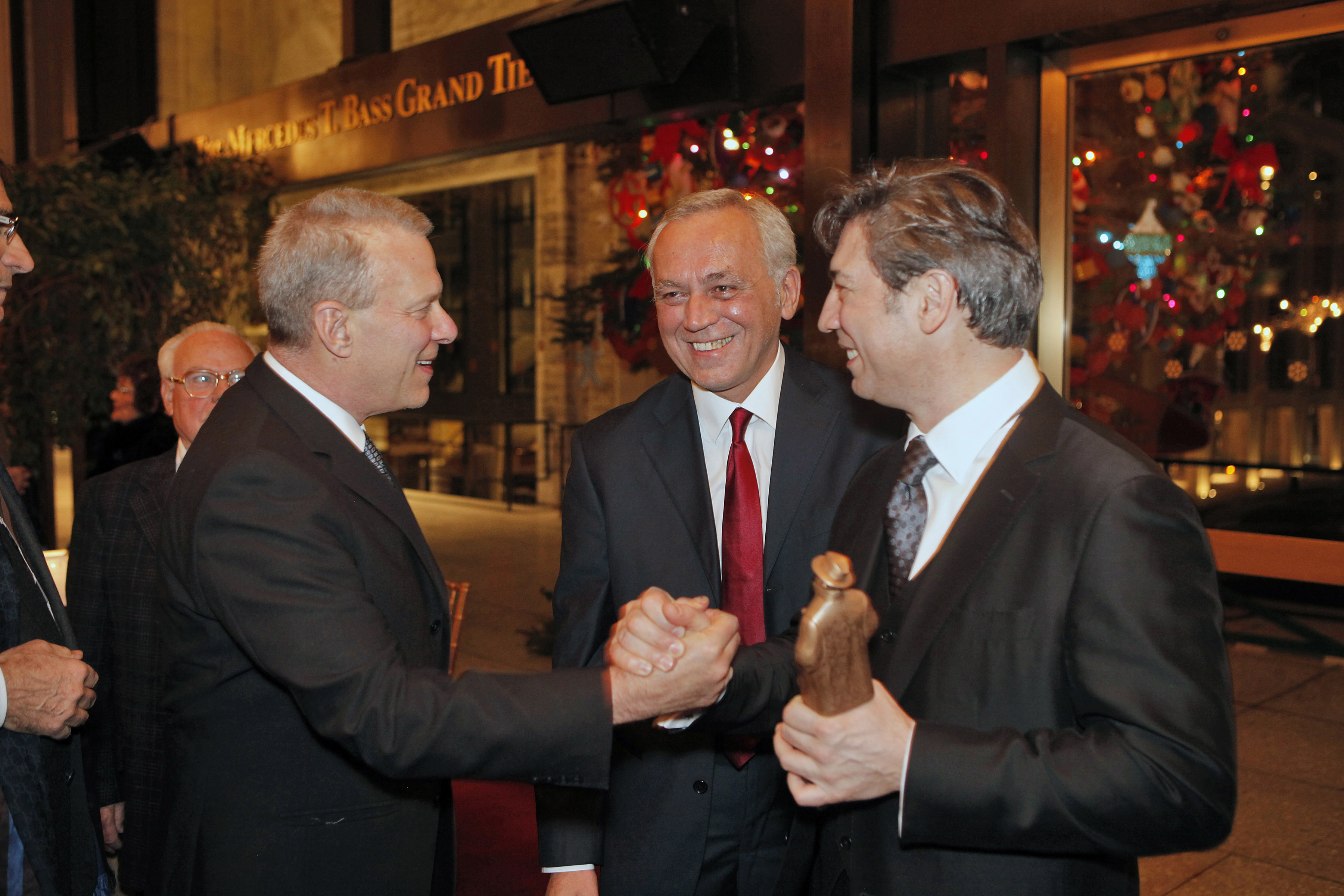
  • GockleyPaolo SpadacciniLuisottihandshake Maestro Nicola Luisotti (pictured with San Francisco Opera‘s General Director David Gockley and President of the Fondazione Festival Pucciniano Paolo Spadaccini; photograph by Cory Weaver) is currently conducting the centennial performances of La Fanciulla del West at the Met, including the upcoming HD simulcast on January 8th. He has been met with success in New York and just received the 39th Premio Puccini Award in recognition for his work. The Opera Tattler spoke to the effervescent conductor just before his final performance of Fanciulla at San Francisco Opera last season. Upon reaching his dressing room, Luisotti could be heard playing the piano.

    What were you playing?
    Some Chopin waltzes.

    Are you always playing?
    I study all the time, 6 to 7 hours a day, if I am not conducting, working with musicians, or listening to auditions.

    You seem to often wear a navy polo shirt with a white sweater draped over your shoulders. What is the story behind how you dress?
    I dress the same all the time, everywhere I go. This is so I am not a distraction to the musicians, I just want people to see that it is me, Luisotti, and get on with the music.

    I hear you are to conduct Fanciulla for the centenary of this work at the Met, where the opera premiered. How many times have you worked on Fanciulla?
    This will be my 7th run of Fanciulla. My first performances were in 1985, as part of the chorus. I have been the chorus master for Fanciulla as well, and the Met production will be my 3rd time conducting the work.

    I was surprised how much certain parts of The Phantom of the Opera sound like Fanciulla. Have you heard this musical?
    Yes, I have. My wife and I went to hear The Phantom of the Opera for the first time in London last April, when I was conducting Aida at Covent Garden. My wife and I like musicals, and we see a lot of them, it makes for a nice light evening. Andrew Lloyd Webber is a good musician, but some whole lines of Fanciulla were lifted out for some of the songs in the musical! In rehearsals with the orchestra, I would say things like “and now let’s start again at the “Music of the Night” part. It made them laugh!

    You have conducted both Puccini and Verdi a great deal at San Francisco Opera, is there non-Italian repertoire coming up for you here?
    I don’t want to say too much, but Tannhäuser, Lohengrin, Carmen are all on the SF Opera schedule for me.

    You are hiring some new musicians, tell me about some of them.
    As far as new hires in the orchestra, we have chosen a new principal oboist Mingjia Liu and a new prinicipal clarinetist just started here, José González Granero. José is great, he can go from nothing to everything to nothing again. You can hear this in Act II when Rance asks Minnie why she loves Ramerrez. I don’t have to tell José anything, he just knows what to do. Music is not a job! Everyone needs a job, of course, but we try to hire musicians, people who love music more than themselves. I love music more than myself! Music is indescribable, just like love. It is just a group of 200 hundred people moving their hands, with me waving my arms, and suddenly you see Canova’s Amore e Psiche, and we stop moving our hands and it is gone!

    You seem to have rearranged the orchestra quite a bit for nearly every production, what exactly is going on?
    We have tried 5 different configurations of the orchestra, even adjusting the level of the floor. The pit is too narrow and too long. The acoustic is challenging so we are trying to find a balance. I know that not every word that the singers utter can be heard, but I don’t want it to be boring. Even if you find something to be too much, that too is a reaction. Being disturbing is a reaction. If I restrained the orchestra, I am afraid it would be boring after a hour. I have to respect the score, for Fanciulla, the winds are doubled, and it wrong to cut that orchestration down. When the composer writes “Tutti forza,” I must follow that. I hate mezzoforte, and love pianissmo and forte. Life is full of colors. It is like when people go to the movies, no one complains that it is too loud, we get immersed in a world, just as in opera.

    Are you still working on a symphonic season with San Francisco Opera’s orchestra?
    We are still working on this, but it will not be in the city. There is no need to compete with SF Symphony, of course.

    Are you going to make it back to San Francisco for the Ring next summer?
    I really wanted to make it back here, but unfortunately, my schedule is just too full!

    Would you consider conducting this work?
    I go back and forth about wanting to conduct a Ring, fighting with myself. I have 30 or 40 years to torture you with my conducting, so who knows!

    Now for a very stupid question! What is your favorite pasta?
    No, no, it isn’t stupid, everyone has to eat, food is important! I like homemade pastas with Bolognese sauce or egg and tuna. I also like risotto with fresh mushrooms!
    Leave a comment

  • 01122010 006 * Notes * 
    The pianist Nicolas Hodges paired Stockhausen and Beethoven for a recital at Cal Performances this afternoon. Hodges made Stockhausen's Klavierstück X oddly compelling for a piece played with wrists, forearms, and elbows. He was able to get quite a lot of sound out of the piano, and emphasize the percussive nature of the instrument. At the same time, he did nuance the various dynamics, and the strange, ethereal harmonics also came out beautifully. In comparison, Beethoven's Hammerklavier was less excitingly played. Hodges seemed to be holding his breath, and the performance was on the dry side. The playing was direct and perhaps a bit mechanical, yet not precise. One wishes a stronger case had been made for putting these particular pieces together, besides the obvious, that both are very difficult.

    * Tattling * 
    There was some whispering, but for the most part, the audience was very quiet. I kept laughing during the Stockhausen, out of both delight and shock, but kept this as silent as I could.

    Leave a comment

  • Sacramento Opera has canceled the rest of their 2010-2011 season after poor ticket sales of Orlando.

    Sacramento Press | Official Site

    Leave a comment

  • Nicholas-mcgegan-pbo * Notes * 
    Philharmonia Baroque Orchestra's latest offering of Händel's Messiah was very jolly. Nicholas McGegan conducted the third of four concerts last Sunday in Berkeley in his usual chipper way. The orchestra was together and in tune, as was the chorus. The soloists included soprano Mary Wilson, countertenor Daniel Taylor, tenor John McVeigh, and bass Tyler Duncan. The overall impression was that of airy lightness, though all could be heard.

    * Tattling * 
    A woman in Row O made a request for me to switch from my aisle seat with my companion so that she could see the stage, because I am rather short. Naturally her companion inanely exclaimed that the piece was in English once the tenor started. A cellular phone rang during the aria "He was despised and rejected of men."

    Leave a comment

  • Sf-opera-inside This year's subscriber survey from San Francisco Opera was a little bit boring, so here are the funniest ones, with answers from the Opera Tattler filled in, of course. To be perfectly honest, I should have checked all of the boxes for question 6, but somehow that did not seem helpful, so I picked ones that I would consider going if I were normal, and did not go to all the operas at San Francisco Opera. I find it particularly alarming that none of the operas that I listed were ones in questions 5 or 6.


    * * *

    4. Please name up to five operas you would most like to see in the near future.
    Monteverdi's L'Orfeo
    Gluck's Armide
    Mozart's La finta semplice
    Vivaldi's Orlando Furioso
    Berg's Lulu

    5. To help us plan for future seasons, please indicate which of the following operas you would be extremely interested in attending in the next five years. Please check all that apply.
    Rigoletto (Verdi)
    The Flying Dutchman (Wagner)
    Lohengrin (Wagner)
    x Don Giovanni (Mozart)
    x Tales of Hoffmann (Offenbach)
    x Die Meistersinger (Wagner)
    Lucia di Lammermoor (Donizetti)
    The Magic Flute (Mozart)
    x Peter Grimes (Britten)
    The Barber of Seville (Rossini)
    Il Trovatore (Verdi)
    Aida (Verdi)
    Elektra (R. Strauss)
    x The Trojans (Berlioz)
    Carmen (Bizet)
    x Porgy and Bess (Gershwin)
    Turandot (Puccini)
    La Traviata (Verdi)
    The Marriage of Figaro (Mozart)
    Die Frau ohne Schatten (R. Strauss)
    A Masked Ball (Verdi) Madama Butterfly (Puccini)
    Così fan tutte (Mozart)
    Der Rosenkavalier (R. Strauss)
    Norma (Bellini)
    Cavalleria rusticana (Mascagni)
    x Nixon in China (John Adams)
    Falstaff (Verdi)
    La Bohème (Puccini)
    Tosca (Puccini)

    6. To help us plan for future seasons, please indicate which of the following works you would CONSIDER ATTENDING. Please check all that apply.
    The Dialogues of the Carmelites (Poulenc)
    Attila (Verdi)
    West Side Story (Bernstein)
    Eugene Onegin (Tchaikovsky)
    Les Misérables (Claude-Michel Schönberg)
    x Julius Caesar (Handel)
    x Jenůfa (Janáček)
    Pagliacci (Leoncavallo)
    Susannah (Carlisle Floyd)
    x From the House of the Dead (Janáček)
    x Xerxes (Handel)
    Carmina Burana (Orff)
    King Roger (Szymanowski)
    Show Boat (Jerome Kern)
    I Puritani (Bellini)
    La Cenerentola (Rossini)
    Manon (Massenet)
    Lucrezia Borgia (Donizetti)
    x Moby Dick (Jake Heggie)
    Adriana Lecouvreur (Cilea)
    x Lady Macbeth of Mtsensk (Shostakovich)
    I Capuleti e i Montecchi (Bellini)
    x Ainadamar (Osvaldo Golijov)
    Mefistofele (Boito)
    Florencia en el Amazonas (Daniel Catán)
    Andrea Chenier (Giordano)
    Don Quichotte (Massenet)
    Nabucco (Verdi)
    Cendrillon (Massenet)
    The Portrait (Weinberg)
    X Rusalka (Dvořák)
    Sweeney Todd (Stephen Sondheim)
    x Mosè in Egitto (Rossini)
    x Ernani (Verdi)

    Leave a comment

  • Fleming-loc Soprano Renée Fleming has been named the first Creative Consultant of Lyric Opera of Chicago.

    Press Release | Renée Fleming's Official Site

    Leave a comment