• Crocetto * Notes *
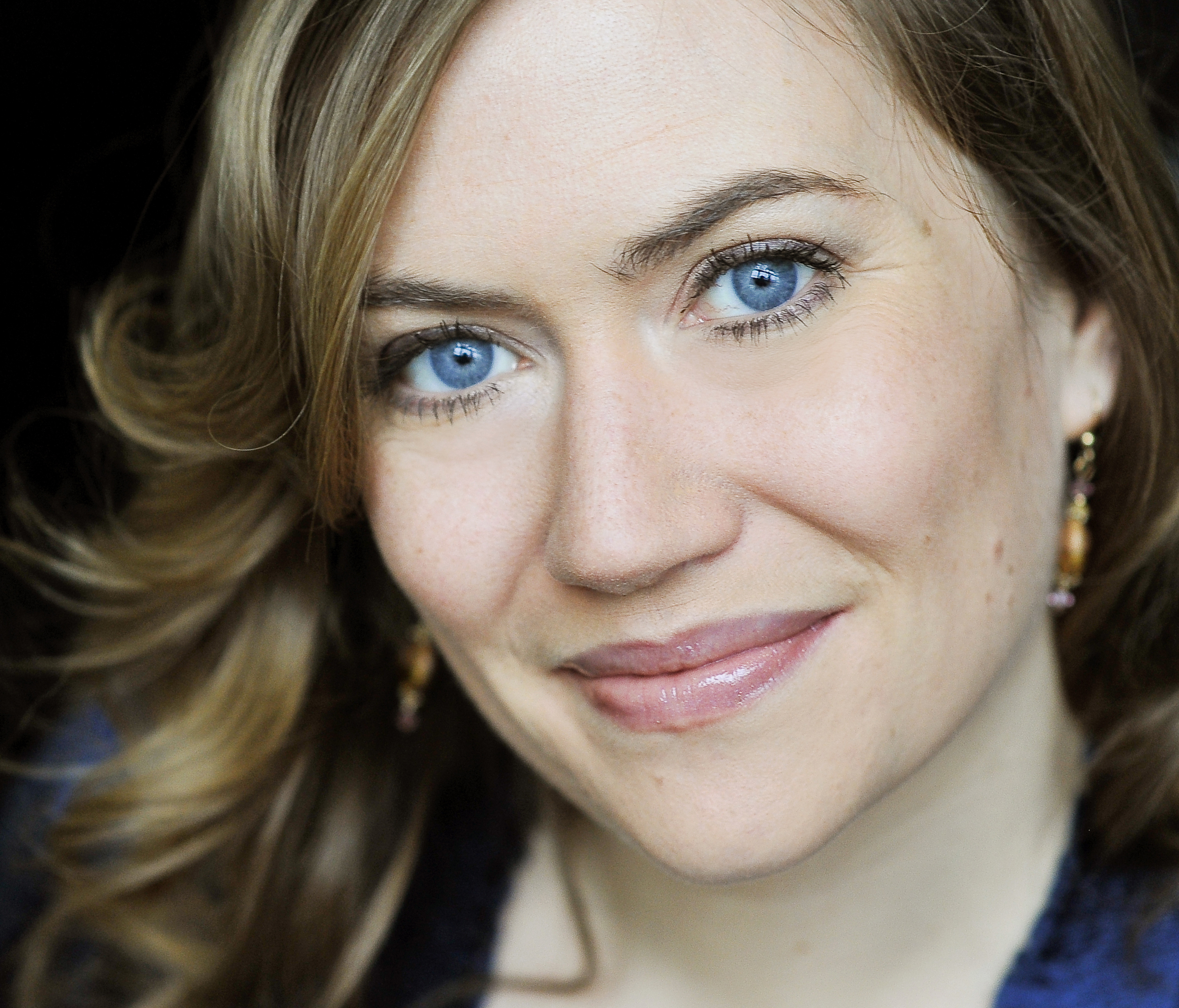
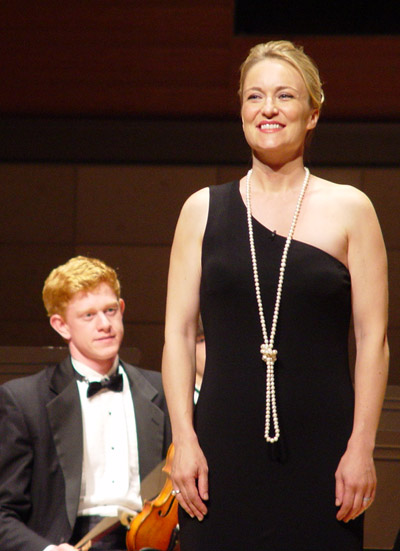
    Soprano Leah Crocetto gave a recital of her favorite songs with pianist Tamara Sanikidze for the Salons at the Rex series yesterday evening. Crocetto began with “Ain’t it a pretty night?” from Carlisle Floyd’s Susannah. She learnt this piece at the age of 18, and it sounded very natural for her. This was followed by 3 Rachmaninoff songs, 2 from the Opus 21 Song Cycle and the Vocalise (Op. 34, No. 14). Sanikidze milked Richard Strauss’ lovely “Morgen,” Crocetto sounded pure and clear. Her “O mio babbino caro” was spine-tingling. The rest of the program was in English and included “Sure on this Shining Night,” “From Seamus,” “The Boy Next Door,” “The Man that Got Away,” “When Did I Fall in Love,” “Fly Me to the Moon,” “All the Things You Are,” “The Girl in 14-G,” and “You’ll Never Walk Alone.” There were times when her volume was a bit much for the smallness of the room. She did sound equally comfortable singing art songs, arias, or standards.

    * Tattling *
    The recital was sold out, we were packed in fairly tightly, and I was between Axel Feldheim and John Marcher. The audience was well-behaved, though some expressed their enthusiasm by calling out “whoo-whoo” several times in a row during the applause. The clanking of silverware was heard during “Morgen” and Crocetto joked that this was her percussion section.

    Leave a comment

  • Placido- Domingo2010 * Notes * 
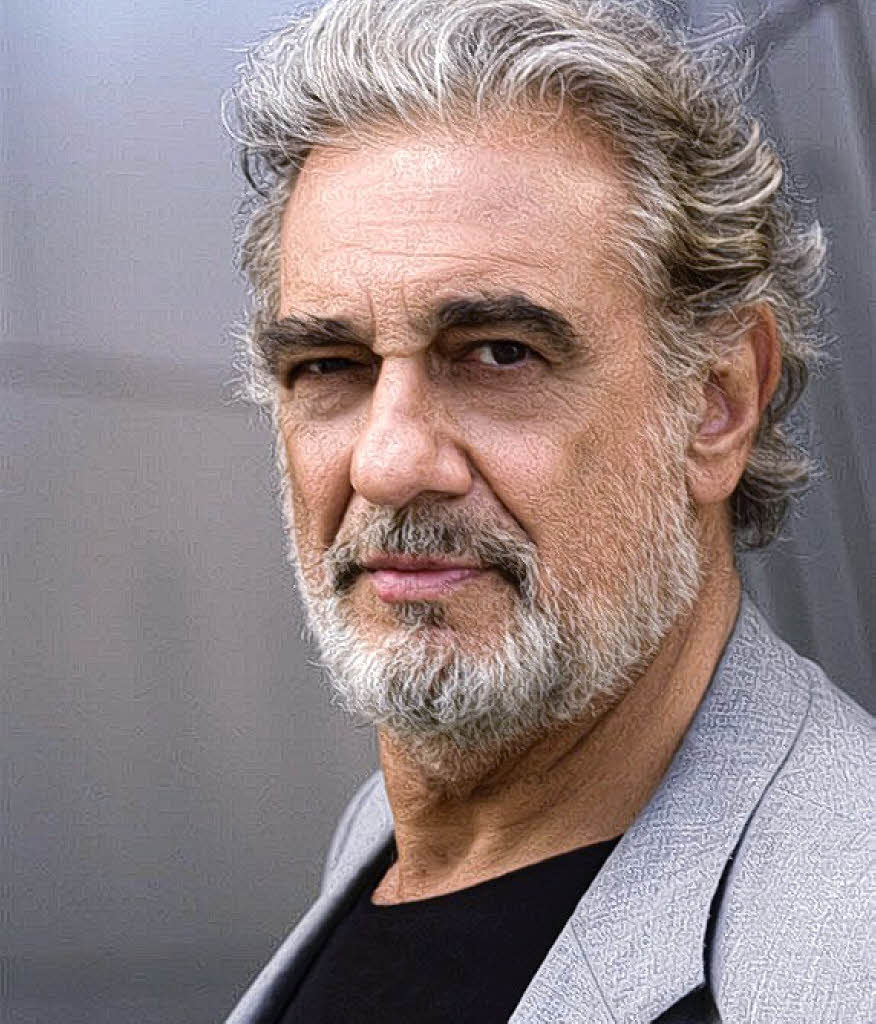
    Today the Communications Department of San Francisco Opera hosted an event with Plácido Domingo in conversation with David Gockley. Domingo will be singing the title role in Cyrano de Bergerac, which opens Sunday, and Gockley spoke a bit about how this was arranged, why we are getting a production from Théâtre du Châtelet, and asked Domingo to tell us more about this opera. We heard about Alfano and how he was the contemporary of Janáček, Berg, and Schoenberg. It was pointed out that Domingo is singing two poets this season back to back, since he just finished as Neruda in Los Angeles Opera's Il Postino. The famous story of how Domingo flew in for the opening of the 1983-1984 season to fill in for an ailing Otello was recounted and he joked that 25,000 people claimed to have been there even though the opera house only seats 3,200.

    Gockley had Domingo speak about taking on baritone roles, and made fun of his own voice, since he is a baritone. The music director, Maestro Nicola Luisotti, was also in attendance, and Domingo complimented Luisotti's fine baritone. As for Domingo himself, he said he does not pretend to be a baritone, but likes doing these interesting roles and has to color his voice very differently for them. At one point he had imagined that Simon Boccanegra would be his last role, and has done 28 performances. His voice is still in good condition, so he wants to sing everyday that he can, but to not sing one more day once he cannot. His next new baritone role is Athanaël in Thaïs, which he will perform in Paris and Valencia soon. He quipped that it was appropriate for his age, since Athanaël is a monk. Charmingly, he also said that Cyrano was likewise good for him in this way, since Cyrano is a "loser," and can be any age. On this more human side, we heard about what Domingo does in his downtime, and he apparently recharges by the results of his work. He is a Real Madrid fan and also watches telenovelas with his wife Marta, who was in attendance.

    During the question and answer period Domingo was asked how he takes care of his voice, since he still sounds so youthful and fresh. One should not drink terribly cold water, and one cannot drink warm beer. Domingo finds it better to eat lunch late, around 2pm and then have dinner after his performance. Ideally as a tenor one should rest 3 or 4 days if possible. Questions were asked bout San Francisco's charm, and Domingo praised San Francisco Opera as one of the most important companies in the world. He did tease us about how there were some bad years before Gockley's tenure that were good for his company, Los Angeles Opera. The challenges of behing the general director out on the West Coast were discussed. It is difficult to get artists out here, in Europe a singer can get to different houses more easily and the euro is so strong.

    Domingo was questioned about the recent Ring at Los Angeles Opera, and he conceded that perhaps two cycles would have been sufficient. That production was to have gone to Mannheim and Seville, but will not. It may still be produced in Korea or Argentina. He was asked about the recent simulcast of Rigoletto in Mantua that he participated in, and he told us he did not feel that opera in cinemas would steal the audience from the opera house.

    * Tattling * 
    The audience was quiet but a cellular phone rang during the aforementioned question about San Francisco as a city. David Gockley was kind enough to call on me for a question, and Nicola Luisotti was gracious enough to introduce me to Plácido Domingo. I encouraged the delightful North American editor of MusicalCriticism.com to have our photograph taken together with Domingo.

    Leave a comment

  • Stober-Heidi * Notes *
    The last three performances of San Francisco Opera's Le Nozze di Figaro this season features four new cast members. In the back of the balcony for the second performance on Saturday everyone could be heard, unlike during matinée I attended a week before in the side balcony. Dale Travis was perfectly funny as Doctor Bartolo. Trevor Scheunemann certainly seemed jealous and tyranical as the Count, and sang well, though his vibrato was rather prominent at the end of the opera. Kostas Smoriginas had a lot of energy as Figaro. His voice is not as reedy as Luca Pisaroni's, but is also not as pretty. Smoriginas did have a warmer, more baritone-like sound. The star of the show was Heidi Stober (Susanna). She sounded full and strong, yet very beautiful. Her acting and movement may not have been quite as sassy as Danielle de Niese's, but it was fascinating to compare the two sopranos.

    * Tattling * 
    There was much talking from a pair of young women around Row L Seats 115 and 117. One of them even used her mobile device during the second half of the opera. Otherwise, it was the usual parade of latecomers milling around in standing room before the first 4 minute pause between the first two acts.

    At intermission I had the pleasure of meeting up with a few friends, one of whom was at the opera for the very first time.

    Leave a comment

  • Mortensen-pbo * Notes *
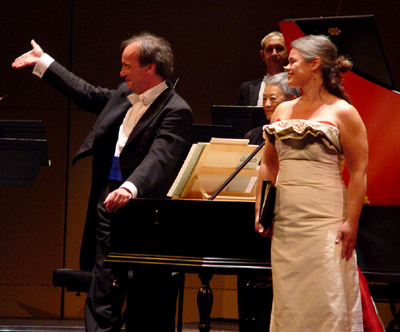
    Lars Ulrik Mortensen (pictured left with soprano Maria Keohane, photograph by Michael Strickland) is currently conducting Philharmonia Baroque Orchestra in a program of Bach. Friday night’s performance in San Francisco started with the Orchestral Suite No. 1 in C major, BWV 1066. Mortensen lead the orchestra from the harpsichord, and it was clear at once we were in for a lively evening. For the following Concerto for Harpsichord in D minor, BWV 1052, the harpsichord was rearranged such that Mortensen did not have his back to us. His playing was not perfectly clean, but this was more than made up for with his cheerful, engaged performance. The orchestra held together beautifully, and the playing was sprightly.

    After intermission we heard Weichet nur, betrübte Schatten, known as the Wedding Cantata in English. Soprano Maria Keohane has a pure, yet rich sound. She employed a fine control of her voice, with neither too much vibrato nor tremolo. Her enunciation of the German may have not been completely comprehensible, but given that this is Baroque music, it was not particularly bothersome. The concert ended with an ebullient rendition of Concerto for Harpsichord in D major, BWV 1054.

    * Tattling *
    I was late meeting SFMike and Miss LCU, but did make it to the concert with Opernphrenologe before the music started. The audience was quiet and no electronic noise was noted.

    Maria Keohane‘s outfit was charmingly absurd, it looked a bit like one ivory frothy ruffled dress had consumed a simple red evening gown.

    Leave a comment

  • Chaconne * Notes * 
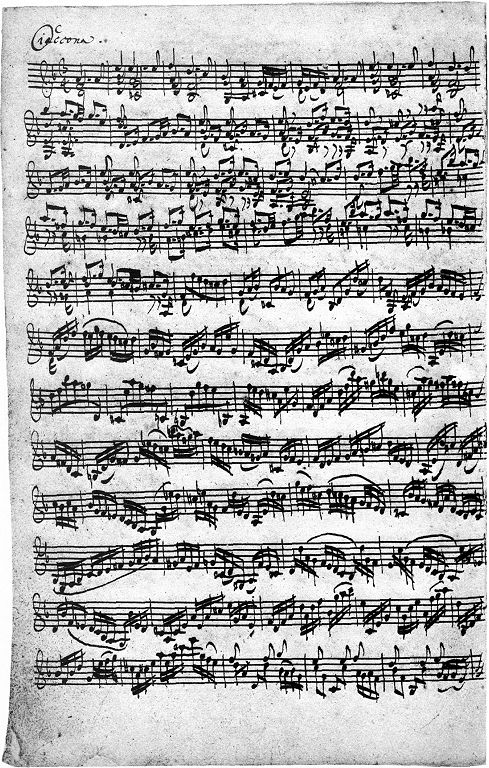
    Cal Performances presented a lecture from Alex Ross entitled Chacona, Lamento, Walking Blues: Bass Lines of Music History last Thursday in Berkeley. The talk is based on the second chapter of his new book, Listen to This. We started off with the chaconne, a Spanish dance popular in the early 17th century. The passacaglia was also mentioned, since both have common origins and are often in triple meter. Ross discussed and played snippets of everything from Monteverdi, Pachelbel, Purcell, Bach, and Beethoven to Nina Simone, the Beatles, the Eagles, and Bob Dylan. Some of his musical examples were even recordings of his own piano playing. I particularly enjoyed hearing Andreas Scholl singing John Dowland's "Flow My Tears" and Lorraine Hunt Lieberson in the Philharmonia Baroque Orchestra recording of Dido and Aeneas.

    * Tattling * 
    The audience was not entirely attentive, and there was some electronic noise. The evening was rather warm, and the temperature in Wheeler Hall was terribly comfortable. Perhaps my sailor outfit was not apropos, and Miss LCU may have had the correct idea with her safari wear.

    After the performance Ross stayed around for questions. I finally had a chance to introduce Axel Feldheim to M. C—, and we all had the chance to greet Mr. Ross.

    Leave a comment

  • Jerry-springer-the-opera  * Notes *
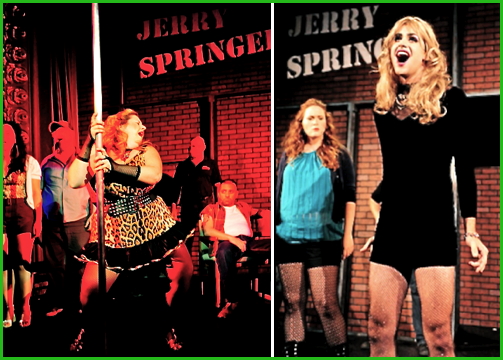
    Ray of Light Theatre's run of Jerry Springer: The Opera closes this weekend. The Wednesday performance I attended with John Marcher confused me a bit, the music sounded almost like an oratorio, but the lyrics were rife with profanity. After the second act I decided the composer, Richard Thomas, must have heard Messiah one too many times at Christmas. The performers were charming, much of the singing was good, and Patrick Michael Dukeman was very funny as Jerry Springer.

    * Tattling * 
    The audience was not particularly stylish. The poor ventilation of the venue and the heat made it obvious that some audience members had less than adequate hygiene.

    Leave a comment

  • Sfopera-butterfly-actii * Notes *
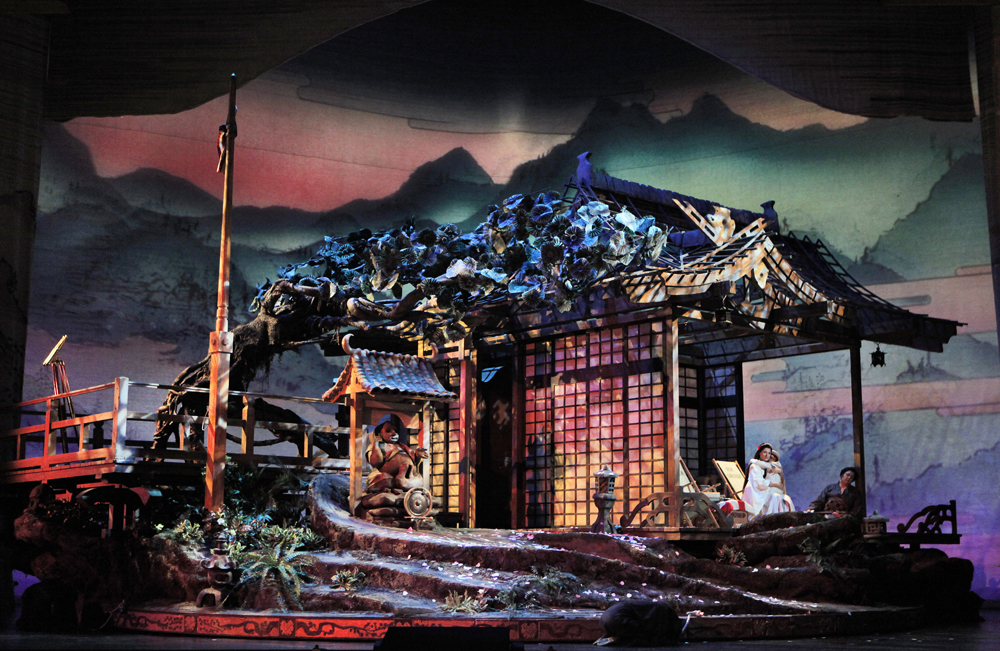
    Harold Prince’s production of Madama Butterfly opened last night at San Francisco Opera. The revolving set, designed by Clarke Dunham, is pretty enough. Though not terribly elegant, it is sure to delight most. The transitions were fluid. Director José Maria Condemi certainly was presented a challenge of getting people on, off, and around this set.

    Maestro Luisotti conducted the orchestra with verve, the playing was sweeping and painterly. The chorus also made strong contributions, and received the only ovation during the music, after the Humming Chorus. Both the Adlers looked and sounded appropriate for Kate Pinkerton (Sara Gartland) and Prince Yamadori (Austin Kness). Christian Van Horn was intimidating as the Bonze. Quinn Kelsey was a tender, kind Sharpless, his voice is rich and strong. Thomas Glenn (Goro) was foppish but also oozed unctuousness. His voice is light but always audible. Daveda Karanas (Suzuki) has a powerful, yet lovely voice. Her notes floated over the orchestra with ease.

    Our leads were perhaps less appealing. Stefano Secco was not the least bit dashing as Pinkerton, though his singing was perfectly fine. His volume is good, there is richness in his lower register, but he is not exciting. In the title role, the petite Svetla Vassileva looked comely, at least when she was still. Her gestures were distressing, as if she was having convulsions limited just to her hands. When she noticed that her hair became accidently unbundled in Act II, she was unable to keep in character. Worse yet, her voice could be shrill and her intonation was imperfect. She did pull it together for “Un bel dì,” and only one phrase was really off in pitch. Her timbre can be pleasant, with nice resonances in her chest voice, but she was a bit too hearty to be a vulnerable young girl.

    * Tattling * 
    There was light talking during the music, but I did not hear any watch alarms. I did have a seat in the Orchestra Ring, as I volunteered in the gift shop, however, I found I was more comfortable in standing room.

    A medical emergency occurred on the north side of the Premium Orchestra seating during the transition between Acts II and III. Many people stood up in the aisle to either help or to get out of the way. A nurse was called in, as was the house manager. The ailing person in question was taken out in a wheelchair.

    Leave a comment

  • Met-boris This season, the Metropolitan Opera is presenting two operas that weave personal emotional drama into the sweep of great historical events: Boris Godunov and Don Carlo. On October 8, the final dress rehearsal of Boris took place, and what follows are the Unbiased Opinionator's impressions.

    * Notes * 
    After Peter Stein's cancellation due to visa difficulties, it was left to Stephen Wadsworth, in only five weeks, to rework the show's staging and direction. Perhaps as a result of this abrupt change in leadership, René Pape's Boris seemed lost, staggering about the stage, looking more drunk than physically and emotionally tormented by the burdens of power and guilt. His vocal delivery seemed to lack core, which might be attributed to the early hour of the rehearsal. Nonetheless, his sound was diffuse and as the rehearsal progressed, tended toward a barked delivery, even in the more legato monologues. I am a great admirer of René Pape's work, however, he seemed miscast here – the effective center of his range is higher than the role demands. But, then, where are the true bassi of yore, those cast in the mold of Ghiarov, George London or Jerome Hines, let alone Chaliapin?

    That said, the remaining, very large, solo cast was uniformly strong. Particularly fine were Ekaterina Semenchuk (Marina) and Aleskadrs Antonenko (Grigoriy). The performance by the young Jonathan A. Makepeace as Boris' son Fyodor was nothing short of astonishing: vocally, dramatically and choreographically. This role is often taken by a mezzo-soprano, and such a level of accomplishment by an adolescent was immensely impressive. I cannot imagine a better Pimen (bass Mikhail Petrenko), whose solemn portrayal of the hermit was very moving. Evgeny Nikitin's Rangoni could perhaps be faulted for a certain ragged vocal delivery, but this was in keeping with the smarminess of the character, alternately coming on sexually to Marina and trying convince her to seduce Grigoriy into returning to Moscow to claim the throne, paving the way for the destruction of Russian Orthodoxy by Rome.

    The large chorus in Boris Godunov is a character in itself, and a very important one. Driven and oppressed, veering from servile obedience to outraged vengeance, the Met chorus was dramatically magnificent and technically unimpeachable, with razor sharp attacks, violent and dramatically overwhelming outbursts — never yelled, or (as in previous years) fraught with poor blend and heavy vibrato in the soprano section. Donald Palumbo's work with this group has created one of the world's finest opera choruses.

    As in Wagner, the orchestra is also itself a character in the opera; never a mere accompaniment, but rather a commentator on and instigator of the events taking place on stage. The incomparable Met orchestra rose to the occasion, which is particularly impressive in light of the fact that the weakest link in this performance was conductor Valery Gergiev, whose head remained buried in the score as he threw out the occasional cue with his left hand, while the right hand flaccidly and indistinctly waved about in unintelligible beat patterns. It is a tribute to the soloists, the choral ensemble and the orchestra that the performance was as cohesive as it was, with only occasional lack of coordination between the pit and the stage. Further, the tempi chosen by Gergiev, in particular in the prologue and in the Third Act Polonaise, were unconscionably rushed. The small string figures that spin over the characteristic rhythm of the Polonaise were reduced to a thin wash as the players struggled to keep up. One can only surmise, generously, that tempo choices were dictated by time constraints.

    The set design was spare – even abstract, with the Novodievichy Monastery in the first act reduced to a small entry portal on stage left. The Kremlin consisted of a gold wall which descended from the flies, with a small curtained door for Boris' entrances and exits. While this created a wonderful acoustic resonator for the singers, the row of bells at the top of the set, remaining motionless as digitally produced bell sounds pealed, was frankly a bit silly. The Polish court scene consisted of rows of black columns, which provided a fine backdrop for the elaborate white gowns and hats worn by the noblewomen (designed by Dorothee Urmacher). The triumphant return of Grigory the Pretender's forces in Varmy forest, en route to Moscow, was set on a bare, raked staged, with a central rectangular opening, out of which emerged banner-waiving soldiers and two white horses, which reinforced the old maxim – live animals and children are scene-stealers. At the conclusion, the Holy Fool (in a very fine delivery by tenor Andrey Popov), bemoans the dark destiny of Mother Russia; godless, populated by a mob and rabble ready to follow any leader strong enough to bludgeon his way to power.

    * Tattling * 
    Peter Gelb's latest innovation, offering 1,000 dress rehearsal tickets by lottery, in addition to those offered to patrons and guild members, combined with a thoughtful and intelligent spoken introduction, and his humorous admonition that the only electrical devices that should operate during the performance be on stage and not in the auditorium, provided for a mercifully quiet, disciplined and cellphone-free audience. If only this were the case in performances and not just dress rehearsals!
    Leave a comment

  • Singing-cupcake In case you, gentle reader, were wondering who the Opera Tattler and her lovely guest writers are, here are some brief biographies. The Unbiased Opinionator’s first review will be posted tomorrow, covering the Boris Godunov that premieres tonight at the Met. You can hear the performance live tonight at 7pm EST.

    Leave a comment

  • Breckenridge * Notes *
    The ninth season of the BluePrint series at the San Francisco Conservatory of Music opened on Saturday night. The performance started with the West Coast premiere of Laura Schwendinger's Chiaroscuro Azzurro, which featured violinist Wei He. The New Music Ensemble sounded tightly together under conductor Nicole Paiement, whose every move seemed carefully noted by the musicians. Schwendinger's music ranged from ghostly to strident to meditative.

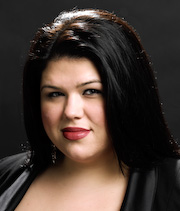
    After intermission we got a bit of a preview of Ensemble Parallèle's forthcoming Orphée production, first in the form of the selections from the Orphée Suite, arranged for solo piano by Paul Barnes. Keisuke Nakogoshi played movements II, III, IV and VII. The playing was compelling, simply very beautiful. This was followed by the world premiere of David Conte's Sexton Songs, sung by soprano Marnie Breckenridge (pictured above, photograph by Michael Strickland) who is also singing in the aforementioned Orphée. Breckenridge was ill, and there may have been an ugly edge to her voice as a result, but she was arresting in these five poems by Anne Sexton set to music. Again the ensemble sounded clear and coherent.

    * Tattling *
    Since I sat next to John Marcher and behind SFMike, there is very little to tattle about as far as the audience. The audio system did misbehave and played during the Glass instead of just before the Conte.

    Leave a comment