• Ramey-as-boris

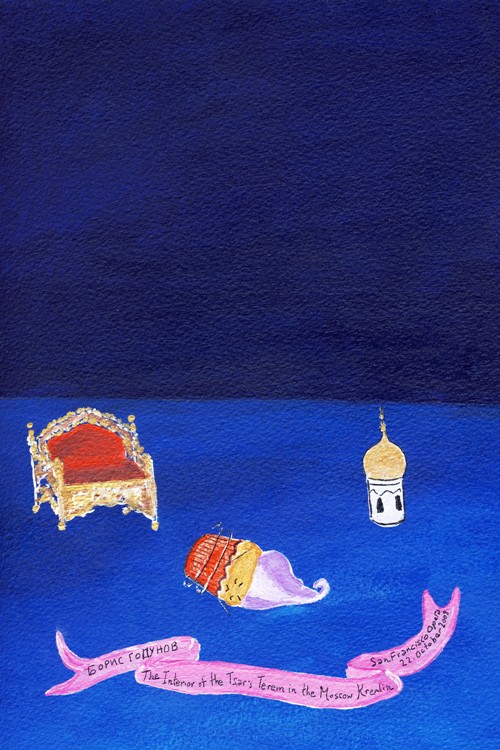
    This is the fifth scene from Boris Godunov. Boris, portrayed by Samuel Ramey, has just thrown himself to the ground in an agressive manner.

    This painting is on display until March 11th at Squat and Gobble in Lower Haight (237 Fillmore), along with several other cupcake opera paintings.

    Details of Painting | Performance Review of Boris Godunov

    Leave a Reply

  • Cecilia-maria * Notes *
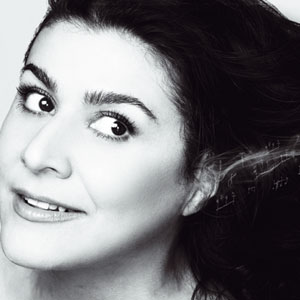
    Cecilia Bartoli is touring to promote her Maria Malibran-themed album, and sang this afternoon in Berkeley. She had a shaky start with Rossini's "La regata veneziana," she was quite wobbly and gasping, though her voice certainly is vibrant. She did better with Bellini, her rendering of "L'abbandono" was poignant and clear. Some of her higher notes were thin, and this was apparent in Bellini's "Malinconia, ninfa gentile." Her legato was beautiful in the "Ma rendi pur contento" and her arpeggios sounded effortless. In the first half, the audience responded best to Rossini's percussive "Canzonetta spagnuola."

    After the intermission came several Donizetti and Rossini songs, of these "Amore e mortea," from the former, was most delicate. Bartoli hammed it up for "La grande coquettte," twitching her eyebrows madly and making everyone laugh. She herself had a giggling fit during Pauline Viardot-García's "Havanaise," but sang her "Hai Luli!" with a certain loveliness. She was a bit faster than her piano accompanist, Sergio Ciomei, during "Yo que soy contrabandista," though otherwise they were together and had a good rapport.

    Bartoli does not have a particularly clean sound, her breathing is rather audible, and she even cracked a few times. She is, however, ridiculously delightful and her girlishness is refreshing. She gave four encores: "Ti voglio tanto bene," "Pres des remparts de Seville," "Non ti scordar di me," and "Canto Negro."

    * Tattling *
    Zellerbach looked completely full. The audience was attentive, and quiet, for the most part. There was a man in Row F Seat 109 of the mezzanine who would whisper loudly or even speak aloud in Russian even when Cecilia was singing. He also fell asleep and snored for much of the performance.

    Ms. Bartoli's first evening gown looked like a prom dress gone awry, the iridescent blue taffeta was not flattering, nor was the sleeveless style. The silver embroidery on the bodice and at the hem was not elegant either. She wore the identical dress in red for the second half, and that color looked better on her. One must admit that even her odd fashion sense was strangely disarming.

    Leave a Reply

  • Bluebeard * Notes *
    A double-bill of Bluebeard's Castle and Erwartung opened at Seattle Opera this evening. The two works were originally directed by Robert Lepage for the Canadian Opera Company, but were directed by François Racine in Seattle. The Bartók was stunning, though the orchestra was not always perfect under Evan Rogister, the music is compelling and the production does not get in the way. Michael Levine's set and costumes were understated, the clean lines were pleasing but offered surprises. Only the interaction at the end between the three other wives and Judith seemed a bit too obvious. The media effects, designed by Laurie-Shawn Borzovoy, were striking without being overwhelming.

    As for singing, Malgorzata Walewska (Judith) had incredible moments, her voice has warmth, but it is also somewhat wobbly. There were points in which she was simply shrieking. John Relyea seemed a bit blunt at first as Bluebeard, though his voice is lovely. He was impressively mournful after the opening of the sixth door, as he sings about tears.

    Erwartung involved more acrobatics. The piece seemed interminable, though it was a mere 30 minutes long, even with all of the visual effects and overt illustrations of narrative. Susan Marie Pierson sang well, she had good control and was never shrill.

    * Tattling *
    The hall was not full, and though there was a little talking during the music, it was very minimal. Afterward, a person asked us if these were the worst operas we had seen, and we responded in the negative. Apparently he had not enjoyed himself at all, and has attended at least a hundred opera performances.

    Leave a Reply

  • October 23-27 2009: Tancredi
    February 26- March 2 2010: Madame White Snake
    April 30- May 4 2010: La Grande-Duchesse de Gérolstein

    Ewa Podleś sings the title role in Tancredi and Stephanie Blythe is La Grande-Duchesse de Gérolstein.

    Official Site

    Leave a Reply

  • * Notes *
    NPR's Wait Wait… Don't Tell Me! returned to Cal Performances last night. Host Peter Sagal was as entertaining as ever, as was official judge and scorekeeper Carl Kasell. Kasell was particularly cute when he high-fived panelists Tom Bodett, Paula Poundstone, and Mo Rocca. The show ran long, so for 2 hours instead of 90 minutes, without an intermission. As one would expect, there were moments of utter hilarity, the Limerick Challenge was particularly funny. Oddly enough, there were also some jokes about Belgium, of all places.

    The celebrity guest was mezzo-soprano Frederica von Stade, who seems like a genuinely lovely person. Sagal mentioned that opera fans are both highly fanatical and rather elderly. Von Stade told a nice story about someone named Lois who goes to every Met performance. She also commented that new operas are important in building a younger audience, and cited the recent production of The Bonesetter's Daughter as an example of this in action.

    * Tattling * 
    The audience was enthused but well-behaved for the sold-out performance. There were no cellular phones, watch alarms, or even much talking. However, the person next to my companion had a five-course meal during the performance.

    Leave a Reply

  • * Notes *
    Yesterday evening Kurt Masur conducted San Francisco Symphony in a program of Gubaidulina and Bruckner. Gubaidulina's The Light of the End conjured up waves and air, there were parts near the beginning that sounded rather insectile, and parts near the end that were more bird-like. The marimba made for a pleasing earthy contrast with the more ghostly glockenspiel and vibraphone.

    The brass players were rather prominent in Bruckner's 4th, they were a bit ragged at times, not to mention blaring. I particularly enjoyed the strings in the slow movement, and the hunting theme of the third movement was entertainingly jaunty. Masur certainly had the symphony in hand, the dynamics were beautifully rendered.

    * Tattling * 
    The audience was very contained, there was only assorted whispering as far as poor-behavior was concerned.

    Leave a Reply

  • September 4-30 2009: La Juive
    September 28- October 4 2009: After Life
    September 29- October 6 2009: Dido and Aeneas
    October 29 2009- July 11 2010: L'elisir d'amore
    November 10- December 1 2009: Salome 
    December 2-28 2009: La fanciulla del West
    January 15- February 3 2010: Le nozze di Figaro
    February 1-28 2010: Der fliegende Holländer
    March 5-14 2010: Il prigioniero / Bluebeard's Castle 
    March 18-21 2010: Emilie
    April 4- May 2 1010: Les Troyens
    May 7-30 2010: Turandot
    May 12-15 2010: Altre Stelle 
    June 7-29 2010: A Dog's Heart
    June 20-27 2010: Don Chisciotte in Sierra Morena

    Karita Mattila stars in the world premiere of Kaija Saariaho's Emilie. René Jacobs conducts Francesco Bartolomeo Conti's Don Chisciotte in Sierra Morena (1719).

    Official Site

    Leave a Reply

  • Philip-glass-ensemble * Notes *
    Yesterday evening the Philip Glass Ensemble played Music in Twelve Parts at Davies Hall. The vocalist, Lisa Bielawa, was unbelievable. The parts without her, 9 and 10, seemed inhuman and overly synthetic. The playing was, with the exception of Mr. Glass', very dexterous. Much stamina must have been required for the performance. Overall, the piece certainly has a hypnotic ethereality, but one could see how the pall of repetition could also inspire mere listlessness.

    * Tattling * 
    Many of the people in the center terrace seemed bored, as if they were only there out of duty. Though easily ignored, there was much whispering, photograph-taking, and reading of mobile devices during the music.

    I was late, not once, but twice. The will call line was utter chaos, and I barely slipped into the hall before the music started. Then I managed to be quite tardy after the dinner break. One could just blame a pernicious Belgian influence, though it is hardly fair.

    Leave a Reply

  • Don-quichotte-sdo * Notes * 
    Massenet's Don Quichotte opened at San Diego Opera on Valentine's Day, after a nearly 40-year absence from that opera's stage. Ralph Funicello's scenic design for this production is much in keeping with a very traditional aesthetic and Missy West's costumes invoked the ineluctable Gustav Doré illustrations of Don Quixote, though the influence of Velasquez and Murillo was also evident. Each scene began with a relevant quote from Cervantes translated into English and projected on the scrim. This was interesting in that the libretto of this opera is fairly different from the novel, for one thing, Dulcinea does not exactly exist in the latter, whereas she is quite present in the Massenet.

    Denyce Graves is an arresting Dulcinée, though her voice is breathy and not smooth, she is incredible. She certainly does not sound like anyone else. Likewise, Ferruccio Furlanetto was fully engaging in the title role, completely embodying the long-faced knight. The duet in Act I between the two leads was quite effective, and Furlanetto was plaintive in Act III's "Seigneur, reçois mon âme, elle n'est pas méchante."

    The rest of the singing was perhaps not as amazing, but perfectly fine. Eduardo Chama was charming as Sancho Pança, though his French diction was unclear and he did lack a certain resonance. Bryan Register started off sounding a bit distant as Juan, but did well. The French of the chorus members as bandits in Act III left something to be desired.

    The choreography from Nicola Bowie was strong, the dancers were together and on beat. Only their hand movements were not completely exact. Karen Keltner kept the orchestra synchronized with each other, though not perfectly with the singers. There were moments that were somewhat sluggish, though the overture to the last act was exceedingly pretty.

    * Tattling * 
    Though there were no watch alarms or mobile phone rings, some audience members seemed to have difficulty being silent. The scene changes took some time to complete, and during the first one the ladies behind us in Row S of the orchestra commented that they should have played music. Naturally once they did play music for the second scene change, they expressed their approval aloud, but once the music stopped, everyone was perfectly quiet.

    More alarmingly, the couple in Row Q Seats 7 and 9 not only spoke when Denyce Graves was singing and whenever else they felt like it, but also kissed rather loudly throughout the evening. They left before Act V.
    Leave a Reply

  • The London premiere of George Benjamin's Into the Little Hill seems to have occurred in the Royal Opera House's bar.

    Guardian Article | Production Site

    Leave a Reply