• Maypole* Notes *
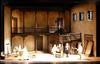
    Henry Purcell’s King Arthur or The British Worthy is not an opera in the usual sense, as the main characters do not sing. The Mark Morris Dance Group production had its American premiere in Berkeley last Saturday, and all of Dryden’s spoken dialogue is cut, meaning King Arthur himself never appears as such and basically there is no plot. The production also features the Philharmonia Baroque Orchestra under the direction of Jane Glover, the UC Chamber Chorus, and seven English National Opera singers as principals.

    At times Morris’ choreography is pat, simply miming the text, and worse yet was the absurd simulated sex at the end of Act II between shepherds and shepherdesses. There were many delightful moments also, especially the maypole dance in Act V. The dancers were all competent and utterly nonplussed by going through doors that lead nowhere dressed as giraffes or ducks or Bavarians as the case might be.

    The singing was fairly consistent as well. Iestyn Davies shows much promise as a countertenor, his voice has good volume and is quite clear. Soprano Mhairi Lawson was perhaps least impressive, she wasn’t bad by any means, but her voice is not especially pretty.

    * Tattling *
    The people in Row Q all shifted over from the side to the center, and subsequently, the man directly in front of me fell asleep for most of the first two acts. He woke up when the audience was laughing at the depraved bits of choreography. At least he and his companion had the good sense to leave the theatre at the intermission.

    Leave a comment

  • Verdiballo* Notes *
    Deborah Voigt recovered enough to sing Amelia at the closing of Un Ballo in San Francisco on September 29th. Both she and Anna Christy (Oscar) stood out as good. I noticed that Marcus Haddock (Gustavus III) doesn’t have a certain staccato quality that is necessary for some of the music. After seeing this production four times, I determined that it is a bit boring. It is so pretty, but not quite right.

    * Tattling *
    Some Scandinavian tourists brought their young daughter to the opera. The child was perhaps two-years old and was unable to keep quiet during the beginning, she screamed during the overture. The mother took the child outside for most of Act I, but returned for the rest. Thankfully the child slept for much of Acts II and III.

    Leave a comment

  • Sandyandjeanniklittlefield_2This week, San Francisco Opera received a $35 million gift from philanthropist Jeannik Mequet Littlefield, pictured here (right) with her daughter-in-law Sandy Montenegro Littlefield in September 2005 at last season’s opening.

    IHT Article

    Leave a comment

  • Neuenfelsheads1

    When I heard that a Mozart opera had been removed from the 2006-2007 Deutsche Oper Berlin season because it might upset Muslims, I immediately thought the offending opera was Die Entführung aus dem Serail (The Abduction from the Seraglio). My initial feeling was that it was a misunderstanding, as Abduction does involve conflict between Christians and Muslims. Of the two main Islamic characters, Osmin is stereotypically bumbling, violent, and chauvinistic. However, the other, Pasha Selim, is the most noble one in the opera, and in the end he is merciful.

    Imagine my surprise when I found that the opera in question was Idomeneo: Re di Creta ossia Ilia e Idamante, set in the time of the Trojan War. Apparently Hans Neuenfels’ production from 2003 features the severed heads of Poseidon, Jesus, Buddha and Mohammed.

    Neuenfelsheads 

    There were four performances of Idomeneo scheduled for November 2006, and these have been replaced by Le Nozze di Figaro and La Traviata. From the description and photographs, this Idomeneo production looks fairly typical for German opera fare. Die Entführung aus dem Serail entirely on multi-colored sofas, Semiramide in a gym, or Die Walküre with air traffic controller torches, these are par for the course. There is much to be offended by, not so much because of cultural insensitivity, but lack of respect for the audience’s intelligence.

    The cancellation must be a disappointment for the cast and crew:

    Conductor   Lothar Zagrosek
    Producer   Hans Neuenfels
    Sets, Costumes   Reinhard von der Thannen
    Chorus master   Ulrich Paetzholdt
      ~
    Idomeneo    Roberto Saccà
    Idamante    Marina Prudenskaya
    Ilia    Jacquelyn Wagner
    Elettra    Iano Tamar
    Arbace    Burkhard Ulrich / Paul Kaufmann
    Die Stimme    Harold Wilson

    Deutsche Oper Berlin Statement | NPR Segment | Deutsche Welle Article

    Leave a comment

  • Erin WoodSoprano Deborah Voigt was ill with a stomach flu last night, and her understudy, Erin Wood, made her San Francisco Opera debut as Amelia in Un Ballo in Maschera. Wood’s voice is cold and pretty, but not nearly as expansive as Voigt’s. At times she was slightly shrill and had too much vibrato. Wood wore a purple gown instead of the gold one worn by Voigt in the last scene.

    Leave a comment

  • Verdiballo1* Notes *
    A Washington National Opera production of Un Ballo in Maschera opened the new season in San Francisco under the direction of Gina Lapinski. Entirely traditional in set and costume design, it was a spectacle quite pleasing to the eye with much Louis XIV splendor. There are six scenes but only one intermission, so it was no mean feat having nearly each one rather different than the next. The least fleshed-out scene is Act III Scene 2, when Gustavus is musing in his quarters before the ball. A black screen simply hides the upstage, and a desk and chair are downstage. The last scene emerges when Commedia dell’arte characters dance out and pretend to lift the screen, revealing the splendid hall with a balcony on the upper floor and large chandeliers.

    Marco Armiliato did not seem to have complete control of the orchestra, they seemed just slightly off from the singers, particularly in the first act. The singers were all reasonably good, though of course, Deborah Voigt stands out, as her voice has a good deal of volume and command. Her voice is not flashy, but elegant and solid. It may not be worth mentioning, but Ms. Voigt had gastric bypass surgery and went from a size 28 to a size 14. A few years ago her contract with the Royal Opera, London was canceled because their production of Ariadne auf Naxos involved a little black dress that they felt would not work on Ms. Voigt. Her surgery, thankfully, has not ruined her voice.

    Other fine singing came from soprano Anna Christy, who made a trim and dashing Oscar. Her bird-like voice has a charming effervescence. Former Adler Fellow Joshua Bloom sang well as the Count Ribbing. Bloom has had six roles at San Francisco Opera in the last two years, and I look forward to hearing him in a larger role soon. Current Adler Fellow Eugene Brancoveanu also shows promise as the sailor Christian.

    None of the four singers who made their San Francisco Opera debuts with Un Ballo were terribly striking. Tenor Marcus Haddock (Gustavus III) was slightly quiet and reedy; baritone Ambrogio Maestri (Anckarström) was lackluster at times. Mezzo-soprano Tichina Vaughn may have produced fireballs on stage as Madame Arvidson, and though her voice does not lack fire, her singing was a bit rough and gasping. The other Adler Fellow, Jeremy Galyon, was adequate as Count Horn, but did not make a strong impression.

    This is the first production of Un Ballo I have managed to see. In 2003, I had a ticket to this opera in Munich, but instead went to Venice for a few weeks. Verdi’s 21st opera is based on an incident in 1792. For the premiere in Rome, Verdi was obliged to change the names of the characters and set the opera in colonial Boston instead of 18th century Stockholm. The music often has simultaneous elements of tragedy and comedy, to great effect, as seen in the finale of Act II, "Ve’se di notte qui con la sposa." The conspirators Ribbing and Horn think they’ve discovered Anckarström’s assignation with his own wife, while Anckarström mistakenly believes that his wife and Gustavus have had a tryst. The jesting of Ribbing and Horn as Anckarström vows revenge and Amelia grieves makes for a distressing irony.

    * Tattling *
    The side supertitles have been removed this season and are replaced by four small screens under the boxes so the titles are nearly unavoidable. The new general director is has also concerned himself with the length of the performances, he favors early curtain times during the week, and fewer intermissions. The sentiment is a fine one, however, many people were arrived late and naturally they chattered in standing room during the first scene. During the September 13th performance I heard no less than three cell phones, one of these was from a latecomer right next to me. The audience this day was quite absurd in other ways, they applauded when Deborah Voigt made her entrance midway in Act I Scene 2, before she had sung a note. Perhaps they did not notice she is billed last in the program, as the cast is listed by vocal appearance. They also clapped for the scenery of the last scene, the ball room. In addition, they giggled at the supertitles for Madame Arvidson’s line "Perchè possa rispondere a voi è d’uopo che innanzi m’abbocchi a Satàno." Apparently reading the word "Satan" is simply hilarious, for this happened at the September 20th performance as well.

    Leave a comment

  • Yesterday in the standing room line for Un Ballo in Maschera, two men behind me were yelling at each other. "Shut up!" said one, and "No, you shut up!" said the other. At first I assumed they must be friends simply having a bit of fun, but it became clear this altercation was in earnest. Strangely enough, there were only 5 people in line. A lady behind me asked if I had been waiting ahead of her, and I confirmed that I was second. She asserted that she was before the yelling men, and they let her be third. It was all especially bizarre since one of the men did not materialize at the appointed time for when they allow us in to take our spots.

    Leave a comment

  • CarolvanessDieter Kaegi's production of Der Rosenkavalier was revived in Seattle last month. I remember seeing posters for the 1997 performances, in which Angelika Kirchschlager sang the role of Octavian. Alice Coote made her Seattle debut in the role this time around, and her voice was strong. She is petite next to Carol Vaness, but had a suitable boyish demeanor. Julianne Gearhart was cloying as Sophie, her voice so bright it was almost as if she was making fun of the role. Peter Rose was hilarious as Baron Ochs, he danced well, but his low notes were muddled. Carol Vaness was surprisingly inoffensive as the Marschallin, though her diction left something to be desired and she didn't have terribly good control, her acting wasn't bad.

    The production itself was quite standard, the set was not elaborate but still traditional. The costumes were beautiful, all in fine rococo style. The choreography was overwrought at times. Baron Ochs' footmen got into many antics in the background, piling into the Marschallin's bed during Act I and chasing the help in Act II. Also in Act II, Valzacchi and Annina sneaked into Herr von Faninal's house and pretty much did a dance with vases while Sophie and Octavian proclaim their love for each other. While these foibles had some humor in them, in the end they were distracting and did not go with the music.

    Leave a comment

  • FigaroactiA revival of Le Nozze di Figaro opened last Saturday, directed by John Copley. The production is of the standard traditional type, the setting is a Spanish villa, curiously there is no set designer credited. There are four sets, one for each act, none painfully elaborate, no moving parts, everything is quiet and simple. This is not to say the sets were not beautiful nor to suggest they were modernist in any way. The costumes were also 18th century, they were not striking but also not gaudy.

    The cast is rather impressive, both vocally and dramatically. The only errors I noticed were minor. Camilla Tilling (Susanna) had her debut at San Francisco Opera with this performance. Her voice is pretty, though she has a bit of a raw edge. She cracked just slightly during Venite, inginocchiatevi in Act II, and she and Relyea seemed slightly off from the music in Act I, but just for a few seconds.

    Peter Mattei sings Count Almaviva well, I have never heard him in another role, but I did hear him in Le Nozze at Bayerische Staatsoper. His voice is pleasing and sweet. He acts well even though he is terribly tall and gangly, he manages to look elegant. I first saw this production in 1997 with Bo Skovhus as the Count, so I’m a bit spoilt. Skovhus is amazing.

    John Relyea is slightly more awkward as Figaro, though he is not as tall, I believe it is something about how he holds his hands. His voice is rich, he can hit all the notes in the lower range with enough ease to be quite pleasing. He is not terribly subtle in his shading, but it is Figaro, so this is fine. It is straightforward music.

    Ruth Ann Swenson was a marvelous Countess Almaviva. Her voice is cold, sweet, and bright, never shrill, with great control. Her carriage is also good, clear even from the back of the balcony.

    The audience was appalling. Apparently it is too difficult for certain people to arrive on time, and in the balcony, the ushers cordon off the seating and then watch the operas themselves. This leaves tardy and disgruntled patrons to wait in the standing room area. They are often disoriented, out of breath, and not particularly polite. They speak and one man decided that he was going to wedge himself between me and my companion. He apologized as he put his elbow between us, this was during Figaro’s cavatina in Act I. I suggested that next time, he might wait until the music was over before he inserted himself between people. I do not enjoy talking during the opera, and what’s worse this didn’t make him leave. There wasn’t enough room for him there, so my companion and I spread out just a little more so that he had to remove his elbow from the railing. He was pretty close to me, we were touching, but he was pressed up against my companion, and she had to kick him away. He wanted to intimidate us into making room for him, and possibly he did not know we were together. It was unpleasant but also humorous. He finally left after Act I, when he was seated.

    During Act III, a young blonde wearing noisy high-heeled mules was late after intermission. She was uncomfortable and walked around a lot and also spoke to her friend, once loudly exclaiming "Totally!"

    San Francisco Opera needs to keep late people in their own special section. Los Angeles Opera has a telecast in the lobby, and they simply don’t let you in at Bayerische Staatsoper if you are late.

    Leave a comment

  • Madamabutterfly1A revival of Madama Butterfly opened 27. May at San Francisco Opera. Directed by Ron Daniels and designed by Michael Yeargan, the production involves shoji screens that slide across the stage. This device was used quite a lot, and it was slightly tiresome. Also, the paintings and calligraphy on the screens in Act I were not good, and there were too many of them all bunched together without any regard. The stage creaked a bit, but at least the screens were mostly quiet. The choreography was not thoughtful, particularly ridiculous was when the chorus sang "Rispondi, Cio-cio-san!" and they all turned around and pointed their fans at Butterfly each time they repeated these words.

    The singing was consistent, no one stood out, but no one sang poorly either. Everyone acted well. Pinkerton was sung by tenor Franco Farina, who had good volume but was somewhat late during a duet with Sharpless in Act I. Everyone was crazy for Patricia Racette, the Merola alumna who sang the title role. She received a standing ovation. Her voice isn’t bad, she has too much vibrato when singing loudly, betraying a lack of control. Her voice is pretty but neither angelic nor sweet, and cold.

    I must admit that Madama Butterfly is not my favorite, there is a lot of dissonance and only one aria, Un Bel dì, vedremo, that doesn’t bore me. The snippets from The Star-Spangled Banner and the various orientalist motifs are tiresome. I do enjoy the interspersed English, including "America for ever," "Butterfly," and "Whiskey."

    The audience was incredibly stupid. They laughed at the various interactions between Sharpless and Butterfly in both Acts I and II. The Act I laughter is understandable, when Sharpless asks if Butterfly has sisters and she responds that she does not, but she has a mother, but they laughed when they saw the supertitles, now both above the stage and on the sides, not when the words were sung. They also laughed when Sharpless guessed Butterfly’s age as 10. However, in Act II, they laughed when Butterfly asked when the robins nest in America, and when she tells her child to say his name is Dolore, or "sorrow." I suspect many were there because of the geisha aspect of the plot.


    Act I
    Sharpless
    E ci avete sorelle?
    Butterfly
    Non signore. Ho la mamma.

    Sharpless
    Quant’ anni avete?
    Butterfly
    Indovinate.
    Sharpless
    Dieci.
    Butterfly
    Crescete.
    Sharpless
    Venti.
    Butterfly
    Calate.
    Quindici netti, netti;
    sono vecchia diggià.
    Sharpless
    Quindici anni!

    Act II
    Butterfly
    Mio marito m’ha promesso
    di ritornar nella stagion beata
    che il pettirosso rifà la nidiata.
    Qui l’ha rifatta per ben tre volte, ma
    può darsi che di là
    usi nidiar men spesso.

    Butterfly
    Rispondi:
    Oggi il mio nomè Dolore. Però
    dite al babbo, scrivendogli, che il giorno
    del suo ritorno,
    Gioia, Gioia mi chiamerò.

    Leave a comment