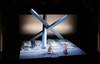
• MacbethoteyA new production of Verdi’s Macbeth opened at Seattle Opera on May 6th. The director was Bernard Uzan, his work on Tosca at San Francisco certainly was different. The Tosca production was pretty, but somewhat boring. This Macbeth is both ugly and boring.

    Robert Israel’s set was a silver room with three doors and a balcony that could be hidden. There were various ruins strewn about, and these were manipulated by the witches. The stupidest part of the opera was when blood started dripping from one of the panels of the room, predictably, for Lady Macbeth’s mad scene. Mats had been carefully placed on the floor where the blood dripped, so when one panel started dripping, the audience could see just where the next blood streams would appear. Israel’s costumes were pretty dull, a lot of tartan, except for the witches, who seemed to be dressed as either brides or widows from different eras, with some red shoes or gloves for good measure.

    Gordon Hawkins was adequate in the lead role, he had sung the night before and Louis Otey was set to sing for our particular performance, but he took ill and was replaced at the last moment. Elena Zelenskaya was a cold Lady Macbeth, her voice is icy. The cast was all fine, but not particularly exciting, with the exception of tenor Joseph Calleja as Macduff. He was the only voice that stood out and his brief aria in Act III was the high point of the performance.

    It was a bit surreal to hear the famous lines of Shakespeare being sung in Italian, for some reason Otello doesn’t bother me as much as Macbeth as an opera. Also, much of the music in Act I and II struck me as inappropriately gleeful.

    Leave a comment

  • RodalindaactiiWadsworth production of Händel's Rodelinda opened at the Met on Tuesday, May 2, 2006. I was surprised that Thomas Lynch's set was so beautiful, since his Lohengrin was reminiscent of IKEA, though admittedly, his Ring set for Seattle was gorgeous. The library set was particularly impressive to the audience, which gasped when it was revealed in Act II. Act II also featured a horse, this device being a perennial favorite. The scenes changed flawlessly, the set moved both left and right and up and down. It was a bit much though, one did feel that things were always in motion, if not in the set itself, then in the choreography. The singers frenetically dashed around, seemingly without purpose. It was as if they believed the music was just so boring that it was necessary to fidget and fumble all over the stage as a method of distraction.

    As for the singing, the lead, Renée Fleming, was somewhat flat, her voice is thin and she seems distant even though her volume is fine. Her voice has not a trace of sensuality, though I am not convinced that is necessary for Baroque music. Mezzo-Soprano Stephanie Blythe (Eduige) had more emotion in her voice, though she can be harsh. Tenor Kobie van Rensburg (Grimoaldo) also had passion, though his arpeggios and trills were weak and muddy. Bass John Relyea was a suitable villain as Garibaldo, the role does not show off how beautiful his voice is. Countertenor Christophe Dumaux (Unulfo) has an exceedingly girlish voice, light and slightly quiet. Andreas Scholl certainly was the star of the show, though his Bertarido was slightly stiff and awkward, vocally he was amazing. He has incredible power and control. His transitions between head voice and chest voice were perfect.

    Leave a comment

  • Ken_howard_brian_asawa_lisa_medThe Met production of Händel's Giulio Cesare in Egitto opened at San Diego Opera last Saturday. This production was in San Francisco in 2002, so I was familiar with both the music and the staging. This was somewhat unfortunate, as it started off badly, Ewa Podleś, in the lead role, was ahead of the orchestra. The conductor, Kenneth Montgomery, attempted to catch up to Podleś, and it was just painful, they sounded rushed and confused. It was a disappointment, as Podleś has an incredible voice. She was also off during the aria "Va tacito e nascosto." The production would have benefited from a prompter. If there was one, I did not see this person, and it certainly did not sound like there was a souffleur.

    Mezzo-soprano Vivica Genaux played and sang the part of Sesto rather well, her aria that ends Act II was one of the best moments of the evening. Perhaps my poor impression of her in Il Ritorno d'Ulisse in Patria was just because the production was so awful, because she sang well in L'Italiana in Algeri.

    Countertenor Brian Asawa was fabulous as the villain, Tolomeo, acting and singing well. He seemed so unassuming when he replaced David Daniels in Saul, I was surprised to see how much he swaggered and so forth.

    I was unimpressed by Lisa Saffer's Cleopatra, her voice is nice, if not somewhat bland, until she gets to her high range. When singing loudly at this range, she sounded out of control.

    I hope that Florida Grand Opera's production of this opera, which comes to Seattle next year, is better. Alexandra Deshorties joins Podleś and Asawa, it should be interesting.

    Leave a comment

  • FrazuremooreluceyWhen the advertisements on buses declare "This Ain’t Your Daddy’s Mozart" in reference to a run of Così fan tutte, one certainly should be prepared for something outlandish. Jonathan Miller’s production opened late last month at Seattle Opera, and it is certainly both hilarious and bizarre in a way that many contemporary offerings are not. At least he is engaging the audience, quite opposite of Robert Wilson or Anna Viebrock. Sadly, the performance lost steam by Act II, the plot is less absurd and more disturbing, and the buoyancy was significantly reduced in the second half.

    The super titles for this production were exceedingly loose in their translation, and made the audience laugh pretty much throughout the performance, simply because it was clear that the words on the screen were not the words coming out of their mouths. "Bella vita militar!" was rendered "Come join the army!" and "Io non so se son Valacchi o se Turchi son costor." was something like "Are they from California or Aberdeen?" (a far cry from Walachia or Turkey). It was unclear whether or not the libretto was changed in all cases, because the laughter often obscured the words and the diction of the singers was not particularly good. I suppose this was a novel shift, how perfectly post-modern to make the super titles a focal point of the opera!

    The costumes and staging were brought into modern day. Instead of being a maid, Despina is a personal assistant. She brings Dorabella and Fiordiligi Starbucks lattes instead of hot chocolate. Ferrando and Guglielmo wear UN uniforms to battle, and later, instead of pretending to be indeterminate foreigners from east of Naples, they are from Federal Way, WA. Except for the very first scene, the action all takes place in a single room with white walls, with one doorway in the middle, a few white upholstered chairs, a coffee table, a pile of white cushions, and a pink upholstered couch with a white sheet over most of it. This means the chorus is never seen, and their singing is rather muffled. As for the choreography, it involved much dancing about and air guitar.

    This production would have been much better if the singers were with the orchestra. Perhaps it was the lack of souffler, but at least three of the singers were off from the music at various times during the performance. There are only six parts, so that is definitely a poor showing. It seems that the director was more interested in being witty and not as concerned with something as basic as having one’s singers sing in correct time with the orchestra. Taken as a whole, the singers seemed quiet, in the dress circle, where the acoustics should be at their best, there were times when I had to strain to hear. This was the alternate cast, so perhaps the regular cast was better. Frances Lucey sang a charming Despina, her part is not particularly difficult as far as singing. Jessica Jones did not quite have the low range for Fiordiligi, her voice cracked slightly when she jumped down in "Come scoglio immoto resta." Don Frazure was decent as Ferrando, it is nice to have a tenor that isn’t awful. Maria Zifchak (Dorabella) and David Adam Moore (Guglielmo) acted well but did not have exceptional voices.

    Leave a comment

  • Looking at the upcoming season for 2006-2007 for San Francisco Opera, I felt a bit boggled. Even the new site design was somewhat alarming, simply because the aesthetic is about a 180 degree turn, from pop to traditional. Then I remembered that Pamela Rosenberg has left for the Berlin Philharmonic and David Gockley, most recently of the Houston Grand Opera, is the new general director.

    The season is as follows:
    Verdi’s Un Ballo in Maschera
    J. Strauss, Jr.’s Die Fledermaus
    Verdi’s Rigeletto
    Wagner’s Tristan und Isolde
    Rossini’s Il Barbiere di Siviglia
    Puccini’s Manon Lescaut
    Bizet’s Carmen
    Mozart’s Don Giovanni
    R. Strauss’ Der Rosenkavalier
    Gluck’s Iphigénie en Tauride

    First of all, there are ten operas, more than we’ve had in recent memory. Second, there are no contemporary operas included. How strange, indeed. At least the productions of Tristan und Isolde and Don Giovanni look particularly unpromising, the former is directed by Herbert Kellner, who used Noh puppeteers in the Chicago Lyric Ring, and the latter apparently has an oversized skeleton in the last scene.

    As for interesting singers, Deborah Voigt is singing Amelia in Un Ballo, Karita Mattila is Manon Lescaut, and Bo Skovhus is Oreste in Iphigénie.

    Leave a comment

  • K. Jernek’s production of Rigoletto at Státní opera Praha is fairly traditional, the costumes looked to be from Renaissance and the set was simple, but not stark. There was a large gold ring hanging above the stage with curtains coming down from it that never seemed to leave the stage, though the curtains would be pulled up and so forth. This blocked some of the background. The staged turned and this facilitated some of the changes of scene. I couldn’t quite figure out why the beginning of the first scene features a dancer wearing a brown-hued unitard and scant jewelry, her face painted dark and wearing a short curly black wig. She danced on the table. This was even worse than the last Rigoletto I saw at San Francisco, which had a few dancing ladies in it wearing under-bust corsets without chemises.

    As for the singing, only the soprano, Marina Vyskvokina, was better than mediocre. Her voice is cold, bright, and flexible, which is perfectly in vogue at the moment, but also suitable for the part of Gilda. The tenor, Valentin Prolat, had bad timing and was ahead of the orchestra at the very beginning. His voice is overly bright, nasal, and reedy. He was especially bad in the quartet in Act III, his intonation was even off at that point. Too bad his was the most famous aria of the opera. The bass, Lukáš Hynek-Krämer, sounded artificial and also had poor intonation. Thankfully, at least Richard Haan was pretty good in the title role. His voice lacks a bit in fullness, but he acted well.

    The audience was possibly the worst-behaved I have witnessed to date. They could not stop taking photographs of the inside of the opera house, although it was stated, in several languages both in spoken and written forms, that such photographs were not allowed. A French girl behind me actually sang along with the Act II overture.

    Leave a comment

  • WilsondonutA new production of Parsifal opened at Los Angeles Opera on Saturday, directed and designed by Robert Wilson of The Black Rider fame. The production itself is awful in every sense, being no less than pretentious, cold, and boring. The choreography involves a lot of lying on the ground, random angular arm movements that relate neither to the text nor the music, slow walking, and having the characters ignore each other. The highlights of Stephanie Engeln’s set include an enormous swan wing falling slowly in the background, a lighted giant bagel-half that descends from above, a bunch of small white birds of paradise sculptures that move across the stage, and a large version of one bird of paradise that takes the same path of the wing from Act I. The Frida Parmeggiani costumes have an Egyptian flair, dresses for everyone, in black or white, save Kundry’s plum-colored outfit. A.J. Weissbard’s lighting does not seem entirely polished, at several points the lights wavered and did not follow the characters.

    Plácido Domingo sings Parsifal well enough, the tenor strains a great deal and the apparent lack of affect that characterizes the production did not make him very convincing as a young man. Bass Matti Salminen also sings beautifully as Gurnemanz. Linda Watson’s Kundry is not wild in the least, her high notes may be clear and brilliant, but her low notes are weak. Kent Nagano certainly tosses his hair a great deal, at least he conducts with some passion, perhaps the only sign of life to be seen all evening.

    Leave a comment

  • FidelioSan Francisco Opera’s revival of Fidelio opened last night. The production is directed by Michael Hampe and designed by John Gunter. The set is clever, with floors that lift up, and walls that can be moved aside. This facilitates scene changes, which went seamlessly throughout. The contrast of the openness in the final scene and the rest of the opera was rather deft. The set and costumes were both kept in 19th century style, no fedoras, no trench coats. The only noticeable flaw in the staging was the timing of the curtain, which came down before the music ended in both acts, causing the audience to clap before the music was finished.

    The singing was solid with the exception of tenor Thomas Moser as Florestan. Moser’s voice is a bit thin and reedy, especially in his upper range. At the end of his sole aria in the beginning of Act II he was simply shrieking. Soprano Christine Brewer was not visually convincing as Leonora, but when she sang, her lovely warm voice fit the role very well. The other roles were cast appropriately: Mathias Zachariassen (Jacquino), Greta Feeney (Marzelline), and Arthur Woodley (Rocco) all sang and acted well.

    John Pearson played the Trompetenfanfare in Act II beautifully, it was the very sound of salvation.

    Leave a comment

  • LaforzaSan Francisco Opera's new production of Verdi's La Forza del Destino, directed by Ron Daniels, opened last Wednesday. They used the revised 1869 version and not the 1862 version that premiered in St. Petersburg. In this revised version Don Alvaro does not throw himself off a cliff, and there is something of a sense of hope despite the demise of the other two main characters.

    The premiere of this new production was rather fraught with problems. Since there are so many scenes and so many set changes, curtains were often employed to hide the various changes. After Act I Scene i, Catherine Cook (Curra) and a fancy chair got caught on the wrong side of the curtain. Cook handled this well, hiding up against the curtain, and since her costume was the same color as the curtain, she was fairly discreet until she ducked under it. Other lapses in the professionalism behind the scenes were striking. The people backstage were far too loud. At the end of Act I Scene iii of La Forza there is a beautiful organ solo, and this was marred by a woman's voice backstage who clearly said "Standby." Moreover, during the last few moments of the sublimely quiet final scene, talking from backstage was audible.

    The synopsis printed in the program was rife with oversights, both in terms of numerous typographical errors and simple plot inaccuracies. For instance, Act II was incorrectly marked as Act I, which anyone could see at first glance. They did manage to correct this by the second performance on Saturday. But worse was the plain misinformation. Don Alvaro does not appear in Act I Scene ii at all, yet the synopsis read "The young villagers welcome the travelers (Alvaro and Leonora in disguise)…" Also, for Act I Scene iii, the synopsis read "Frightened and alone, Leonora prays that the Virgin will not abandon her. Because she is not a woman, she's not permitted to enter the monastery." This editorial sloppiness seems to betray an overdependence on spell check and a general dearth of competence.

    Both Roland Aeschlimann's set and Andrea Schmidt-Futterer's costumes were vulgar. First there was this odd progression from black and more traditional in the first act, to more modern grey and camouflage in the second act, then to dirty white at the end. As for the actual set, the toppled-over triumphal arch in the first two scenes, the mess of oversized jacks in Act II, and the enormous white sculpture of 3 beams meant to be Leonara's cave were all a bit silly. The costumes were fine until we got to the vivandières in Act II, who were recast as prostitutes and had punky hairstyles and dramatic white makeup on their faces and exposed breasts. The nipples on Preziosilla's red leather vinyl corset were slightly gratuitous as well.

    The whole production was overwrought and ponderous. The recorded sounds of bombs, bullets, and machine gun fire during the battle in Act II was unnecessary, there is plenty of noise being generated by the orchestra. Also, why have the chorus try to dance around in the dark during the patrol chorus of in the same act? They failed to be together with each other or the orchestra during the working rehearsal, the opening performance, and last Saturday's matinee.

    Soprano Andrea Gruber was perhaps not the best choice for Leonora. Her vibrato lacks control, and her gasping is audible from the very back of the opera house. She lacked acting skills as well, during Saturdays' performance her robes got tucked up in her belt, showing an uncomely amount of thigh and calf. With her back toward the audience, she tried to fix her costume, instead of simply letting it go. Tenor Vladimir Kuzmenko was, however, great as Don Alvaro. His voice is huge, but he shows a lot more control than Gruber. Željko Lučić was also very good as Don Carlo di Vargas, and his duets with Kuzmenko were some of the best moments of the opera.

    Nicola Luisotti conducted with great energy, and the orchestra played very well. This opera has a beautiful overture, a good deal of lovely music, and the ending has a certain remarkable stillness.

    Leave a comment

  • Forzaacti_5San Francisco Opera’s new production of La Forza del Destino opens next week on Wednesday, November 2nd. The opera company invited subscribers to see a working rehearsal yesterday, and the experience certainly was educational. One could hear the director, Ron Daniels, screaming at the performers, and this is quite a different view than one usually has, to say the least.

    The production looks to be an odd mixture of time periods, there are swords and machine guns, Preziosilla wears a red vinyl corset and trousers with a long black vinyl coat, but the dancers in the same scene wear long black gowns with ruffled petticoats. The scenery is bizarre, in the background of the first two scenes is a triumphal arch toppled over, the last scene features an enormous white sculpture of 3 beams leaning on each other like oversized sticks for a campfire. In Act II, the part which occurs in the forest near Velletri, Italy, the floor is covered with a camouflage design.

    Though it is perhaps not fair to judge the singers based on this rehearsal, I found the Leonora, soprano Andrea Gruber, to be lacking. She doesn’t seem to have much control of her vibrato, and her voice has a breathy, gasping quality. She did have sufficient volume. She fell out of character at times, brushing her hair off her face at inopportune moments, but this may not be representative of what will happen at the actual performances. Don Alvaro was sung rather well by tenor Vladimir Kuzmenko, who also has a good deal of volume. I most enjoyed the Padre Guardiano, bass Orlin Anastassov, but he only sang for Act I Scene 3, the rest was sung by an understudy or stand-in. Fra Melitone, sung by baritone Lucas Meachem, was a good actor, but he is a bit quiet, which was fine for Act I Scene 3, but for Act III Scene 1 he sang with most of the orchestra playing, and one could not make out much of his voice over the din.

    The opera itself is strange, the main singers are kept off the stage for many scenes and only sing together at the beginning and the end. Musically, the ending is weak, it simply sputters out into silence. But it may well be I need to listen to this again.

    Leave a comment