• NormaThe Canadian Opera Company’s production of Norma opened at San Francisco Opera last Sunday. The cast is strong, so it is certainly worth seeing. The production itself is uninspired. Remember those tiny houses you built in 3rd grade with your meticulously saved popsicle sticks? The set, designed by Allen Moyer, is reminiscent of these crafts, but on a larger scale. The haphazard walls made from wooden boards, along with the tree stumps, were apparently metaphor for how the Romans did not care about what the Druids held most dear. I wonder what the dirt-covered hems of Druidic costumes were a metaphor for, also note that the wooden structures were painted black at the bottom, but were light-colored at the top.

    The costumes for the Druids were more bizarre than the Roman ones. The priestesses wore gauzy straightjackets that laced up the back and flowing gowns. Some of the Druid men wore loincloths in Act II, which was slightly startling, some put on robes later, others did not. The Romans wore short tunics with breastplates, military belts, and greaves.

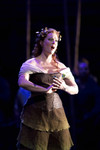
    Catherine Naglestad is a beautiful Norma, she sang well, though not without great effort. Mezzo-soprano Irina Mishura was more impressive as Adalgisa, her tone is sweet but her voice is powerful.

    I spend much of the intermission speaking to the architect-coot from Napa, who introduced himself as Dave. We first met in the standing room line for Rodelinda last month, and he recognized me because of my absurd costume. Dave started going to San Francisco Opera in 1957. His first opera performance was Gounod’s Faust, when he was around 20, at the Glimmerglass Opera Festival. He asked me if I was a music student, and when I had seen my first opera.

    Leave a comment

  • DAactI_093John Adams' Doctor Atomic had its world premiere on the first day of this month at San Francisco Opera. The opera is in English and is set in New Mexico in July 1945. It starts off with the chorus singing something like "Energy! Matter can neither be created nor destroyed!" It was difficult not to laugh, and I admit, I did laugh many times rather inappropriately to the situations being depicted. The audience was more or less indifferent to these scenes, which I found impossibly absurd.

    Adrianne Lobel's set was appropriately stark, many aspects of it moved vertically and hung from the unseen ceiling. The floor had geometric shapes carved into it, a circle off to the right side midstage, upstage some lines met. Certain elements of the set design and staging were rather cliché. The shadow of Oppenheimer behind the sheet covering the bomb was especially egregious, as was a crib strategically placed beneath the bomb itself.

    Lucinda Childs' choreography was somewhere between Graham and dance seen in musicals. Too bad SF ballet has no sense of synchronization, it could have been very good. The loudness of the music did cover up most of their eternal clumping, however. One of the dancers did execute a gorgeous hinge to the ground as Pasqualita (Beth Clayton) sang about cloud blossoms.

    The singers were quite solidly good. Often with contemporary music, I can't really tell one way or another. I liked the aria "Batter My Heart, Three-Personed God" at the end of the first act, it almost sounded Baroque. The words are from John Donne's Holy Sonnet XIV, and thus are not completely inane. It actually has a tune a normal person can follow and perchance even remember. Adams, at times, sounds very much like Glass to me, a lot of agitated clanging and building up without release.

    In the end, the release is simply silence. This dead silence is extremely unusual at the opera and only happened because the audience was could not tell if there was to be more singing.

    John Adams' Doctor Atomic had its world premiere on the first day of this month at San Francisco Opera. The opera is in English and is set in New Mexico in July 1945. It starts off with the chorus singing something like "Energy! Matter can neither be created nor destroyed!" It was difficult not to laugh, and I admit, I did laugh many times rather inappropriately to the situations being depicted. The audience was more or less indifferent to these scenes, which I found impossibly absurd.

    Adrianne Lobel's set was appropriately stark, many aspects of it moved vertically and hung from the unseen ceiling. The floor had geometric shapes carved into it, a circle off to the right side midstage, upstage some lines met. Certain elements of the set design and staging were rather cliché. The shadow of Oppenheimer behind the sheet covering the bomb was especially egregious, as was a crib strategically placed beneath the bomb itself.

    Lucinda Childs' choreography was somewhere between Graham and dance seen in musicals. Too bad SF ballet has no sense of synchronization, it could have been very good. The loudness of the music did cover up most of their eternal clumping, however. One of the dancers did execute a gorgeous hinge to the ground as Pasqualita (Beth Clayton) sang about cloud blossoms.

    The singers were quite solidly good. Often with contemporary music, I can't really tell one way or another. I liked the aria "Batter My Heart, Three-Personed God" at the end of the first act, it almost sounded Baroque. The words are from John Donne's Holy Sonnet XIV, and thus are not completely inane. It actually has a tune a normal person can follow and perchance even remember. Adams, at times, sounds very much like Glass to me, a lot of agitated clanging and building up without release.

    In the end, the release is simply silence. This dead silence is extremely unusual at the opera and only happened because the audience was could not tell if there was to be more singing.

    But as I look back on other recently composed operas that have happened at SF, Doctor Atomic is probably the least awful. Saint Francis just sounded like cell phones because of the ondes martenot, Le Grande Macrabre was painfully absurd, and Doktor Faust was simply nothing much.

    Leave a comment

  • Yesterday someone pulled the fire alarm at just ten minutes before curtain time for the last performance of L’Italiana. Everyone filed out in an orderly fashion, but it took quite a long time to get back inside and settled in again. During the performance I wanted to note that in Act II, Vivica Genaux does a pivot with floreos where Olga Borodina did a cute head slide gesture that went with the music better. Also I would like to remember how nicely William Burden and Ricardo Herrera danced throughout, but especially when they are explaining to Mustafà about the Papatacci, their dance that involved pesk horns at the end was charming.

    The latter part of Act II bears a striking resemblance to parts of Così fan tutte. The scene in which Isabella sings "Pensa alla patria" has a choral part like "Bella vita militar!" When Taddeo gives Mustafà the oath of the Papatacci, "Di veder e non veder," it is somewhat like the scene Così where Despina pretends to be the notary.

    Additionally, Patrick Stewart was at the symphony the night before last. I believe he had a box. He probably couldn’t hear Leon Fleisher’s vocalizing from so far away. Though the acoustics at Davies are rather special.

    Leave a comment

  • The alternate in the title role for San Francisco opera’s production of L’Italiana in Algeri is excellent. I was not impressed by mezzo-soprano Vivica Genaux in Il Ritorno d’Ulisse in Patria, but I think her voice is better suited to something airy and light like L’Italiana. Her voice was incredible in the role of Isabella, her ornamentation was good and her bird-like voice is prettier than Borodina’s. Genaux does seem more awkward than Borodina, almost boyish, she doesn’t have that swagger and sass. Also to be noted, the other alternate, bass Dean Peterson, was pretty good as Mustafà, but still not perfect.

    I was glad to see that some of the choreography was changed to suit Genaux and Peterson, it makes more sense than forcing them to do movement that worked perfectly on Borodina and Abdrazakov. For example, at the end of Act I when Isabella is first presented to Mustafà, Borodina slyly steals Mustafà’s turban and pushes him off his velvet throne. On the other hand, tiny Genaux could not carry this off, so instead she climbs on the throne and and steals the turban from there. Genaux does not quite have the same confidence in movement as Borodina, but she did rather well, considering she is an opera singer, and Borodina certainly is an exception.

    The performance solidified my admiration for tenor William Burden, his voice is certainly worth hearing again.

    Leave a comment

  • The Oakland Opera Theater's production of Philip Glass' La Belle et la Bête was fully-staged instead of using Jean Cocteau film. Tom Dean & Garrett Lowe's set took inspiration from the film, but the staging also had a bit of a circus influence. There was stilt walking and contorting, which may have been my favorite part.

    The staging had a few flaws that were inexplicable unless one has seen the film. The part of the white horse, Magnifique, is cut, and Belle goes through a mirror instead. But then how do Avenant and Ludovic find their way to the domain of the Bête? Also, the parts of the Bête and Avenant are played by different people, so the dialogue at the end makes very little sense.

    Oakland Opera Theater performances always have a rumpled feel, of being not particularly polished, but honest, at least. The singers seemed to do well in their parts, but in a theater that only held 70 people, one didn't need to project much. Also, the orchestra was behind and above the stage, so one could always hear the singers just fine. I do find it terribly strange that in their two casts, one Belle is a soprano (Marguerite Krull), the other a mezzo (Jennifer Boesing).

    Glass' music is rather repetitive and very suitable as a film score. As an opera, it doesn't quite cohere, one feels that the musical line never develops.

    Leave a comment

  • Aldenrodelinda1The production of Händel’s Rodelinda currently at San Francisco Opera is one from the Bayerische Staatsoper, and I had attended a few performances of it in Munich a few years ago. It is one of the tamer offerings of this particular director, David Alden. The opera is set as 1930s film noir, Buki Shiff’s costumes are rather pretty because of this, especially Rodelinda’s dashing black evening gown in Act II. The set consisted of various brick walls that were strategically moved about, there was also a recurring black and white image of a man with his arms crossed in front of him. He appears in eight cut-out figures in Act I, the largest being around 16 feet tall, and the smallest about 7 feet. Later he shows up in Act III, but only as a half-length, and only seven pictures this time.

    I objected to just how buffoonish they had Unulfo be, when his character is rather noble, he is loyal to Bertarido and is willing to die for him. Instead they have Garibaldo beat him up and stuff wadded up paper down his throat. It was annoying when Garibaldo sings an aria in Act II, Unulfo screams in pain during the music. Then in Act III when Bertarido mistakenly attacks Unulfo with a kitchen knife, the latter runs into a wall, making his wound all the worse. Of course the knife is simply placed under the arm, and this is made extremely obvious.

    Another flaw in the staging occurred at the end of Act II, during the very end of the gorgeous duet between Rodelinda and Bertarido, "Lo t’abbraccio." Catherine Naglestad and David Daniels sang brilliantly, but the staging involved putting Bertarido in the trunk of the vintage black Mercedes on stage. This elicited titters from the audience, which is completely inappropriate considering both how moving and ravishing the music is at that point.

    The choreography was perhaps too difficult for the singers, I remember choreographer Beate Vollack being quite a favorite in Die Fledermaus in Munich. The choreography, minus drunken staggering, could have worked with just the right cast. It was a stark contrast to the excellent movement in L’Italiana last weekend.

    As for singing, Naglestad sounded unsure at the beginning, slightly shrill, her voice cracked a bit during her second aria. She doesn’t make it seem effortless. But there were some beautiful moments later in the opera. Daniels had a good performance, his voice is powerful and resonant, no trace of grit today. When he occasionally moved into his chest voice one gets a sense of how much heft his voice has, it is incredible. Tenor Paul Nilon was rather colorless as Grimoaldo, his dancing also did not betray much verve. Mezzo-soprano Phyllis Pancella did not impress either, and her dancing was flat-out bad, her back looks incredibly stiff and she has slumped shoulders. Gerald Thompson showed promise as Unulfo, at least in his voice, his countertenor has a sweet tone.

    Leave a comment

  • The production of Rossini’s The Italian Girl in Algiers currently at San Francisco Opera belongs to Santa Fe Opera, where it was premiered in 2002. The style of director Christopher Alexander is possibly more suited to this comic opera. The last opera he directed at San Francisco was Turandot in 2002, which looked like something from the circus, but this can be squarely blamed on David Hockney’s lurid set and costumes. The set of L’Italiana was designed by Robert Innes Hopkins, and consisted mainly of a huge pop-up book with one scene of arcades. Also included was a crashing plane and hot air balloons. The costumes, designed by David C. Woolard, were from 1920. The choreography throughout was done quite well, and all of the singers were proficient at movement, they performed splendidly.

    As for singing, mezzo-soprano Olga Borodina, as Isabella, was in good form. Her voice is strong, dark, and piercing. At times it is slightly breathy. Tenor William Burden was impressive as Lindoro, his first aria "Languir per una bella" was excellent, his tone exceedingly sweet and sufficiently loud. Bass lldar Abdrazakov sang adequately as Mustafà, the part is demanding, and Abdrazakov’s voice is not exceptional. He is , however, a fine actor. Bass Ricardo Herrera sang the buffo part of Taddeo well, his duet with Borodina in Act I, Scene 2 was good. Soprano Jane Archibald was fine as Elvira, nothing flashy, but she was the anchor of the finale in Act I.

    The first half of the opera is stronger than the second musically, Act II just doesn’t come through on the promise of Act I. The end of Act II is simply not strong, neither musically nor dramatically. Though the libretto has much in common with Die Entführung aus dem Serail, L’Italiana is mere farce.

    The matinee audience was fairly well-behaved, with a notable exception. Some person had an altercation with Sharon, one of the people who heads the ushers. She apparently asked him not to lean against the wall during the overture of Act I and he had a fit which involved him speaking at full volume and calling her a "pain in the ass."

    Leave a comment

  • GheorghiumastromarinoThe current Los Angeles Opera production of Pagliacci is surprisingly good, especially when one considers the opera company is a mere 20 years old. Franco Zeffirelli brought the staging into the 20th century, the set was urban, the costumes were fit for a disco, but there was also a roller blader, so a bit of a mix. There were a bunch of acrobats, a person on stilts, a live donkey, drag queens, and confetti.

    Tenor Roberto Alagna seemed somewhat hesitant at first as Canio. His voice is light with a slightly reedy nasality. But his voice came through for Recitar…Vesti la giubba at the end of Act I, and he sang well in Act II. Soprano Angela Gheorghiu also has a fresh light voice without much heft, but still has sufficient volume. She also is extremely attractive, and thus quite believable as Nedda.

    Baritone Mariusz Kwiecien held his own as Silvio, this part is to be sung by Rodney Gilfry in the last two performances this season, but for now Gilfry is only singing in The Grand Duchess. Kwiecien was very good in La Bohème at San Francisco Opera a few seasons ago, and this time around I was impressed by how warm and rich his voice is compared to the two leads. On the other hand, though baritone Alberto Mastromarino acted well in the part of Tonio, he lacked control and was off key at times.

    The choreography and costumes both came off well. The most lovely costume was Columbina’s, a frothy pink skirt with black polka dots and swallows paired with a tight high-collared black blouse with pink-sequined trim.

    The patrons of LA opera are terribly noisy, whispering a great deal, and applauding at every little thing. After the Act II overture there was so much clapping that the conductor had the orchestra rise to be acknowledged further. The opera also started with the Star-Spangled Banner, for Patriot Day, one imagines, but this was not stated.

    Leave a comment

  • Last month I attended a performance of The Queen of Spades at San Francisco Opera. The Russian operas are always very well attended here, so generally there is one each season, though surprisingly, Eugene Onegin was also given earlier in the 2004-2005 season.

    The production presented is owned by the Welsh National Opera, and the singers involved were better than the ones the Petersburg production I attended last year. Roy Rallo’s stage direction was somewhat tedious. At first it might have been tolerable; the enormous portraits of the title character used as scrims and decor were silly, but not unbearable. The puppet show they put on in Act II was cynical to the point of being moralistic, but also, I could have overlooked this.

    But in the last act, second scene, we are looking down into Gherman’s room, and the bed was disproportionately large. I knew something was going to occur. The ghost of the Countess popped up as an enormous skeleton, and the singer herself had to sing from backstage. Hanna Schwarz had the best voice of the cast, and I had been looking forward to hearing her one last time. Of course, the absurdity of the staging elicited tittering. Then at the end, the skeleton reappears, peering in through the skylight.

    Leave a comment

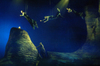
  • RheingoldSeattle Opera is especially dedicated to the works of Richard Wagner. The founder of this opera company, Glynn Ross, apparently adored Wagner at a time in which his works were generally neglected by most American opera houses. Seattle Opera has built its reputation on staging Wagner in a traditional manner, a reaction to the ultra-minimalism of Bayreuth. From 1975 to 1983 they gave Der Ring des Nibelungen every summer, in both English and German versions. This month Seattle Opera is staging their third production of Der Ring for the second time. Glynn Ross' ambitions certainly have been fulfilled, as these performances were sold-out a year in advance, even the waiting list had to be closed 8 months before the cycle began.

    Stephen Wadsworth's production has a particular emphasis on nature, many of Thomas Lynch's sets are covered in greenery. The most evident motif throughout were human coverings: the robes of Wotan and Siegmund were especially prominent, the former used as Brünnhilde's pillow, the latter dragged all about by Siegmund, Sieglinde, and Siegfried.


    Das Rheingold
    The audience was rather delighted with the acrobatic Rheintöchter, they were suspended from the ceiling and did all sorts of flips and dives. They were still able to sing quite well despite the athleticism required, good thing they were forced to be on some sort of cardio/yoga/pilates regimen beforehand. I was a bit confused by the staging though, it leaves Alberich on the bottom of the Rhein, since he is on the stage and they are above him.

    They cast people well, Richard Paul Fink and Thomas Harper were suitably small as Alberich and Mime respectively, and Fasolt and Fafner, Stephen Milling and Gidon Saks, were convincing giants.

    The weakest scene of the opera, and possibly the whole cycle, was the third scene in when Wotan and Loge go to Nibelheim and trick Alberich into changing into first a giant snake and then a toad. Both simply looked like children's toys, and the snake was not impressively larger than the toad. This received an audible giggle from the audience.

    The singing was fairly even. Compared to the Bayerische Staatsoper Ring production of 2003, the only singer that was less impressive was Greer Grimsley, because John Tomlinson was an amazing Wotan. Grimsley was slightly quiet, but consistent. Tomlinson was fuller and more brilliant, but he was also singing with a poorer cast, so it could be simply the contrast. The most exciting vocals came from Ewa Podleś in her tiny role as Erda. As she rose from the earth her enormous voice seemed a force of nature.

    Die Walküre
    Everyone seemed to adore Margaret Jane Wray and Richard Berkeley-Steele as the Wälsungen, but I found Stephen Milling's voice most compelling in his role as Hunding, though he did not make a particular impression on me as Fasolt in the earlier opera. His voice had a certain command, it is very solid. Jane Eaglen was at her best as Brünnhilde, her high range never grates nor threatens to break glass, her low range is quiet.

    The set for Act III (Auf dem Gipfel eines Felsenberges) where we find the Walküre left something to be desired. It looked too clean and neat, as if one had bought it from IKEA. It reminded me of the set for Seattle's Lohengrin, similarly flat and linear. Thomas Lynch designed both, no surprise there at all.

    Also, the Walküre threw around the various body parts of fallen heroes during that first scene. For some reason, this struck me as slightly tacky, something out of a horror movie. Another trivial point, it might have been nicer if the rest of the Walküre had been a little more substantial physically, since Jane Eaglen may well be around 300 pounds. This visual contrast was slightly bizarre.

    Siegfried
    The most notable flaw in this performance was having the singers be percussionists. One would never force the singer of Siegfried to play the famous horn call, why should a singer then, be forced to be a percussionist? Thomas Harper (Mime) was more confident of his playing, but still was off at times, and Alan Woodrow's playing was just painful to watch, and more importantly, hear. It was too bad, since he made a nice enough Siegfried otherwise, singing adequate, and his acting was charming. He does petulant and boyish well. They also pulled off the bear part at Siegfried's first entrance, the bear suit donned by tenor Steven Goldstein.

    Surprisingly, the Act II scenes with Fafner as a dragon were also done well. The puppet was suitably grand. However, the Waldvogel part came off less well. A stuffed bird was illuminated in the trees, but it was very difficult to see. Wendy Hill's voice sounded very pleasing, and it might have been better if we could have heard her from the stage.

    Act III Scene 1 was definitely the best part because of Podleś. The Act III love scene was slightly painful, Eaglen waddles, and when she spun around in delight at Siegfried, I didn't know whether to laugh or cry.

    Götterdämmerung
    The beginning Norn scene was impressive, Podleś and Stephanie Blythe have such big voices, Wray is full but not as hefty. Gidon Saks (Hagen) was ill and his voice was quiet and strained. Woodrow's singing in Act III Scene 2 as Siegfried dying was especially good, not flawless, but very beautiful. Eaglen put everything she had into the Immolation scene, it was transcendent, her voice gleaming.

    As for the staging and set, the Halle der Gibichungen was very dull, it was in no danger of being a distraction. Act III Scene 1 with the Rheintöchter down from their harnesses was charming, though the arm choreography didn't much make sense, it looked like they were flapping. The last scene was utter madness, the scrim came down with fire projected on it, the gods all reappeared on a platform, and the Rheintöchter reappeared to catch the ring that Brünnhilde throws up into the air. Somehow this all came together.

    Overall, it certainly was ambitious. Robert Spano did not seem to have any exquisite control over the orchestra, nor was his conducting particularly fiery. The traditionalist approach to the stage direction makes it obvious how difficult it is to stage something so fantastical without being kitschy. One begins to understand why all those bizarre contemporary stagings exist, they are a sort of distraction.
    Leave a comment