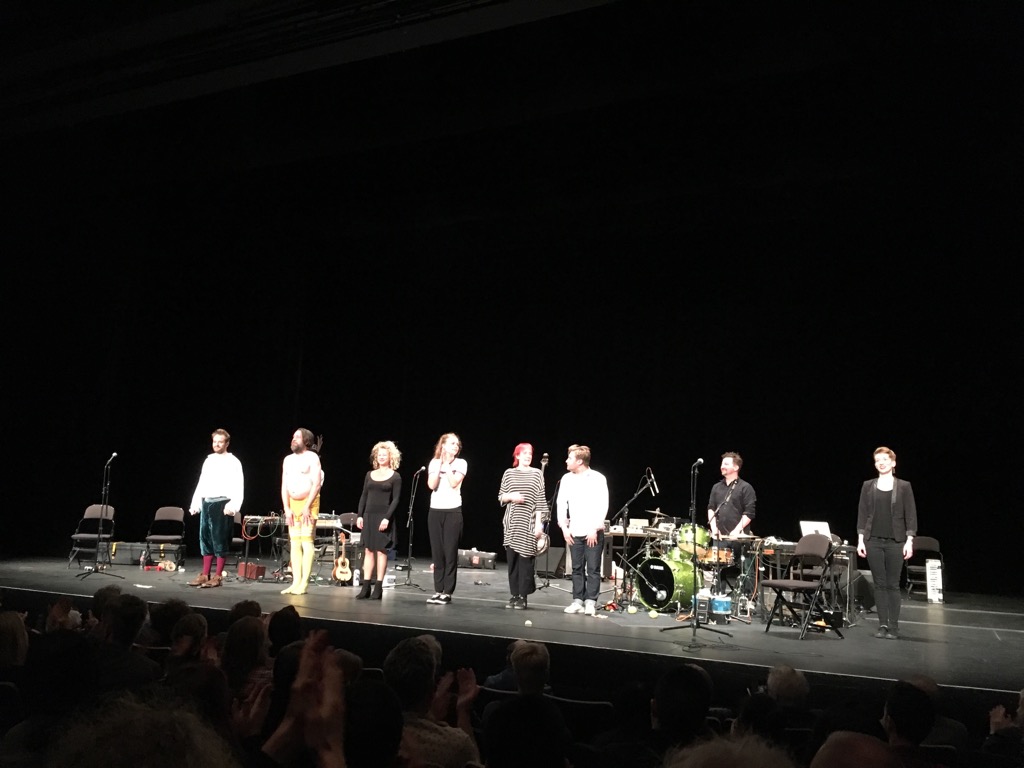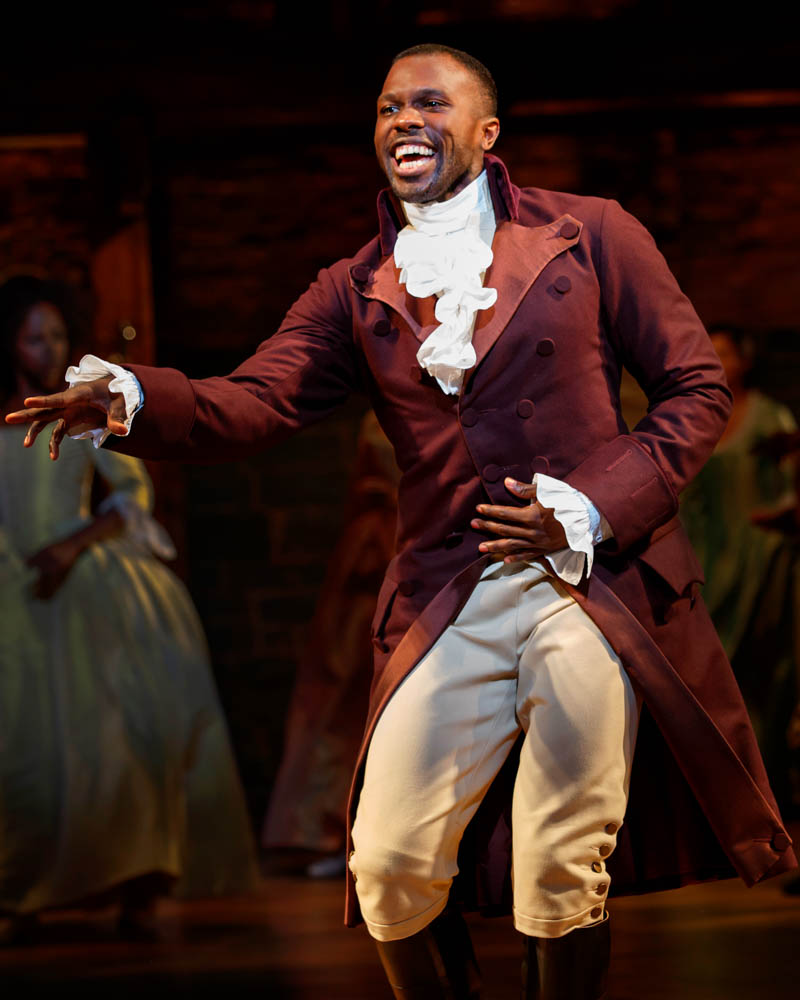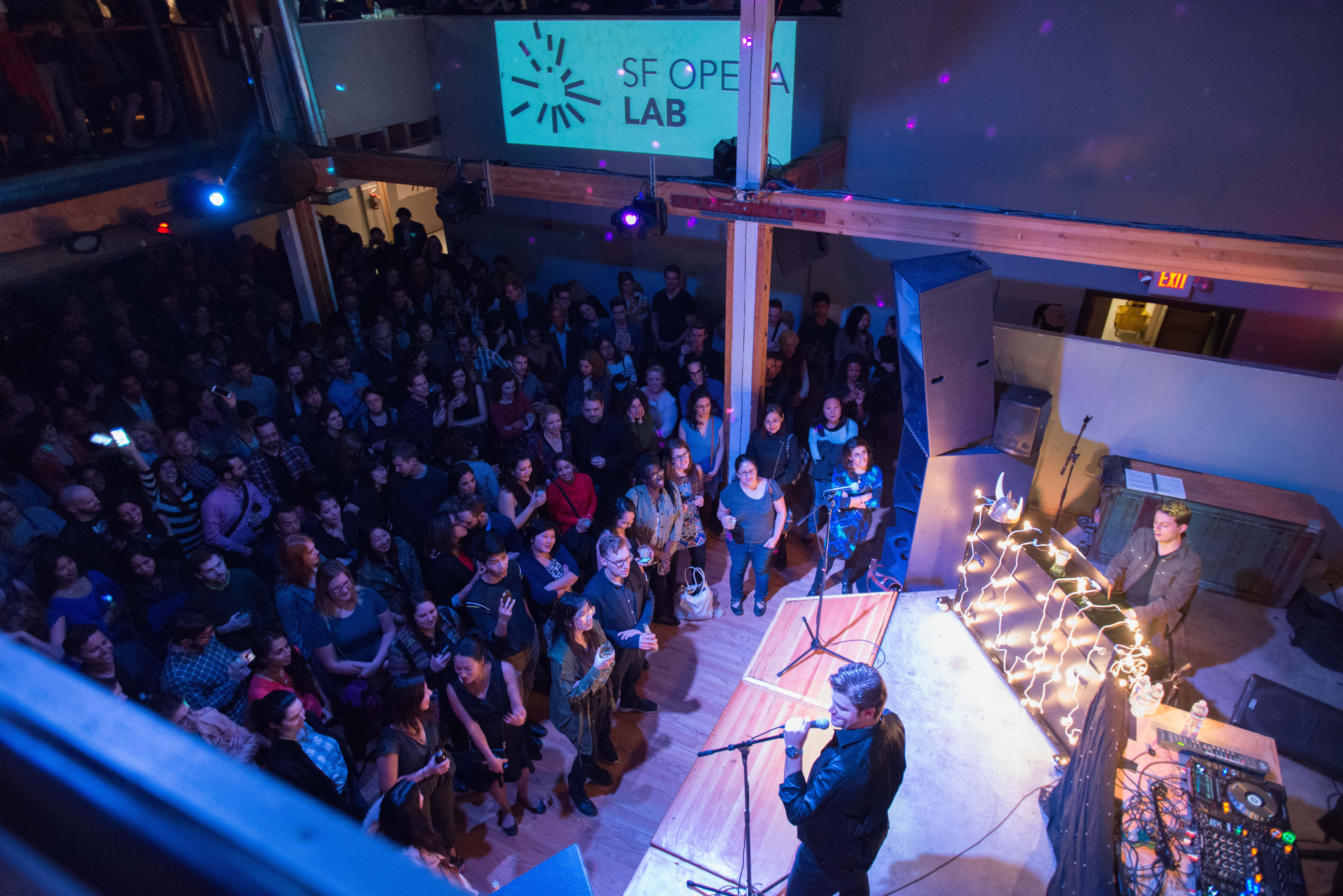
* Notes * Yesterday SF Opera Lab opened a second season with Ted Hearne's disturbing oratorio The Source. The 2012 piece concerns Chelsea Manning's disclosure to WikiLeaks of classified material about the wars in Iraq and Afghanistan. Unconventionally staged with the four singers dispersed in the audience (Isaiah Robinson pictured left, photograph by Stefan Cohen) and with enormous video projections on each side, the experience was completely immersive.
Mark Doten's libretto uses primary source texts, tweets from Manning and Adrian Lamo (the former hacker that ultimately turned Manning in), chat logs from Manning and Lamo, interview questions posed to Wikileaks co-founder Julian Assange, and random cultural artifacts from the time period ranging from an interview of Steven Hawking to Big Boi's "Shutterbugg." The collection is unsettling, and all the more so because the repetitive vocals are highly processed by Philip White in real time.
The music is often loud and cacophonous, and the ensemble hidden above, behind one of the video screens, consisted of what amounts to a string trio plus keyboard, guitar, bass, and drums. The playing and singing seemed to come off tightly together, most impressive given the lack of conductor. It wasn't at all clear to me how this was accomplished.
Most of the videos used were of people's faces as they watched the leaks, gleaned from footage of nearly 100 people taken by director Daniel Fish and production designer Jim Findlay. It is all very unsettling. When we finally see the gunsight footage of the July 12, 2007 Baghdad airstrike, known as "Collateral Murder," we understand all too well what these people have been reacting to and experience it for ourselves. The dead silence at the end lasted an uncomfortable and imposing amount of time.
Tattling * Many audience members (I saw at least five at one time) fell asleep despite the volume of the music and fact that they may have been next to one of the vocalists. This was all the more obvious because the two halves of the audience faced one another.
* Notes * Last weekend San Francisco Symphony continued celebrations for John Adams' 70th birthday with The Gospel According to the Other Mary. The oratorio was tastefully semi-staged (Daniel Bubeck, Brian Cummings, Nathan Medley, Jay Hunter Morris, Kelley O'Connor, and Tamara Mumford pictured left; photograph by Stefan Cohen) and featured a truly resplendent cast.
The libretto, compiled by Peter Sellars, is a mish-mash of the Bible and texts from Dorothy Day, Rosario Castellanos, June Jordan, Louise Erdrich, and Primo Levi. The collage makes for a narrative that is disjointed and jumps from different time periods, but essentially recounts the story of Mary Magdalene, Martha, and Lazarus and their interactions with Jesus.
The music is vivid with textures and rhythms, and there is much for the three percussionists to do, as they share a dozen instruments including timbale, almglocken, and cimbalom. Not a note of this seemed gratuitous in the least, though it did seem very difficult. Maestro Grant Gershon looked as if he was counting and cuing constantly, and this did give the music a bit of a square feel.
The singers were unreal. In the title role, mezzo-soprano Kelley O'Connor showed off some alarmingly low notes and beautiful clear high ones as well. Mezzo-soprano Tamara Mumford also displayed a dark richness as Martha. Tenor Jay Hunter Morris was able to navigate choppy lines as well as ones more lyrical and legato.
The trio of ghostly countertenors Daniel Bubeck, Brian Cummings, and Nathan Medley were effective as was the small chorus, whose members were very together. Everything was impressively loud, and microphones were used but were not distracting in the least.
Tattling * The audience was quiet but there was a noticeable amount of attrition during intermission.
September 25- December 16 2017: Norma September 26- October 28 2017: Les Contes d’Hoffmann September 27- October 14 2017: Die Zauberflöte October 2 2017- March 10 2018: La Bohème October 12 2017- April 5 2018: Turandot October 26- November 21 2017: The Exterminating Angel November 2 2017- March 16 2018: Madama Butterfly November 11- December 2 2017: Thaïs November 24- December 2 2017: Verdi’s Requiem November 25- December 9 2017 The Magic Flute December 6 2017- January 19 2018: Le Nozze di Figaro December 14 2017- January 11 2018: The Merry Widow December 18 2017- January 6 2018: Hansel and Gretel
December 31 2017- May 12 2018: Tosca January 8- February 1 2018: Cavalleria Rusticana & Pagliacci January 16- February 17 2018: L’Elisir d’Amore January 22- February 15 2018: Il Trovatore February 5-27 2018: Parsifal February 19- March 17 2018 Semiramide March 1-23 2018: Elektra March 15- April 19 2018: Così fan tutte March 22- May 10 2018: Lucia di Lammermoor March 29- April 21 2018: Luisa Miller April 12- May 11 2018: Cendrillon April 23- May 12 2018: Roméo et Juliette
The Met announced the 2017-2018 season today. There will be 220 performances of 26 works, including five new productions. The Met premieres include Thomas Adès’ The Exterminating Angel and Massenet’s Cendrillon.
* Notes * The Pulitzer Prize winning Silent Night by Kevin Puts and Mark Campbell is a fine choice for Opera San José, which gave the West Coast premiere last night. It was a worthy challenge for the company, which has a many youthful repertory members, all of whom seemed to rise to the occasion.
Campbell's libretto is based on the screenplay for the 2005 film Joyeux Noël, which in turn is based on a World War I Christmas truce of December 1914 between Scottish, German, and French soldiers. It's a good story, the horrors of war is a serious topic, but has some great humor as well.
The tender portrayals of the various characters, and there are a lot, no less than 14 principals, were convincing. I could hardly even recognize some of the resident company members, even from the fourth row, so much did the singers embody their roles.
The quality of the singing was certainly up there. Soprano Julie Adams played opera singer Anna Sørensen to a tee, her Act II Scene 2 aria was beautiful. Likewise tenor Kirk Dougherty seemed natural in the role of opera singer/German soldier Nikolaus Sprink.
Puts' music sounds very cinematic and sweeping, it definitely is not challenging or dissonant, aside from perhaps the bagpipe featured in Act I Scene 5. Ricardo Rivera (Lt. Audebert) and Brian James Myer (Ponchel) had some of the most lovely music in the middle of Act I. It was not clear to me how well the orchestra played under Maestro Joseph Marcheso, sometimes it sounded a bit off-kilter, the strings sounded out of tune in Act I Scene 4, but this could have been written this way. The brass wasn't always perfectly clean. The woodwinds did have some gorgeous exposed moments.
The production, directed by Michael Shell and designed by Steven Kemp makes excellent use of the space. There are ten scenes and Kemp employs three moveable rectangular wooden frames as each of the camps to keep the action going and this is very effective.
* Tattling * The audience absolutely loved this opera. There was hardly a seat open in the whole orchestra section, and the whole run is close to being completely full. Given that Minnesota Opera sold-out the world premiere in 2012, Opera San José looks to do just as well.
* Notes * Opera Parallèle has opened another near impeccable production with Jonathan Dove's Flight, which has a three performance run this weekend at Yerba Buena Center for the Arts in San Francisco. Featuring an ensemble of 10 vocalists, the cast, mostly alumni of the Merola Opera Program, is incredibly strong. The small orchestra of 29 musicians also played with precision and verve.
The piece, though based on the true story of Iranian refugee Mehran Karimi Nasseri and his extended stay in the Charles de Gaulle airport, is both comedic and tragic. British playwright April de Angelis' narrative is taut and the most of characters are compellingly human, having very understandable emotions that come through the music. The Older Woman, played by San Francisco Conservatory of Music faculty member and mezzo-soprano Catherine Cook, is both very funny as she recounts her romance with a young man, yet beautifully vulnerable. As the heavily pregnant Minskwoman who refuses to board her airplane, mezzo Renée Rapier sings a gorgeous confessional aria about how much has changed and how she would like to be free again.
Dove's vocal writing is lyric and he deftly handles the ensembles, the overlapping conversations seem natural and flow together nicely. Duets between the bickering couple of Bill and Tina were especially great, as were the contrasting passionate Steward and Stewardess. Tenor Chaz'men Williams-Ali (Bill) had a wonderful warmth and soprano Amina Edris (Tina) got to show off some fiery and hilarious coloratura when she became angry with him.
More otherworldly are the top billed characters of the Controller, sung here by soprano Nikki Einfeld, and the Refugee, countertenor Tai Oney. Einfeld spends most of her time up in a room by herself observing and commenting on the action from above. Her voice is clear and biting. Oney's vocal type lends itself to a certain mysticism, as the most defenseless person of the opera, he tries to charm others into helping him, telling them what they want to hear. Oney had a few hooty notes at the beginning, but really sounded lovely for the rest of the evening.
Maestra Nicole Paiement is nothing if not consistent, and again proved herself to be truly one of the best opera conductors in the Bay Area. The orchestra played Dove's music, which is clearly influenced by minimalism, with ease. The orchestra never seemed head of the singers, but also never sounded slack.
Director Brian Staufenbiel employs a wall of 15 square screens at the back of what looks like a typical airport lounge. The video projections develop the story in a literal way by showing airplanes or rain and also try to heighten certain more mysterious passages with abstraction, such as swirling purple smoke. There is much movement both with those on stage and in the projections, driving in the fact that we are in a space for transit, except for the hapless Refugee.
* Tattling * The announcement to turn off cellular telephones and locate emergency exits before the performance sounded like something out of one would hear at an airport.
June 11 2017: Merola Opera Program 60th Anniversary Gala & Concert July 6-9 2017: Schwabacher Summer Concert July 20-22 2017: La Serva Padrona/ Savitri/ The Bear August 3-5 2017: La Cenerentola August 19 2017: Merola Grand Finale
The Merola Opera Opera program announced its 60th anniversary season this afternoon at the John M. Bryan Education Studio in San Francisco.
Merola is commissioning its first work, If I Were You, by Jake Heggie and Gene Scheer. The opera, based on the novel by Julien Green, is slated for the 2019 season.
The 2017-2018 season at Lyric Opera of Chicago today. Highlights include Orphee et Eurydice with the Joffrey Ballet, which goes to Los Angeles Opera next year and the continuation of the latest Ring with Die Walküre.
The other new productions are Faust and Jesus Christ Superstar.
By Charlise Tiee Feb 8, 2017 | Updated Jan 11, 2024
Scene from Ted Hearne’s oratorio ‘The Source’. (Photo: Noah Stern Weber)
There are so many contemporary operas happening in the Bay Area in February, it looks like we might have an all-out regional festival on our hands.
While this operatic flowering is more or less a happy coincidence, the fact that the San Francisco Opera (SF Opera) isn’t in season right now means that smaller companies can attract singers, directors, and musicians to work on innovative repertoire in more intimate spaces.
Here is the lowdown on a few upcoming productions.
Nikki Einfeld as the Controller in Opera Parallele’s 2017 production of ‘Flight.’ (Photo: Steve DiBartolomeo/Westside Studio Images)
British composer Jonathan Dove’s timely 1998 work tells the true story of Iranian refugee Mehran Karimi Nasseri who lived at Charles de Gaulle airport for almost 18 years. Nasseri was unable to exit the French airport because he lacked documentation — and, being a stateless person, he had no country of origin to return to, either.
Opera Parallèle’s take on Dove’s darkly comic opera stars up-and-coming American countertenor Tai Oney, who goes on to sing in Berlin and Aix-en-Provence later this year. Oney shares the stage in this production with a slew of talented, former SF Opera apprentice singers such as Nikki Einfeld and Eugene Brancoveanu, as well as many local opera professionals such as Catherine Cook and Philip Skinner.
“When we first programmed Flight for this season, we knew the topic of international refugees was important,” says Opera Parallèle’s artistic director, founder and conductor Nicole Paiement. “But we had no idea how sharp the political focus on immigration would become.”
Colin Ramsey (Father Palmer) and Kirk Dougherty (Nikolaus Sprink) in Opera San Jose’s ‘Silent Night.’ (Photo: Chris Ayers)
Also dealing with real-life events, is Kevin Puts’ Pulitzer Prize-winning opera concerns the World War I Christmas truce between Scottish, French and German soldiers. Depicting the horrors of war, the piece has been wildly successful, taken up by nearly a dozen opera companies since the 2011 premiere at Minnesota Opera.
Opera San José presents the west coast premiere of Silent Night in a new production designed by Steven Kemp, a finalist at this year’s World Stage Design in Taipei for his work on a production of Falstaff. The cast includes soprano Julie Adams, a San Francisco Conservatory of Music alum who won the prestigious Met auditions and just finished a two-year stint as an apprentice at SF Opera.
Looming video projections in Ted Hearne’s ‘The Source.’ (Photo: Noah Stern Weber)
The 30-something, Los Angeles-based composer Ted Hearne’s body of work is overtly political, covering such topics as Hurricane Katrina and Edward Said. SF Opera Lab, the experimental arm of SF Opera, opens its second season with Hearne’s oratorio about Chelsea Manning and Wikileaks. The piece made a huge splash at the Brooklyn Academy of Music in 2014 and at Los Angeles Opera last year.
The 75-minute, 12-movement piece for four singers and seven instrumentalists sets Manning’s own words and other primary source documents to music. Video projections from director Jim Findlay and designer Daniel Fish loom on four screens around the audience. Hearne incorporates many different modalities in this abstract work, using real-time voice processing and evoking the Bach Passions.
Chelsea Hollow, Kristen Princiotta, Shawnette Sulker, and Kindra Scharich in ‘Why I Live at the P.O.’ by Stephen Eddins and Michael O’Brien, part of Snapshot Program 1. (Photo: West Edge Opera)
Building on its impressive festival season at Oakland’s abandoned train station last summer, West Edge Opera just launched Snapshot — a new program highlighting the work of contemporary Northern Californian composers. The series features excerpts from as-yet-to-be-produced works by composers like Carla Lucero and Linda Bouchard, brought to life by half a dozen solo vocalists and the musicians of the Earplay new music ensemble.
The February program includes a work about Helen Keller, an operatic version of E. M. Foster’s novel Howard’s End, a piece that sets text from Uruguayan writer Eduardo Galeano, and a comedic parody of Tennessee Williams’ A Streetcar Named Desire.
The program provides an opportunity to observe operas at the “workshop” stage of the production process. It also includes performances by local talent such as soprano Amy Foote (seen in the title role of West Edge’s The Cunning Little Vixen last season) and baritone Daniel Cilli (who had his SF Opera premiere in Carmen last year, but has appeared at every regional house around here) in a cozy setting.
October 20- November 5 2017: Samson and Dalila October 27-November 12 2017: La traviata February 9-17 2018: Erich Wolfgang Korngold’s The Ring of Polykrates March 9-17 2018: Michel van der Aa’s Sunken Garden April 13-29 2018: Don Giovanni
The Dallas Opera announced a 2017-2018 season which includes the American premieres of the Korngold rarity The Ring of Polykrates and Michel van der Aa’s Sunken Garden.
September 9-23 2017: Carmen October 7-28 2017: The Pearl Fishers October 14-November 19 2017: Nabucco October 28-31 2017: La Belle et la Bete November 9-12 2017: Keeril Makan's Persona January 27- February 18 2018 Bernstein's Candide March 10-25 2018: Orpheus and Eurydice May 12- 31 2018: Rigoletto May 26 2018: Matthew Aucoin's Crossing June 22-24 2018: Gordon Getty's Usher House and Canterville Ghost
Los Angeles Opera announced its next season on Facebook Live this evening at 6:30pm. Domingo sings the title role of Nabucco, Morris Robinson sings Zaccaria. Robinson returns as Sparafucile in Rigoletto. Maxim Mironov and Lisette Oropesa star in Orpheus and Eurydice with the dancers of the Joffrey Ballet. Oropesa also sings Gilda in one of the Rigoletto casts, sharing the role with Irina Lungu. Of local interest, Sara Jobin conducts the Gordon Getty operas and Brian Staufenbiel of Opera Parallèle directs.
Leave a comment