• Woods-schwabacher-2017* Notes *
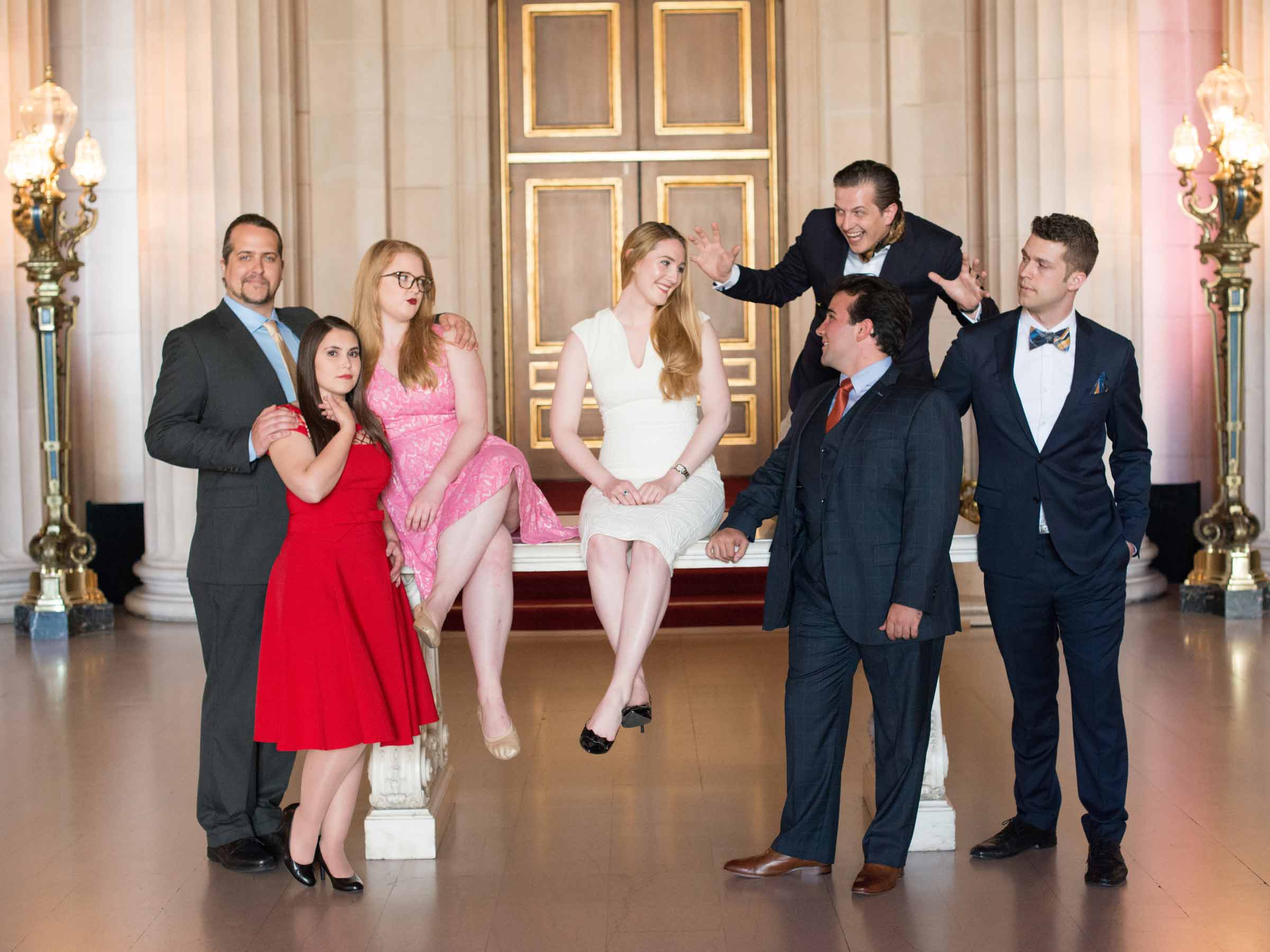
    The Schwabacher Debut Recital Series continued yesterday with an unusual twist: Adler Fellow Aria Umezawa directed a narrative for mezzo-soprano Renée Rapier and bass Anthony Reed entitled The Woods: A Rom-Com Recital. Set in a bar called "The Woods," the plot (put together by Reed) involves an encounter between a lovelorn barkeeper and an unhappily married patron, pieced together with about twenty American songs including contemporary composers such as Ned Rorem, Thomas Pastatieri, and Stephen Sondheim and older favorites from Cole Porter and George Gershwin.

    The staging was simple, a projection of a neon bar sign, a bar, a karaoke stage, a couple of tables and chairs, and of course the piano upstage played by John Churchwell. Clocking in at an hour, with no intermission, it was a quick and engaging evening. The pieces went together nicely and the young singers gamely played their roles.

    It was especially nice to see Reed in a role that he's not ridiculously young for, as many of his bass parts on the War Memorial stage he plays are of characters seem at least three times his age. His voice is fresh and youthful despite how deep it is. Rapier too has a flexible, balanced sound that is attractive in this rep. The two sang the duets Gershwin's "I've got a crush on you" and Sondheim's "Move On" particularly well.

    The next Schwabacher at the end of the month goes back to the normal recital format with pianist Warren Jones and three current Adler Fellows, but it was fun to get a taste of something different and perhaps more operatic. I had wondered how San Francisco Opera would handle having a director as an Adler Fellow, and it seems that Ms. Umezawa is bringing a lot of creativity to the fore, having recently also put together an SF Opera Lab pop-up in Oakland involved audience participation in a manner that was actually fun and not annoying.

    * Tattling *
    I sandwiched myself in the front row between two avid opera fans, both of whom were very quiet.

    Leave a comment

  • 12th-night-filter-theatre-2017* Notes *
    Filter Theatre brought a manic 90-minute multi-media version of Twelfth Night to Cal Performances last night as part of a tour of the state. Directed by Sean Holmes, Shakespeare’s comedy — already chock full of love triangles, cross-dressing, and mistaken identity — involves a lot of music and takes audience participation to a new level.

    The stage has no real scenery and is littered with instruments, microphones, and various props. Alan Pagan sat at a drum kit stage left, while Ross Hughes, who shares music and sound responsibilities with Tom Haines, played ukulele and attended to other effects.

    The evening was carefully controlled chaos and very engaging. From the very beginning, the unconventional nature of the production was obvious. Jonathan Broadbent, as Orsino, starts us off by wandering around the audience with a cup of mint tea, then comes to the stage with the first words of the play “If music be the food of love, play on” but in an agonizingly slow way, as if he is composing the poetry on the spot. Our Viola, Amy Marchant, wearing a damp rain poncho, asks for a man’s hat and jacket, and rejected someone’s rain coat in favor of something “smarter, like a blazer.”

    The high point of the piece is certainly the riotous Act II Scene 3, it was basically a party set to the song “What is love? ‘Tis not hereafter.” Jonathan Broadbent plays a very silly Sir Andrew Aguecheek here, wearing a velcro-covered cap that he catches balls on, and a ridiculous amount of balls were thrown out to the crowd so we could all try. A dozen audience members were taken on stage to dance about. A pizza from La Val’s was passed around.

    The most comic scenes work best. Ferdy Roberts was completely ridiculous and absurd as Malvolio when he gets the fake letter from Olivia, and his two pairs of yellow stockings with tiny yellow short shorts provoked a ton of laughs.

    While I definitely appreciate how captivating the performance was, the cuts to the text are extensive. Antonio does not appear at all, and Viola’s brother Sebastian only shows up at the very end. The Clown and Fabian are condensed into Feste, played charmingly by Gemma Saunders, who also is Maria. I wondered the whole time what was going to happen when Sebastian and Viola appear on stage together, since they both are played by Marchant, who simply said the lines of both parts from the stage. I don’t know if this works for people that don’t know the play well, but seems like it could be confusing.

    * Tattling *
    The audience loved this performance and it was hard to imagine anyone there was bored in the slightest.

    Leave a comment

  • Hamilton-joshua-henry* Notes *
    The first U.S. tour of Hamilton started in San Francisco on March 10 and already looks like a huge success. There are only two more previews before the show official opens this Thursday but it very much seems like most of the kinks have been worked out, Sunday's evening performance was tight and synchronized.

    Lin-Manuel Miranda's musical is sharp, he brings these distant historical figures to life with hip-hop, humor, and an excellent multi-ethnic cast. It is incredible how many words he got into the 2 hours and 30 minutes of music. There's only one set which includes a revolving section in the middle, some movable staircases, and a small balcony above. The staging involves all the fancy dance numbers you would associate with any musical, with the ensemble members all singing as well.

    Michael Luwoye's Hamilton is charismatic, especially in Act I. Solea Pfeiffer has a bright sound and is a lovely, sympathetic Eliza Hamilton. Joshua Henry (pictured left, photograph by Joan Marcus) does a fine job with the role of Aaron Burr, and is much more than a one-dimensional villain of the story.

    It always impresses me that musicals have such tiny orchestras, in this case two keyboards (one played by conductor Julian Reeve), drums, percussion, bass, guitar, and a string quartet.

    Tattling * 
    It was such fun seeing how excited all the audience members were to be there. One young fan in Row M clutched the Hamilton: The Revolution book, which she seemed to have brought to the show. The woman next to me in Row N Seat 10 knew every song and often sang along. A woman behind me clapped her hands with such vigor she made contact with my head twice, her companion loved the piece so much she wanted to see it again. As I walked back to our car with my date, a couple behind us talked about putting the musical soundtrack on as they drove home.

    Personally my take ways were the following: I don't think I like musicals (which is so weird, since I love opera so much) and I remember an alarming amount from U.S. history class in high school even though I haven't really thought about the American Revolution since I was about 15.

    Leave a comment

  • SFOperaLabPopUp2016_2_by Kristen LokenSan Francisco Opera is having its first pop-up (pictured left, photograph by Kristen Loken/San Francisco Opera) in the East Bay at the Uptown Nightclub in Oakland. Entitled "Hands-on Opera," there will be lots of audience interaction at this event on Thursday March 23, 2017 at 7:30pm.

    Curated by Adler stage director Aria Umezawa, the evening will feature sopranos Sarah Cambidge and Amina Edris; tenors Amitai Pati and Kyle van Schoonhoven; baritone Andrew G. Manea; bass-baritone Brad Walker; bass Anthony Reed; and pianists Jennifer Szeto and Ronny Michael Greenberg. Tickets are 25 dollars, available at Event Brite or at the door.

    Official Site | Uptown Nightclub | Tickets

    Leave a comment

  • 37A0329* Notes *
    Last night the arresting soprano Anna Caterina Antonacci (pictured left, photograph by Cory Weaver/San Francisco Opera) gave the first of three performances of songs by Berlioz, Debussy, and Poulenc paired with a piano version La Voix Humane at SF Opera Lab. Antonacci gave a compelling renditions of the various French songs, all the more impressive since it was only her voice and the spare accompaniment of Donald Sulzen's piano.

    Part of her appeal is certainly her voice, which is far from your garden variety clean, pure soprano, and in fact Antonacci started her career singing mezzo roles, especially Rossini, which doesn't seem particularly well suited to her sensual sound. She did great with Berlioz's "La mort d'Ophélie", very emotionally on point and haunting. Likewise her "Le tombeau des Naïades" from Debussy's Chansons de Bilitis was particularly strong.

    37A0382Poulenc's 1958 La Voix humane is essentially a monologue of a suicidal woman on the telephone with her former lover. Its success as a piece of drama rests heavily on the the one singer, and Antonacci delivered, she is an incredible actress and it was hard to look away.

    Simple and concise, the 40 minutes flew by, and we experience everything from the petty annoyances of being on a party line to the utter depths of despair of being abandoned and unloved.

    The plain, stripped down staging of a simple rain drop covered window with a view of Paris with only a table, chair, and a few pillows was perfect and matched the simplicity of the opera itself.

    Antonacci's costume was a bit odd, it looked like a 70s floral house dress, with panels that opened in the front and a cut-out in the back. I was also confused by (though also enjoyed) her gown for the songs, which looked to be a long grey leotard-inspired tunic whose sleeves covered her hands and had the saddest tulle tutu-like skirt.

    Tattling *
    Many audience members were mostly quiet, though a few people had to exit during the music.

    Leave a comment

  • SF-Symphony-4x6September 14 2017: MTT conducts Saint-Saëns, Tchaikovsky, Bernstein, Ravel; Yo-Yo Ma, cello
    September 22-24 2017: MTT conducts Bernstein
    October 6-8 2017: Krzysztof Urbański conducts Penderecki
    October 13-15 2017: Jakub Hrůša conducts Dvořák, Smetana, and Janáček
    October 26-28 2017: Osmo Vänskä conducts Sibelius
    October 31 2017: Zubin Mehta conducts Israel Philharmonic Orchestra
    November 2-5 2017: MTT conducts Bernstein's The Age of Anxiety, Symphony No. 2
    November 5 2017: Lu Jia conducts China National Centre for the Performing Arts Orchestra
    November 10–12 2017: MTT conducts Ives' Psalm 90 and Symphony No. 4
    November 16–18 2017: MTT conducts Ives' Symphony No. 3, The Camp Meeting
    December 1-2 2017: North By Northwest film with live orchestra
    December 9 2017: Masaaki Suzuki conducts Bach Collegium Japan
    December 16-17 2017: Home Alone film with live orchestra
    January 19-21 2018: MTT conducts Bernstein's Candide
    January 28-29 2018: Charles Dutoit conducts Royal Philharmonic Orchestra
    February 1-3 2018: Bernstein's West Side Story film with live orchestra
    February 8-10 2018: Herbert Blomstedt conducts Stenhammar
    February 15-17 2018: Herbert Blomstedt conducts Mozart and Beethoven
    February 22-24 2018: Andrey Boreyko conducts Bernstein and Shostakovich
    March 1-3 2018: Pablo Heras-Casado conducts Esa-Pekka Salonen's Helix
    March 8–10 2018: Edward Gardner conducts Tippett, Gershwin, and Rachmaninoff
    March 11 2018: Academy of St. Martin in the Fields; Joshua Bell, violinist and leader
    March 15–17 2018: MTT conducts Charles Wuorinen
    March 16 2018: Itzhak Perlman, violin and Martha Argerich, piano
    March 27–29 2018: West Coast tour with Gil Shaham, violin
    March 30 2018: Ragnar Bohlin conducts San Francisco Symphony Chorus
    April 4-5 2018: Batman film with live orchestra
    April 6-7 2018: Amadeus film with live orchestra
    April 14-15 2018: Daniel Harding conducts R. Strauss and Beethoven
    April 19-21 2018: Charles Dutoit conducts Ravel; Susan Graham, mezzo-soprano
    April 26-29 2018: Charles Dutoit conducts Holst's The Planets and Liszt; Jean-Efflam Bavouzet, piano
    May 3-5 2018: Juraj Valčuha conducts Andrew Norman's Unstuck
    May 10-12 2018: Stéphane Denève conducts Saint-Saëns and Connesson
    May 17-20 2018: Itzhak Perlman conducts Bach
    May 25-26 2018: David Robertson conducts Brett Dean's Engelsflügel
    May 31–June 2 2018: Semyon Bychkov conducts Taneyev and Tchaikovsky
    June 7–9 2018: Susanna Mälkki conducts Saariaho
    June 14-17 2018: MTT conducts Boris Godunov
    June 28-30 2018: MTT conducts Mahler's Symphony No. 3

    Season Highlights | Press Release

    Leave a comment

  • Thesource_stefancohen016* Notes *
    Yesterday SF Opera Lab opened a second season with Ted Hearne's disturbing oratorio The Source. The 2012 piece concerns Chelsea Manning's disclosure to WikiLeaks of classified material about the wars in Iraq and Afghanistan. Unconventionally staged with the four singers dispersed in the audience (Isaiah Robinson pictured left, photograph by Stefan Cohen) and with enormous video projections on each side, the experience was completely immersive.

    Mark Doten's libretto uses primary source texts, tweets from Manning and Adrian Lamo (the former hacker that ultimately turned Manning in), chat logs from Manning and Lamo, interview questions posed to Wikileaks co-founder Julian Assange, and random cultural artifacts from the time period ranging from an interview of Steven Hawking to Big Boi's "Shutterbugg." The collection is unsettling, and all the more so because the repetitive vocals are highly processed by Philip White in real time.

    The music is often loud and cacophonous, and the ensemble hidden above, behind one of the video screens, consisted of what amounts to a string trio plus keyboard, guitar, bass, and drums. The playing and singing seemed to come off tightly together, most impressive given the lack of conductor. It wasn't at all clear to me how this was accomplished.

    Most of the videos used were of people's faces as they watched the leaks, gleaned from footage of nearly 100 people taken by director Daniel Fish and production designer Jim Findlay. It is all very unsettling. When we finally see the gunsight footage of the July 12, 2007 Baghdad airstrike, known as "Collateral Murder," we understand all too well what these people have been reacting to and experience it for ourselves. The dead silence at the end lasted an uncomfortable and imposing amount of time.

    Tattling *
    Many audience members (I saw at least five at one time) fell asleep despite the volume of the music and fact that they may have been next to one of the vocalists. This was all the more obvious because the two halves of the audience faced one another.

    Leave a comment

  • Sfsgospelmary010* Notes *
    Last weekend San Francisco Symphony continued celebrations for John Adams' 70th birthday with The Gospel According to the Other Mary. The oratorio was tastefully semi-staged (Daniel Bubeck, Brian Cummings, Nathan Medley, Jay Hunter Morris, Kelley O'Connor, and Tamara Mumford pictured left; photograph by Stefan Cohen) and featured a truly resplendent cast.

    The libretto, compiled by Peter Sellars, is a mish-mash of the Bible and texts from Dorothy Day, Rosario Castellanos, June Jordan, Louise Erdrich, and Primo Levi. The collage makes for a narrative that is disjointed and jumps from different time periods, but essentially recounts the story of Mary Magdalene, Martha, and Lazarus and their interactions with Jesus.

    The music is vivid with textures and rhythms, and there is much for the three percussionists to do, as they share a dozen instruments including timbale, almglocken, and cimbalom. Not a note of this seemed gratuitous in the least, though it did seem very difficult. Maestro Grant Gershon looked as if he was counting and cuing constantly, and this did give the music a bit of a square feel.

    The singers were unreal. In the title role, mezzo-soprano Kelley O'Connor showed off some alarmingly low notes and beautiful clear high ones as well. Mezzo-soprano Tamara Mumford also displayed a dark richness as Martha. Tenor Jay Hunter Morris was able to navigate choppy lines as well as ones more lyrical and legato.

    The trio of ghostly countertenors Daniel Bubeck, Brian Cummings, and Nathan Medley were effective as was the small chorus, whose members were very together. Everything was impressively loud, and microphones were used but were not distracting in the least.

    Tattling *
    The audience was quiet but there was a noticeable amount of attrition during intermission.

    Leave a comment

  • MetoperaSeptember 25- December 16 2017: Norma
    September 26- October 28 2017: Les Contes d’Hoffmann
    September 27- October 14 2017: Die Zauberflöte
    October 2 2017- March 10 2018: La Bohème
    October 12 2017- April 5 2018: Turandot
    October 26- November 21 2017: The Exterminating Angel
    November 2 2017- March 16 2018: Madama Butterfly
    November 11- December 2 2017: Thaïs
    November 24- December 2 2017: Verdi’s Requiem
    November 25- December 9 2017 The Magic Flute
    December 6 2017- January 19 2018: Le Nozze di Figaro
    December 14 2017- January 11 2018: The Merry Widow
    December 18 2017- January 6 2018: Hansel and Gretel

    December 31 2017- May 12 2018: Tosca
    January 8- February 1 2018: Cavalleria Rusticana & Pagliacci
    January 16- February 17 2018: L’Elisir d’Amore
    January 22- February 15 2018: Il Trovatore
    February 5-27 2018: Parsifal
    February 19- March 17 2018 Semiramide
    March 1-23 2018: Elektra
    March 15- April 19 2018: Così fan tutte
    March 22- May 10 2018: Lucia di Lammermoor
    March 29- April 21 2018: Luisa Miller
    April 12- May 11 2018: Cendrillon
    April 23- May 12 2018: Roméo et Juliette

    The Met announced the 2017-2018 season today. There will be 220 performances of 26 works, including five new productions. The Met premieres include Thomas Adès’ The Exterminating Angel and Massenet’s Cendrillon.

    Online 2017-2018 Brochure | Official Site

    Leave a comment

  • Silent-night-2017* Notes *
    The Pulitzer Prize winning Silent Night by Kevin Puts and Mark Campbell is a fine choice for Opera San José, which gave the West Coast premiere last night. It was a worthy challenge for the company, which has a many youthful repertory members, all of whom seemed to rise to the occasion.

    Campbell's libretto is based on the screenplay for the 2005 film Joyeux Noël, which in turn is based on a World War I Christmas truce of December 1914 between Scottish, German, and French soldiers. It's a good story, the horrors of war is a serious topic, but has some great humor as well.

    The tender portrayals of the various characters, and there are a lot, no less than 14 principals, were convincing. I could hardly even recognize some of the resident company members, even from the fourth row, so much did the singers embody their roles.

    The quality of the singing was certainly up there. Soprano Julie Adams played opera singer Anna Sørensen to a tee, her Act II Scene 2 aria was beautiful. Likewise tenor Kirk Dougherty seemed natural in the role of opera singer/German soldier Nikolaus Sprink.

    Puts' music sounds very cinematic and sweeping, it definitely is not challenging or dissonant, aside from perhaps the bagpipe featured in Act I Scene 5. Ricardo Rivera (Lt. Audebert) and Brian James Myer (Ponchel) had some of the most lovely music in the middle of Act I. It was not clear to me how well the orchestra played under Maestro Joseph Marcheso, sometimes it sounded a bit off-kilter, the strings sounded out of tune in Act I Scene 4, but this could have been written this way. The brass wasn't always perfectly clean. The woodwinds did have some gorgeous exposed moments.

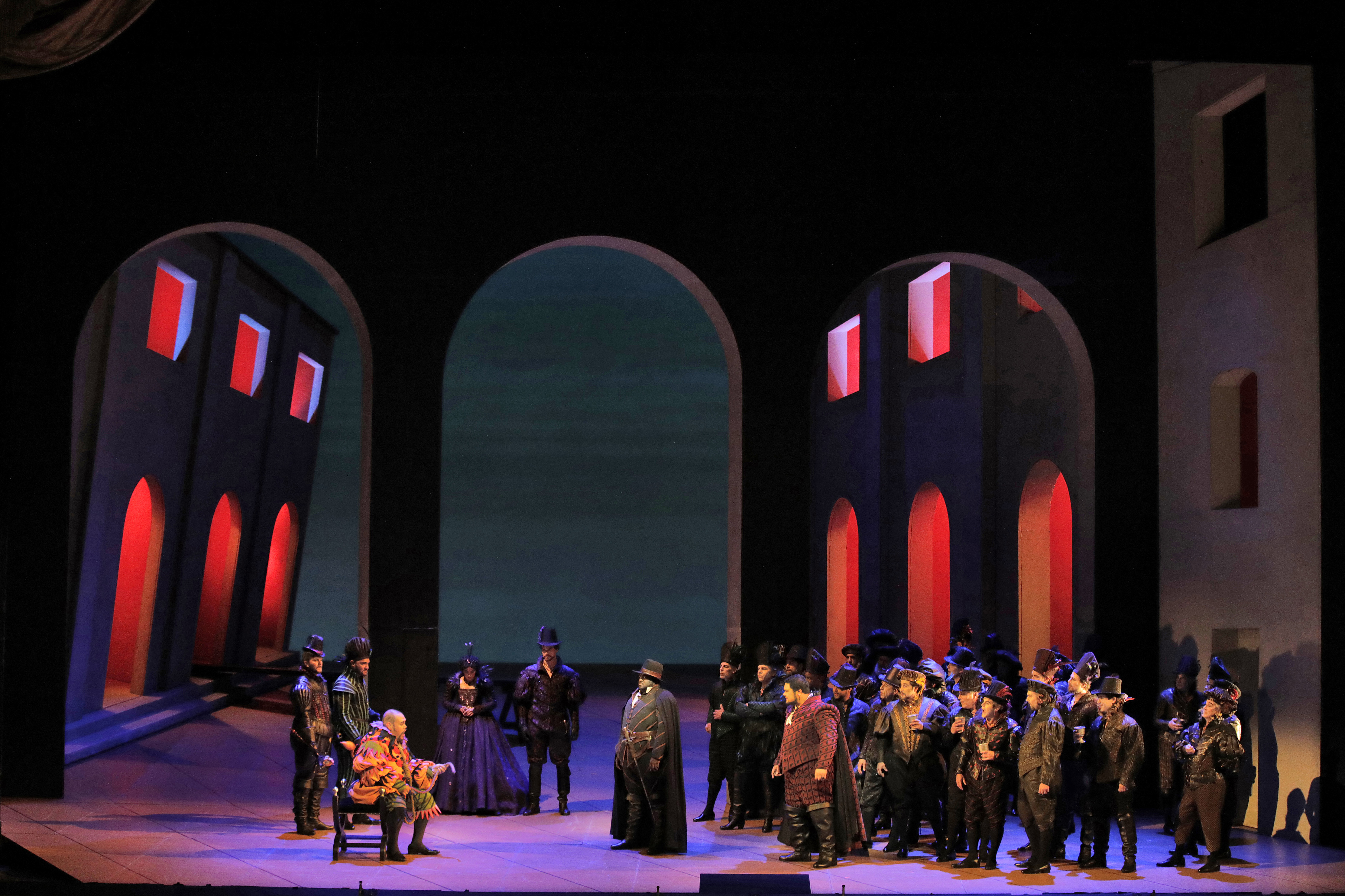
    The production, directed by Michael Shell and designed by Steven Kemp makes excellent use of the space. There are ten scenes and Kemp employs three moveable rectangular wooden frames as each of the camps to keep the action going and this is very effective.

    * Tattling * 
    The audience absolutely loved this opera. There was hardly a seat open in the whole orchestra section, and the whole run is close to being completely full. Given that Minnesota Opera sold-out the world premiere in 2012, Opera San José looks to do just as well.

    Leave a comment