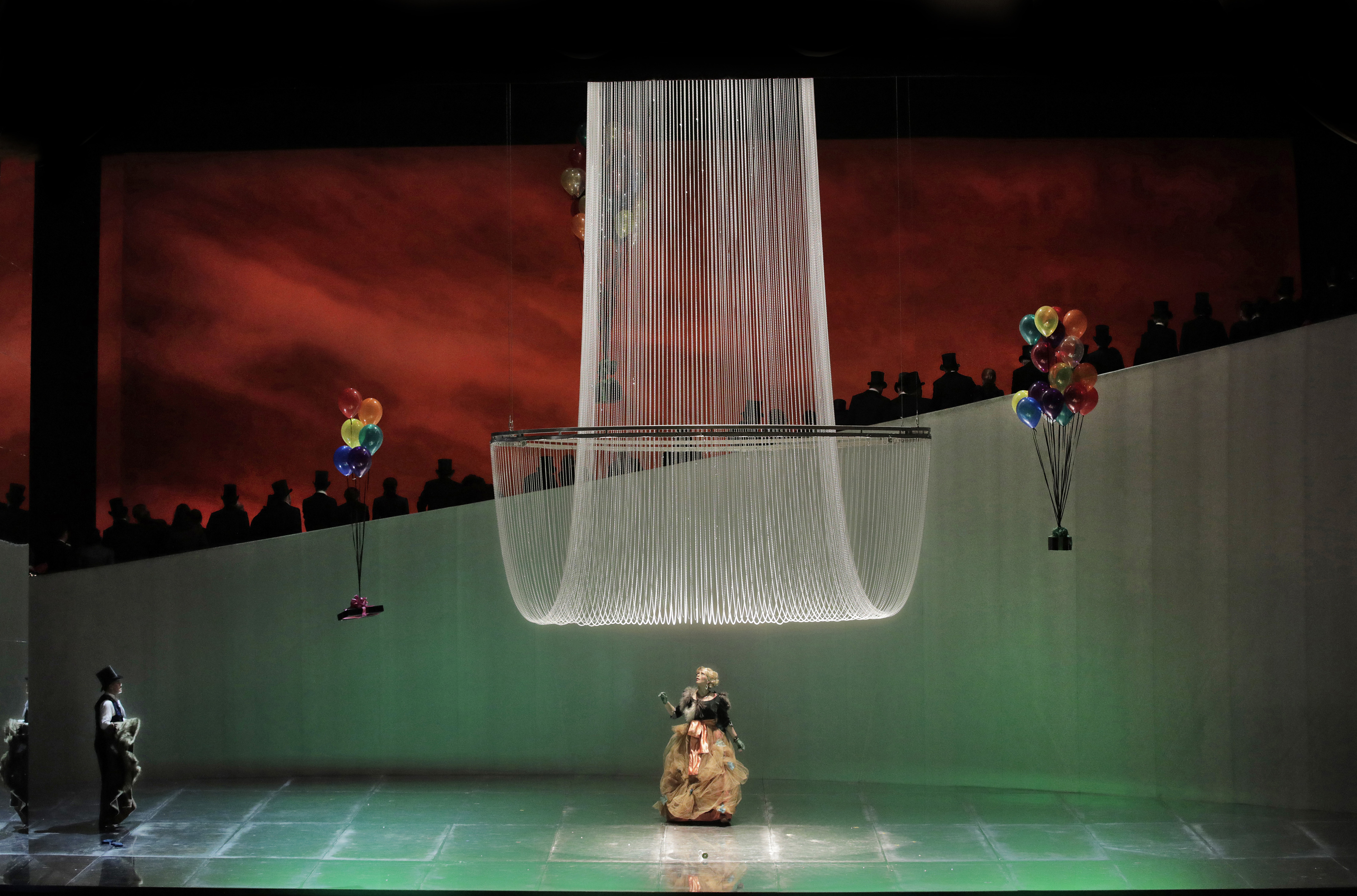
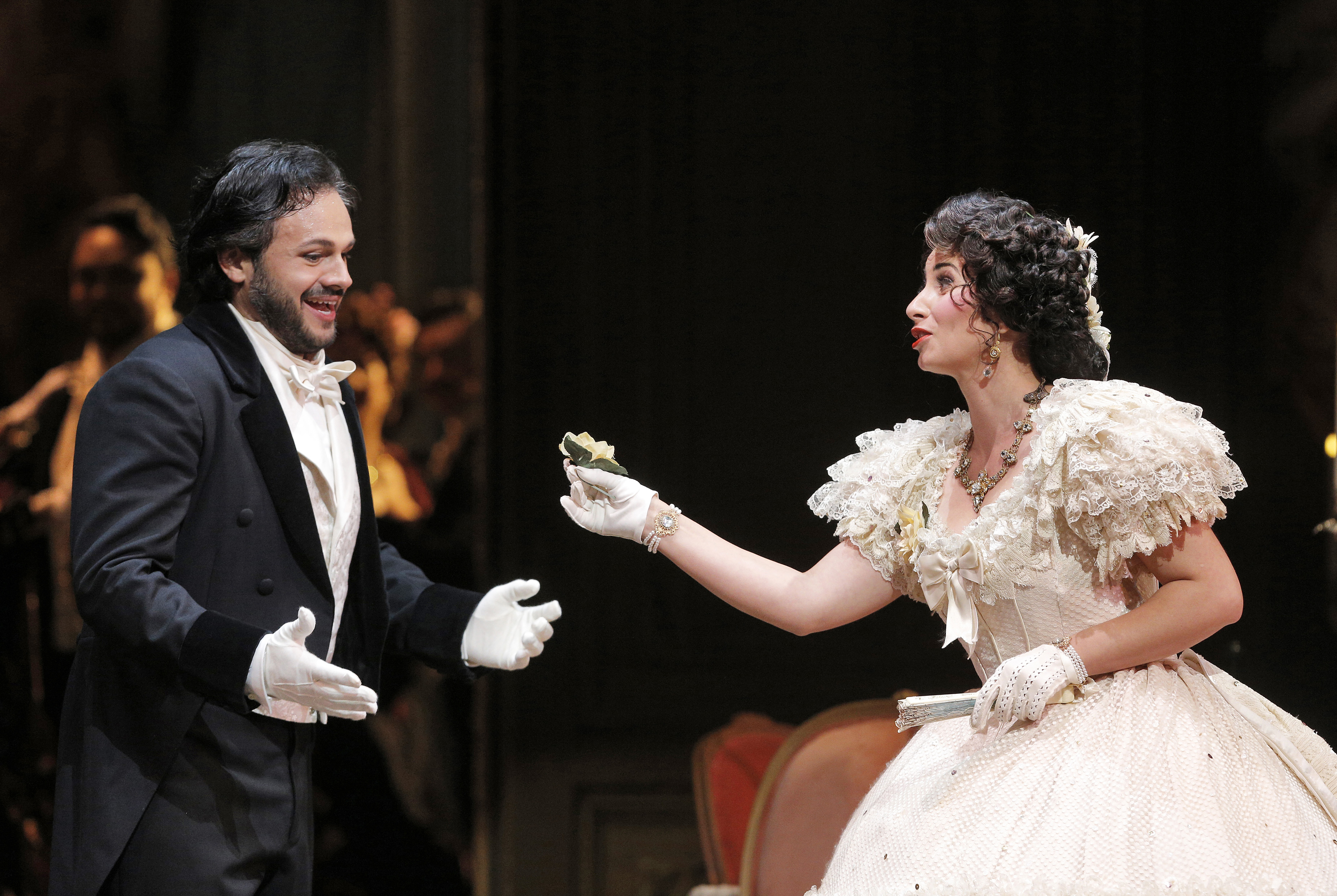
* Notes * The second set of opera performances from the Merola Opera Program this year was Rossini's La Cenerentola at the San Francisco Conservatory of Music on August 3 and 5. The sugary sweet staging from Chuck Hudson showcased a plethora of fine young singers (pictured left, photograph by Kristen Loken) supported by conductor Mark Morash and a mostly competent orchestra.
The production featured three wardrobes moved around the stage by the male chorus, meant to look like the doors of various edifices. The costumes were slightly baffling, the male chorus members wore moto jeans splattered with paint and none of the women's clothing seemed to have sleeves. The choreography involved a lot of voguing.
But as usual for Merola, the voices were preeminent, and even the smallest roles are filled by very strong talents. Soprano Natalie Image, Clorinda, one of the step-sisters, has an especially gorgeous voice, and one would love to hear her sing more. The trio of bass-baritones were all strong. Szymon Wach sounded lovely as Alidoro, Christian Pursell made for a dashing, pretty voiced Dandini, and Andrew Hiers was a perfectly silly Don Magnifico.
Anthony Ciaramitaro has a sweet-toned tenor suited for Prince Ramiro, contrasting well with mezzo-soprano Samantha Hankey's dusky sound. Hankey has a fabulous physicality that Ciaramitaro obviously lacks, she moves in an elastic and adorable way that made the cloying title role much more sympathetic.
* Tattling * I was so sad to learn that long-time opera supporter John Lindstrom died a few weeks before the performances, which were dedicated to his memory.
* Notes * The Merola Opera Program presented a triple bill of Pergolesi's La Serva Padrona, Holst's Sāvitri, and Walton's The Bear at the San Francisco Conservatory of Music on July 20 and 22. It came off as a deadly boring tragedy sandwiched by cutesy frills, perhaps because of Peter Kazaras' staging. But as always, the singers were almost all great.
La Serva Padrona ("The Servant Turned Mistress") is a light, bubbly piece, only 45 minutes long. Full of sight gags, the production did get a lot of laughs, from the popcorn eating of mute Vespone (played by David Wiegel) at the start to the fake parrot on his shoulder when he pretends to be a very pirate-like Tempesta near the end. Jana McIntyre's Serpina was sassy and stylish, her sound is bright. As Uberto, Daniel Noyola was perfectly hapless, and his voice has a pleasant weight to it.
Sāvitri was staged in a stark, static manner, it dragged a bit for being so short, a mere 40 minutes or so. The title role sounded challenging for Kelsea Webb, though she has a big voice. The men, David Wiegel as Death and Addison Marlor as Satyavān, fared better. Wiegel's sound is deep and grave, and such a stark contrast to his role in the previous opera.
Of the three pieces, The Bear (pictured above, photograph by Kristen Loken) was most successful, though also staged in a silly and quaint way. Daniel Noyola was hardly recognizable as servant Luka. Bass-baritone Cody Quattlebaum has an impressive stage presence, and delighted as Smirnov, while mezzo-soprano Ashley Dixon was a convincing Popova.
* Tattling * The audience was fairly quiet, though the person on my right elbowed me many times during the first opera as he took notes (he was left-handed), and I had nowhere to shift away, until the next opera, when the lady next to me was notably absent.
Bass-baritone Erwin Schrott (pictured left) and bass Erik Anstine will share the role of Leporello in Don Giovanni at San Francisco Opera this summer. Both artists are making their debuts with the company and are stepping in for previously scheduled bass Marco Vinco, who has withdrawn for health reasons. Schrott is scheduled to sing the first six performances from June 4 to 21 and Anstine the last two on June 24 and 30.
* Notes * It is a shame that Rameau's Le Temple de la Gloire at Cal Performances (Prologue pictured left with Aaron Sheehan as Apollo and his muses from New York Baroque Dance Company, photograph by Frank Wing) only has three performances this weekend. The music is delightful, and I could have happily gone again today after hearing the first two on Friday and Saturday nights.
The pretty production is historically informed, lead by Artistic Director of the New York Baroque Dance Company, Catherine Turocy. It is a nice contrast between the usual contemporary versions of Baroque operas I've seen from Mark Morris or Pina Bausch, but it becomes very clear very quickly why traditional stagings aren't the norm. It is a lot of ballet music, and Turocy's dancers are tame compared to the acrobatics and antics we've grown accustomed to.
The movements are understated, lots of swaying and swishing, and what I'm guessing is the precursor to petit battement. For myself, I liked that the dancing didn't compete with the playing, I would rather listen to PBO play Rameau's beautiful music without any elaborate distractions.
Nonetheless, there was a lot to look at, the costumes are eye-poppingly bright and feature lots of feathers. A dancer dressed as an ostrich in Act III was a hit. The set uses tasteful projections of painted scenes within a painted proscenium. I enjoyed very much that the UC Berkeley mascot, Ursus arctos californicus, was painted on the shield at the top.
Nicholas McGegan conducted with his characteristic bouncy cheer, the orchestra sounded clean but lively. Even the horns were mostly in tune. The flutes had some gorgeous, exposed moments. The chorus was off to the side, stage left, but sounded robust. There were a few brief moment of asynchrony, but mostly on the first night rather than the second.
The soloists, mostly from the Centre de musique baroque de Versailles, have lovely voices, very light and flexible. Of the two haute-contres, I preferred Aaron Sheehan (Apollon, Trajan) to Artavazd Sargsyan (Un Berger, Bacchus, Premier Roi) though both were nice, the latter did sound more fragile. The standout was definitely soprano Chantal Santon Jeffery who sang Lydie, Une Bacchante, and La Glorie herself. Her sound is absolutely clarion.
* Tattling * On Friday night, my date had me sit on the aisle of Row S so that I didn't have to hear the two chatty Germans in Row T Seats 104 and 105. He did giggle a lot at the dancing though. Also, someone near us wore a watch that was 10 minutes fast and chimed on the hour.
For the second performance, the first half was fine but during the second, a woman in Row J Seat 4 could not stop fidgeting (she also briefly talked to her companion on the aisle). She tapped her fingers to parts that did not have percussion and repeatedly rustled the paper in her Altoid box. Many pointed glances were shot her way but she seemed mostly oblivious to this. At least she did keep quiet for the last five minutes of the show. I felt badly for the man directly in front of her, he was obviously bothered and trying hard to focus on the performance instead.
Either she or her neighbor pressed and kicked my seat more than once as well, but it was easy to ignore since I'm being pressed and kicked internally by a 37 week old fetus. I expected the woman behind me to be infirm or elderly, but she was simply a slim middle-aged person with a blond bob and fringe.
By Charlise Tiee Apr 26, 2017 | Updated Jan 11, 2024
A scene from ‘The Temple of Glory,’ an 18th century French opera that carries a strong political message for U.S. audiences today. The work is being revived by the Philharmonia Baroque Orchestra and Cal Performances at the end of the month. (Photo: Jeff Phillips)
Opera has always been a means for voicing political dissent. Mozart’s The Marriage of Figarocriticized the aristocracy. Verdi’s operas reflected on Italy’s struggle for independence. John Adams wrote a whole opera about Nixon’s 1972 visit to China.
Even a frilly Baroque opera-ballet like 18th century composer Jean-Philippe Rameau’s The Temple of Glory(Le Temple de la Gloire) uses history to weigh in on current events.
Nicholas McGegan is conducting the Bay Area’s Philharmonia Baroque Orchestra and Chorale in a rare production of the obscure French work in collaboration with Cal Performances at the end of the month. “It’s really about what makes a good leader, which is topical,” McGegan says of the allegorical work’s particular relevance to U.S. audiences today.
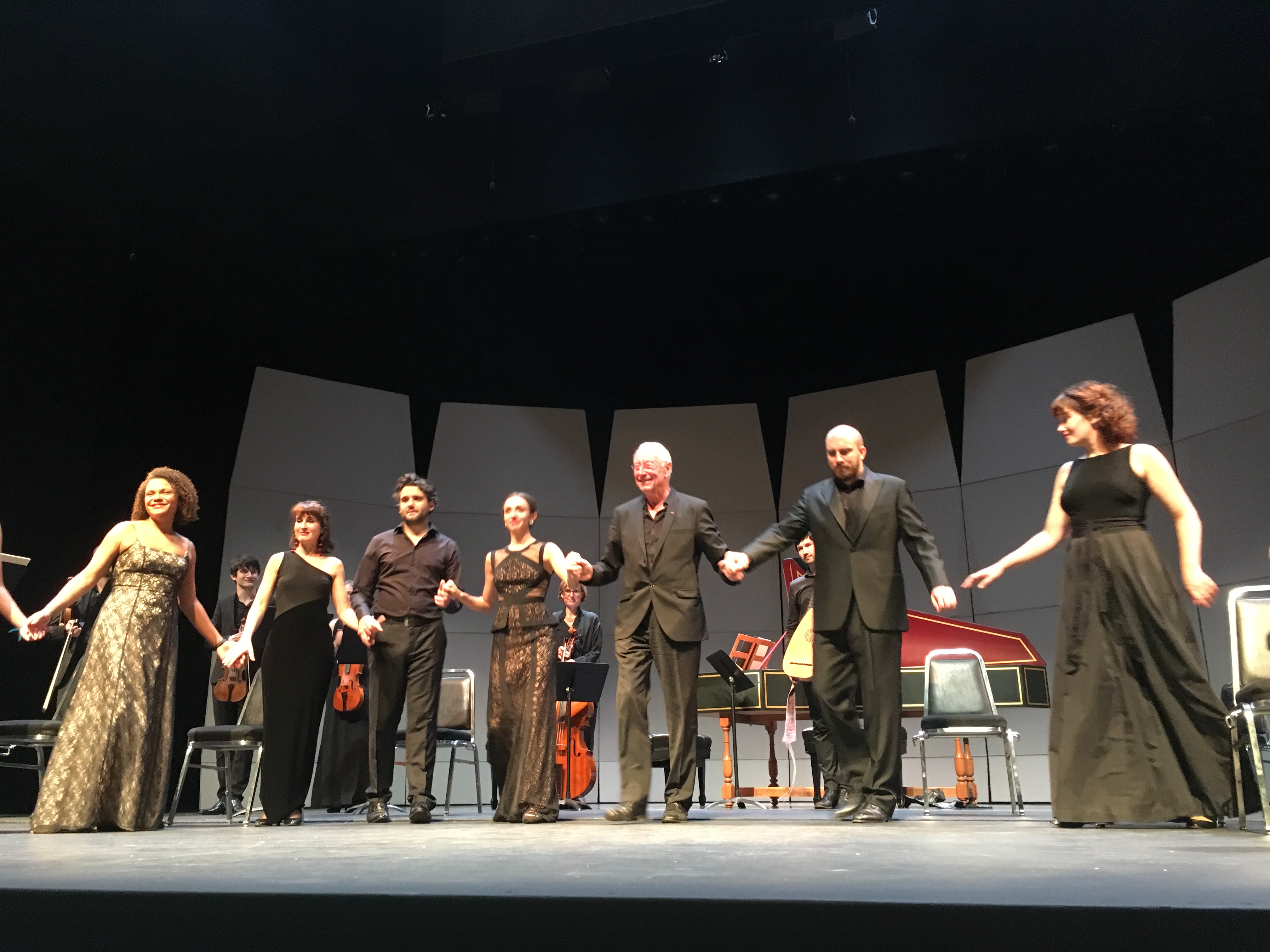
Conductor Nicholas McGegan with soloists for ‘The Temple of Glory.’ (Photo: Philharmonia Baroque Orchestra)
The satirical libretto, by Voltaire, follows what happens when a variety of different kings try to enter Apollo’s “Temple of Glory” — a bower for heroes guarded by the Muses. Two of the monarchs are barred for brutality and drunkenness. The third, Trajan, is allowed in for his generosity — he lets five conquered kings go — and insists on making the temple a bastion of inclusivity, “each rank, each sex, each age.”
Supposedly, when Voltaire asked Louis XV “Is Trajan happy?” after the 1745 premiere, he was answered only with a chilling silence. “The opera was meant as a lesson in kingship,” McGegan says. “It is not enough to win battles; real heroes act a certain way. Unsurprisingly, the king did not enjoy being lectured on how to rule.”
The opera clearly cut too close for Louis XV. Though the monarch is known as “the well-loved,” his reign was riddled with financial crises, lost wars, fights with judges, and clashes between religions. Described as weak and adolescent, Louis XV was not much of a leader, spending much of his time chasing women and hunting. The French Revolution came only 15 years after his death.
The opera was not a success and Rameau insisted on a rewrite of The Temple of Glory less critical of leadership styles and more focused on love. Voltaire was ejected from the court and went on to write Candide, perhaps his most politically incendiary work.
The Cal Performances production represents the first time modern audiences will get to experience the work in its original, unbowdlerized form. Those that attend the performances at Zellerbach Hall may see a parallel between the opera’s sly attempt to school the reigning monarch in the art of sensible leadership and John Oliver’s hilarious “Catheter Cowboy” ads aimed at educating President Donald Trump about everything from healthcare to sexual harassment.
The opera may also help put things into perspective when you consider the fact that Louis XV, with a temperament unsuited for leadership, reigned for more than 50 years. That certainly makes the next four to eight here feel a little more bearable, and belies the myth that everything was better in the past.
‘The Temple of Glory’ runs Friday, Apr. 28–Sunday, Apr. 30 at Zellerbach Hall on the UC Berkeley campus. For tickets and information, click here.
* Tattling * I got to interview Maestro Nic McGegan for this piece, which was both exciting, because I love PBO, and embarrassing, because I'm particularly awkward on the phone. McGegan talked for nearly an hour and was as charming and jaunty as he seems on stage. It was adorable when he cheekily explained that The Temple of Glory is "A wonderful opera, but not in the sense of sopranos dying in garrets."
August 5 2017: Asian Youth Orchestra with Sarah Chang, violin September 21 2017: Gustavo Dudamel and the National Youth Orchestra of Venezuela September 23-24 2017: Reggie Wilson/Fist and Heel Performance Group; Moses(es) September 30 2017: Lila Downs October 7 2017: Matt Groening and Lynda Barry October 11 2017: ODC/Dance; boulders and bones October 13-15 2017: Chicago Symphony Orchestra and Riccardo Muti October 21-22 2017: Théâtre de la Ville, Paris; State of SiegeOctober 22 2017: Olli Mustonen, piano October 23 2017: Garrison Keillor October 27 2017: Dorrance Dance October 28 2017: Korean National Gugak Center Traditional Orchestra October 29 2017: Anssi Karttunen, cello; Nicolas Hodges, piano November 4-5 2017: Mariinsky Orchestra and Valery Gergiev November 9 2017: Les Arts Florisssants and William Christie November 10 2017: Ian Bostridge, tenor and Wenwen Du, piano November 11 2017: Tango Buenos Aires; The Spirit of Argentina November 12 2017 Tetzlaff Quartet November 12 2017: Festival of South African Dance November 17-19 2017: The Joffrey Ballet November 24-26 2017: Imago Theatre; La Belle December 2 2017: Claire Chase, flute December 2-3 2017: Ragamala Dance Company; Written in Water December 2-3 2017: Simon O’Neill, tenor December 8-10 2017: Camille A. Brown & Dancers; BLACK GIRL: Linguistic Play December 10 2017: Takács Quartet; Garrick Ohlsson, piano December 15-24 2017: The Hard Nut; Mark Morris Dance Group January 27-28 2018: Peking Acrobats January 28 2018: Musicians from Marlboro February 3-4 2018: Circa; Il Ritorno February 9-11 2018: St. Paul Chamber Orchestra and Joshua Weilerstein with Jonathan Biss, violin February 16 2018: Dorothea Röschmann, soprano and Malcolm Martineau, piano February 18 2018: St. Lawerence String Quartet February 21 2018: Tony Kushner and Sarah Vowell February 24-25 2018: Company Wang Ramirez; Borderline February 25 2018: Sérgio & Odair Assad and Avi Avital February 28 2018: Emanuel Ax, piano; Leonidas Kavakos, violin, Yo-Yo Ma, cello March 4 2018: Kronos Quartet; Rinde Eckert; Vân-Ánh Võ; My Lai March 7 2018: Eva Yerbabuena Company; ¡Ay! March 11 2018: Wu Man and the Huayin Shadow Puppet Band March 16-18 2018: Manuel Cinema; Ada/Ava March 18 2018: David Finckel, cello and Wu Han, piano March 22 2018: Jazz at Lincoln Center Orchestra with Chick Corea March 25 2018: Julia Bullock, soprano and John Arida, piano April 6-7 2018: Spectrum Dance Theater; A Rap on Race April 7-8 2018: Seattle Symphony and Ludovic Morlot April 10-15 2018: Alvin Ailey American Dance Theater April 14 2018: Armenian State Chamber Choir April 20 2018: Apollo’s Fire; Monteverdi’s L’Orfeo April 21 2018: Gala at the Greek III April 22 2018: Richard Goode, piano May 4-5 2018: Ex Machina; 887 April 4 2018: Leif Ove Andsnes, piano May 6 2018: TAO; Drum Heart
Cal Performances announced the 2017-2018 season on today. Lots of Baroque opera in the season including Purcell’s Dido and Aeneas and Charpentier’s Actéon from Les Arts Florissants; Monteverdi’s Il ritorno d’Ulisse in patria from the circus arts group Circa; and a semi-staged L’Orfeo by Monteverdi played by Apollo’s Fire. The Koret Recital Series includes Ian Bostridge, Simon O’Neill, and Dorothea Röschmann.
October 14-22 2017: The Pirates of Penzance November 10-12 2017: Laura Kaminsky's As One January 26-28 2018: Ástor Piazzolla's Maria de Buenos Aires February 24- March 4 2018: Turandot March 17-25 2018: Daniel Catán's Florencia en el Amazonas
The 2017-2018 season at San Diego Opera was announced April 23.
Leave a comment