• Walkuere-2013* Notes *
     
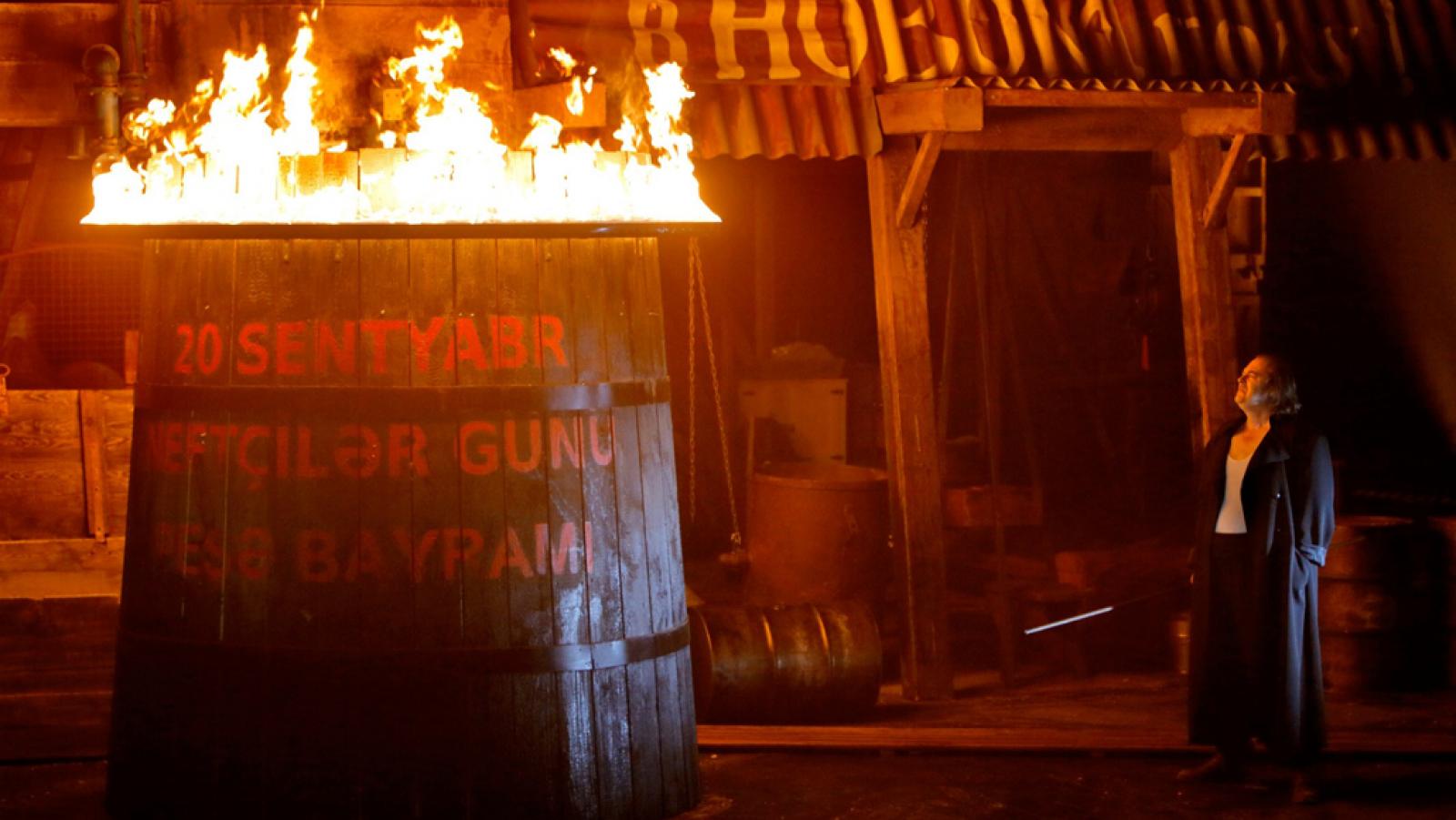
    Frank Castorf's new Der Ring des Nibelungen continued with Die Walküre at Bayreuth last night. The production continues to be dramatically vacuous. The set looked to be a large barn situated in Azerbaijan, which did transform into an oil derrick for Acts II and III. The live video captures are distracting, at times blocking the action, only to show mediated versions of what they are covering. Some of the prerecorded parts are rather nonsensical, near the end of Act I, there is a short film depicting a woman messily eating cake. The woman answers the telephone and then sets it down on the cake, then tries on a sleeveless dress, only putting one of her arms through an armhole before returning to her cake and telephone.

    The staging is often overwrought, doors are opened, objects brought out, and so forth. There are a lot of unnecessary props, such as the giant pumpjack that extends over the edge of the stage in Act III. The effect is creepy, but has little else to do with anything else happening in the production at that moment, much less in the libretto. Oddly though there is not a lot for the singers to do while they are singing, often they just stand and are ignored by the other characters.

    The orchestra continued to float lucidly under the direction of Kirill Petrenko. The brass was not completely translucent at all times, but for the most part sounded lovely. There were no obvious errors as with the previous night. The string soli were radiant. The sound of the singing was not swallowed up by the playing.

    The Walküren made a fine effort, some were easier to hear than others. Franz-Josef Selig sounded robust as Hunding. Claudia Mahnke was an effective Fricka. Catherine Foster's Brünnhilde has a wonderful lightness, she did not bear down on her voice or scream her notes. Wolfgang Koch sang Wotan with nuance and color, despite the production. Johan Botha sounded utterly secure as Siegmund, never straining. Anja Kampe (Sieglinde) was the obvious audience favorite, her brilliant, searing voice did not disappoint.

    * Tattling * 
    In short, everyone was better-behaved for this second performance of Der Ring. The woman who thought I was in her seat the night before greeted us in a conciliatory manner on Thursday. She brought her daughter to Walküre, and they were fairly still and quiet. The woman in Orchestra Left Row 20 Seat 26 who talked a lot also brought a different person to the opera, and they whispered but not that much.
    Leave a comment


  • Rheingold-2013* Notes *
     
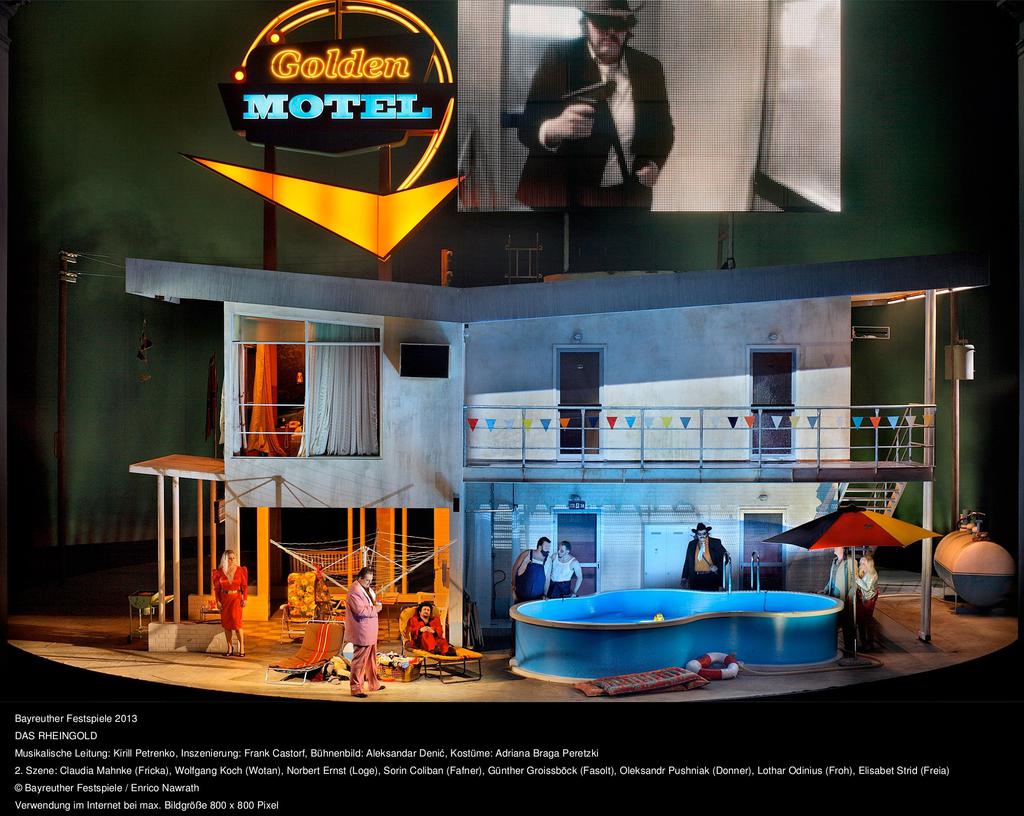
    The second cycle of Frank Castorf’s Der Ring des Nibelungen at the Bayreuther Festspiele opened yesterday with Das Rheingold. The production is a hodgepodge of Americana that does not give the characters any place to go. The action takes place at a Texan motel and gas station, all carefully arranged on a turntable. An electronic billboard above shows both live video capture and prerecorded footage.

    It was impressive how well-coordinated the performance is, but often the characters act in completely irrational ways that have nothing to do with the opera or even normal human behavior. For instance, Nibelheim is depicted as an Airstream that is dragged into the gas station by stagehands. At the top of Scene 3, Wotan and Loge have taken Alberich and Mime hostage, and tied them to posts. This is completely against the text, and makes the rest of the scene unnecessary. There are also no vocal Nibelungen, and thus part of the score is missing, as their cries and screams simply were absent.

    Kirill Petrenko conducted the orchestra with a beautiful lightness. Maestro Petrenko perhaps does not instill the same sort of fear as Christian Thielemann does, and an obvious brass error was heard in Scene 4 before Fafner, Fasolt, and Freia enter. Nevertheless, the music sounded palpably fresh and dazzling. The orchestra only rarely overwhelmed the singers.

    Singing is fine. The smaller roles are not terribly strong, Oleksandr Pushniak (Donner) was wheezy, while Lothar Odinius (Froh) and Burkhard Ulrich (Mime) were fairly nondescript. However, all three acted splendidly. Pushniak twirled his mustache in a charming way. Ulrich was endearing when he found that the Airstream was all his, and not only started maniacally polishing it, but cheerfully switched out the Confederate flag of the motel with a rainbow one. Mirella Hagen (Woglinde), Julia Rutigliano (Wellgunde), and Okka von der Damerau (Floßhilde) looked rather listless as the Rheintöchter but sounded pretty. The Riesen are cast distinctly, Sorin Coliban’s Fafner is grumbly, while Günther Groissböck’s Fasolt is almost sweet. Nadine Weissmann made for an ethereal Erda, her sound is delicate yet not too quiet. Elisabet Strid (Freia) had a much more muscular voice. Claudia Mahnke was a bit breathy as Fricka, but her voice is neither shrill nor strident.

    Norbert Ernst was a unctuous enough Loge, with a nice voice. There was a little strain in his higher notes, but his acting made up for this. For me, the weakest link was Martin Winkler, whose vibrato I find disagreeable. His Alberich is made to be extremely puerile, which does not do him any favors. His voice sounds more than passable when the his music is not highly orchestrated, but does not have the brightness to cut through when it is. Wolfgang Koch, on the other hand, is an excellent Wotan. He sings with effortlessness, power, and warmth.

    * Tattling *
    This was the worst-behaved audience of my time in Bayreuth so far. There was an electronic sound at the beginning of the first scene. Talking was heard during the music irrespective of singing. I hushed the loud couple in Orchestra Left Row 20 Seats 25 and 26, and thankfully they whispered instead for the rest of the opera. Gallingly, the female half of the couple screamed “Bravo” at singers she had not been fully listening to.

    An uptight German-speaking couple (possibly mother and son) in Orchestra Right Row 21 Seats 27 and 28 were convinced I was in one of their seats despite the fact that my ticket clearly shows that I am in Orchestra Left Row 21 Seat 27. I tried to gently remind them that 27 comes after 28, and that logically Orchestra Right Seat 27 would be to the right of Seat 28. They remained doubtful, talking to the usher on the right side of the house, then harassing a grey-haired East Asian couple, oblivious to the fact that they were not me and Axel Feldheim. By the time they made it back to the middle of the row, they refused to believe me, my companion, or the kindly person in Orchestra Left Row 21 Seat 25 that they were in the wrong.

    The son demanded that we speak to the usher on the left side of Row 21, so we made everyone on the left side of the row get up to let us through. Finally, the usher explained that 27 comes before 28, so the pair’s other seat is to the right of 28, since their tickets clearly read “Parkett Rechts.” We marched back to the middle of the row, inconveniencing 25 people yet again. When the high-strung man explained to his mother that they were mistaken, she shooed away the European-looking (but evidently not German-speaking) man in her seat, even taking his seat cushion and sort of pushing it at him. After all this, these two did not even apologize for their various rude blunders. At least they were very quiet, the man hardly shifted in his seat, and managed not to elbow me even once.

    Leave a comment


  • Hollaender-2013* Notes *
     
    Bayreuther Festspiele‘s Der fliegende Holländer had a fourth performance this season yesterday evening. Christian Thielemann conducted the orchestra with precise control and intimidating intensity. The brass had a perfect clarity. The woodwinds played vividly. The chorus shone once again, singing robustly and moving persuasively. The singers were synchronized in every way.

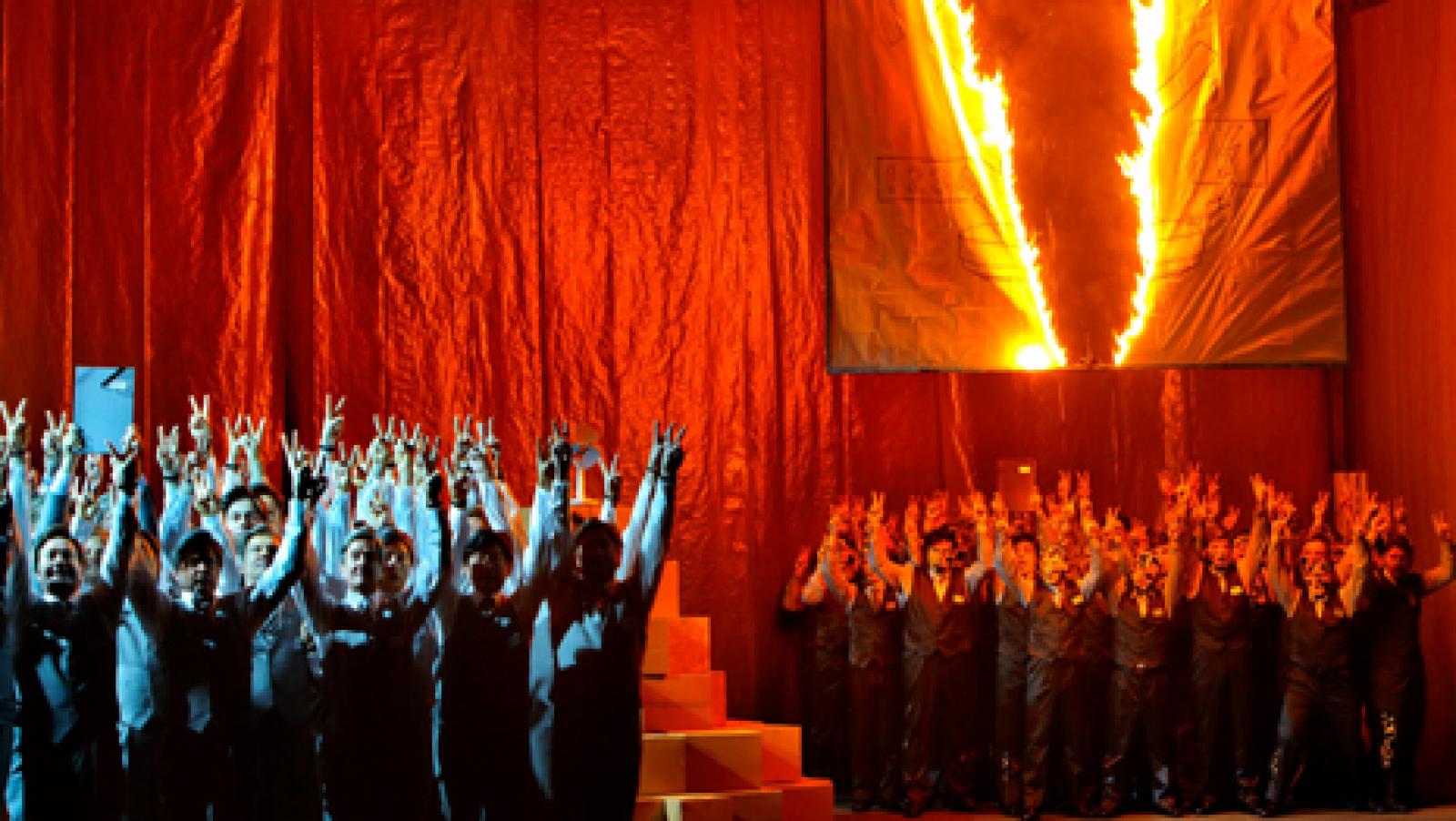
    The Act I set is rather dizzying with flashing lighted lines and numbers on two giant curved walls. It is odd that Der Steurmann and Daland are in a row boat, when the rest of the staging indicates they were businessmen at an exchange or commodity market of some kind. The scene changes are seamless, and it is particularly stunning when the Act I walls came apart while the male chorus walks from upstage all the way downstage with the Act II room following them. As far as the production goes, Acts II and III make few references to seafaring or spinning or anything else in the libretto. Nevertheless, director Jan Philipp Gloger’s narrative on capitalism is clear and hangs together well. The pyrotechnics are especially spectacular.

    Singing was fairly good. Benjamin Bruns (Der Steuermann) and Christa Mayer (Mary) made serviceable contributions to the proceedings. Tomislav Muzek was a sympathetic Erik. Franz-Josef Selig was a warm, paternal Daland. Ricarda Merbeth sang Senta with a lot of force. Intonation did not seem a primary concern for her. Samuel Youn was a very pleasant Holländer, and could have been much more menacing. His voice is pretty.

    * Tattling *
    A couple in Row 21 on the left side had the audacity to speak during the terrifying overture, but were silenced right away with one hushing. Someone loathed the two principals and booed them at full volume during their curtain calls.

    Leave a comment


  • Tannhaeuser-2013* Notes *
     
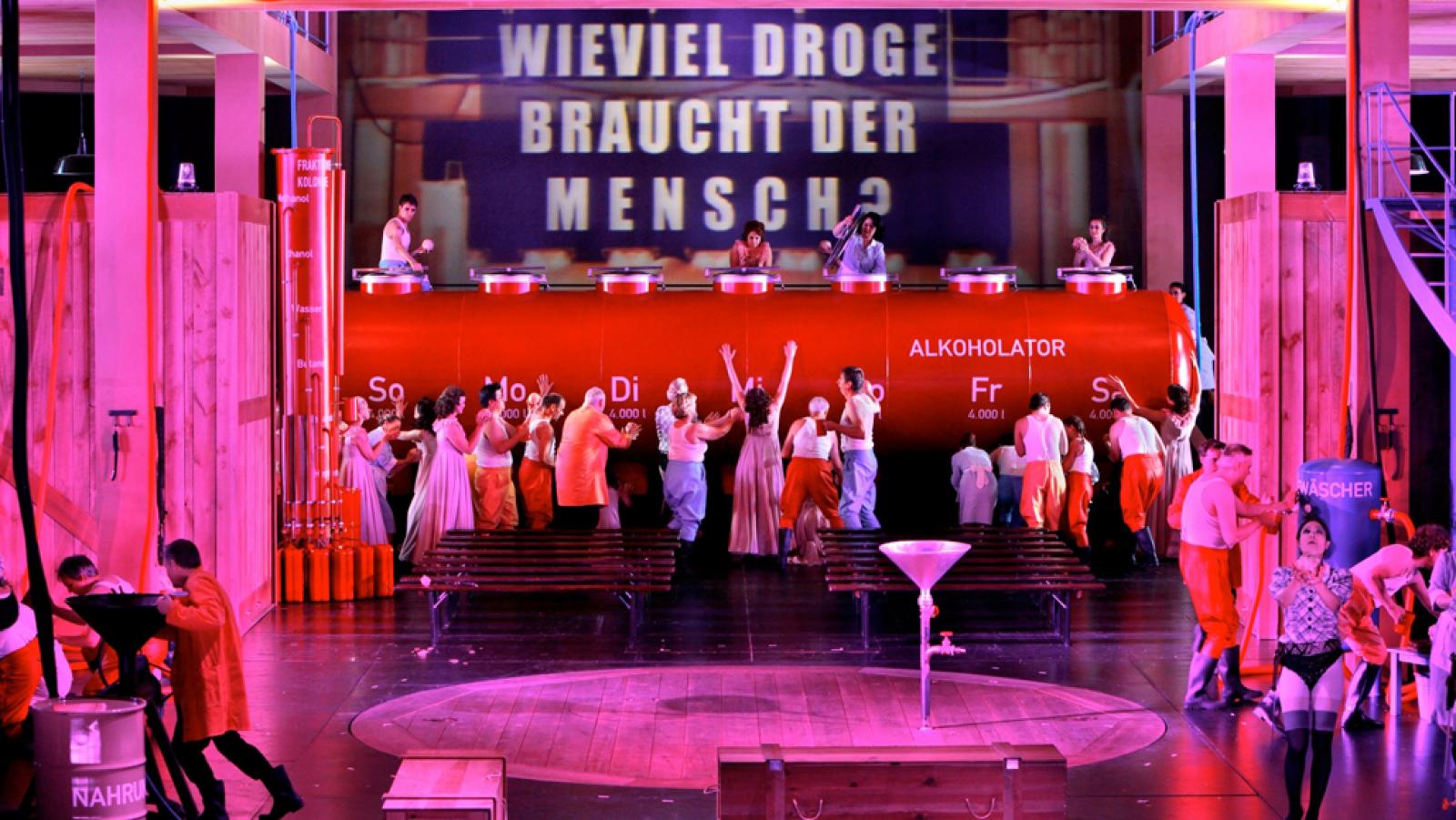
    The current production of the Bayreuther Festspiele's Tannhäuser is unsatisfying. Sebastian Baumgarten directed a busy and tedious staging, relying on lots of projected text. There were also giant stuffed animal-like rays, menacing ape people, and assorted funny characters. The set, with its multiple levels, could have been used much more cunningly, but instead blocked the back projections. All of the singers showed a deep commitment to the direction, but the many unconnected ideas never cohered. The action did not go with the music in any way, and in the end, the spectator was left bored.

    The orchestra was lead by Axel Kober, whose tempi were measured. Although not bad, the playing lacked sensuousness. On the other hand, the chorus sounded great. The most formidable part of the evening was certainly the end, where the set was put to best effect with chorus members on different stories. The volume alone was quite impressive.

    Singing was the redeeming factor in the performance on Tuesday night. Katja Stuber (Ein junger Hirt) was exacting in her choreography as some sort of drunken hoodlum, and yet sounded brilliant and unreal. Günther Groissböck was a commanding Landgraf Hermann, his voice has a lovely richness. Michelle Breedt may not have been the most alluring Venus, but sang with power.

    Camilla Nylund (Elisabeth) was occasionally shrill, though has a certain vulnerable quality that is appealing. Michael Nagy did a beautiful job with Wolfram von Eschenbach. His "O du, mein holder Abendstern" was exquisite, he sang with sensitivity and warmth. Torsten Kerl was fine in the title role, never pushing his voice too hard, yet always audible.

    * Tattling *
    Someone tried clapping after the overture and one could feel the disapproval of the other audience members. A grey-haired woman next to me (Row 20 Seat 27 on the right side of the theater) collapsed on me during Act I. I was afraid she was having a seizure, but she had simply fainted from the stuffy heat, and recovered in a few minutes.

    Before Act III there was some sort of mass acted on stage, and when some of the audience clapped at the end of this, others booed to express their contrary opinion of the production. Likewise, there was a segment of the audience that was vocal in ridiculing the staging at final ovation, and I was surprised to hear my companion join in, as I have never heard him boo before.

    Leave a comment


  • Lohengrin-2013 * Notes * 
    Last night’s performance of Lohengrin at the Bayreuther Festspiele was compelling. The orchestra sounded clear and fresh under the baton of Andris Nelsons, without ever being dull or devoid of passion. The brass was perfectly clear, as did the strings and the woodwinds. Nelsons also struck a fine balance between the instrumentalists and singers, and only rarely overwhelmed the latter. The chorus also sounded remarkably beautiful and in unison.

    The rest of the singing was even. Samuel Youn has impressive hair as Der Heerrufer des Königs, and sang nicely. Petra Lang was an impassioned and insistent Ortrud. Thomas J. Mayer (Friedrich von Telramund) does not have a particularly rich voice, but was suitably threatening. Wilhelm Schwinghammer was not the most commanding König Heinrich, but gave a satisfactory perforrmance. Annette Dasch made for a sweet-voiced Elsa von Brabant. Klaus Florian sounded bright and pleasantly brassy in the title role, his voice cut through the chorus and orchestra with ease.

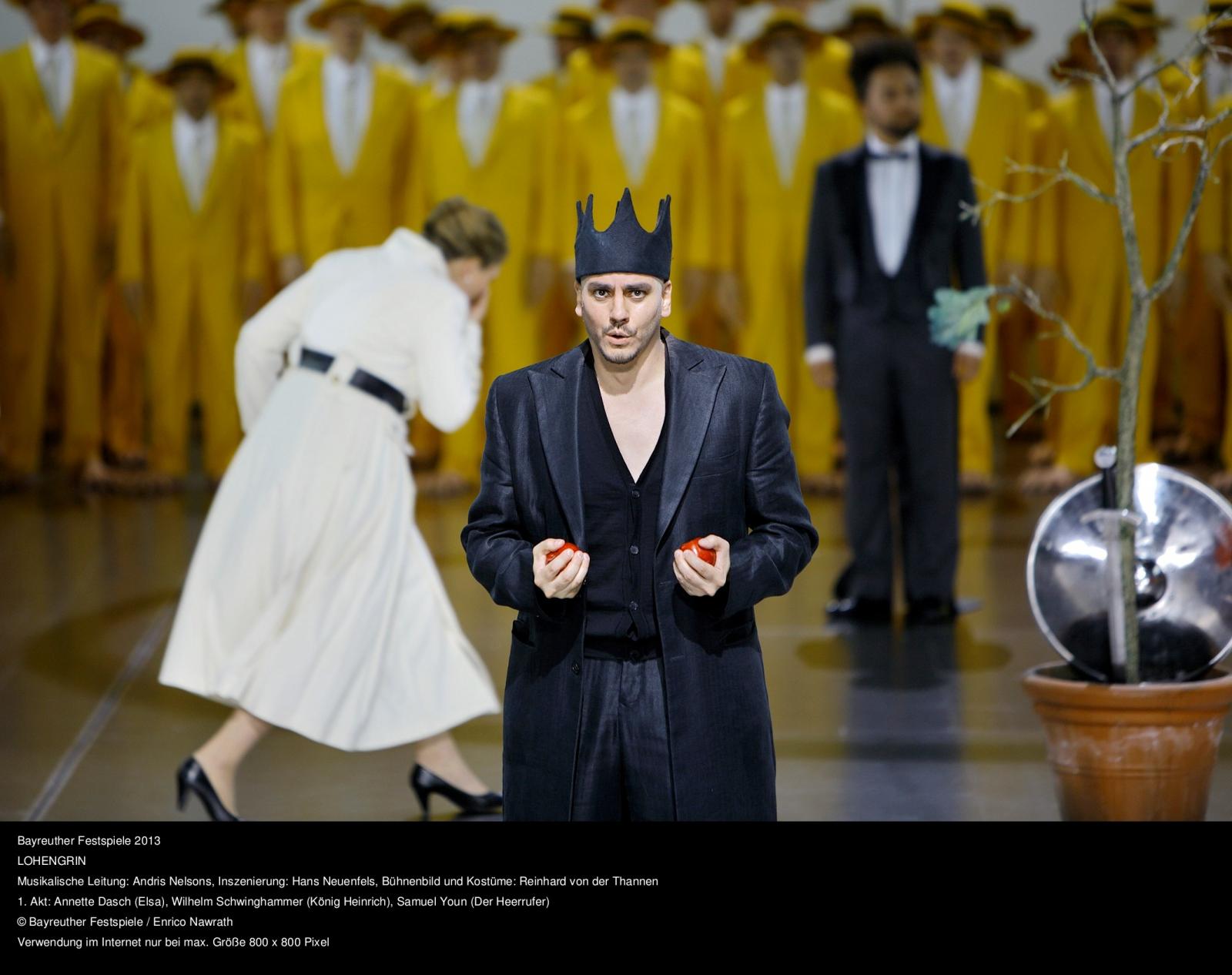
    The production from Hans Neuenfels certainly appears to have an internal consistency, featuring chorus members dressed as laboratory rats. Said rodents were a skillful combination of cute and creepy. Everyone moved elegantly. At various times the treatment of the swan used taxidermy, bathtubs, and sculpture. It was all entirely entertaining, though it was not clear to me what any of it had to do with Wagner’s opera, despite the fact it was all splendidly coordinated with the music.

    * Tattling * 
    There were scattered whispers when only the orchestra played. The audience laughed when the lab rats did funny things, especially the small pink ones that must have employed child supernumeraries. A couple in front of us in the middle of the twenty-second row read the vocal score.

    A very nice couple from Düsseldorf let Axel Feldheim and I practice German with them at our shared table during the second intermission.

    Leave a comment


  • 7.18.13_Merola-2600* Notes *
     
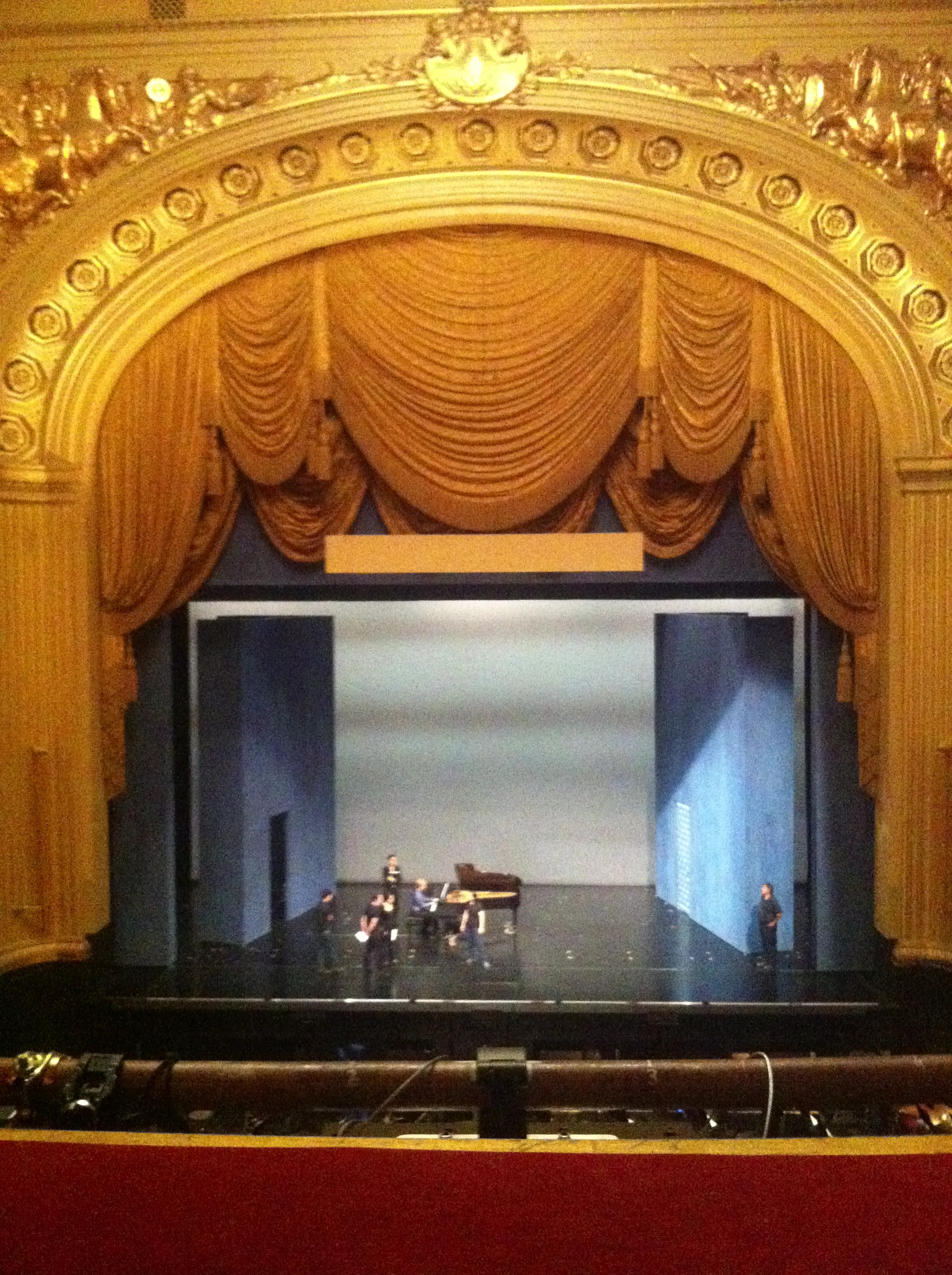
    Last night’s Schwabacher Summer Concert began with a sparkling overture from Der Schauspieldirektor. The orchestra, conducted by Kevin Murphy, was on the stage and there were subsequent synchronization problems with the singers starting with Act I, Scene 5 of Don Giovanni. Aviva Fortunata made for a dramatic Donna Elvira, while Rhys Lloyd Talbot struggled to stay with the orchestra in “Madamina, il catalogo è questo.” The excerpt of Don Carlo from Act IV, Part 2 went better, and Alex Desocio sounded solid as Rodrigo.

    The most delightful part of the evening was certainly from Act I, Scene 3 through 5 of L’Italiana in Algeri. Matthew Newlin was humorous as Lindoro, his light voice sounded somewhat constricted at the top, but is quite pretty. Zanda Švēde made for a wonderfully sassy Isabella, and her scenes with Pene Pati and Issachah Savage (pictured above, photograph by Kristen Loken) were charming. The direction was somewhat overwrought, but this was easy to ignore.

    Pene Pati (Edgardo) impressed in Act II, Part 2 of Lucia di Lammermoor. His voice is pleasantly metallic and generally appealing. The singers of the chorus did not sound cohesive because of how slowly they walked to the foot of the stage, and how spread out they were. Pati was also strong in the excerpt of L’Amico Fritz, singing the title role of the opera. Zanda Švēde sang Beppe quite beautifully as well.

    The performance ended with the end of Otello. Aviva Fortunata sounded nearly ideal as Desdemona, but having her simply stand completely still for much of her singing was rather dull to watch. Issachah Savage was arresting as Otello with his full, lovely voice.

    * Tattling * 
    Latecomers were loud and obnoxious, stamping down the aisles and aggressively swinging down seats. Watch alarms sounded a every hour and a cellular phone rang after the words “Oh! Gloria! Otello fu.”

    Leave a comment


  • 7.9.13_Lucretia-4747* Notes *
     
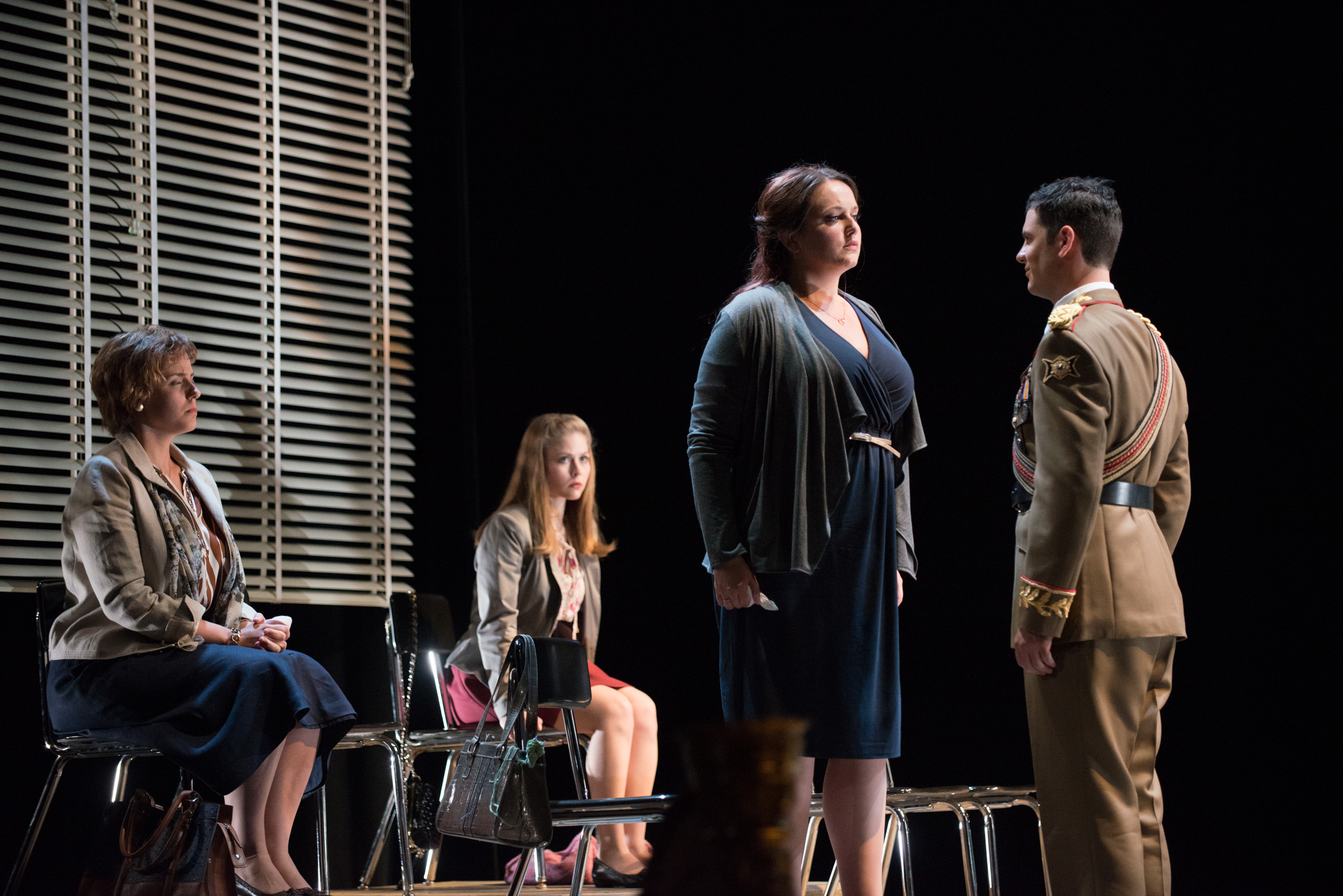
    Britten’s The Rape of Lucretia was performed last night by the Merola Opera Program at Everett Middle School in San Francisco. The production (pictured left with Katie Hannigan as Bianca, Alisa Jordheim as Lucia, Kate Allen as Lucretia and Chris Carr as Tarquinius; photograph by Kristen Loken) directed by Peter Kazaras, is elegant and contemporary. Donald Eastman’s scenic design is essentially just platforms, furniture, and blinds, but comes to life beautifully with Chris Maravich’s lighting. The production complements the music, and the dramatic moments of this opera held together nicely. The proceedings seemed altogether fresh and vibrant.

    Mark Morash conducted the small ensemble to fine effect. Though there is no pit in the theater of Everett, the situation seems better than at Cowell, as the musicians sounded robust, vivid, and synchronized. The harp playing was especially lovely, as was the oboe and English horn.

    The singing was impressive all around. Alisa Jordheim (Lucia) sounded perfectly sweet and bird-like. Katie Hannigan made for a protective Bianca. David Weigel’s pain as Collantinus was palpable. Efraín Solís was quite disturbing as Junius, particularly when goading Tarquinius at the end of Act I Scene 1.

    Linda Barnett sang the Female Chorus with a certain calm, while Robert Watson was more rousing as the Male Chorus. Chris Carr’s Tarquinius was expressive and disquieting. Kate Allen was a magnificent Lucretia, with gorgeous low notes.

    * Tattling * 
    There was very little talking, except when a super-title error occurred during Act I. The J Church light rail street cars were clearly audible from inside the auditorium.

    Leave a comment


  • 7-placido-8849Plácido Domingo is performing at UC Berkeley's Greek Theatre on Saturday, September 7, 2013 at 8pm. He will be joined by guest sopranos Angel Joy Blue and Micäela Oeste and guest conductor Eugene Kohn. Presale tickets are available Tuesday, July 9, at 10am until Saturday, July 13, at 11:59 pm online only through Another Planet Entertainment and Ticketmaster. The presale password is "GREEK."

    APEConcerts | Ticketmaster

    Leave a comment


  • Merola-general-director-auditions-2013* Notes *

    The Auditions for the General Director of San Francisco Opera occurred last night after the matinée performance of Les Contes d'Hoffmann. The twenty-three singers in the Merola Opera Program performed, each accompanied by one of five apprentice coaches. There were some interesting tenors and mezzo-sopranos. The baritones, though all very loud and competent, seemed a little bland this year.

    Mezzo-soprano Rihab Chaieb, tenor Issachah Savage, soprano Maria Valdes, mezzo-soprano Zanda Švēde, tenor Pene Pati, and mezzo-soprano Daryl Freedman were called back. Both of these tenors had a robust warmth and their own particular sound. Švēde was most distinctive of the these female singers, her voice is quite deep. Pati and Freedman were especially praised by David Gockley.

    Of those not called back, Gockley seemed most enthused about baritone Chris Carr, soprano Aviva Fortunata, tenor Matthew Newlin, and bass-baritone Thomas Richards.

    Leave a comment


  • Mary-magdalene-act-2-2013Production Web Site | SF Opera's Blog

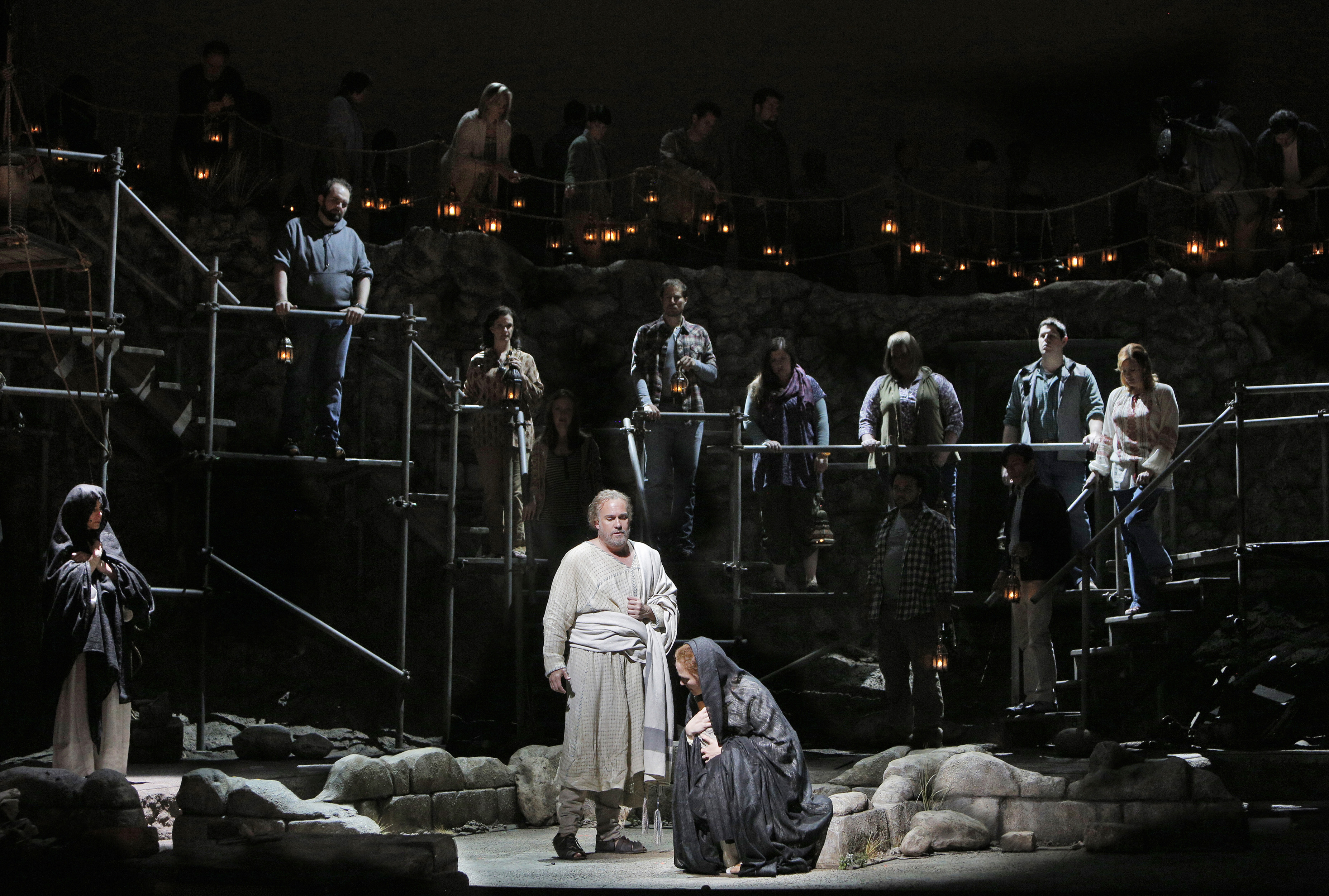
    The reviews of San Francisco Opera's The Gospel of Mary Magdalene (Act II pictured left with William Burden as Peter and Sasha Cooke as Mary Magdalene, photograph by Cory Weaver) are varied, but mostly fair to middling.

    Performance Reviews: Civic Center | Los Angeles Times | New York Times | San Francisco Chronicle | San Francisco Classical Voice | San Francisco Examiner | San José Mercury News

    Leave a comment