• Amanda-forsythe* Notes *
     
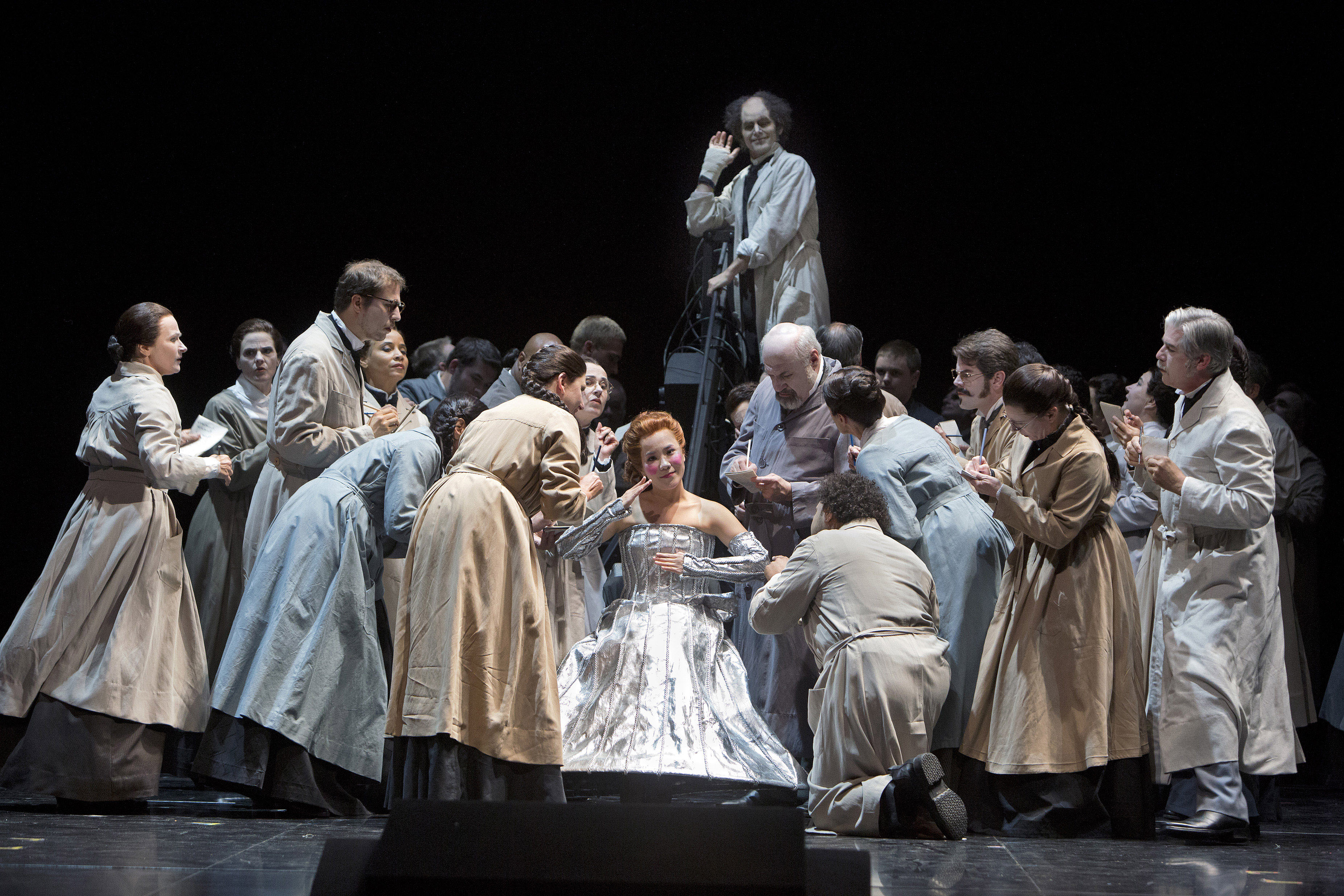
    Philharmonia Baroque Orchestra is currently performing Händel’s Teseo in the Bay Area. The opera certainly has some very silly moments, and this semi-staged version simply embraced the absurdity. The orchestra is set up around the two harpsichords, with Maestro Nicholas McGegan at one and Hanneke van Proosdij at the other. As a result, a number of the musicians are facing the stage, making it easier for them to engage with the singers. This keeps the orchestra and singers together, and the vocalists have a clear rapport with the instrumental soloists. Because the pit in Herbst Theater for Thursday’s performance is so small, theorbo player David Taylor played from the stage. For Clizia’s aria “Risplendete, amiche stelle,” both Clizia and Arcane interact with Taylor, to amusing effect.

    The cast featured many high voices. The two countertenors had opposing problems, Robin Blaze (Arcane) with his upper range, and Drew Minter (Egeo) with his lower notes. They did both act well. Blaze has some sweetness to his voice, but the quality of his high notes has a strained, whooping quality. Minter has a pleasant resonance in the middle of his voice, but the transitions between his head and chest sounds were jarring.

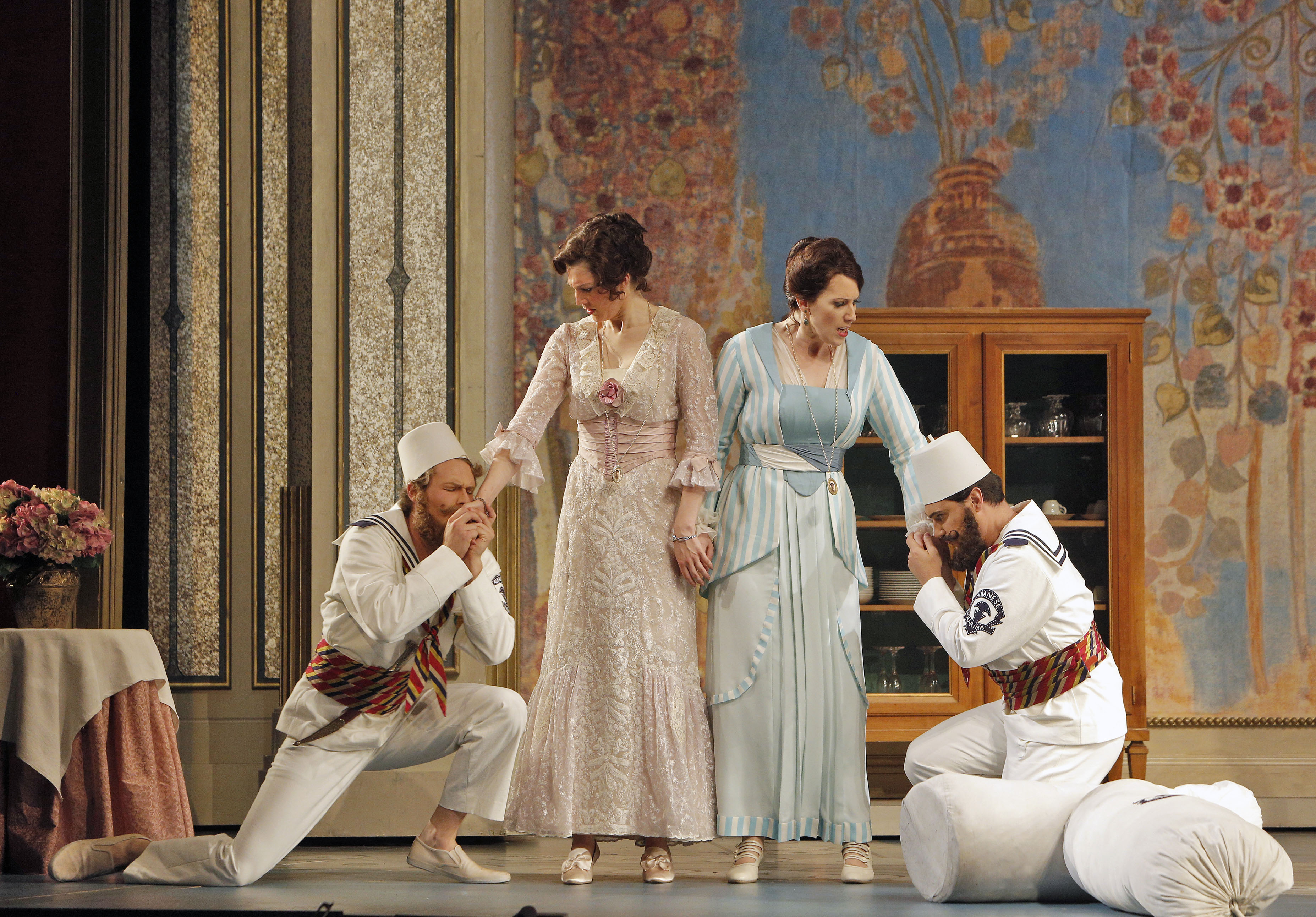
    The four sopranos also have sounds distinct from one another, but fared better. Céline Ricci (Clizia) was committed to her acting. As Agilea, Valerie Vinzant started off a bit squeaky, but smoothed out over the course of the performance. Her “M’adora l’idol mio” with the oboe soloist conveyed the conviviality of the evening’s proceedings. In the title role, Amanda Forsythe (pictured above) sounded secure and well-supported. Dominique Labelle relished playing the villainess Medea. Labelle’s voice is sturdy and rich. She was able to explore an array of emotions, and express these through her sound.

    * Tattling * 
    There were many loud whispers and outright talking in the first half. Quite a few people left at the interval, so the second half was much quieter.

    Leave a comment

  • PBO_byRandiBeachOctober 2-6 2013: Pergolesi's Stabat Mater
    November 15-19 2013: Berezovsky, Facius, Fomin, Glinka
    December 6-10 2013: Stanley, Croft, Boyce
    December 14-15 2013: Händel's Messiah
    February 5-9 2014: C.P.E. Bach, Haydn
    March 5-9 2013: Muffat, Schmelzer, Schein, Biber, Benda, Bach, Telemann
    April 10-14 2013: Vivaldi's Juditha Triumphans

    Philharmonia Baroque Orchestra's 2013-2014 season was announced on today. Carolyn Sampson and David Daniels are the soloists in Stabat Mater. Cécile van de Sant, Vivica Genaux, Diana Moore, Dominique Labelle, and Virginia Warnken are featured in Juditha Triumphans.

    Official Site

    Leave a comment


  • Giuliocesare_0844sAccording to a press release, Natalie Dessay (pictured left, photograph by Marty Sohl) was ill for the second performance of the Met’s Giulio Cesare. Danielle de Niese sang the role of Cleopatra instead.

     Production Web Site for Giulio Cesare | Casting Changes

    Leave a comment


  • Davies-Full-Ext-NightThe musicians of San Francisco Symphony are returning to work as of March 31, 2013. They have reached a tentative agreement for a new 26-month contract.

    Official Site | Press Release

    Leave a comment


  • Noah StewartTenor Noah Stewart (pictured left, photograph by Mitch Jenkins) is singing the world premiere of Steven Stucky’s The Stars and the Roses with Berkeley Symphony this Thursday.

    How did you start singing?
    I first started singing when I needed extra school activities while at junior high school in New York City. I was drawn to a diverse mix of musical styles ranging from jazz to Broadway and back. Before the age of 12, I had already sung in Latin, German, French, Swahili, and Hebrew. It definitely set the stage for an international career.

    La costanza in amor vince l’inganno was the first opera you performed in, which seems unusual. How did that come about?
    When I was a senior at LaGuardia High School or “The Fame School,” I was given the options of Gospel Chorus or Opera Workshop. Most of my friends chose gospel, as it was closer to pop music, while I chose opera. At this stage, I was truly obsessed with opera and would jump at the chance for free tickets at the Met to see some of my favorite singers like Pavarotti and Jessye Norman.

    Aminta, from Caldara’s La costanza in amor vince l’inganno, was my first operatic role. (Tenor great, Beniamino Gigli frequently included songs like “Sebben, crudele” in his concerts.) My opera workshop teacher would stay after school teaching the recitatives, because he saw this passion for opera within me. Interestingly enough, it was the North American premiere of that opera. I wasn’t your ordinary 16-year-old, I would say. By the time I auditioned for Juilliard, I had already sung with full orchestras for three years as a soloist for regular mass and oratorio performances while in high school.

    Do you like creating roles, as for Appomattox?
    I have been very fortunate to have had experience singing traditional repertory as well as contemporary music in my career. I enjoy working along side living composers and creating roles like T. Morris Chester in Glass’ Appomattox here at SFO. It’s nice to not have constant comparisons to artists and ghosts of the past. It also keeps up my technique as far as learning music.

    What are your favorite operas?
    At this time, my favorite operas to perform are those of the leading Italian and French heroic roles. I feel that the timbre and weight of my voice lends itself to the music of Donizetti, Verdi, Puccini, and Massenet. I also enjoy the dramatic and physical challenges of a role like Don José, the dangerous soldier and lover in Bizet’s Carmen.

    How did you choose the pieces on your debut CD?
    The music selections for the CD were made between the producer, creative team from Universal/Decca and myself.

    How has working with Joana Carneiro and Berkeley Symphony been?
    I had the pleasure of meeting and working with Joana at Chicago Opera Theater on John Adams’ A Flowering Tree. She is one of my favorite conductors around. Not only is she an incredible musician, but the sheer passion that she displays inspires me whenever I see her perform.

    Tell me about the piece you are debuting.
    The piece that I am premiering is comprised of three songs. The texts are poems written by Czesław Miłosz and the music is composed by Steven Stucky. The themes are nature and love, and are beautifully set.

    Which singers to you look up to?
    The singers of whom I look up to are the singers of the Golden Age. I collect historical recordings and often play them for inspiration and guidance. My favorite tenor and singer is Enrico Caruso who really changed what a leading tenor sounded like, combining a rich color capable of beautiful lyrical and dramatic shadings. The first time I saw and heard the voice of Leontyne Price, I was in love. It’s like fine crystal and anyone I speak to who had the chance to hear her soprano says the sound was simply stunning. Other favorites include Gigli, Ponselle, Verrett, Bumbry, Callas, Corelli, and Cappucilli to name just a few.

    You are really diligent with tweeting, how do you keep up?
    I try to make time for it like so many things. The life of the modern day opera singer is very different from that of yesteryear. Being a New Yorker, I had to become good at multitasking.

    What is your fitness regimen?
    I try to do yoga as much as I can while on the road. I feel that it centers and helps me focus, as well as helps my breath in singing. I also love to enjoy the food and culture of every country and city I visit, so a gym membership is a must!

    The picture you took of custard tarts from Pastéis de Belém in Lisbon was really cute. Are they really good for the voice?
    They are good for the voice. Art is fed from life and great experiences. To be a great artist, you must be a communicator of many emotions. We feel special connections to our favorite people and artists. We do so because they are able to translate their experience through different mediums and forms of art. That custard definitely makes my High C a bit shinier, or so I like to think so.

    Leave a comment


  • Jansons_BR_02* Notes *
     
    Mariss Jansons and Symphonieorchester des Bayerischen Rundfunks (pictured left, photograph courtesy of Bayerischer Rundfunk) performed Shostakovich and Beethoven as the closing concert of this year’s Lucerne Festival zu Ostern. The orchestra played Shostakovich’s Symphony No. 6 in B minor, Op. 54 first. The piece is quite odd, having a vernal, yet dark quality to it. The playing all around was splendid. The brass was clean but warm, the woodwinds gleamed, the strings shimmered, and the whole sound came together perfectly.

    During intermission, the orchestra was rearranged to have first and second violins on the outside, the violas next to the seconds, and the celli next to the firsts. Before the violas had been downstage, the celli next to them, and the seconds next to the firsts. To end we heard Beethoven’s Symphony No. 5 in C minor, Op. 67. Jansens seems to have immaculate control of the orchestra, and the musicians played evenly, with precision, but much bright richness as well. I was impressed by how good the horn sounded, and how the piccolo, which seemed sinister in the Shostakovich, sounded perfectly bird-like in the Beethoven.

    * Tattling * 
    There was light whispering and some coughs during the music, but this was only a minor nuisance.

    Leave a comment


  • Mariss-jansons* Notes *
     
    Symphonieorchester des Bayerischen Rundfunks, Chor des Bayerischen Rundfunks, and the Tölzer Knabenchor were conducted by Mariss Jansons (pictured left) in Britten's War Requiem op. 66 at Lucerne Festival Saturday evening. The orchestra sounded secure and polished. The brass fanfares in the Dies irae were particularly fine. The chorus was perfectly good. The boys' choir sang from backstage and sounded eerie.

    The soloists sang well. Emily Magee's icy soprano was somewhat shrill in the Liber scriptus, but sounded creamier as the piece proceeded. The contrast of her voice with the warmth of the chorus was unnerving. Christian Gerhaher's voice is also pleasantly warm, complimentary to both the soprano and tenor. "Out there, we walked quite friendly up to death" was especially beautiful. Tenor Mark Padmore sounded otherworldly in this, and seemed incorporeal throughout the work, as suits Britten. The Lacrimosa with soprano and chorus interspersed with Padmore's solo "Move him, move him" was sublime.

    * Tattling * 
    This year's common cold features a terrible cough, and this was on full display at between the six movements of the War Requiem. The audience in the third balcony was quiet during the music, but the man in Row 4 Seat 13 clapped (and screamed) at a painful volume during the final ovation.

    Leave a comment

  • * Program *
    Johannes Brahms
    Tragic Overture, Op. 81
    Daniel Cohen

    Ludwig van Beethoven
    Symphony No. 9 in D minor, Op. 125 (first movement)
    Giedre Slekyte

    Claude Debussy
    Nuages from Trois Nocturnes
    Paolo Bortolameolli

    BHA050* Notes * 
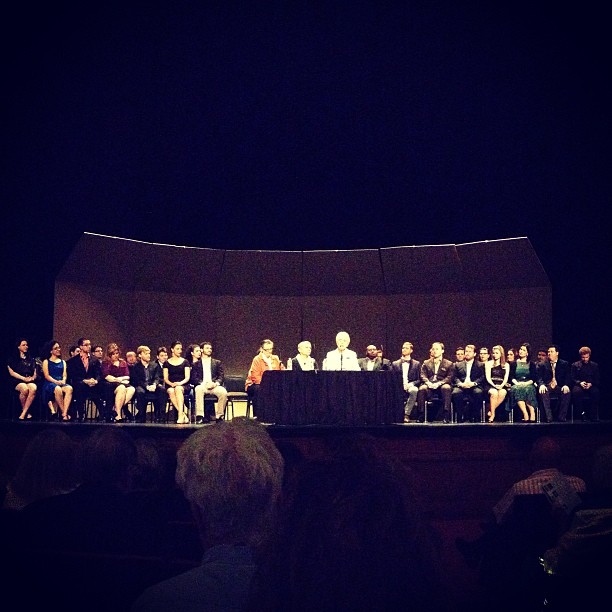
    Bernard Haitink has been giving master classes in conducting for the Lucerne Festival for three days. This morning's session included three young conductors from Israel, Lithuania, and Chile. Festival Strings Lucerne, which can include brass and wind instruments, played with great patience. Daniel Cohen gave a breathless, almost cheerful rendition of Tragic Overture. Haitink said that Brahms should have more stature and serenity, mentioning later that his work should sound serious, dignified, but not boring. Cohen managed to bring this out within the 30 minutes allotted to him. Haitink suggested that Cohen not make faces and to keep the elbows out from the body.

    The beginning of Beethoven's Ninth was conducted rather tentatively at first by Giedre Slekyte. Things got better, and Haitink was pleased. He praised her left hand, but told her the sound should be rounder and more mysterious. He went on to produce just these qualities with the orchestra. He also suggested she stop shifting from side to side so much, and not focus just on the box in front of her, i.e. the woodwinds.

    Before the first break of the master class, Paolo Bortolameolli had the orchestra playing Nuages from Trois Nocturnes. Haitink felt the tempo was too slow, that it was "standing still." He mentioned that the French woodwinds were brighter in sound than one might think, and that the pianissimo had to be a bit louder so that the più pianissimo could be discerned. Haitink was concerned with the clarity of the lines, but by the end he told Bortolameolli that it was "getting more beautiful all the time."

    Leave a comment


  • John-eliot-gardiner* Notes *
     
    John Eliot Gardiner conducted (pictured left, photograph by Sheila Rock / Decca) English Baroque Soloists and Monteverdi Choir in Johannes-Passion BWV 245 at Lucerne Festival Friday night. The playing was crisp and genial, and any intonation errors were within reason given the period instruments. The singing was lucid and very much together. The choir has a gorgeous, clean sound.

    The soloists are all fine singers. Hannah Morrison sang the soprano aria "Ich folge dir gleichfalls mit freudigen Schritten" with a spring-like freshness. Meg Bragle sang "Es ist vollbracht!" with strength. Tenor Nicolas Mulroy (Evangelist) was only slightly quiet when singing with the full ensemble, otherwise his voice is pleasant, while Andrew Tortise sounded sweet singing the tenor arias. Dietrich Henschel (Jesus) and Peter Harvey (Pontius Pilate and bass arias) made for a good contrast vocally.

    * Tattling * 
    The woman in Gallery 3 Left Seat 16 spoke on a few occasions during the music, while the men in Seats 19 and 20 tended to only whisper slightly. There were a lot of coughs when the orchestra was tuning between parts.

    Leave a comment


  • 11_matrimonio_0* Notes *

    A run of Cimarosa's Il Matrimonio Segreto is currently being held at Teatro Regio di Torino. Francesco Pasqualetti conducted last night's performance, and the overture went nicely, but there were some raw, blurry moments in the pit.

    Likewise with the singing, which was often quiet compared with the sound of the orchestra. Emanuele D'Aguanno (Paulino) seemed particularly strained. Barbara Bargnesi (Carolina) was cute, but her acting was on the dull side. Only Chiara Amarù, as aged aunt Fidalma, shone. Her sense of comic timing sparkled, and her voice is strong.

    The singers were not helped by the bland production, which featured a generic set that could have been used for any number of operas or plays. All the action happens in a single symmetrical room, with three large doors up stage, and doors left and right.

    * Tattling * 
    A woman in Box 12 talked the entire performance. Apparently someone was explaining the libretto for a person who was unable discern what the words were from either listening to the singing or reading the super-titles.

    Leave a comment