• Cupcake-trovatoreThe Spring For Music festival in New York is holding an arts blogger challenge that involves answering various questions on a weekly basis for a month. Though I am not much for competition or contests, this seems fairly harmless and the possibilities for the earnest and absurd are promising. The first question posed, apparently due today, is “New York has long been considered the cultural capital of America. Is it still? If not, where?” My initial reaction to this query is simply that it seems somewhat broad and also rather loaded.

    New York City has a population upwards of eight million inhabitants, the most populous in North America. It has more than twice the number of people than the next largest metropolis, Los Angeles. It would be very odd indeed if New York were not the center of arts and culture, given this alone. With so many people packed into 321 square miles, even the sheer number of people whose deictic center is New York is impressive.

    Even if one were to argue that New York is not the cultural capital of the United States, it seems difficult to back up the claim of another single place. Let us just take opera companies as an example. The Metropolitan Opera held 289 performances in 2009 and had total operating expenses of $266,400,000. In contrast, San Francisco Opera (which has made claims to being the second biggest opera company in North America) held about 89 performances and had an annual operating budget of $67,806,615 in Fiscal Year 2009.

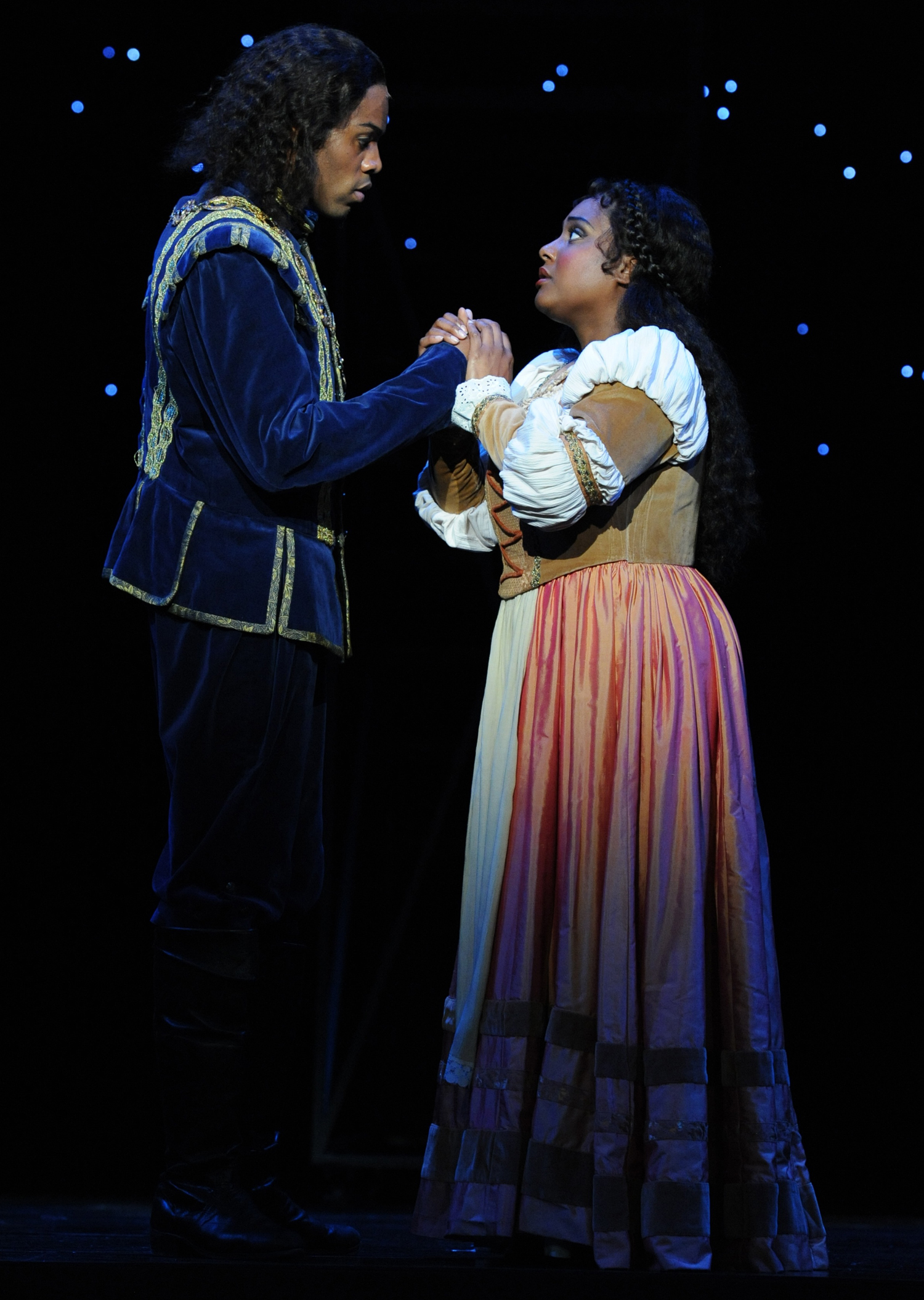
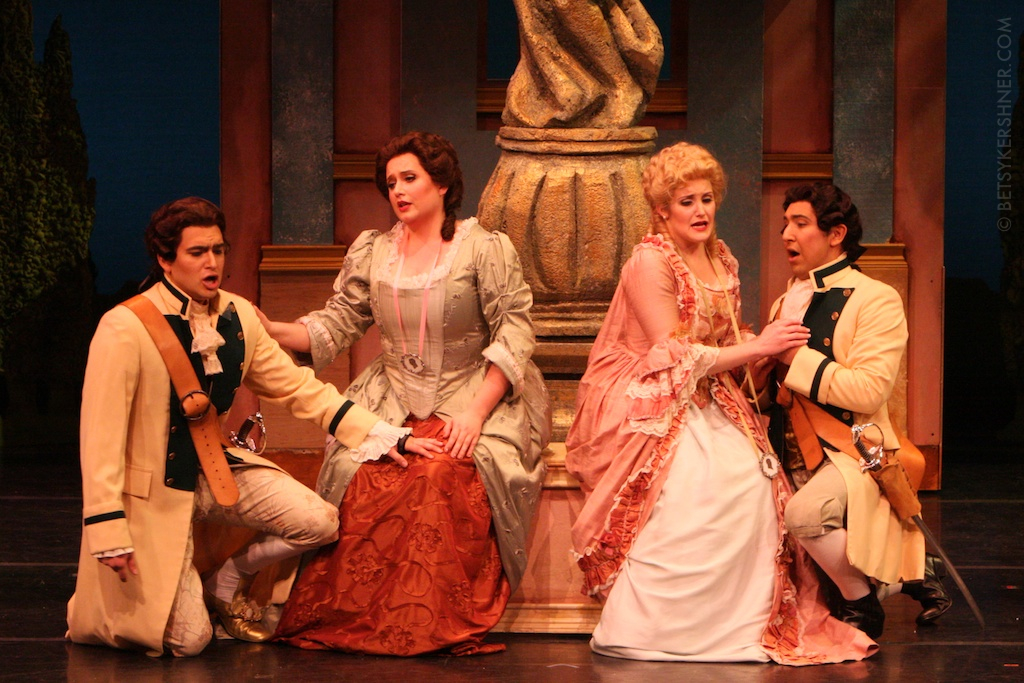
    It is interesting to note, however, that the Met’s 2008-2009 report highlights the debuts of three famous directors, namely Robert Lepage, David McVicar, and Penny Woolcock. Perhaps it doesn’t signify much, but both Lepage and McVicar had productions (The Rake’s Progress and Don Giovanni, respectively) at San Francisco Opera before 2008. McVicar’s Il Trovatore (pictured above in a cupcake rendering) debuted at Lyric Opera of Chicago in 2006, was performed at the Met in 2008, and came to San Francisco in 2009. It is also funny that the Woolcock production was of Doctor Atomic, the opera itself having premiered in San Francisco.

    Another strange fact about the cultural power of New York is that it seems not to have imposed its dialect on the rest of the country. Standard American English is based on accents of the Midwest (that is, away from New York), while British Received Pronunciation is comes from the south of England and Standard French is more or less Parisian.

    To be clear, these are just asides. New York City is home to unrivaled arts and cultural organizations, drawing in tons of people from everywhere as tourists or residents. It is rather bizarre to take the time to muse on something so self-evident, but I suppose a little navel-gazing never hurt anyone.

    Leave a comment

  • Certitude-and-joy* Notes *
    Erling Wold's chamber opera Certitude and Joy opened at Bindlestiff Studio in San Francisco this evening. The piece involves several pairs, these being two actors, two dancers, two singers, and two pianists. The action, directed by Jim Cave, took place on and around a small, beautifully-constructed pier in the middle of the theater. The work certainly had a lot going on, every moment seemed filled with sound and movement.

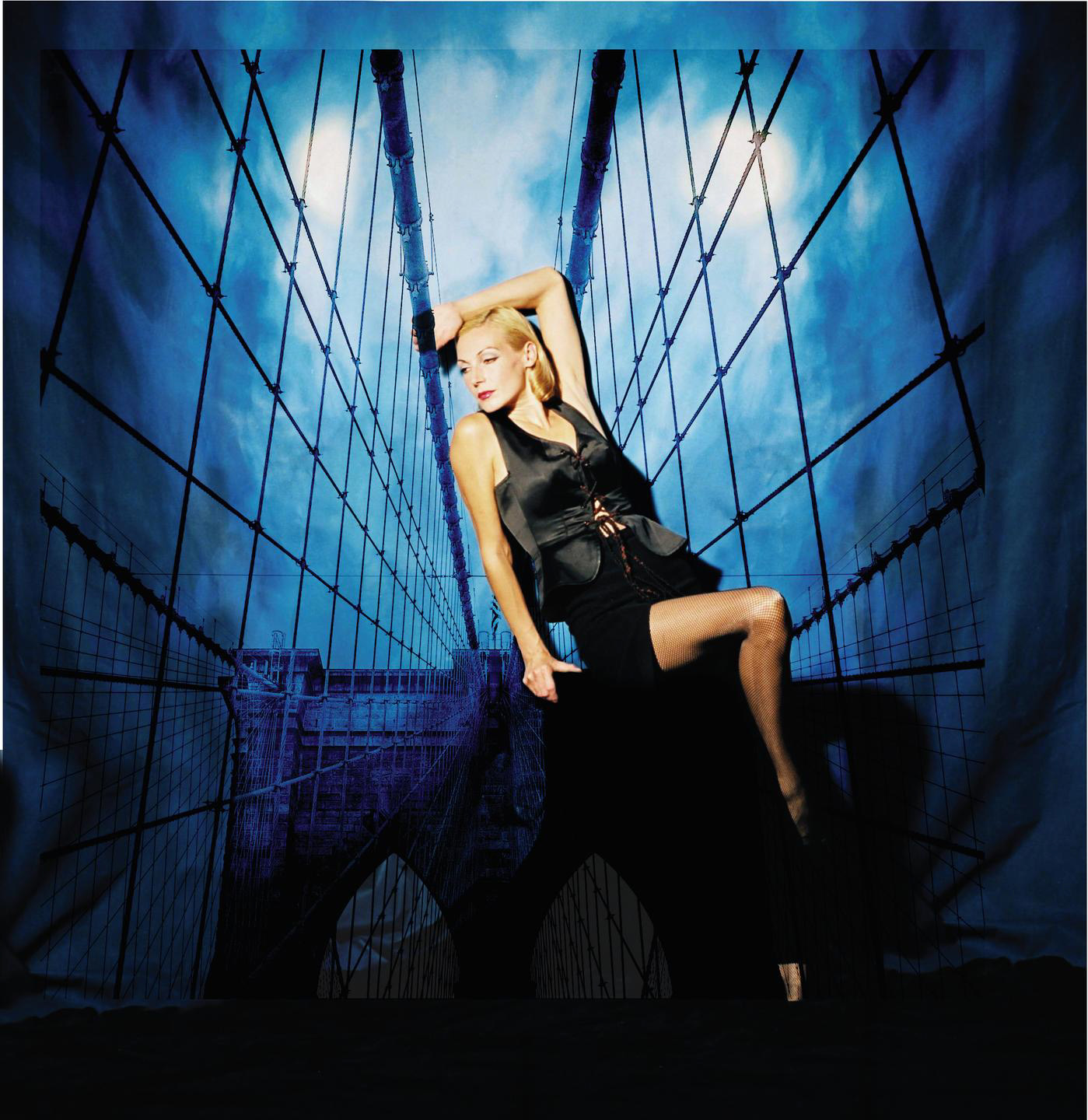
    It seemed like a lot of words since the actors (Bob Ernst and Talya Patrick; the latter pictured above, photograph by David Papas) and even dancers (Kerry Mehling and Travis Rowland) all spoke, sang, or vocalized at various times. Soprano Laura Bohn and baritone Jo Vincent Parks sang well in the small space and were not overwhelming. The ZOFO duet, which includes Keisuke Nakagoshi and Eva-Maria Zimmerman, played intently and with vigor.

    The effect of all this was rather novel and strangely alien. The narrative concerns LaShaun Harris, the young woman who threw her three children into the Bay in 2005. Though she seems quite pitiful, she is not a particularly sympathetic individual. One did appreciate the interlaying of the Abraham and Isaac story, which is obviously relevant. There were also some arresting visuals employing leaps, lifts, falls, and fabric.

    * Tattling *
    The audience was engaged and attentive. No inappropriate behavior was noted.

    Leave a comment

  • Dawn-harmsDawn Harms is conducting Symphony Parnassus in a spring concert this weekend with guest artist Frederica von Stade at the San Francisco Conservatory of Music. Harms also plays violin in the San Francisco Opera Orchestra and is Associate Concertmaster of New Century Chamber Orchestra. She spoke with The Opera Tattler on March 19, 2012.

    How did you come to be a violinist?
    My parents always wanted a violinist in the family. My sister played cello, my brother played viola, and my mother was a voice teacher. I still remember a lot of the etudes and exercises she taught me. She was my accompanist when I was growing up too.

    So you are from a musical family! I heard that one of your cousins is Tom Waits, is that true?
    Yes, our mothers are sisters. Tom is a great guy. I've played on three of his albums. He'll often tell me that my playing is too sweet, and that I should play more like a child, rough it up more. He really loves the weirdest sounds!

    How did you start playing for the opera?
    I was in a string quartet in Amarillo, Texas, and that's only 4 hours away from Santa Fe Opera, so I auditioned and played there for 5 summers. The atmosphere there is really something.

    How did you meet Frederica von Stade?
    It was actually in Santa Fe, and because of recycling. It was early in the morning after a party, and I was recycling some bottles. I happened to see Flicka and introduced myself. She was and is so gracious and down-to-earth.

    When did you come to San Francisco?
    San Francisco Opera had an opening for the principal violist. I auditioned, and actually, I didn't get the position, the current principal, Carla Maria Rodrigues, did. She couldn't start right away though, so I played principal viola for one season, and then switched to violin.

    What appeals to you about opera?
    Who doesn't love drama? My favorite operas are Der Rosenkavalier and Peter Grimes. I tend toward the more dramatic. I'm a Puccini freak and also I love Jake Heggie's music.

    How is working with other string players different than working with singers?
    Playing a string instrument is similar to singing. It is an analogy I use with my students at Stanford, and I have them sing phrases. It helps them connect to the music and emote. The bow is like a vocal cord.

    How did you start conducting?
    I studied conducting in 2008 at Aspen, for an intensive 9 weeks. It was great to conduct such a fantastic orchestra.

    What do you like about conducting?
    A lot of people think conducting is about power and egotism, but I would say it is a bit more like dance. It is expressing music through movement, and the whole orchestra becomes your instrument.

    Tell me about Symphony Parnassus.
    It is a community orchestra made up of doctors, health care workers, and students from UCSF. People have to pay dues in order to join, and they are there for the love of the music. They are very devoted, rehearsing every Monday night after a full day of work.

    Leave a comment

  • Uusf-03182012

    * Notes *
    Clarinetist Brenden Guy presented a genial afternoon of Bay Area music at First Unitarian Universalist Church in San Francisco on Sunday. The performance began with David Conte’s rather lyrical Sonata for Clarinet and Piano (1978), played by Guy and pianist Miles Graber. Valinor Winds played Nicholas Pavkovic’s Eight Figments (2010), whose movements all sounded just as they were named. John Adams’ China Gates were introduced and played by pianist Sarah Cahill, who brought the original score, but only used it toward the end of the piece. Before intermission came Joseph Stillwell’s Quartet for Clarinet, Violin, Cello and Piano (2012). Guy, violinist Kevin Rogers, cellist Erin Wang, and pianist Aaron Pike played the piece with exuberance.

    The second half of the program started with Aaron Pike’s Child’s Play (2011), played by Rogers, Guy, and Pike. This seemed like fun to perform. Barnaby Palmer conducted Rogers, cellist Michelle Kwon, flutist Sasha Launer, Guy, and Graber in Dan Becker’s Chaos Theory-inspired S.T.I.C. (1995). This was followed by Rogers playing Nigun – No. 2 from Baal Shem Suite by Bloch, accompanied by Graber. The piece was startling in contrast with the other more recent music, but was performed beautifully. The concert ended with Conte’s Sextet (1999, arranged 2011), which the composer introduced. He explained that he initially had wanted Palmer to conduct this as well, as there are 100 meter changes in this 8 minute piece. However, Conte found that the way the musicians listened to one another made a maestro unnecessary.

    * Tattling *
    Because the American Mavericks concert at 2pm last Sunday ran until 4:15pm, it was a challenge for me and Axel Feldheim to run to this concert. We did make it exactly at 4:30pm.

    The audience was rather silent. The acoustic this space made the piano sound slightly muddy.

    Leave a comment

  • Meredith-monk

    * Notes * 
    The American Mavericks Festival at San Francisco Symphony had one last performance yesterday before heading on tour. The chamber music program included pieces by Steve Reich, Meredith Monk (pictured left), Lukas Foss, and David Del Tredici. The afternoon began with Reich's Music for Pieces of Wood (1973), which was played by Jack Van Geem, Raymond Froehlich, David Herbert, Tom Hemphill, and James Lee Wyatt III. These five musicians used claves of varying sizes to hit out various patterns. One person would start and then the others would join in one by one. It seemed simultaneously very simple and very complex, and the effect was meditative and pleasing.

    The second piece that followed was newest by nearly forty years, in fact this was the first performance of Monk's Realm Variations (2012). The instrumentalists included Catherine Payne, piccolo; Nadja Tichman, violin; Adam Smyla, viola; Bruce Roberts, horn; Stephen Paulson, bassoon; Steve Sánchez, contrabass clarinet and B-flat clarinet; and Jieyin Wu, harp. Payne was featured, along with the voices of Meredith Monk & Vocal Ensemble. Monk's alto is distinctive, and was easily picked out from the other five voices. The music has an elemental quality to it, at times serene, and at others rather strident.

    After the intermission came Foss' Echoi, which included the talents of Jeremy Denk, piano; Jack Van Geem, percussion; Carey Bell, clarinet; and Peter Wyrick, cello. The music was seemed rather fun to play, and third movement was perhaps most amusing. Denk plays in a showy manner, but it suited the piece just fine.

    The final work was Del Tredici's Syzygy, scored for 21 musicians, including a soprano. Michael Tilson Thomas conducted the two contrast-filled songs, settings of poems by James Joyce. Kiera Duffy's voice seemed icy and hard, the amplification made her sound a bit harsh. Nicole Cash's horn playing was rather warm and round.

    *Tattling*
    There was a lot of talking, and many people were sternly hushed. The woman in front of me in W 19 loudly asked both the people around her if the Reich "was good." Perhaps if she had bothered to listen, she could have formed her own opinion.

    Leave a comment

  • 2012Winners

    The 2012 winners (pictured left, photograph by Marty Sohl/Metropolitan Opera) of the Metropolitan Opera National Council Auditions are soprano Janai Brugger; mezzo-soprano Margaret Mezzacappa; countertenor Andrey Nemzer; tenor Matthew Grill; and baritone Anthony Clark Evans. Brugger is currently a young artist in the Domingo-Thorton program at Los Angeles Opera.

    Official Site

    Leave a comment

  • War_Memorial_Veterans_Building_entrance

    * Notes *
    San Francisco Opera's Annual Meeting for 2012 was held Thursday afternoon at the Intercontinental Hotel in San Francisco. Board of Directors President George H. Hume, CFO Michael Simpson, and General Director David Gockley all spoke. The outlook this year is better, though the company did run a deficit again, donations are up and they expect to break even in 2013. The most interesting plan we heard about was the Diane B. Wilsey Center for Opera, which is to be built on the fourth floor of the Veterans Building in the War Memorial complex. This will provide space to house most of the opera's operations including the costume shop, space for rehearsals, and a small performance venue. There will also be room to house an archive of San Francisco Opera's recordings on various media.

    Four Adlers performed: soprano Marina Harris; mezzo sopranos Laura Krumm and Renée Rapier; and pianist Robert Mollicone. Rapier sang "All' afflitto" from Roberto Devereux , Harris sang "Einsam in trüben Tagen," from Lohengrin, and Krumm sang "Quis fais-tu, blanche tourterelle" from Roméo et Juliette.

    * Tattling *
    Somehow I managed to spill ink all over both my hands at the very beginning of the meeting. The people next to me offered me tissues and wipes. Three mobile phones rang at different points during the proceedings.

    Leave a comment

  • September 7- October 3 2012: Les Contes d’Hoffmann
    September 8-27 2012: Capriccio
    September 15- October 25 2012: Le Nozze di Figaro
    October 10-30 2012: The Rake’s Progress
    October 15- November 11 2012: La Fille du régiment
    October 23- November 20 2012: Tosca
    November 22 2012- March 25 2013: La Cenerentola
    December 4-29 2012: Carmen
    January 22- February 9 2013: Khovanshchina
    January 23- February 13 2013: Le Nain / L’Enfant et les sortilèges
    January 29- February 12 2013: Das Rheingold
    February 17- March 10 2013: Die Walküre
    February 27- March 24 2013: Falstaff
    March 21- April 15 2013: Siefried
    April 14- May 6 2013: Hänsel et Gretel
    May 2-31 2013: La Gioconda
    May 21- June 16 2013: Götterdämmerung
    May 23- June 18 2013: Giulio Cesare
    June 18-26 2013: Der Ring des Nibelungen

    Official Site | 2012-2013 Season

    Leave a comment

  • October 5-7 2012: Purcell's Come Ye Sons of Art & Dioclesian
    November 7-11 2012: Emanuel Ax plays Beethoven
    December 8-9 2012: Masaaki Suzuki conducts Händel's Messiah
    December 13-16 2012: Masaaki Suzuki conducts Bach
    January 12-16 2013: Four Seasons Tour
    February 13-17 2013: Haydn, J.C. Bach, Mozart
    March 15-20 2013: Rachel Podger, violin and leader
    April 10-14 2013: Händel's Teseo

    Philharmonia Baroque Orchestra's 2012-2013 season was announced on 13 March 2012. PBO will tour Carmel, La Jolla, and Palo Alto with a program that includes Vivaldi's Le quattro stagioni.

    Official Site

    Leave a comment

  • Sopranos
    Elizabeth Baldwin, Sylvania, Ohio
    Jennifer Cherest, La Plata, Maryland
    Aviva Fortunata, Calgary, Alberta, Canada
    Jacqueline Piccolino, Palatine, Illinois
    Suzanne Rigden, Dartmouth, Nova Scotia, Canada
    Rose Sawvel, Denver, Colorado
    Melinda Wittington, Wilson, North Carolina

    Mezzo-sopranos
    Erin Johnson, Washington, New Jersey
    Sarah Mesko, Hot Springs, Arkansas
    Carolyn Sproule, Montreal, Quebec, Canada

    Tenors
    Joshua Baum, Kansas City, Missouri
    Casey Candebat, New Orleans, Louisiana
    AJ Glueckert, Portland, Oregon
    Theo Lebow, Sierra Madre, California
    Yi Li, Shandong, China
    Andrew Stenson, Rochester, Minnesota
    Chuanyue Wang, Hei Long Jiang, China

    Baritone
    Joseph Lattanzi, Mableton, Georgia

    Bass-baritones
    Hadleigh Adams, Palmerston North, New Zealand
    Gordon Bintner, Regina, Saskatchewan, Canada
    Seth Mease Carico, Signal Mountain, Tennessee
    Matthew Scollin, Walled Lake, Michigan

    Bass
    Andrew Kroes, Onalaska, Wisconsin

    Apprentice Coaches
    Francesco Fraboni, Senigallia, Italy
    Artem Grishaev, Moscow, Russia
    Elena Lacheva, Plovdiv, Bulgaria
    Kevin Miller, Bronx, New York
    Sun Ha Yoon, Seoul, South Korea

    Apprentice Stage Director
    Jennifer Williams, McLean, Virginia

    Official Site | Press Releases

    Leave a comment