• _75A0387* Notes * 
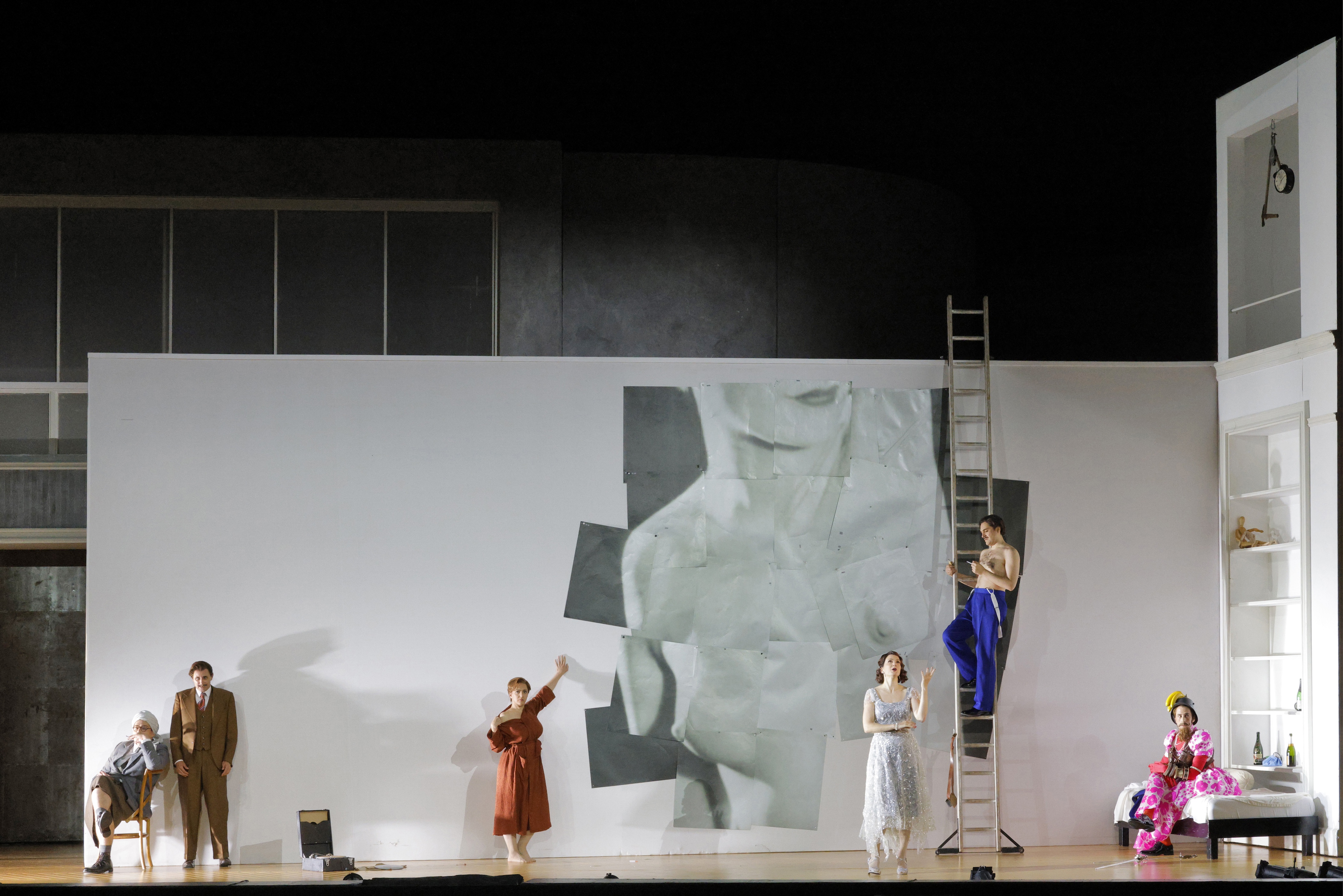
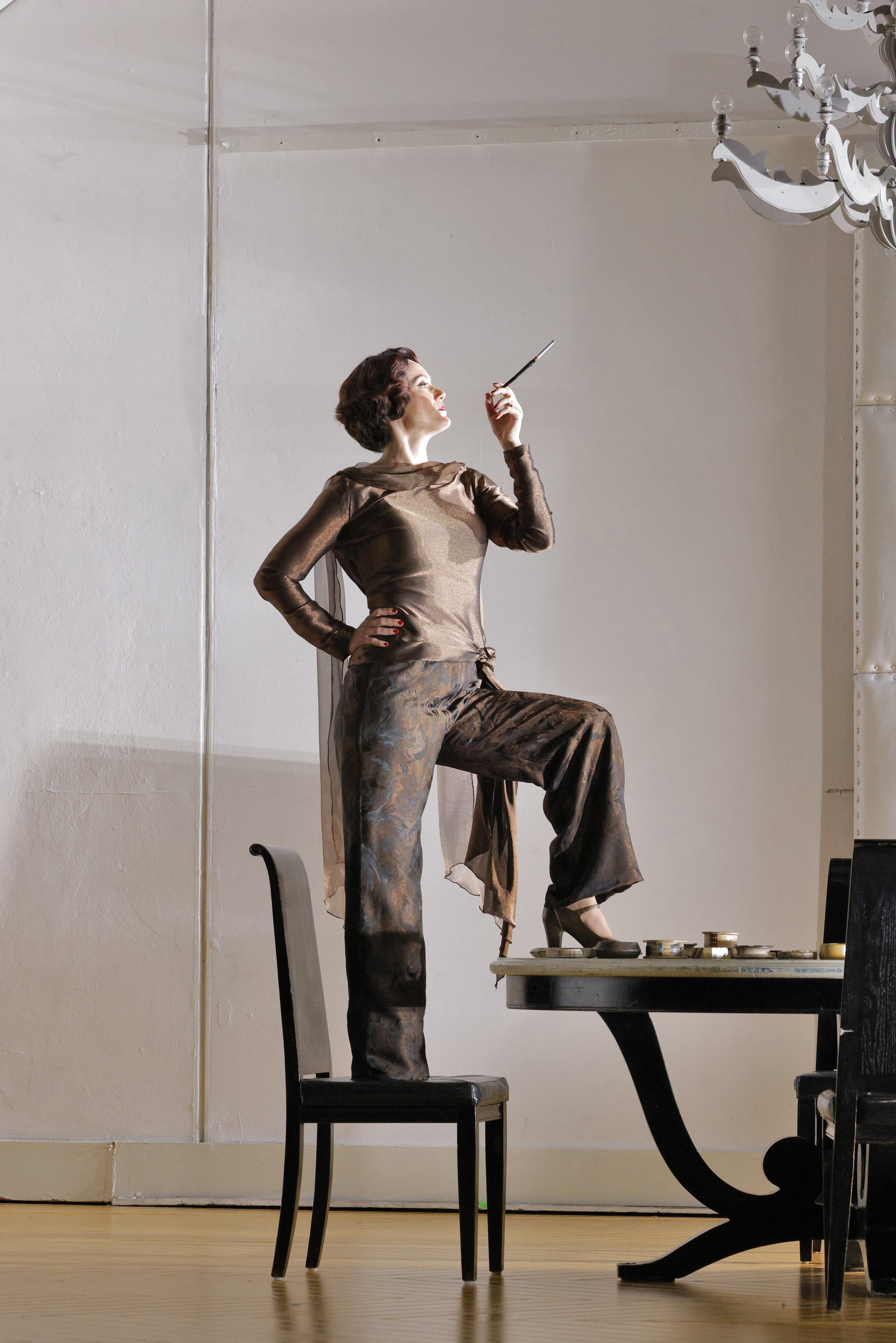
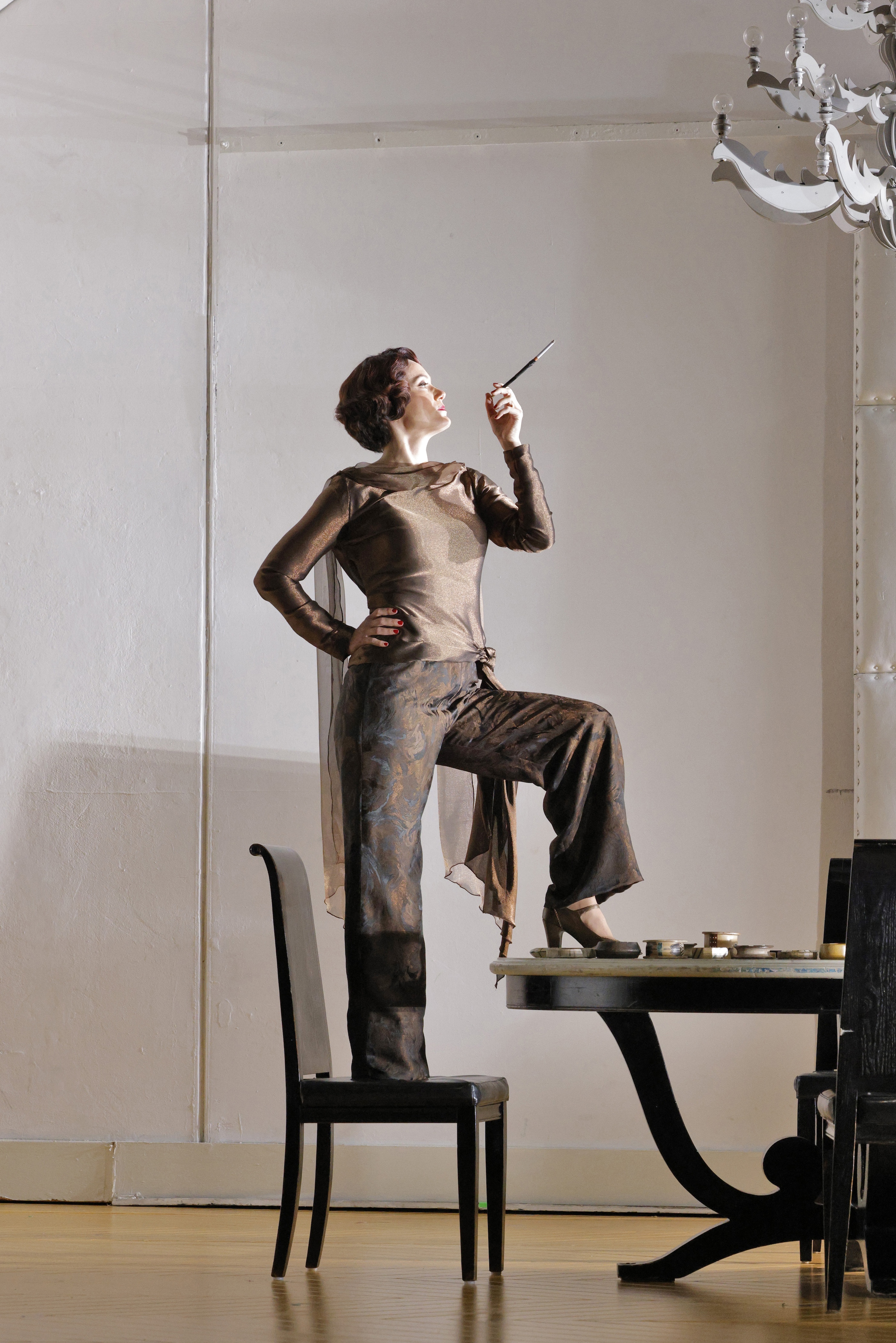
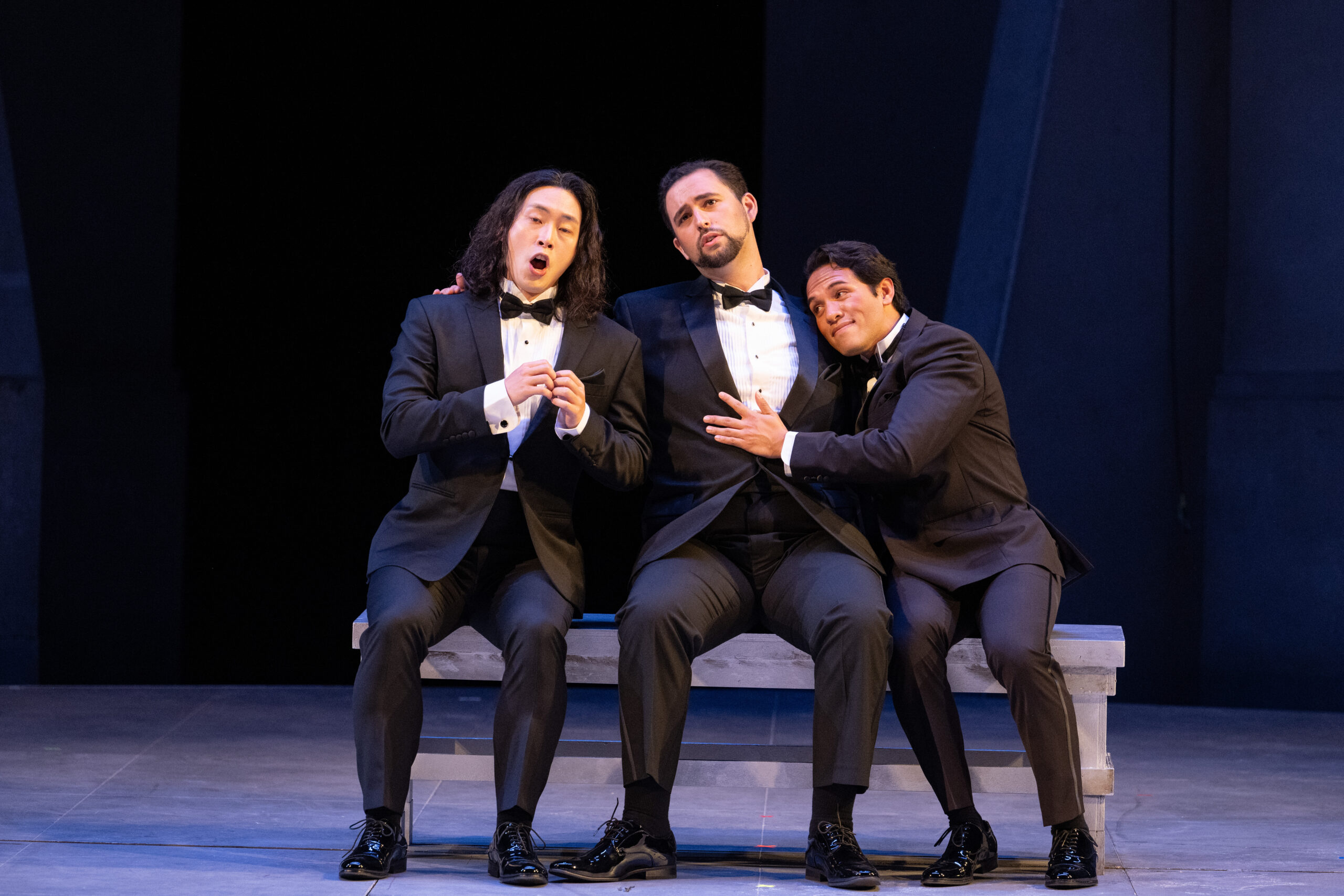
    Barrie Kosky and Suzanne Andrade’s delightful and clever production of Die Zauberflöte (end of Act I Scene 3 pictured left, photograph by Cory Weaver) opened at San Francisco Opera last night. Eun Sun Kim conducted a beautifully transparent performance with much lovely singing.

    This 2012 production originates from Komische Oper Berlin and stages the opera in the silent film era. All the spoken text is cut, instead there are intertitles with Mozart’s Fantasia in D minor K. 397 and Fantasia in C minor K. 475 played on fortepiano as accompaniment.

    The stage is basically a large white surface with six revolving doors, all but one are situated high up, with little ledges for the singers to stand on. There are many animations to propel the story forward, all the scene changes are instantaneous. It was startling how many animation cues there were, some 729, all done by a dedicated stage manager, and they all appeared to go perfectly smoothly. The draw back of this elaborate scheme is that the singers have to be extremely exact in their positions and movements, and are hemmed in by the stage, often standing in a confined space for quite a long time as the projections move around them. But it certainly was an immersive experience, so much was happening and it was difficult to resist being drawn in to all the many sight gags and entertaining theatrical jokes and references.

    Maestra Eun Sun Kim had the orchestra sounding completely transparent, I felt like I could hear every musical line and even feel where certain instruments were doubled. It was very nice to hear Mozart played with so much clarity. The soloists all did well, Julie McKenzie (flute), Stephanie McNab (pan flute), and Bryndon Hassman (glockenspiel) all played cleanly.

    The chorus sounded strong, even if they were often hidden in two triple=tiered towers on either side of the projecting surface, we could always hear them.

    The three boy sopranos Niko Min, Solah Malik and Jacob Rainow are suitably eerie as the the three spirits. Soprano Arianna Rodriguez is adorable as Papagena. The three ladies, sung by soprano Olivia Smith and mezzo-sopranos Ashley Dixon and Maire Therese Carmack, started off a bit hesitant but were fine by the end. Their scene mooning over Tamino was very much played for laughs. Tenor Zhengyi Bai’s Monostatos was dressed as Count Orlok from Nosferatu, which was also very funny.

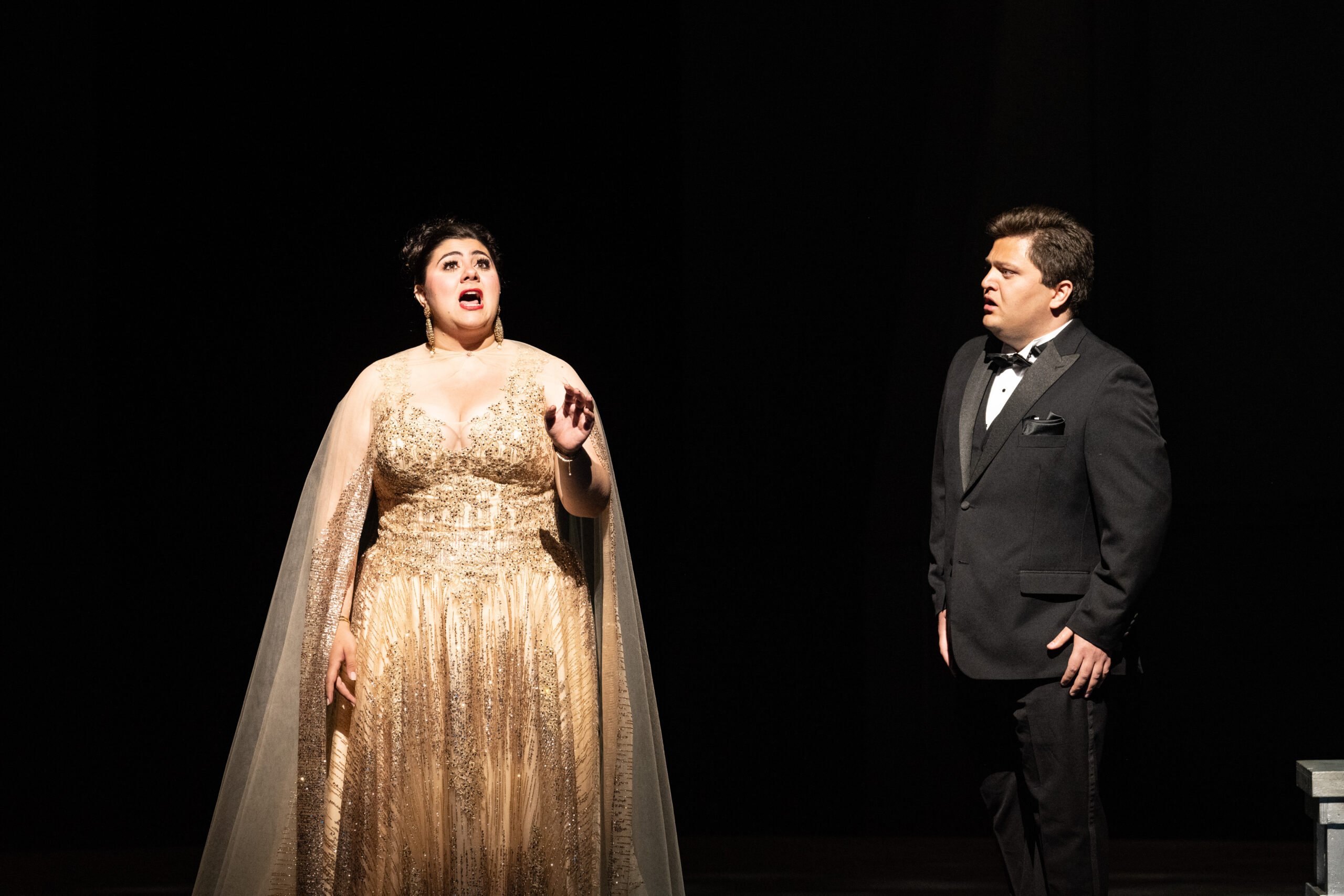
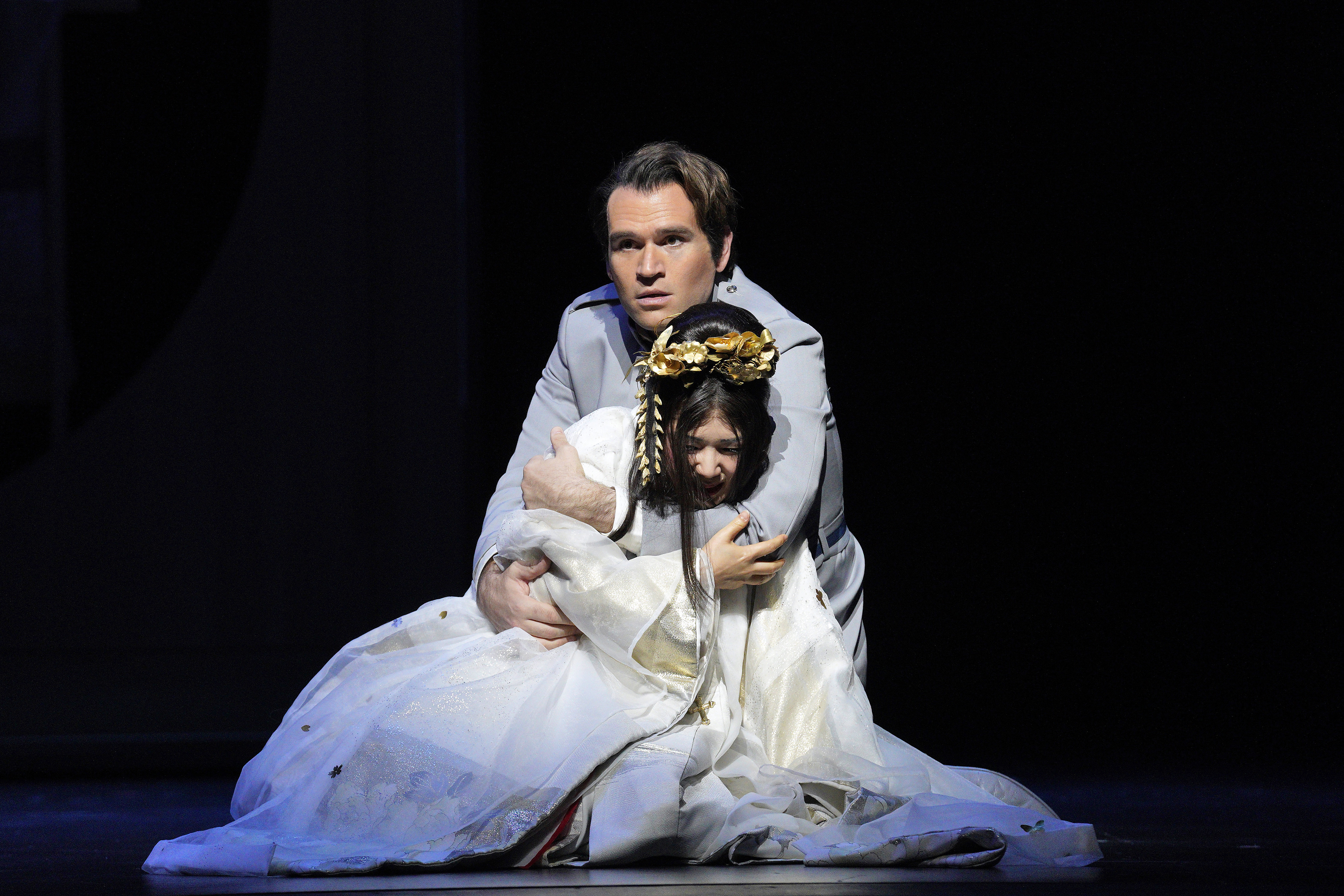
    _75A7111Bass Kwangchul Youn is a solid and powerful Sarastro, while soprano Anna Simińska was a more delicate and ethereal Queen of the Night. She hit all her notes, sounding very fluttery and birdlike. Bass-baritone Lauri Vasar has a darker timbre than any Papageno I’ve ever heard, he has a breathiness to his sound as well, and a winsome manner. His duet with Christina Gansch (Pamina) in Act I, Scene 2 (pictured, photograph by Cory Weaver) sounded great. Gansch has a robust, well-rounded sound but also a certain brilliance. Tenor Amitai Pati has a very pretty voice, and his Tamino is sweet.

    * Tattling * 
    There were some lozenges loudly unwrapped toward the beginning of the performance, but not a lot of electronic noise. The audience did seem very engaged and reacted to the misogyny of the text. I also was bothered by the light of someone’s phone in Row Q, in the center section, right on the aisle.

    There were also a few pen clicks from the journalist behind me, who was clearly taking notes for a review. This person was asked to give an opinion of the opera at intermission by an audience member, which seemed quite inappropriate. I understand the audience member was just curious but it seems unkind to interrupt someone at work.

    Leave a comment

  • Cal-performances-vikingur-olafsson-by-ari-magg-3 * Notes *
    Pianist Víkingur Ólafsson (pictured, photograph by Ari Magg) is playing Bach's Goldberg Variations all over the world in the 2023-2024 season and came to Cal Performances last Saturday afternoon. The recital he gave was potent and focused, getting all sorts of colors out of the instrument.

    He started off very sedately with the aria and proceeded to explore the wide range the thirty variations have to offer. His playing is always crystal clear and yet not bland in the least, there were always nuance and a varied array emotions that were palpable. He was never needlessly flashy, which one always does appreciate.

    It definitely took the listener on a journey though the world of this piece. There were times in which I was flooded with the purest joy and other moments when I was close to tears. The clarity of Bach's music was a near religious experience.

    * Tattling *
    As is often the case with a performance without an intermission, this recital started 12 minutes late. Someone's cellular phone rang during the aria and Ólafsson stopped playing until the ringing stopped, and started again at the beginning. Somehow we made it through the 80 minutes without more phones ringing, though I did hear a watch alarm chime at 3pm and some doors slamming shut. There were also a lot of weird feedback sounds in Zellerbach, lots of loud buzzing and humming.

    Ólafsson declined to do an encore, since the piece is so complete in and of itself, finishing with the Aria again at the end. He spoke to us instead, forgiving the cellular phone owner and praising Bach as the greatest composer in history while excusing himself to John Adams, who was in attendance, and whose new piano concerto After the Fall will premiere next season at San Francisco Symphony with Ólafsson as the soloist.

    Leave a comment

  • Cunning-little-vixen-2024* Notes *
    In April Pocket Opera did a charming run of Cunning Little Vixen (Příhody lišky Bystroušky) and I managed to catch the last performance at the Legion of Honor in San Francisco last weekend. It was the premiere of this translation from Pocket Opera's late founder Donald Pippin.

    Janacek's opera was done in a new chamber version by the tiny orchestra that was seated on the stage behind singers. Maestro Jonathan Khuner had the musicians going at a fast clip, but the vivid music came through well and has stuck in my head for several days now.

    Stage director Nicolas A. Garcia's production is very sweet and moves easily through the many scenes. The choreography, by Lissa Resnick, employs two talented dancers that portray a pair of insects and the human couple of Terenka and the Forester. I appreciated their movement through the lush instrumental interludes. The costumes were very cute, for the most part they suggested which animal they were to represent without being completely literal. The vixen wears a stylish sweatsuit in orange plus ears and a tail and the chickens have fifties dresses in black and white with red headbands and shoes (pictured), and it's just enough to feel intentional and cool rather than simply being on a shoestring budget.

    The singing was all very strong. Contralto Sara Couden sounded great as both the Badger and the Parson, her rich voice is surprisingly well suited to these roles. The contrast of her with the tenor Erich Buchholz as the Mosquito and the Schoolmaster was very pleasing, they can hit the same notes and they sound totally different. Bass-baritone Robert Stafford did fine as Harašta the Poacher, as did mezzo-soprano Hope Nelson as GoldStripe the Fox, who was appealing and incisive.

    Baritone Spencer Dodd also sounded plaintive as the Forester, a nice reedy sound. Best of all was soprano Amy Foote in the title role, her icy flexible sound and physical embodiment of SharpEars the Vixen was heartrending.

    * Tattling * 
    There was a lot of back and forth with one of the ushers as people were being seated during the beginning of Act I Scene 1, it was loud and hard to ignore. There was also one watch alarm at 4pm.

    It's been about twenty years since I first heard this piece done at San Francisco Opera, and almost eight since I heard it at West Edge Opera in Oakland (also with Amy Foote, incidentally). It's embarrassing to remember how much I disliked it the first time, but I'm glad I've been able to come to appreciate Janáček so much more.

    Leave a comment

  • Opera-San-Jose_Florencia-en-el-Amazonas-8_Photo-Credit_David-Allen_edit-scaled * Notes *
    Daniel Catán's Florencia en el Amazonas (Act II pictured, photograph by David Allen) had a long overdue Bay Area premiere at Opera San José last weekend. The attractive new production features lots of strong singing.

    The music is reminiscent of Puccini, lots of shimmery swells of sound. The orchestra sounded robust under Maestro Joseph Marcheso. Likewise the singing was very powerful.

    Bass-baritone Vartan Gabrielian (Captain) has impressive low notes that resonate well. Baritone Ricardo José Rivera has a loud, booming voice, and he was suitably fey as Riolobo. Baritone Efraín Solís sounded very distinct from Rivera, his part as Alvaro is much more of this world, and his warm, textured sound was charming. He sang well with mezzo-soprano Guadalupe Paz, I like her part of Paula, as there are an interesting range of feelings that are explored with this role.

    Tenor César Delgado and soprano Aléxa Anderson are convincing as young lovers Arcadio and Rosalba. Delgado is plaintive and Anderson is bright. Soprano Elizabeth Caballero did a fine job with the title role of Florencia Grimaldi. She has a dramatic flair to her sound, her final aria "Escúchame" was effective.

    The set, designed by Liliana Duque-Piñeiro, has two pieces of scenery that suggest the river boat, basically some stairs with a deck and a paddlewheel. There are also a bunch of large cutout pieces hanging from the ceiling that are leaves and vines of the jungle, it is pretty, and the lighting pulls everything together. It wasn't always clear when the characters were on the boat or not, or when they were traveling on the river. Director Crystal Manich has the singers push the pieces of the set around to change the scenes, which went smoothly. I liked the butterfly imagery that was employed throughout the opera, there was a puppet, winged costumes, and blue butterfly confetti.

    * Tattling * 
    The audience silent for the most part, I only noted a light crinkling of paper from the center of the orchestra level during Act II, but it was only for about a minute.

    Leave a comment

  • 4.4.24-2105 Vinkensport Ensemble Credit Kristen Loken* Notes *
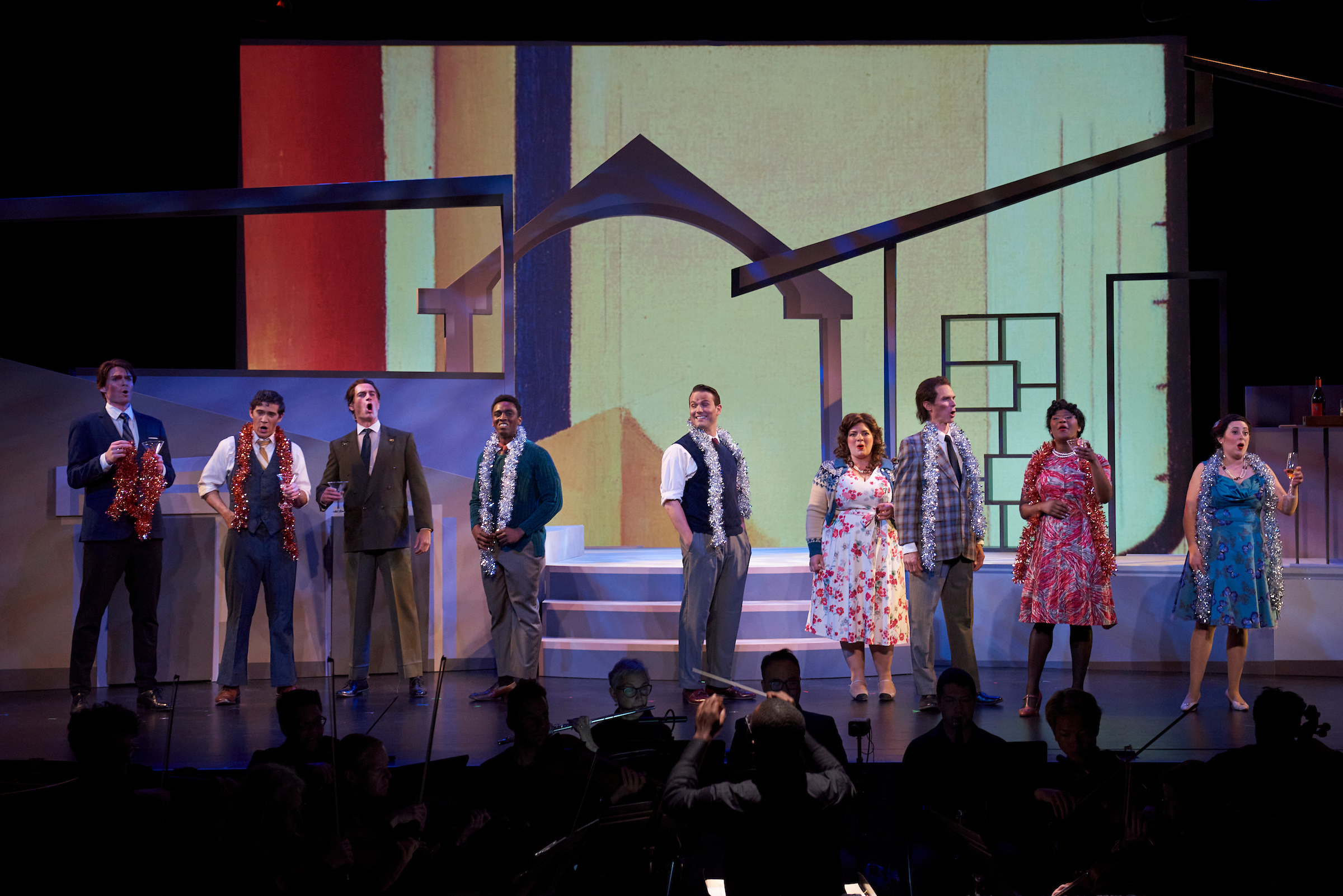
    Opera Parallèle gave a splendid performance of two comedic one-act operas yesterday at SFJAZZ. Done in one go, the evening began with David T. Little's Vinkensport, or The Finch Opera (pictured, photograph by Kristen Loken), which was followed by Laura Karpman's Balls. It was impressive how cohesively these works were presented together, both visually and musically.

    Director Brian Staufenbiel put us in a 70s telecast of these two very disparate sporting events, with Mark Hernandez as sports announcer Howard Cosell engaging the audience and even the conductor. There were projections surrounding us, and the live-image capture was especially effective. As always, Maestra Nicole Paiement deftly held the orchestra and singers together. It was fun to hear her conduct a bit of Verdi's Triumpal March from Aida in Balls, when Billie Jean King enters. At one point in this opera nearly all the musicians stopped playing their instruments and clapped beats with their hands, they were all very much synchronized, Paiement keeps everything very precise.

    Vinkensport is about Flemish folk sport of Finch-Sitting, in which trained finches try to sing the most "susk-e-wiets" in an hour as possible. In this opera there are six competitors, all the finches have very amusing names. Soprano Jamie Chamberlin gave a very vulnerable and human performance as Holy St. Francis's Trainer, she's had quite a lot going on in her personal life, while soprano Chelsea Hollow's character of who trains Farinelli is actually just using a tape recorder, since her bird is deceased. Hollow's voice is crystalline and very beautiful. Soprano Shawnette Sulker as Sir Elton John’s Trainer drinks many martinis and is very funny, her bird-like voice seems very apropos. Tenor Nathan Granner is likewise entertaining as Han Sach’s Trainer, his nice light sound is very pretty. Rich-toned bass-baritone Chung-Wai Soong is more somber as Prince Gabriel III of Belgium’s Trainer, we learn he inherited his role as trainer from his father.  Baritone Daniel Cilli as Atticus Finch’s Trainer is also serious, setting his bird free in the end.

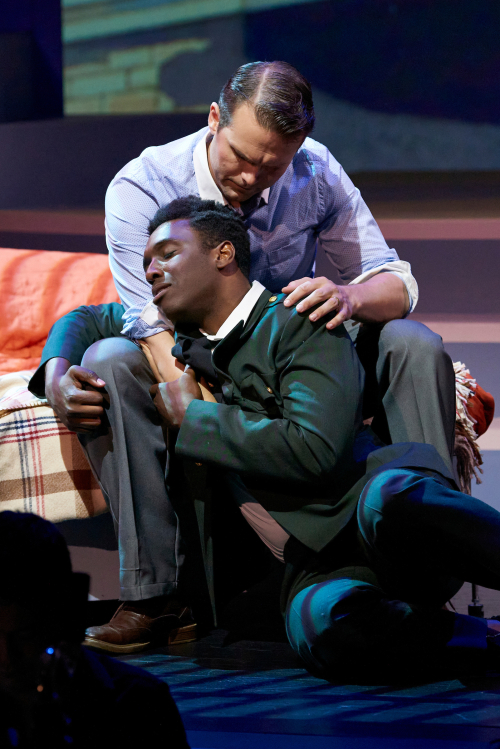
    4.4.24-3004-Nikola Printz as BJK in Victory with Cast Credit Kristen Loken Balls (pictured, photograph by Kristen Loken) tells the story of "The Battle of the Sexes" tennis game between Billie Jean King and Bobby Riggs in 1973 with a surrealist bent, Susan B. Anthony is a character, and at one point Billie Jean King dons a tricorn hat.

    Many of the singers in the first opera were also in the second, but Balls has the jazz singer Tiffany Austin as King's secretary, Marilyn. Austin has a lovely voice that stood out. Tenor Nathan Granner is again very humorous as Bobby Riggs. Mezzo-soprano Nikola Printz was compelling as Billie Jean King, their sound is resonant and powerful.

    * Tattling *
    The audience was mostly quiet, but as Billie Jean King sang about the pressure of tennis, someone dropped some plastic cups in the Left Terrace, Row TJ.

    Leave a comment

  • Cal-performances-mark-padmore-mitsuko-uchida-by-justin-pumfrey* Notes *
    Tenor Mark Padmore sang Schubert's Winterreise at Cal Performances yesterday afternoon. Accompanied by the pianist Mitsuko Uchida ( pictured with Padmore, photograph by Justin Pumfrey) we were taken on an intense journey with these 24 songs.

    Padmore has a bright voice and clear German diction. He was able to convey the text not only through his enunciation but by coloring the notes, the meaning felt completely obvious. I liked how he could sound like a perfectly pretty bell but also get across the passion of the words. There were times when his intonation was inexact, but this heightened the drama of these lieder rather than detracting from the piece. Uchida's playing was clean and supportive.

    Der Lindenbaum and Die Post were particularly strong. The former starts with such sweetness, and turns darker and more strident, and then back. It was sad that during this performance the song began with a cellular phone ringing and had so much rustling of programs before it ended that Uchida hushed the audience. It was maddening given how beautiful and engaging the performance was.

    * Tattling *
    The performance started 15 minutes late, as it had no intermission. The audience was embarrassing. The person next to me in Row D fell asleep three or four times, jerking awake and shaking not only her seat but the ones around her. There was so much electronic noise, throughout, the worst of which was a phone that rang five times during the last song.

    Leave a comment

  • 3cal-performances-the-joffrey-ballet-cheryl-mann* Notes *
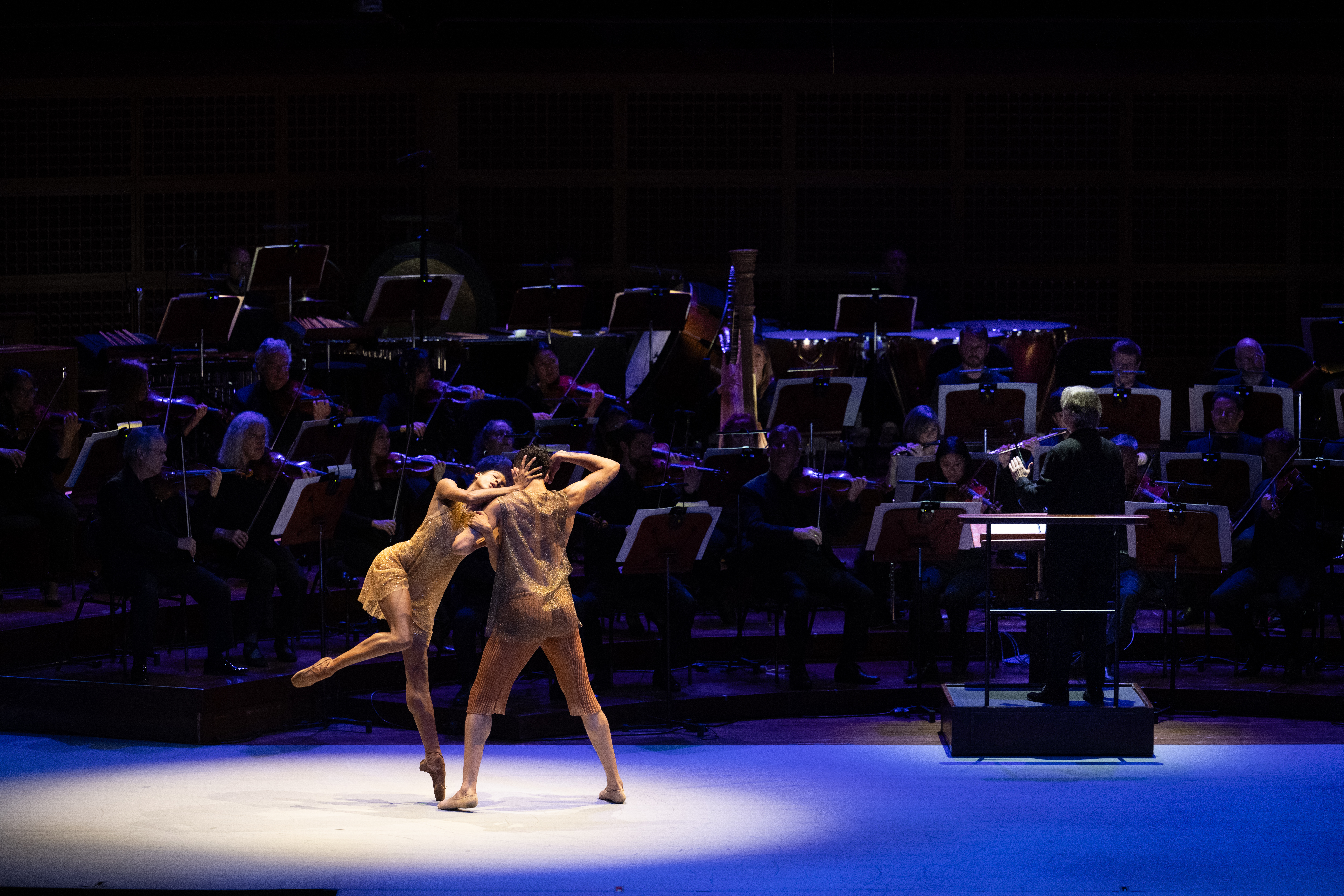
    The Joffrey Ballet's Anna Karenina was presented by Cal Performances last night at Zellerbach Hall in Berkeley for the first of three performances. The 2019 ballet with music by Ilya Demutsky was played live by Berkeley Symphony and conducted by Scott Speck.

    The music is eerie and busy, there is a lot going on with a full orchestra, piano, and vocalist Lindsay Metzger.

    Choreographed by Yuri Possokhov, the story is condensed into two acts and runs just shy of two hours. Possokhov uses the floor quiet a bit, but judiciously, the movements are beautifully fluid. The racehorse scene (Act I, Scene 4) was particularly impressive as far as utilizing the many dancers all together, as was Act II, Scene 5, in Betsy Tverskaya's salon (pictured, photograph by Cheryl Mann). I was very much amused by the use of different colored tutus in this latter scene. There was also a lot of using furniture in the dancing, there's a couch that is featured in the love scene between Anna and Vronsky, a bed in Act II's prologue when Anna has a fever and the subsequent scene, and lots of chairs for the Parliament scene.

    The production made good use of lighting, projections, and props, it moved through the many scenes effectively without falling flat or feeling too overdone with meticulous details.

    The dancers were strong. From the very beginning, Hyuma Kiyosawa is an exuberant Levin, and Yumi Kanazawa is a sweet Kitty. Dylan Gutierrez is a lanky, almost gangly Karenin, but didn't have any trouble doing lifts with both Anna Karenina and their son Seryozha (played by Jimmy Gershenson). Alberto Velazquez is convincing as Vronsky, his duets were particularly good. Best of all was Victoria Jaiani as Anna Karenina. Her extension is incredible, and her utter brokenness at Obiralovka Train Station was haunting. The staging of her death, with the railroad tracks and light of the train, was artful.

    * Tattling *
    The audience was quiet, there was no talking or whispering, only a few rustles of programs or lozenge wrappers disturbed the music.

    Leave a comment

  • 03_ESA_PEKKA_II_SF_SYMPHONY_0564-v3September 5-8 2024: Joe Hisaishi Symphonic Concert: Music from the Studio Ghibli Films of Hayao Miyazaki
    September 19-21 2024: Salonen conducts Verdi's Requiem
    September 25 2024: Opening Gala with Salonen; Lang Lang, piano
    September 27-28 2024: Salonen conducts Nico Muhly
    October 4-6 2024: Salonen conducts Brahms 4
    October 18-20 2024: Salonen conducts Beethoven's Pastoral
    October 25-26 2024: Thomas Wilkens conducts Rhapsody In Blue; Michelle Cann, piano
    October 27 2024: Emanuel Ax, piano
    October 31 2024: Pyscho film with live orchestra
    November 1 2024: Coco film with live orchestra
    November 7-9 2024: Nicholas Collon conducts Enigma Variations
    November 10 2024: Itzahk Perlman and Friends
    November 15-17 2024: Kazuki Yamada conducts Fauré's Requiem
    November 21–23 2024: Bernard Labadie conducts Mozart; Lucy Crowe, soprano
    November 24 2024: Top Gun:Maverick film with live orchestra
    November 29-30 2024: Amadeus film with live orchestra
    December 6-7 2024: Stephen Stubbs conducts Händel's Messiah
    January 9-11 2025: James Gaffigan conducts Mazzoli, Barber, and Prokofiev; Ray Chen, violin
    January 16-19 2025: David Robertson conducts Carmina Burana and Adams' Piano Concerto
    January 24-25 2025: Mark Elder conducts Also sprach Zarathustra
    January 30- February 1 2025: Herbert Blomstedt conducts Schubert and Brahms
    February 6-9 2025: Paavo Järvi conducts Mahler 7
    February 9 2025: Seong-Jin Cho, piano
    February 13-16 2025: Salonen conducts Stravinsky and Debussy; Yuja Wang, piano
    February 19 2025: Tessa Lark, piano
    February 21-23 2025: Salonen conducts Xavier Muzik, Prokofiev, and Stravinsky; Daniil Trifonov, piano
    February 26 2025: Joshua Bell and Academy of St. Martin and the Fields
    February 28-March 2 2025: Robin Ticciati conducts Rachmaninoff 2
    March 2 2025: Yuja Wang and Víkingur Ólafsson Duo Piano Recital
    March 13-15 2025: Elim Chan conducts Tchaikovsky
    March 23 2025: Lahav Shani conducts Israel Philharmonic
    March 27-30 2025: Juraj Valčuha conducts Brahms and Shostakovich; Gil Shaham, violin
    April 4-5 2025: Titanic film with live orchestra
    April 6 2025: Anne-Sophie Mutter, violin with Lambert Orkis, piano
    April 9 2025: Martin James Bartlett, piano
    April 10-12 2025: Marin Alsop conducts Music of the Americas; Gabriela Montero, piano
    April 20 2025: Evgeny Kissin, piano
    May 2–3 2025: Gabriel Kahane's Talent and Phoenix
    May 8-10 2025: The Lord of the Rings: The Two Towers film with live orchestra
    May 15-17 2025: Dalia Stasevska conducts Rachmaninoff
    May 20 2025: Jean-Yves Thibaudet, piano and Michael Feinstein, piano with San Francisco Symphony
    May 21 2025: Tony Siqi Yun, piano
    May 23-25 2025: Salonen conducts The Firebird
    May 23-25 2025: Salonen conducts Beethoven; Hilary Hahn, violin
    June 1 2025: Sheku and Isata Kanneh-Mason Duo Recital
    June 4 2025: Xavier Foley, double-bass with Kelly Lin, piano
    June 6-8 2025: Salonen conducts Sibelius' Symphony No. 7
    June 12-14 2025: Salonen conducts Mahler Symphony No. 2; Sasha Cooke, mezzo-soprano

    Next season at San Francisco Symphony will be Esa-Pekka Salonen's last as Music Director.

    Season Highlights | Press Release

    Leave a comment

  • DAP_1646_Resized-scaledSeptember 14–29 2024: The Magic Flute
    November 16– December 1 2024: La bohème
    February 15– March 2 2025: Bluebeard’s Castle
    April 19– May 4 2025: Héctor Armienta’s Zorro

    Today new General Director Shawna Lucey (pictured, photograph by David Allen) announced Opera San José’s next season, which includes a regional premiere of Zorro by Héctor Armienta, which opened at Fort Worth Opera in 2022.

    Press Release | Official Site

    Leave a comment

  • MF rehearsal 3* Notes *
    Livermore Valley Opera's The Magic Flute (Act I pictured with Liisa Davila, Megan Potter, Leandra Ramm, Victor Cardamone, and Alex DeSocio) opened last night with a delightful and well-characterized cast of singers. 

    The English-language production, directed by Yefim Maizel, is straightforward and the set is simple, a platform with three stairs and a background with video projections. There were also a pair of doors that came in to change the space. The backdrops that represented the outdoors looked more fairytale-inspired, while the interiors had more of a video game from the early nineties feel. The costumes were often draped and Grecian though Tamino and the Queen of the Night looked more like they were from Mozart's time.

    Alexander Katsman held the small orchestra together, though there certainly were times when the flute and horns were exposed and not in tune. The main attraction of the evening was certainly the singing. Bankhead Theater is an intimate space and everyone was very audible, especially given how small the orchestra was.

    Bass Kirk Eichelberger was convincing as Sarastro, the acoustics were very good for his low notes and it was impressive hearing the depths of his voice. Baritone Alex DeSocio is an adorable Papageno, his sound is very resonant and pleasing. He was funny and sprightly.

    MF photo 6Soprano Shawnette Sulker's chirping, bright sound was almost too pretty for the Queen of the Night (pictured in Act II with Phoebe Chee) she just bordered on shrill on the run up to the hardest passages of both her big arias, but seemed to effortlessly and beautifully hit the high notes. Soprano Phoebe Chee is a robust and dramatic Pamina, well-supported and clear. I'd really like to hear her as Donna Elvira in Don Giovanni, which Liveremore Valley Opera is doing next season. Tenor Victor Cardamone makes for a very fine Prince Tamino, such a lovely, powerful sound, with such ease.

    *Tattling *
    The audience was focused and pretty quiet. I did hear some electronic noise when Papageno's pan pipes responded to Tamino's flute call.

    I was a bit flustered upon my arrival to the theater as I had been running late all day, and didn't manage to put my leftover tiramisu in my purse before entering. One of the theater staff rightly took it from me, but I wasn't able to discern where I was to pick it up after the performance, and abandoned the cake as it was rather late and raining a lot.

    Leave a comment