• Death-in-venice * Notes * 
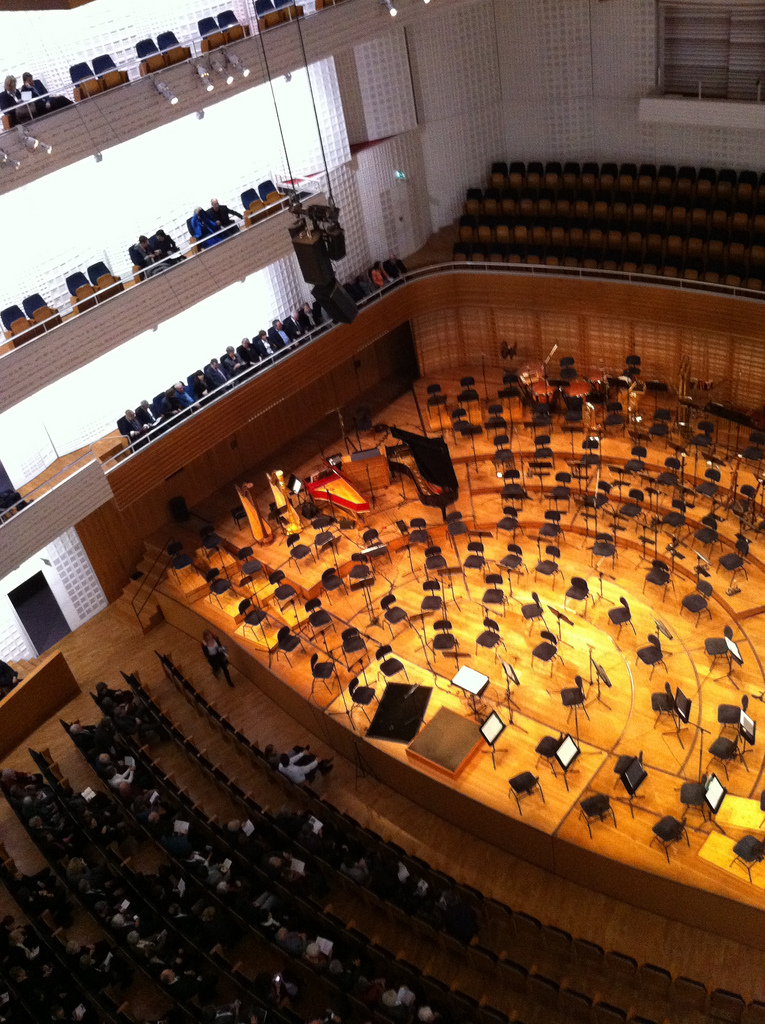
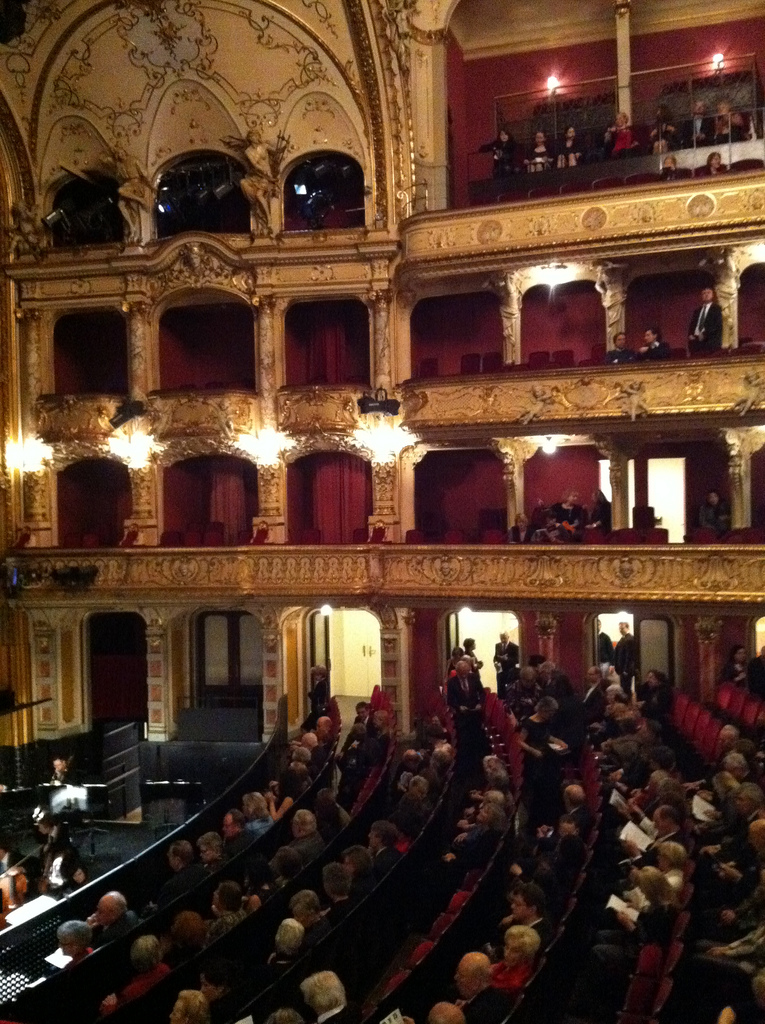
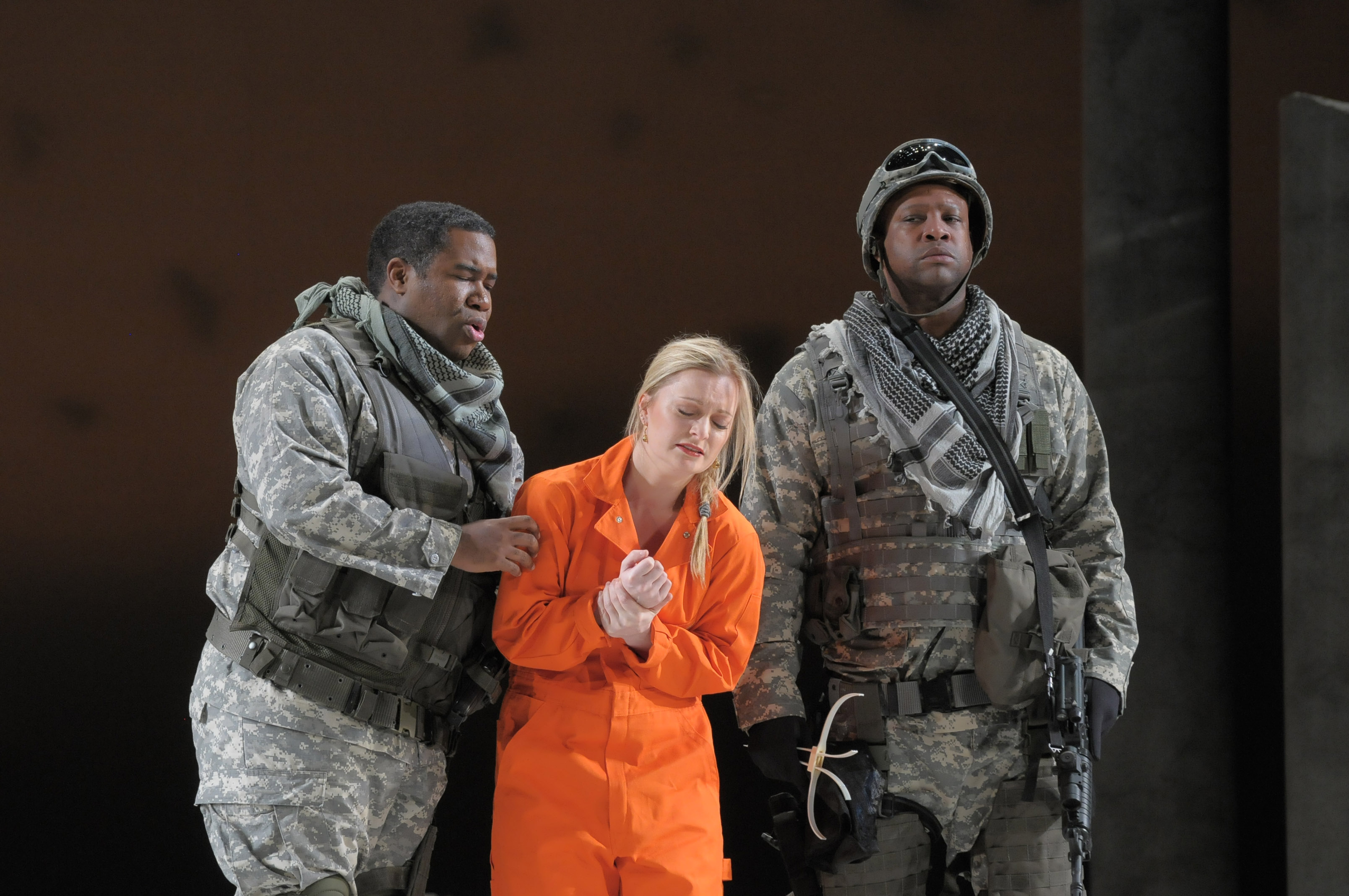
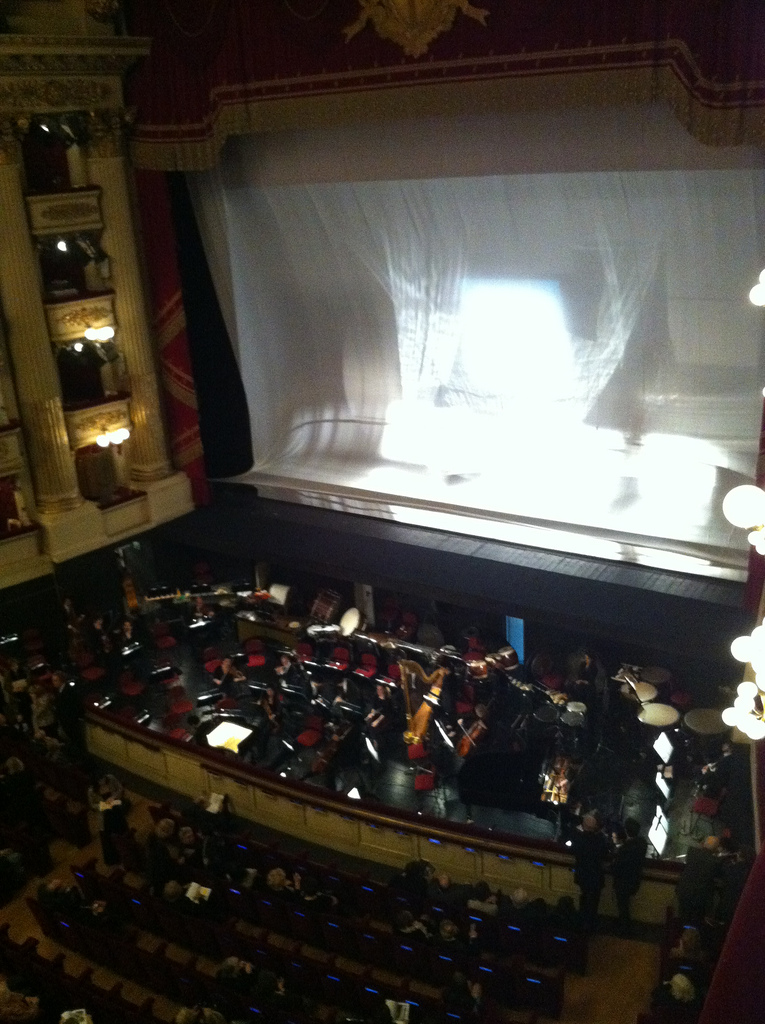
    Saturday night's performance of Death in Venice at Teatro alla Scala had a strong visual appeal. Unfortunately, since so many of the sightlines seem rather poor in the house, this aspect may have been lost on the droves of audience members that left at intermission. Jean Kalman's lighting was particularly beautiful, evoking the colors of Venice. The choreography, from Kim Brandstrup, was descriptive without being too mannered. The orchestra, conducted by Edward Gardner, shimmered and swirled. The percussionists played well, and with restraint, though one did drop a drumstick during Act I.

    Because I barely know this opera, it was exceedingly difficult for me to gauge the quality of singers voices. I was struck by the clarity of Anna Dennis' tone, she was haunting as the strawberry-seller. John Graham-Hall certainly made a fine effort as Gustav von Aschenbach. He was believable in his acting, and seemed genuinely tortured. His last notes were especially eerie, though a bit rough.

    * Tattling * 
    The person in Seat 5 of the Box 9 Right on the fourth floor felt that she could simply sit in Seat 1. When an American couple came to claim Seats 1 and 2, the woman in Seat 5 was extremely annoyed. She made a great fuss and her companion, in another box, came in and there was much arguing in a Slavic language. Unfortunately, this was during the music, and they were sternly hushed. Finally they were frightened off by a certain Limburger. After intermission, the nice American couple wished us well, and took off, since they were rather jet-lagged. As mentioned earlier, audience attrition was marked, about 30% of the attendees left.

    Leave a comment

  • KKL * Notes * 
    Yesterday Jonathan Nott conducted Luzerner Sinfonieorchester in a program of Arvo Pärt, Sofia Gubaidulina, and Dmitri Shostakovich. Pärt’s Cantus in Memory of Benjamin Britten was haunting, played with a certain tenderness, and even warmth. This was followed by the Gubaidulina’s Concert for Violin und Orchestra “In tempus praesens.” The soloist, Vadim Gluzman, played with fire with the orchestra buzzing and humming along. After the intermission came a tastefully played Symphony No. 15 by Shostakovich. There were two or three times when the horns had to play in unison and sounded cloudy, but for the most part the brass was clear and vibrant. The first cello and the concertmaster were particularly striking, as were the percussionists.

    After the performance proper came a “Nachtkonzert,” in which Gluzman played Eugène Ysaÿe’s Sonata for Solo Violin, Op. 27, No. 2 in A minor and Lera Auerbach’s T’filah (Prayer) for Solo Violin. Both were played with vim.

    * Tattling * 
    There were the requisite titters over the Rossini quotes in the Shostakovich.

    Leave a comment

  • Opernhaus-zuerich * Notes * 
    Opernhaus Zürich held a performance of Cavalleria rusticana and Pagliacci Wednesday night. Grischa Asagaroff’s production was straightforward, the set simple, the costumes very cute. The orchestra sounded lovely under Stefano Ranzani, fluid and clear.

    Cavalleria rusticana featured Beatrice Uria-Monzon (Santuzza) and José Cura (Turiddu). Uria-Monzon embodied her role, the anguish in her voice was palpable. Cura sang with strength, his reedy voice was easy on the ear. The rest of the cast supported them well. Cheyne Davidson did have some timing problems as Alfio, particularly in his first vocal entrance. Katharina Peetz was alluring as Lola and Cornelia Kallisch maternal as Mama Lucia. The latter had a poignant scene with Cura near the end of the opera.

    The female lead of Pagliacci, Fiorenza Cedolins, was less exciting. Her singing was not bad, perhaps it is simply more difficult to sympathize with the character of Nedda. Cura sang Canio compellingly, his voice sounded secure, his high notes without strain or compression. Carlo Guelfi was persuasive in the Prologue and threatening as Tonio. The supporting cast here was likewise fine, including Boiko Zvetanov (Peppe) and Gabriel Bermudez (Silvio). The orchestra continued to play with spirit, and cello soli were particularly beautiful.

    * Tattling * 
    There was much whispering in the boxes. A man tapping out the rhythm during Pagliacci, but he was silenced with a stern glance. The maestro tried to stop the ovation after Cavalleria rusticana‘s intermezzo by dismissively waving his hands.

    Leave a comment

  • La-finta-giardiniera * Notes * 
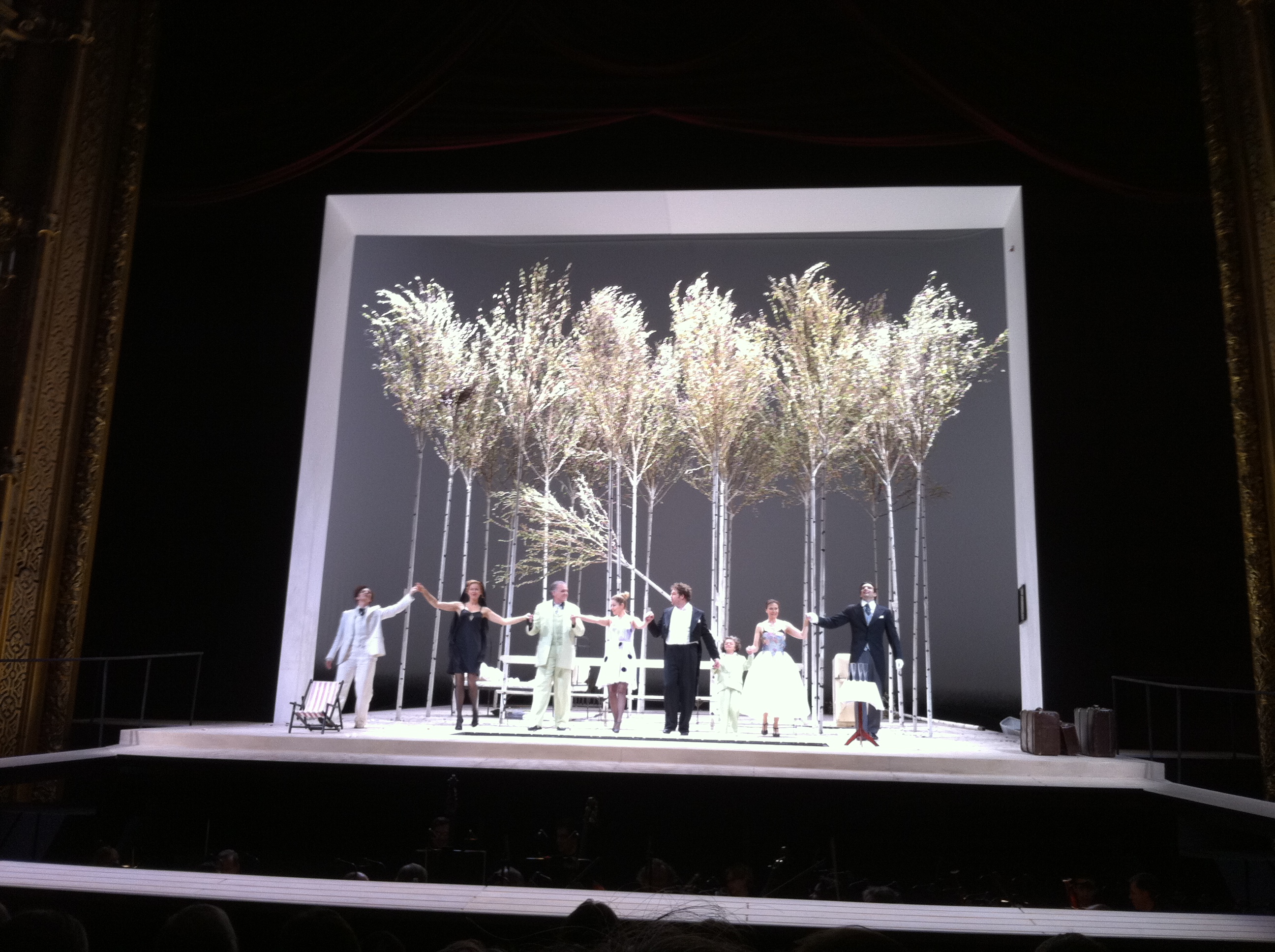
    De Munt has revived a production of La Finta Giardiniera from the National Theatre, Prague, but based on one originally from De Munt that premiered in 1986. Directed by Karl-Ernst Herrmann and Ursel Herrmann, the production featured a little person, one Mireille Mossé, who seemed to be the ringmaster of this circus of an opera. She gave monologues in German before each act, some silent commentary throughout the scenes, and seemed to direct the rather absurd plot, which worked well. It made the motivations of the characters clearer. Given that there are 7 principal singers, and over 3.5 hours of music, any insight was welcome. The set consisted of a grove of trees upstage, a narrow pond downstage, and a strip of stage around the orchestra pit. From the front orchestra level, it almost felt as if the audience was in the performance.

    John Nelson conducted De Munt’s orchestra, which sounded jaunty and spirited. All the principals suited their roles, both vocally and dramatically. Adam Plachetka was strong as Roberto (Nardo). Katerina Knežíková was funny as Serpetta, her voice bird-like and pleasant. Stella Doufexis was a boyish Ramiro, clear voiced and beautifully icy. On the other hand, it took me a bit to warm up to Henriette Bonde-Hansen (Arminda). Perhaps I was overwhelmed by her cow print ensemble, complete with hat and purse. Her first aria was fine though a little dull, but her second aria was impetuous and had more fire. Jeffrey Francis (Podestà) acted convincingly, but his voice was a bit underpowered. Jeremy Ovenden sounded both warm and sweet as Belfiore, and his comic timing was precise. In the title role, Sandrine Piau impressed. Her singing was delightful, rich but with the appropriate lightness and grace for Mozart.

    * Tattling * 
    There was light whispering, especially for the first overture. The audience attrition for this 4 hour and 15 minute performance was marked.

    Leave a comment

  • Kaufmann On the evening of Sunday, March 13, LCU and UO attended the highly anticipated song recital of internationally acclaimed tenor, Jonas Kaufmann. Co-presented by Cal Performances and the San Francisco Opera, the performance took place at Zellerbach Hall in Berkeley. What follows is a discussion of the performance between LCU and UO.

    LCU: Kaufmann is typically very expressive in his operatic roles and I was surprised that he employed minimal facial expressions and hand or body gestures with this program. It was pure, honest singing; not mawkish or overly theatrical, which is often the danger when opera singers attempt the German Lied – they can’t seem to leave the drama at the door. But Kaufmann sang with disciplined restraint, relying solely on the nuances of his voice to articulate the emotions and meaning of the songs. His delivery was lean and exact, with that touch of German austerity. Now UO, I understand that last summer you sang with Kaufmann in the Bayreuth production of Lohengrin. How does his style and vocal technique on the opera stage compare with what we saw tonight?

    UO: Well, I think it all boils down to one thing: Kaufmann knows how to act with his voice. He trusts the material he sings and knows that if he delivers it in a straightforward way, masterpieces such as Dichterliebe will speak for themselves. In this day of live HD transmission and emphasis on extreme naturalism and cinematic facial expression, I think singers feel compelled to exaggerate their facial gestures and body movements. Even when he sang Lohengrin, Kaufmann generally did what was required of him by the director, in terms of gestures and movement around the stage, no more, no less. Certainly he didn’t change his technique. That’s what makes him so unique. For instance, he sang Lohengrin’s Grail Narrative in Bayreuth with all the nuance that he brought to tonight’s lieder recital. He isn’t afraid employ the entire dynamic spectrum of his voice, from ultra-soft to ringing, metallic forte. He’s one of the few singers out there today who has the ability to sing through an entire spectrum of loud and soft, in a way that reads in large halls. And it all carried beautifully, in part, of course, due to the wonderful Bayreuth acoustic. It worked well tonight, in a hall that isn’t acoustically as generous.

    LCU: As a singer and voice teacher, could you explain the technical challenges of Schumann’s Dichterliebe for the tenor voice despite the fact that Jonas made it look so effortless? He sings with the ease of Fritz Wunderlich!

    UO: Two of the highest vocal hurdles of Dichterliebe occur in the very first song. The “strong, weak” stresses of the words “aufgegangen” and “verlangen” are situated right in the tenor’s so-called “passaggio,” right where the voice has to negotiate a register shift that is quite challenging. Then just look at the word, for instance, “verlangen.” The pitch change from G to F# -moves through two liquid consonants (“l” and “ng”), so a seamless vowel connection in this tricky part of the voice is quite difficult. Also, most of the songs are set quite low. This is partly in order to accommodate a high note in “Ich Grolle Nicht” that is not so stratospheric that it becomes an quasi-operatic acrobatic feat, with everyone on the edge of their seats waiting for the poor guy to crack! Of course, I think we would both agree that Kaufmann could have managed this with no effort at all, but the tonalities of all the songs have to have a coherent relationship to one another, and not be transposed all over the place. So the cycle is quite “range-ey.” You also have potential pitfalls in intonation, particularly in the song “Am Leuchtenden Sommermorgen,” where there are a lots of really radical modulations. Coming to Wunderlich: he had a very different, very sweet and less baritonal quality to his sound when you compare him to Kaufmann. You really never think of technique when you hear Wunderlich, it’s all like child’s play to him. Kaufmann came close to this ease of delivery last night, I think.

    LCU: In one of his interviews, Kaufmann said that there is a huge difference between singing and speaking the German language. Kaufmann’s diction is deliberately round because he chooses not to ‘spit’ his consonants, allowing for a smoother legato line. You mentioned that he has been criticized for doing this and for sounding too Italianate as Lohengrin (even though Wagner himself considered it his most Italian opera). However, does the German Lied call for a distinct German sound with all of its idiosyncrasies intact?  At Bryn Terfel’s recital just a few months ago, I noticed that he was very emphatic with his consonants and even though he’s Welsh, Terfel sounded more German to me than Kaufmann. Does the mellowing out of the harsh and choppy qualities compromise the rugged beauty, character, and integrity of the German language?

    UO: I think we’d agree that in Lieder, especially, text and music have to be co-equal. You can’t have one at the expense of the other. But there are choices to be made; do you maniacally over-pronounce at the expense of vocal quality?  Believe me, a lot of German coaches want just that!  Zellerbach Hall seems to me to be one of those places that swallows consonants, so perhaps that accounted for a certain loss of clarity. It’s a big question, especially in opera: when do you modify text and vowels in order to allow the voice to be free?   Kaufmann seems to me to be one of those singers whose credo is “prima la musica, e poi la parola”, in other words, music first, then text, to put it a bit simplistically. My impression in Bayreuth was that those who didn’t care for his approach to Lohengrin felt that it was too human, not “knightly” enough. It wasn’t so much about lack of clear diction or a matter of style, as I recall. But believe me, the supporters of his Lohengrin there far outweighed his detractors in number!

    LCU: I have to tattle on myself – I shamelessly hooted and hollered and cheered like I was at a Michael Jackson concert. At one point George Hume, who sat across the aisle from me, even flashed me a dirty look. I was having a religious experience and just couldn’t help myself. What do you think of the Berkeley audience?  How do they compare with the audience at the Met and Carnegie?

    UO: I guess you didn’t see me sinking lower and lower into my seat! What’s wrong with enthusiasm?  I believe European artists in general are gratified by our American, somewhat over the top applause. I thought the Berkeley audience was just terrific — absolutely silent during the singing. I saw a woman following along with a vocal score, and most people didn’t turn the pages of their programs in the middle of a song, causing a rush of brittle sound to interrupt the music. Many times I have the feeling that, at the Met and other big venues in New York, and particularly on Broadway, people leap to their feet in a robotic, automatic standing ovation. Maybe that’s just to convince themselves that the evening was great, because the ticket prices are so high! I enjoyed the respectful, informed Berkeley audience – very European – informed, respectful and quiet.
    Leave a comment

  • Someone at Lyric Opera of Chicago‘s Saturday performance of Carmen seems to have been arrested for assaulting an usher.

    Chicago Tribune Article | Lyric Opera Official Site

    Leave a comment

  • The winners this year are soprano Michelle Johnson; baritone Joseph Lim; and bass-baritones Joseph Barron, Ryan Speedo Green, and Philippe Sly. Sly will be a participant of the 2011 Merola Program.

    Official Site | AP Article

    Leave a comment

  • Eric-Owens-Lucy-Crowe-Marckarthur-Johnson-in-Hercules-Dan-Rest * Notes *
    The cast for Lyric Opera of Chicago's Hercules is nothing short of impressive. The Thursday matinée performance seemed well-attended, even the lecture from director Peter Sellars was rather full. Sellars certainly expressed a strong conception for how he staged this oratorio, and has both respect and understanding for the work. However, sometimes it is difficult to see past all the artifical miming, especially with the chorus. While the movements were humorous, I suspect one is not supposed to laugh at the lines "Jealousy! Infernal pest!"

    The set is attractive, not unlike an elaborate, classically-informed water feature in an outdoor mall. The lighting was rather literal, red when fire or passion was mentioned, blue and green if water was invoked. The costumes were somewhat puzzling, the women looked like they were SCA members in their casual wear, the men vaguely like they were from the Pacific Northwest.

    The orchestra lacked crispness in the overture under Harry Bicket. There were parts that were more focused and pretty, and those that were less so. The cello in "There in myrtle shades" was overwhelming, and the first brass part during the triumphal march was somewhat sour.

    The chorus was slightly off from the orchestra in the second choral number, especially when the choral soloists sang. The singers did their choreography well. The last chorus, "To them your grateful notes of praise belong," was moving and beautiful.

    The principals were all exceedingly fine, both in acting and in singing. Despite being ill, Richard Croft (Hyllus) sounded warm and sweet, though quiet at times. Lucy Crowe was brilliant as Iole, her voice is gorgeous, and "My breast with tender pity swells" was one of the best arias of the afternoon. David Daniels made the most of Lichas, sounding clear and lovely. In the title role, Eric Owens showed a full range of emotions with his scant three arias. The last was particularly stirring. Likewise, Alice Coote effectively displayed her dramatic abilties within the constraints of the Baroque form. Her Dejanira is incredibly human, and her voice has strong low notes and striking high ones.

    * Tattling *
    A phone rang during the first half of the show. Many audience members in the boxes fell asleep, at one point there was quite the chorus of snores. Worse yet, an elderly couple in Box 9 kept speaking during the music, once in the overture, once during Daniels' first aria, and once during Crowe's first aria. Thankfully, they responded fairly well to being asked to be quiet, and they left at intermission.

    Leave a comment

  • Fleming_as_Armida An account of the February 18, 2011 performance of Armida at the Metropolitan Opera from the Unbiased Opinionator.

    * Notes * 
    The tale of Armida, derived from an 16th Century epic poem by Tasso, has inspired composers from Lully and Händel to Dvořák and the contemporary British composer Judith Weir. The story of the crusader Rinaldo, tricked into love by the sorceress Armida, was also the source for an impressive cantata for men's voices by Brahms.

    Rossini's version was composed during a fruitful period in Naples, in which he was assured of the best soloists, chorus and orchestra available at the time. In Armida, he had the luxury of writing for an unusual cast that includes seven tenors. The title role is among the most virtuosic and demanding in the entire dramatic coloratura repertory.

    The Metropolitan's production was created by Mary Zimmerman for the 2010 season. Ranging from a painted stage curtain reminiscent of Titian, to Armida's infernal realm with a coffered dome in the style of the Pantheon (complete with an incongruous, huge black spider), to fantasy palm trees bathed in the rich color palette of the post-impressionist Henri Rousseau, the set design was striking.

    John Osborn's sang the role of Goffredo, with its stratospheric high notes and demanding coloratura, most impressively, setting a high bar for the evening. The remaining secondary tenor roles were well cast.

    The true hero of the evening, both dramatically and vocally, was the Rinaldo of Lawrence Brownlee. He sang with astonishing agility and a rich and varied range of vocal color. Compounding the difficulties of the role are the large ensembles, which require enormous stamina. Brownlee met these challenges with an ease of vocal delivery that was jaw-dropping. All the while scaling height after technical height, he managed to convey the expressive humanity of Rinaldo himself — a transcendent achievement.

    The Met's production of Armida was mounted for Renée Fleming. In the 1996 concert version given by the Opera Orchestra of New York, conducted by Eve Queler, this reviewer experienced Ms. Fleming's triumphantly fiery delivery at a time when the soprano had begun to shed her nice girl image and had started applying the "diva dust" required to sell this role.

    While the intervening 15 years have brought Ms. Fleming many triumphs on the great stages of the world, they have not been kind to her in this impossibly challenging repertory. The artist sounded indisposed. Her singing was characterized by a pallid top, labored coloratura and a lack of vocal presence that bordered on inaudibility. The breathy attacks and scooping that have become a Fleming trademark seemed only to further undermine her technique. One hopes for happier moments in her upcoming performance as the Countess in Strauss's Capriccio, repertory in which this fine artist continues to excel.

    Graciela Daniele's choreography, marvelously executed by the Met corps de ballet, featured a solo dance role Rinaldo performed with bravura by Eric Otto. The solo instrumental contributions, especially those of concert master David Chan, cellist Rafael Figueroa and principal harpist Deborah Hoffman, were masterful.

    * Tattling * 
    Absent a stellar singer in the title role, Rossini's Armida is a very long evening, and the audience thinned noticeably after both intermissions.

    Leave a comment

  • September 15-17 2011: Dido & Aeneas
    September 22-25 2011: Mozart & Haydn
    October 25-30 2011: Arias for Farinelli
    November 18-22 2011: Marion Verbruggen & The Italian Baroque
    December 2-6 2011: Bach's Mass in B minor
    January 26-29 2012: Richard Egarr: Masters of the English Baroque
    March 6-11 2012: Steven Isserlis: The Classical Cello
    April 20-25 2012: Händel's Alexander's Feast

    Philharmonia Baroque announced their next season today. Stephanie Blythe will be singing Dido in Dido and Aeneas this September, Mark Morris Dance Company performs. Vivica Genaux sings in the October performances of Vivaldi, Fasch, Telemann, and Rameau.

    Official Site | 2011-2012 Season

    Leave a comment