• Takacs-Quartet-3-by-Ellen-Appel * Notes * 
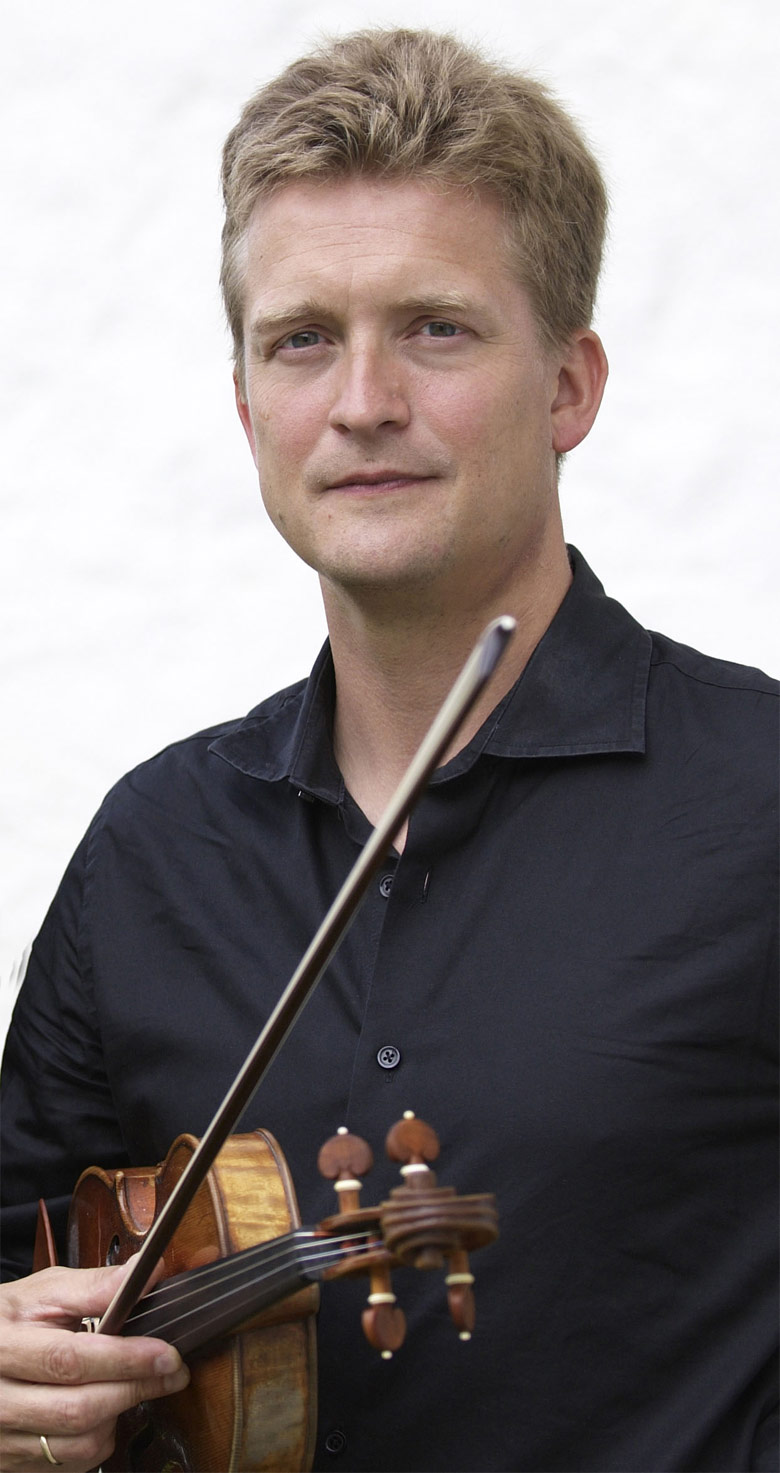
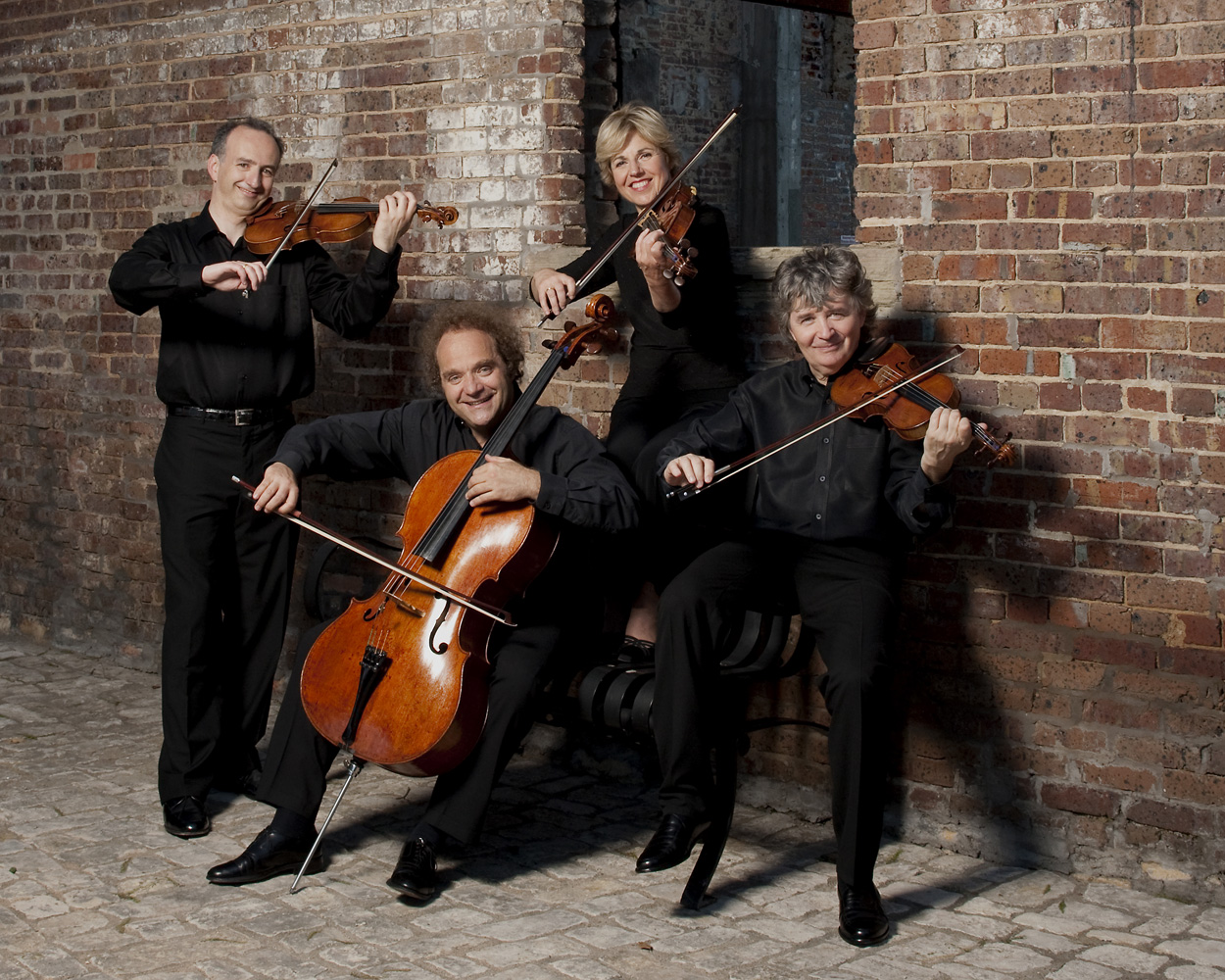
    The Takács Quartet played a program of Haydn, Mendelssohn, and Beethoven at Cal Performances yesterday afternoon. The playing had a lot of fire, yet with geniality as well. There were a few screechy moments in the otherwise courtly Quartet in E-flat Major, Op. 71, No. 3 from Haydn, but it certainly was not boring. One could clearly hear the influence of Beethoven in Mendelssohn's Quartet in A minor, Op. 13. The end of the Intermezzo was particularly cute. Beethoven's Quartet in A minor, Op. 132 was lively and charming. The Allegro ma non tanto sounded especially fresh and the Andante of the third movement was stately.

    * Tattling * 
    There was a child of about 7 or 8 seated in Row O Seat 37. She had great difficulty sitting still, as one would expect for her age, and she would occasionally talk or look turn in her seat to stare at me. There was light talking from others also, a woman in the same Row seemed to fall asleep, she checked her Blackberry on at least one occasion. A watch alarm was heard at 4pm and 5pm.

    After the performance, the Cal Performances Award was given out to an adorable person named "Budd." Part of the award involved staying on the stage to hear the encore, a slow movement from Mozart's "Dissonance" quartet.

    Leave a Reply

  • Tetzlaff9_high * Notes * 
    Christian Tetzlaff played Bach’s complete Sonatas and Partitas for Solo Violin in Berkeley last night as part of Cal Performances 2010-2011 Koret Recital Series. In the first half he played Sonata No. 1 in G minor, Partita No. 1 in B minor, and Sonata No. 2 in A minor. It seemed he only paused briefly between pieces to tune. The contrasts in tempi and dynamics were clear. Tetzlaff was focused without sounding labored. There were a few passages that were muddy and a note or two may have been slightly squeaky, but the intensity of the playing was impressive.

    After the hour-long dinner break were heard Partita No. 2 in D minor, which was incisive but passionate. After the second movement Courante Telzlaff left the stage, and when he returned he explained that there was a noise in the hall that was bothering him. He played the rest of the Partita without further incident. This was followed by Sonata No. 3 in C Major and Partita No. 3 in E Major. The music poured forth relentlessly and the sheer stamina required to play this was in and of itself extraordinary.

    * Tattling * 
    The audience was silent, murmuring approval after each movement, and clapping excitedly after each piece. Someone in G 5 of the orchestra level was even reading the score. There some coughing, and one person may have been asked to leave during the first half, and seemed rather offended. One watch alarm was heard at 7pm, and a cellular phone on vibrate was heard during the third Sonata.

    Leave a Reply

  • Adams_john_175x175 * Notes *
    John Adams is conducting his nativity oratorio El Niño at San Francisco Symphony this week as part of Project San Francisco. The work was modestly staged, with direction from Kevin Newbury, set from Daniel Hubp, costumes from Paul Carey, and lighting from Kirk Bookman. The most charming bit might have been the Charlie Brown Christmas tree downstage for the second half. Adams kept time impressively, but for the most part had an introverted conducting style. Much amplification was used and the overall effect was richly textural and rather loud.

    The chorus sounded pretty, but did not always seem together. It was especially difficult to discern what they were singing in the beginning. The soloists were amplified, so did not have to contend with being lost under the rest of the music. The trio of countertenors did sound angelic, as did the San Francisco Girls Chorus that came in at the end. Bass-baritone Jonathan Lemalu seemed to have a good heft to his voice. His sibilants were somewhat whistled. Mezzo Michelle DeYoung created a pleasant, pewter-like sound. Soprano Dawn Upshaw was bright and also very lovely. Everyone sounded so comfortable singing in English that when they occasionally switched to Spanish, it was noticeably stilted. There were small errors in Spanish pronunciation, initial voiceless stops were aspirated and some vowels were not clear.

    * Tattling * 
    There was light talking in the first half, but the most of the offenders left at intermission so that the audience was unusually quiet for the second part.

    Leave a Reply

  • Adler-Fellows-Bows-2010 * Notes *
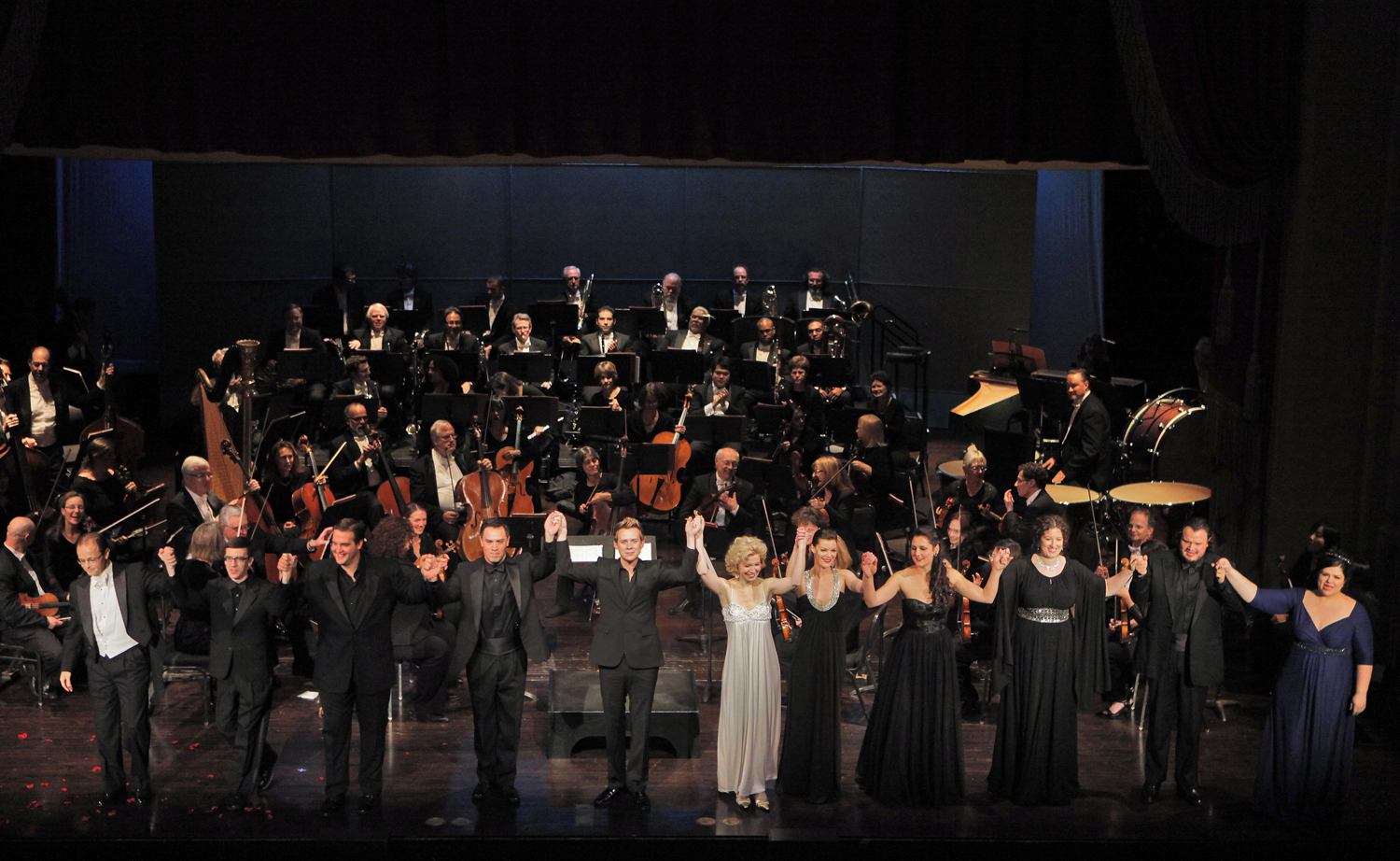
    The Adler Fellows Gala Concert at Herbst Theatre last night involved much repertoire in the French language, there were no arias from Wagner or Strauss. It was refreshing to see the orchestra on the stage as they started the concert with the overture from Ruslan and Lyudmila. Maya Lahyani was the consummate singer/actress as she performed "Mon cœur s'ouvre à ta voix" from Samson et Dalila. Her dark, husky tones suited the role. When she went on to sing Carmen opposite of Brian Jagde in "C'est toi! C'est moi!" in the second half, she was also incredible, the fatalism of the character was apparent. Jagde sounded bright and reedy here, as he did for "E lucevan le stele."

    Austin Kness sang "È sogno? o realtà," Ford's lyric baritone aria from Falstaff, heartily. On the other hand, Sara Gartland labored to sing "Ah rendetemi la speme…Qui la voce" from Il Puritani. Her voice is distinctive, and she sounded better in her duet with Kness, "Étranger, te voilà, comme tu l'avais dit!" I am not familiar with the Massenet opera this piece is from, Thaïs, but from this excerpt it seemed rather absurd.

    Ryan Belongie and Susannah Biller sang "Io t'abbraccio" from Rodelinda with great beauty. There were a few bars in which they did not sound perfectly in tune with each other, but they recovered quickly. The harpsichord, played by Allen Perriello, was lovely. After the intermission Belongie sang "Venga pur, minacci e frema" from Mitridate, Re di Ponto. He sounded pretty, but at times he was hard to hear. Susannah Biller, on the other hand, was clear and strong in Ophelia's mad scene in Thomas' Hamlet.

    The most impressive singers were Leah Crocetto and David Lomelí. Crocetto sang "È strano…Ah, fors'è lui…Sempre libera" admirably and Lomelí sounded incredibly robust from off stage. Their duet from Guillaume Tell was likewise fine. Perhaps the most beautiful part of the concert was the end, when Lomelí sang "Nessun dorma," with Tamara Sanikidze playing the celeste. It was especially moving when the other Adlers came in as the chorus.

    * Tattling * 
    There was some talking during the music. I was seated by a person who was so large that she could not put her arms inside the armrests of the seat. Her left elbow would have easily been touching me if I were less petite. I felt quite grateful to be small, but I did have to stay still in order not to disturb the established equilibrium.

    Leave a Reply

  • Melton_heidi_second_photo * Notes *
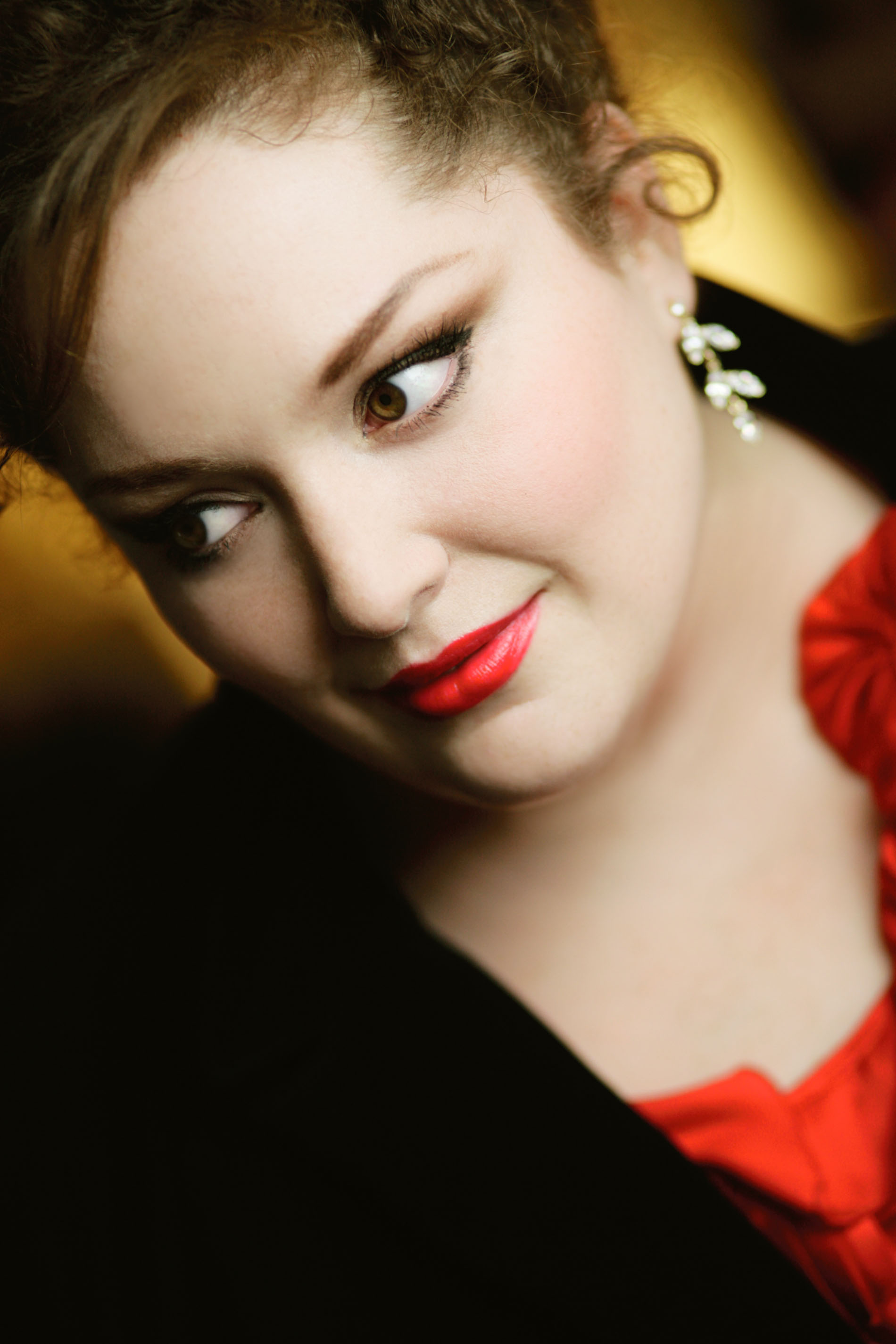
    Soprano Heidi Melton gave a recital with pianist John Churchwell for the Salons at the Rex series yesterday evening. The first half of Melton's performance consisted of art songs by Sibelius and Korngold. As far as the pieces of the former, "Tuol Laulaa Neitonen" was rather dreamy, while "Hiljainen Kaupunki" had an otherworldly quality. One was impressed by how Churchwell used his breath to play, the phrasing was clear, and he absolutely attacked "Hjertats." Korngold's Lieder des Abschieds, Opus 14 were moving. Melton's voice is creamy and strong, and she was never overwhelmingly loud. The second half of the evening consisted of cabaret and torch songs, which Melton sang with verve. The Kurt Weill and Irving Berlin were especially great, but Melton was engaging in every single number.

    * Tattling *
    The recital was sold out, even though Adler Concert was programed for the same night. The audience was well-behaved, there was only the slightest bit of talking during the last piece. Melton was very aware of the time-constraint she was under, and at one point asked how we were doing on time. I believe it was jumping clapping man that exclaimed "We've got all night!"

    Leave a Reply

  • Evdh-full-length-smaller-version Soprano Elza van den Heever (pictured left) is currently an Ensemblemitglied at Oper Frankfurt, but as been in San Francisco this month for Vier letzte Lieder at San Francisco Symphony and a recital presented by San Francisco Performances. She sings Elsa in Bayerische Staatsoper's Lohengrin this January, the Composer in Ariadne auf Naxos and Leonora in Il Trovatore at the Grand Théâtre de Bordeaux from February to April, Vier letzte Lieder with the London Symphony Orchestra next March, Antonia in Les contes d'Hoffmann and Vitellia in La Clemenza di Tito at Oper Frankfurt in April through June, Verdi Requiem with the Frankfurter Opern- und Museumsorchester at the Alte Oper Frankfurt in May, and finishes the season as Fiordiligi in Così fan tutte at Opéra national de Paris in June and July. The Opera Tattler caught up with van den Heever before a rehearsal.

    How are you enjoying San Francisco?
    It is great, this is where I lived for more than 10 years, so it is like coming home. I spent one week in San Francisco just to be here, and the rest of my time has been rehearsing, first with San Francisco Symphony and now for the recital on Sunday. Sheri Greenawald is still my primary teacher, so I have spent a lot of time with her.

    Where did you live in San Francisco?
    Out in the Sunset for 6 years, because that's where the San Francisco Conservatory of Music was, and in Civic Center for 5 years.

    What do you miss most about this city?
    Climbing hills, you don't realize what a difference this makes until you move away and see how flat other places are. You get into this fit zone! There is such a health conciousness in the Bay Area, and an awareness about how what you put into your body matters. San Francisco is also so close to nature, in a couple hours you can be in Point Reyes, for instance.

    How was it singing with San Francisco Symphony this time around?
    Michael Tilson Thomas is one of my mentors, he gave me such particular care, since he knows Vier letzte Lieder so well. Since there is only one soloist in this, unlike the 8 in Mahler's 8th, Michael Tilson Thomas really took me under his wing.

    How are you liking Frankfurt?
    It actually has a lot of greenery. In a way it is like a provincial town with high-rises, as soon as you get out of downtown it is less urban than you would think. At the same time, it is the banking capital of Germany, so it is comsompolitan and diverse.

    How about Oper Frankfurt?
    It is wonderful. It is an important house and I feel lucky to be able to try all these big roles there for the first time. For new productions we get 7 weeks of rehearsal, and then 8 to 10 performances, which is great.

    You were the first-prize winner in the 2008 Seattle Opera Wagner Competition. Are you planning on going in that direction as far as repertoire?
    That was a lot of pressure! It was my first and last competition! I was really glad to win, especially based on just the arias I did from Tannhäuser and Lohengrin, the only Wagner operas I will sing from right now. As far as repertoire, I want to keep all my options open, to sing as much as is right for me. I'm only 31 so I have lots of time, and I'd rather be prudent with my voice.

    Do you have a favorite composer?
    Right now I am really enjoying Verdi, he really lets the voice fly and I feel a special affinity for him. I am working on parts from Otello, the Requiem, and Il Trovatore at the moment.

    Who do you look up to?
    I look up to my colleagues, especially the ones that are of the same age as me, because they make me want to work harder and strive further. My absolute favorite singer is Maria Callas though. I know it is a cliché, but she was truly great.

    Your San Francisco debut in Don Giovanni has been in cinemas and was broadcast on public television. How do you feel about live simulcasts?
    That's right! The Met HD Broadcasts are amazing, they are so impressive. They do make me a bit nervous, I hope people don't cancel their subscriptions and watch them instead of going to the opera house. As a performer, it does make you all the more nervous to be recorded live, since most of media we see or hear are edited to perfection.

    Do you feel pressure to be able to move and act well?
    Yes, there is pressure. This was one of the great things about being in Merola, we had movement lessons. But I still can't dance, I have two left feet, and I always find I want to lead!

    Are there singers in your family?
    No, but my family is artistic. My mother was an actress and now a producer and my father is a film-maker. I have a photographer, a painter, and a chef as brothers.

    I heard you also wanted to be a chef? How did you pick singing as a career?
    Yes, I didn't know what I was in for! [Laughs] I figured I could a chef at any age but if I wanted to be a singer I would have to start training young.

    What do you like to cook?
    I like to go to the grocery store with no idea of what I'm going to get, so I can see what is in season. I like to be creative with vegetables, but I don't specialize in a particular type of cuisine. I never follow a recipe!

    Leave a Reply

  • La-opera-lohengrin * Notes *
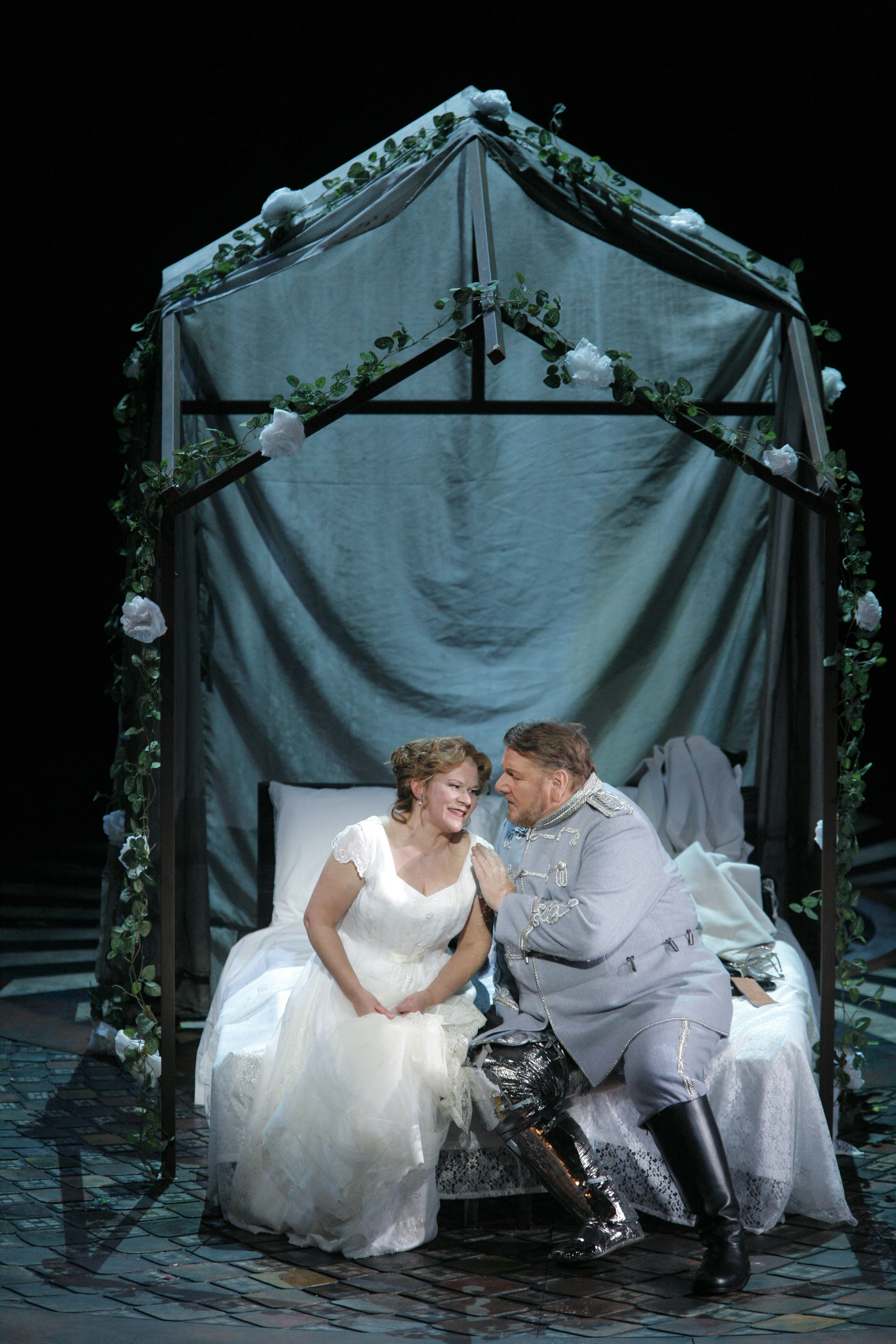
    Yesterday’s matinée performance of Lohengrin opened at Los Angeles Opera was the second of six. The new production, designed by Dirk Hofacker and directed by Lydia Steier, is exceedingly silly. The set is on a turntable and appears to be set amidst German ruins in a Prussian army camp. One especially enjoyed the fact that the swan that brings Lohengrin is a bed covered tent (pictured left with Soile Isokoski and Ben Heppner, photograph by Robert Millard). The choreography was not well-motivated and perhaps merely served the set, which was rotated at various points. At times it seemed that people rushed aimlessly around the stage and ended up at their marks too early.

    Maestro Conlon kept the music going at a good pace. For the most part the woodwinds sounded pretty. The brass make a few mistakes, especially in Act II, but managed to be effective. The chorus was lovely, though again, as with Rigoletto, there were a few times when synchronization was a problem. “Treulich geführt” came off beautifully, sounding clear and together.

    There were many familiar faces in the cast. Robert MacNeil and Greg Fedderly were the First and Second Noblemen, while Domingo-Thornton Young Artists Matthew Anchel and Museop Kim were the Third and Fourth. Baritone Eike Wilm Schulte was the Herald. All sang nicely.

    Most of the principal singers were impressive. Dolora Zajick made for the perfect Ortrud, she sang with strength, richness, and with appropriate haughtiness. James Johnson played a tormented Friedrich von Telramund, his voice too is robust. Kristinn Sigmundsson sounded noble as King Heinrich.

    Soile Isokoski gleamed as Elsa, and sounded particularly sublime in “Einsam in trüben Tage.” Some of her lower notes in Act II were not as lucid as her high ones. In the title role, Ben Heppner struggled. From the start the production did not make him seem heroic. When he emerged from the tent he hardly cut a fine figure, as his coat was unbuttoned, which was not a flattering look. If Heppner was in good voice, this would not have mattered, but unfortunately this was not the case. He had a few good moments, his voice has a warmth to it, and volume. However, he wailed his way up to high notes that were strained and rough. It was painful to hear him hail Elsa in Act II and he even cracked badly in the last act.

    * Tattling * 
    Nearly every type of unpleasant behavior was on display from the audience members in Balcony B. The couple in K 40 and 41 talked nearly every time a soloist was not singing, so even during the famous Bridal March. The woman in L 37 unwrapped cough drops and incessantly scratched herself during Act I, but had the good sense to leave, as she clearly was not feeling well. Someone in Row M tapped her stiletto heels against the concrete floor distractedly, while someone else in Row L quietly sang along. A mobile phone rang during Act II, but it was on so low that he or she did not even hear it, and did not turn it off. There was periodic beeping, perhaps from a recording device. Flash photographs were taken during the ovation. The worst offender was a person at the back of the house with a very loud phone, which rang at the end of the opera on four separate occasions.

    Leave a Reply

  • La-opera-rigoletto * Notes *
    Rigoletto opened at Los Angeles Opera last night. San Francisco Opera's production, designed by Michael Yeargan and directed by Mark Lamos, takes inspiration from the painter Giorgio de Chirico. The stage looked clean, and Mark McCullough's lighting was effective in defining the various spaces, but garish at times. Constance Hoffman's attractive costumes did not seem to take as much from the scuola metafisica art movement founded by De Chirico, except for the color palette, perhaps.

    Music Director James Conlon kept the orchestra together, and the brass sounded more focused than usual. The flute may have had some harsh moments, particularly in "Caro nome," but the oboe was sweet and clear, especially in "Tutte le feste al tempio." The cello solo in "Cortigiani, vil razza dannata" was also strong. The chorus sounded clear, but was not always with the orchestra.

    Many of the smaller roles were filled by Domingo-Thornton Young Artists, including Matthew Anchel (Count Ceprano), Janai Brugger-Orman (A Page), Valentina Fleer (Countess Ceprano), Carin Gilfry (Giovanna), and Museop Kim (Marullo). All aquitted themselves well, but Carin Gilfry's lustrous voice stood out, even against Sarah Coburn's brilliant Gilda.

    As Maddalena, Kendall Gladen acted convincingly, but was somewhat difficult to hear in the quartet of Act III, her voice blended too well with the orchestra. Andrea Silvestrelli was threatening as Sparafucile, his voice has such an endless richness to it. Daniel Sumegi sounded in character for the elderly Count Monterone, gravelly and shaky. Sarah Coburn had a burnished warmth as Gilda, but also a pleasing bird-like quality. She hit a sour note in "Caro Nome," but was otherwise great. Gianluca Terranova was dashing as the Duke of Mantua, he did started off barking a bit too much, but sang more legato as the night wore on. His voice is not meaty, but he sparkled above the orchestra effectively without screaming. George Gagnidze was fairly subtle in the title role. He was behind the orchestra in the "la ra, la ra" part of Act II. He was moving in the final scene, the duet ("V'ho ingannato!") with Coburn was beautiful.

    * Tattling * 
    One was amused to see that the dancers in the opening scene had their bosoms revealed again, as they had been covered up in San Francisco's last revival. There was not a huge amount of talking from the audience in Balcony B. I had a coughing fit during Act I Scene 2, and someone was kind enough to give me a cough drop. The woman next to me in J36 had her leather jacket draped over the arm rest. I should have said something but it was difficult to get her attention, she was ill and engaged in conversation with her companion. After the performance ended, she swung her jacket against me as she put it on, and I could only laugh at how ridiculous this was.

    Leave a Reply

  • Trimphal-march   * Notes * 
    The November/December run of Aida at San Francisco Opera opened last night with Maestro Giuseppe Finzi at the helm and a bevy of new principal singers. The orchestra sounded rather pretty but not perfectly secure, there was some slight squeaking from the woodwinds, brief fuzzy moments in the brass, and the finale of Act II was not exactly together. Though comparisons are odious, it is difficult not to compare this cast with the one that opened the season in September. On the whole, this group was more balanced as far as both singing and acting is concerned.

    Somehow the performance did not coalesce, even though the individuals involved are all talented. Tenor Brian Jagde made the most of the small role of the messenger, and Leah Crocetto sounded robust yet mysterious as the priestess. Christian Van Horn made for a powerful the King of Egypt, and Eric Owens was likewise strong as Ramfis. Quinn Kelsey was beautifully lyrical as Amonasro, his characterization is markedly different than Marco Vratogna's, but still formidable.

    Carlo Ventre had a lot of volume as Radames, his voice is reedy, and has a weeping quality to it, almost as if he was sobbing out the lines. Guang Yang (Amneris) was also rather loud, her voice flexible, but she seemed to rush at a few points. Michele Capalbo obviously understood every word she sang as Aida, and nuanced her voice appropriately. She too has a large, dark voice, but she was not always smooth, there were catches and gasps here and there. During "Ritorna vincitor" in Act I we heard drilling and banging coming from backstage.

    * Tattling * 
    Latecomers talked a great deal as they waited in balcony standing room to be seated. A mobile phone rang right before the words "Immenso Ftah" are sung in Act I, and watch alarms were heard at each hour. During intermission I heard a ridiculous woman complain in Mandarin about how fat Capalbo was, and her companion corrected her, saying that it was Yang that was the heavier one. She only responded that no, they were both fat. After this, someone was nice enough to give me a ticket for the Balcony Circle, but unfortunately people talked aloud throughout. The French speakers in Row D Seats 13 and 15 were particularly chatty.

    Leave a Reply

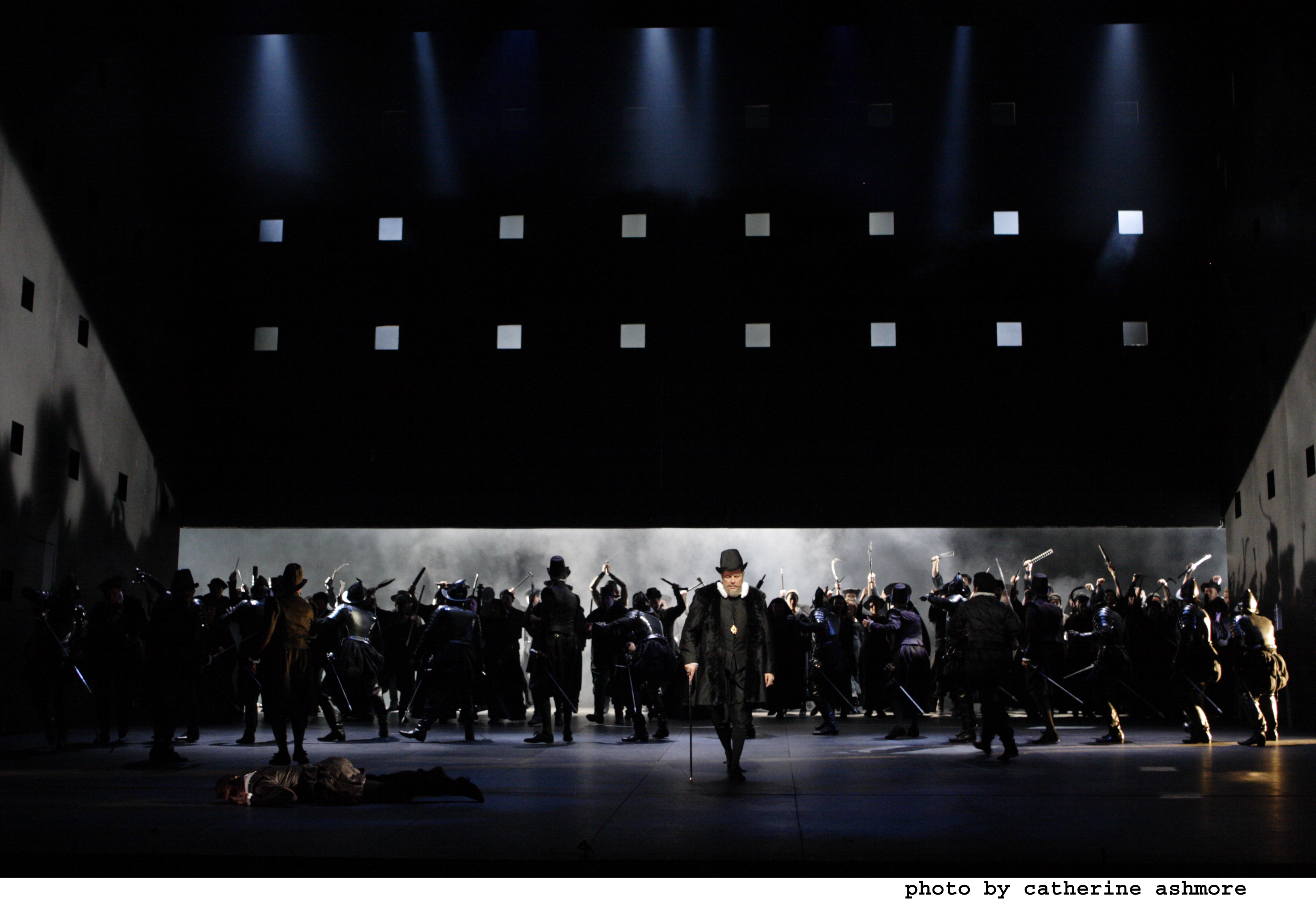
  • Met-don-carlo Metropolitan Opera's Don Carlo, a co-production with the Royal Opera House, Covent Garden, and the Norwegian National Opera and Ballet, opened last night. What follows is the Unbiased Opinionator's account of the prima.

    * Notes * 
    Very rarely does an opera with a 7:00 pm start time and midnight closing curtain, on a Monday night, rivet an audience into rapt silence. Absent Bayreuth-style, hour-long intermissions, the performance can be a grueling experience, for singers and audience alike. I am happy to report that the evening sped by –with compelling stage direction, impressive set design and above all, a very strong cast led by a conductor who knew what he wanted from the score and radiated both confident mastery and reverence and respect for the difficult tasks faced by the principals.

    It would require a curmudgeon the likes of Wagner's Beckmesser to nit-pick the performance last evening, the season premiere of Don Carlo at the Met. The opera was performed in the five act version in Italian, not the original French version, and is loosely based on the Schiller play, reworked by the playwright François Joseph Méry (1798-1866). The libretto was completed by Camille de Locle after Méry's death.

    Verdi spent over twenty years tweaking what is considered by many, and most definitely by this reviewer, as Verdi's magnum opus. Many of his revisions were undertaken after Aida and the Requiem, and Verdi's growth and mastery, acquired after composing Aida (an opera similar in scope and ambition to Don Carlo, where the private passions of individual players take place before an enormous historical back-drop) and the Requiem, which drew Verdi into the realm of the sacred, seem to culminate in the final version of Don Carlo, where personages of enormous political power struggle to reconcile their private loves, disappointments and sense of tragic doom with the crushing political burdens forced upon them by history.

    The sets and costumes were in every way effective and impressive, no more so than in the monastery of St. Just, with its subterranean catacomb containing the sarcophagus of Charles the Fifth, and the striking set of the third act auto-da-fe with the Valladolid Cathedral cast in gold, the sky blood red, and a huge portrait of Christ in torment dominating stage left, which at the end of the Act becomes a transparency behind which we see the remains of heretics burned at the stake. All the horror of the Spanish Inquisition was felt here. Torture and death by fire were suggested, not imposed on the audience literally, which increased the sense of terror and mania underlying the Inquisition.

    Roberto Alagna's performance of the title role, after initial dryness and forcing in his only aria "Io la Vidi," was impressive and moving. This role is thankless and in most performances only memorable if the tenor is not up to its demands. Don Carlo has but one real aria, and the role is extremely long and taxing. As the evening developed, Alagna become more convincing, with an powerful top and deeply felt expression.

    To this reviewer, the musical and dramatic high point of the show was Ferruccio Furlanetto's rendition of the King's great aria "Ella Giammai M'amo." It would take an entire review in itself to explore the rich detail, the sonority and variety of vocal and expressive color Furlanetto was able to bring to this aria, perhaps the greatest aria for bass ever written by Verdi. The arching phrase "Amor per me non ha," greatly feared by basses, is repeated twice. In the first of two repetitions, this great artist succeeded in slimming his large voice into a slender, yet ringing, stream of sound. He did not allow himself to be rushed by the conductor, taking all the time he needed to properly breathe and prepare for each, ever more challenge phrase, but in no way diminishing the intensifying drama of this scena. In the reprise of the difficult phrase mentioned above, he opened up with a massive, engulfing sound that was overwhelming in its emotional intensity, as the King, possessing all the political might of the world, mourns his wife's lack of love and his solitude.

    Marilyn Horne, a great Eboli in her day, correctly describes the this role as actually requiring three singers; one with the flexibility of the Veil Song, one for the enraged Eboli, rejected by Carlo in their in the first scene of Act III, and one who can pull out all the stops for the virtuosic showpiece "O Don Fatale." The mezzo Anna Smirnova was really only truly suited to the last of these challenges: her Veil Song was labored and lacked subtlety. However, her powerful, dark vocalism and marvelous high B in her Third Act aria were breathtaking. Marina Poplavskaya's Elizabeth was sung with great beauty and a sublime fil de voce- the ability to thread a high note into a spinning pianissimo. Unfortunately, she was overburdened by the challenges of this long evening, and her final aria "Tu Che la Vanita" was effortful, with a forced top and limited emotional impact. Simon Keenlyside, who performed an admirable Hamlet last year at the Met in Ambrose Thomas' opera, was a fine dramatic presence, but seemed a bit out of his depth vocally. He was often overpowered by the orchestra, and his aria "Per me Giunto," where he pledges his life to saving beleaguered Flanders and declaring his loyalty and bond of love to Carlo, was weak.

    The great stage veteran, Eric Halfvarson, a memorable Hagen in Götterdämmerung, captured impressively the ancient, blind yet all-powerful and menacing Grand Inquisitor. At this stage in his long career, Halfvarson's voice tends to spread and wobble at climactic moments, but this is a mere cavil – so effective and blood-chilling was his delivery and presence. His cardinal red robe, the only color in the darkness of Phillip's chamber, was a blood-shot reminder of his fanatical pursuit of heretics and the horror of burning at the stake of his victims. In the great confrontational duet between the King and the Inquisitor, I had the sense that phrases were not given an opportunity to resonate, but rather were precipitously jammed together by the conductor, which diminished somewhat the impact of this tremendous scene. Secondary roles were well sung, especially by Lalya Claire (in her Met debut s the Elizabeth's page Tebaldo) and the Celestial Voice (Jennifer Check), who is given the daunting tasking of performing a short, very high and exposed angelic line at the end of the Act III. She met this challenge with courage, and sang from a position high in the auditorium balconies, not on or behind the stage. The Friar (Alexei Tonvitsky, in his Met debut) was imposing. A special mention should be made of the 6 Flemish Deputies, who sing in unison in the Act III auto da fe, imploring King Philip for relief for the Flemish people. The blend was perfect, resulting in the sense of one voice pleading, yet dignified.

    There were too many marvels emanating from the pit to describe them all. The horn section, playing in unison at the beginning of Act IV was perfect in its somber sonority. I had the occasion to hear this performance from two positions, one in the front row of the Grand Tier, where the orchestra seemed overloud, since its sound projects upward while the singers' voices tend to project directionally forward into the hall. A seat in Orchestra Row Z, just under the parterre boxes, gave a better sense of balance, and my initial impression that conductor Yannick Nézet-Séquin was insensitive to the singers was corrected when I heard the performance in this horizontal acoustic plane.

    * Tattling * 
    As this was the opening Gala Performance of Don Carlo, the audience was especially glamorous and well-dressed. Disruptions by cellphones and yakking were minimal, and people remained after the performance long enough to render a loud and fitting approval of the evening's performance, which will remain in my memory as one of the best I have heard at the Met.
    Leave a Reply