• Ian Robertson_photo Matthew Washburn_4S2A0655* Notes * 

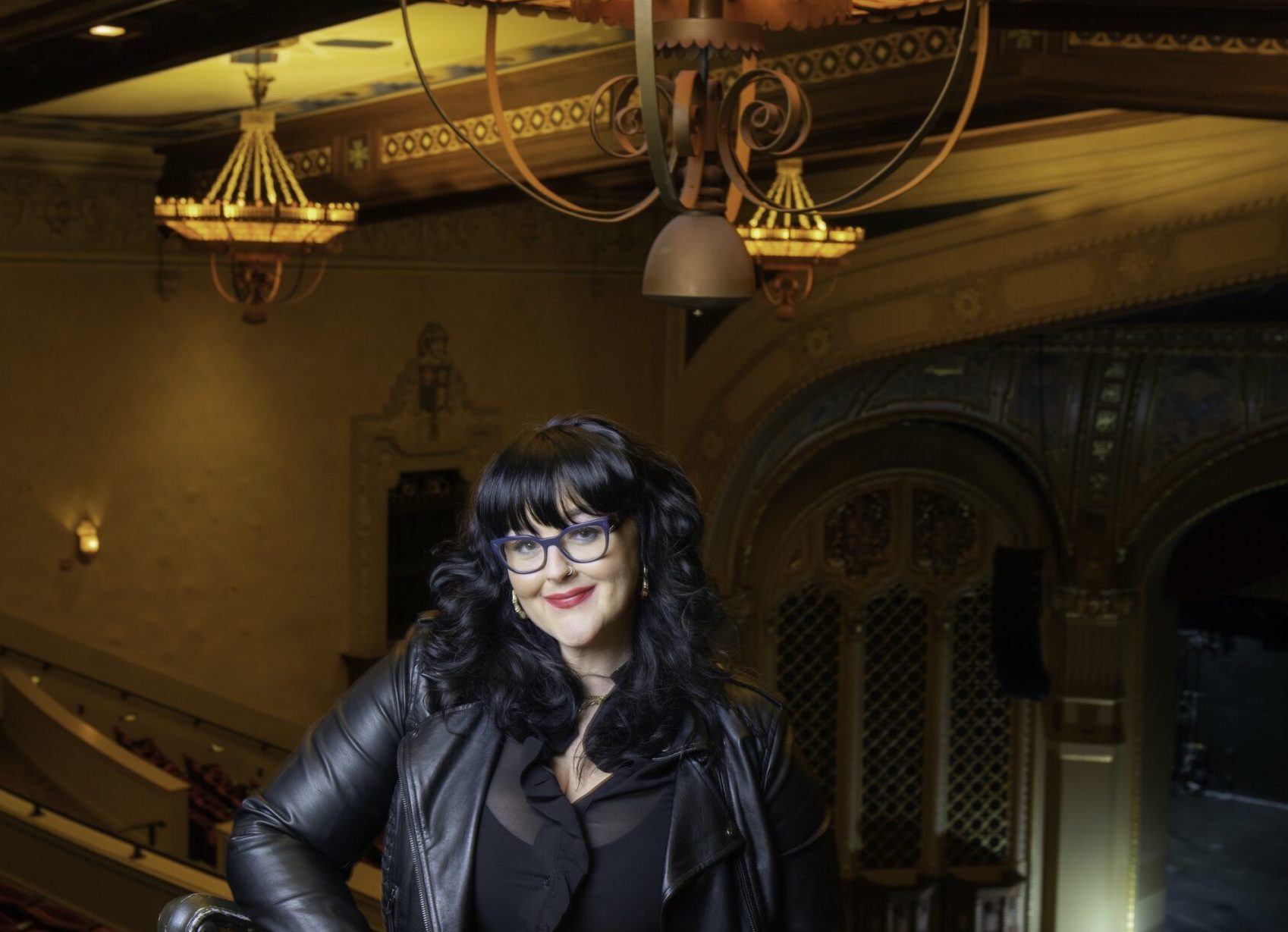
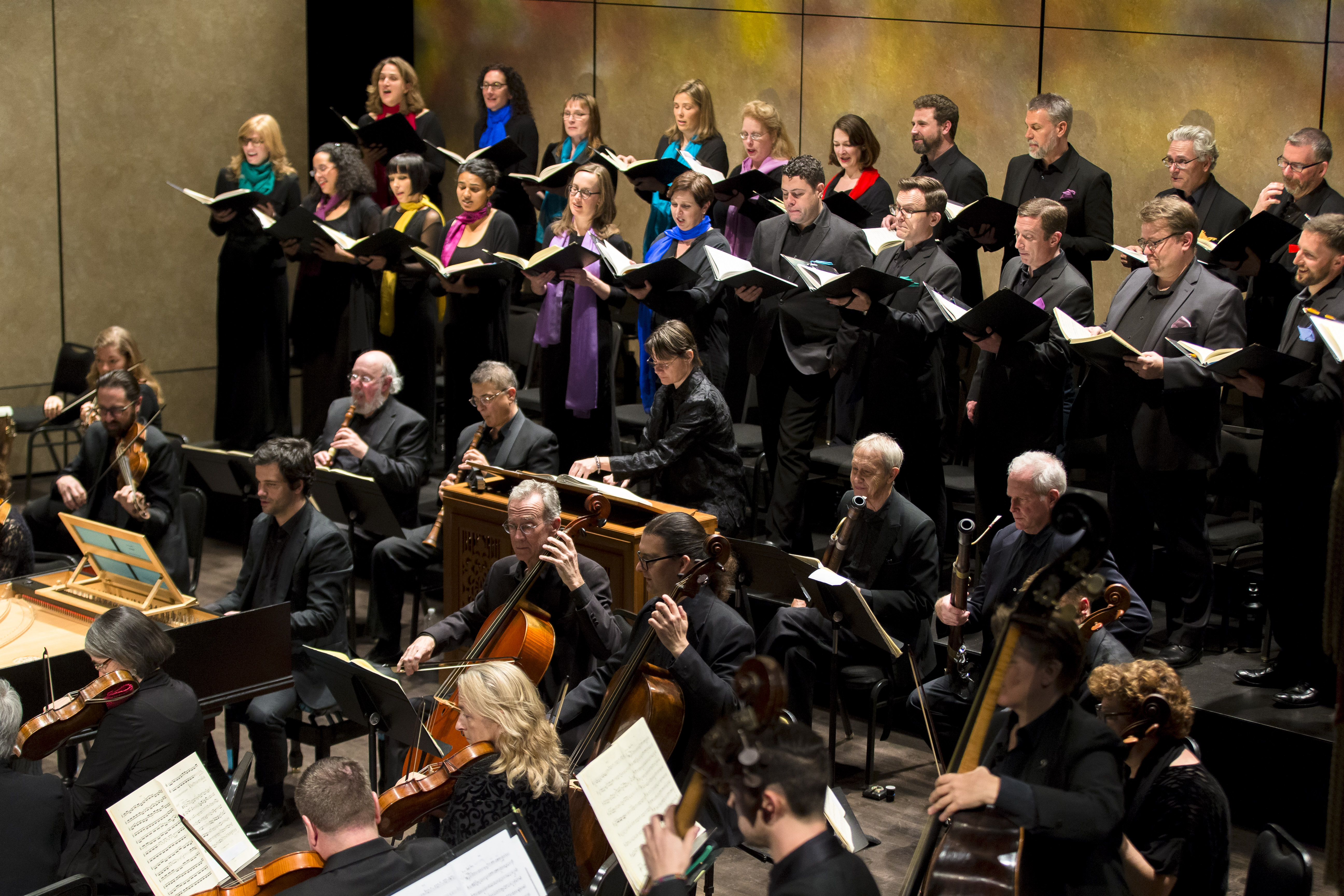
    The San Francisco Opera Chorus is sending off its Chorus Director Ian Robertson (pictured with the chorus, photograph by Matthew Washburn) with two sold-out concerts at the Atrium Theater this weekend. Robertson is ending his distinguished 35-season tenure with these performances, which he is conducting.

    Saturday evening's performance began with Associate Chorus Master Fabrizio Corona playing a processional on the piano as the chorus members filed in and took their places. The first half of the concert included much from the standard choral repertoire beginning with selections from Charpentier's Te Deum.

    It was downright impressive and even somewhat alarming being in such an intimate space with this accomplished chorus. The amount of sound the singers produce has such a visceral effect, and having them front and center is a joy. Robertson introduced pieces as we went along, he's personable and his reflections on the works was most welcome.

    I loved hearing Bach's "Wohl mir, daß ich Jesum habe," the chorale from Cantata BWV 147 sung so harmoniously, a far cry from what the piece sounded like when I played it in my high school orchestra. This was followed by "Endless Pleasure" from Händel's Semele, Mozart's "Placido è il mar" from Idomeneo, and Mozart's "Heil sie euch Geweihten" from Die Zauberflöte. All of this was truly gorgeous, some of my favorites, and the soloists from the chorus are incredible. Lots of nice clean singing.

    Next we heard choruses from operas by Donizetti, Puccini, and of course Verdi. The agility of the singers is striking, so fleet and light for Donizetti, meditative for Puccini's Humming Chorus, and pure and resonant for Verdi's "Va, pensiero."

    Fabrizio Corona and Ian Robertson_photo Matthew Washburn_4S2A0711The second half of the night showcased more unusual pieces, starting with some funny selections from Offenbach's La belle Hélène. "Marche de l'oie" ("March of the goose") was particularly delightful. Low voices were highlighted in Jennifer Higdon's Act II Chorus for the Dead Soldiers from Cold Mountain, while higher voices were in the foreground for Two Mountain Songs by Gabriela Lena Frank. I'm quite curious to hear Higdon's complete opera someday, this chorus is really lovely and Frank's layered, evocative work is also intriguing. "Envuelto por el Viento" has a section of singers humming, another doing whispery echoes, and the last third actually singing.

    There was even a world premiere commissioned by San Francisco Opera in honor of Robertson, entitled Invitation to Love by Oakland-based artist Cava Menzies. The text is a poem from Paul Laurence Dunbar, and the piece showed off how cohesive the ensemble is.

    The performance ended (ovation pictured, photograph by Matthew Washburn) with the optimistic "Make our garden grow" from Bernstein's Candide, a very cheerful and pleasant finale indeed.

    * Tattling * 
    The first rows of the Atrium Theater were blocked off, presumably as part of Covid safety protocols. The venue only holds 320 people at most, so this definitely made tickets hard to come by.

    There was some quiet commentary behind me, but mostly reactions to the singing, so it didn't bother me much. A person in this same row reacted very badly (and somewhat more loudly) however to the woman next to him trying to take a picture of Ian Robertson during the performance, and he was able to switch seats after intermission.

    Leave a comment

  • Adlers2020_c_2400x1800The incoming 2022 Adler Fellows are soprano Mikayla Sager, mezzo-soprano Gabrielle Beteag, tenors Victor Cardamone and Edward Graves; and apprentice coach Marika Yasuda. They join current Adlers sopranos Anne-Marie MacIntosh, Elisa Sunshine, and Esther Tonea; mezzo-soprano Simone McIntosh, baritone Timothy Murray, bass Stefan Egerstrom, and pianist Andrew King. The outgoing 2021 Adler Fellows (pictured, photograph by Cheshire Issacs) are mezzo-soprano Simone McIntosh, tenors Christopher Colmenero, Christopher Oglesby and Zhengyi Bai; and pianist Kseniia Polstiankina Barrad.

    Press Release | Official Site

    Leave a comment

  • 24.Cosi_Act I scene* Notes * 
    Così fan tutte (Act I pictured, photograph by Cory Weaver), the second installment of the Mozart-Da Ponte trilogy directed by Michael Cavanagh, opened at San Francisco Opera last weekend. The second performance was Tuesday night, there was lots of pretty singing, Maestro Henrik Nánási kept the orchestra going at a brisk pace, and the production gave us lots to think about.

    The set, an 18th century manor house in Le nozze di Figaro, looks largely the same, though it is now a country club in the 1930s. There are a few projections on the scrim during the overture and at the beginning of Act II, but they are minimal, mostly silhouettes of the various characters or details about the world we are about to enter. Later we see water and trees on three panels of the graph paper facade of the building as the scenes are changed.

    Don Alfonso is the general manager of the Wolfbridge Country Club and Despina is a maid there, the rest of the characters are apparently guests for a week of fencing and drawing classes, dancing, badminton, and swimming in late spring. All this lends itself to opulent scenes, the one by the pool garnered applause. There are a lot of sight gags throughout, as when we find ourselves in a prettily appointed space with posters depicting lithe, active women declaring this is "how to keep youth and beauty" while the female guests do calisthenics, and promptly help themselves to cocktails and cigarettes.

    The production is certainly more interesting than the Le nozze di Figaro from October 2019, though it is clearly in the same world. Part of this is perhaps because Così fan tutte is a more problematic piece, misogyny is in the very title itself. Each of the lovers is shown to be rather childish, there is much melodrama and silliness. One twist in this portrayal is that Despina discovers that the "Albanians" are Ferrando and Guglielmo in disguise in right before the Act II duet "Fra gli amplessi." The cunning maid shares her discovery with the sisters as the men sing "Così fan tutte," and it means that Dorabella and Fiordiligi are well aware they are having a sham wedding in the last scene, giving it a very different tone than in a more straightforward rendering of this piece. It is all a lot more ambiguous and heartbreaking.

    The orchestra was crisp, the woodwinds and brass sounded particularly fine. Nánási occasionally had the musicians ahead of the singers, he definitely kept things moving. The chorus was powerful and together.

    The principals are all very nicely cast. Soprano Nicole Cabell (Fiordiligi) and mezzo-soprano Irene Roberts (Dorabella) sounded like sisters, their voices have similar qualities. Cabell's voice has very lovely and dark low notes, while Roberts has a metallic incisiveness. Cabell navigated the vocal leaps of the Act I aria "Come scoglio" with brilliant ease, and sang an emotional "Fra gli amplessi," her Act II duet with Ferrando. Speaking of which, tenor Ben Bliss had a dazzling San Francisco Opera debut as Ferrando, his voice is sweet and open, sounding wonderful in this same duet and throughout the evening. His Act II aria "Tradito, schernito" was simply beautiful. Baritone John Brancy held his own as Guglielmo, sounding sturdy and warm.

    13.Cosi_Ferruccio Furlanetto_Nicole CabellIt is always a joy to hear bass Ferruccio Furlanetto, the role of Don Alfonso seems tailor-made for him. His resonances are striking and he moves well, I loved his little victory dance in Act II Scene 2, after Guglielmo reveals that Dorabella has betrayed Ferrando. Best of all though was soprano Nicole Heaston as Despina. Not only is her voice completely smooth and clear, she is genuinely hilarious. She disguises herself as a golfing doctor (pictured with Furlanetto, photograph by Cory Weaver) and putting on a very funny accent that was completely obvious even if you don't know a word of Italian.

    * Tattling * 
    There was some occasional light talking around me in Row P of the Orchestra Level and one "ding" from the center section in the first scene of Act II as Fiordiligi sang. Before this someone just behind me loudly remarked that something onstage was "so stupid," I guess it was Guglielmo's feigning illness. It wasn't obvious to me why this needed to be stated, given that the whole plot is pretty darned absurd.

    I watched the livestream of the opening Sunday matinée performance of Così with my 4-year old and 7-year old children, it was pretty good and only had a couple technical problems. I had hoped my older child would have been fully-vaccinated so he could attend in person, but sadly that won't happen until next month, so it was excellent to have this option. He was very excited about the doctor scene described above, especially the magnets, and about "È amore un ladroncello," Dorabella's Act II aria, which he's heard about a thousand times because he was obsessed with Cecilia Bartoli's Mozart Arias recording when he was a toddler.

    Leave a comment

  • Ars-minerva-messalina-2021* Notes * 
    The inimitable Ars Minerva is presenting the North American premiere of Carlo Pallavicino’s Messalina this weekend at ODC Theater in San Francisco. The Saturday performance was a raucous romp through the Roman imperial court around 47 CE focused on Messalina, the third wife of Emperor Claudius. There are many love triangles and mistaken identities, as is so often the case with Baroque opera, and this production wholeheartedly embraces the humor and absurdity of these situations.

    As is the case with all of Ars Minerva’s operas, this piece by Carlo Pallavicino hasn’t been seen in modern times. The opera premiered in 1679 at the Teatro San Salvatore in Venice and features a libretto by Francesco Maria Piccioli that deals with martial infidelity, jilted lovers, and moral turpitude. Pallavicino’s music is very beautiful and the singing and playing certainly seemed to do it justice.

    This opera does feel a bit more serious than some of the others we’ve seen at Ars Minerva, there is an undercurrent of violence that is more real than some of the sillier plots of many a Baroque drama. Perhaps because the historical figure of Empress Messalina was indeed executed for her sexual licentiousness along with her lover Caius. There are also abductions and rape attempts of Floralba, the wife of Claudio’s advisor Tullio.

    Executive Artistic Director of Ars Minerva Céline Ricci staged the piece as a boisterous caper. The scenes are changed using projections of paintings and props brought in and out by stagehands. It keeps the momentum going without much disruption. I very much enjoyed Marina Polakoff’s costumes, a mash-up of contemporary and classical styles. Male characters (or in one case those disguised as males) wore brightly-colored suits whose jackets might have some toga-like draping on one side and oxford shoes in matching hues. Messalina’s gowns were so much fun, lots of pink roses and elaborate headdresses. She had a fantastical collar shaped like a lotus at one point and a fabulous balloon-filled skirt for the final scene.

    The music sounded lovely, the orchestra is only six people, basically a string quartet with therorbo and harpsichord. Conductor/harpsichordist Jory Vinikour keeps everyone together, the playing has a bracing, brisk quality that is very pleasing.

    The cast boasts a lot of fine singers. The lowest voice featured is Zachary Gordin, whose light baritone has a certain smoky darkness. His Tergisto contrasted nicely with mezzo-soprano Kindra Scharich, his betrayed erstwhile fiancée Erginda (disguised most of the opera as Alindo). Scharich’s sound is warm and solid. She also had the funniest sight-gag of the evening, as she reveals her identity by baring her obviously-fake breasts near the end of Act III. Gordin did have a very amusing scene in Act II when he puts on a bunny tail and ears and hops off stage too. Our other secondary couple Tullio, played by tenor Kevin Gino, and Floralba, portrayed by soprano Shawnette Sulker, were likewise strong. Gino’s voice is well-supported and Sulker has a pretty flutey sound. Tenor Marcus Paige as Lismeno is the only character in this story who isn’t directly involved in romantic intrigues. His resonant voice stood out, and his sly commentary on the action through his physicality was memorable.

    Tenor Patrick Hagen‘s Caio, the much younger lover of Messalina, was consistent, his voice has a reediness to it that is pleasantly plaintive. As Emperor Claudio mezzo-soprano Deborah Rosengaus sounds icily pristine, an unsettlingly foil to the jealous, violent nature of the character. Soprano Aura Veruni seemed to perfectly embody Messalina, her voice has such a spark to it, so alive and clear. Her movements are also very decisive and conveyed humor well.

    * Tattling * 
    It really seems that the pandemic has confused some audience members about how to behave. There was so much talking behind me in Row C around Seats 8 and 10 that I didn’t know how to react either, I simply froze. Thankfully my 615 days of being in close quarters with chattering children have honed my ability to focus.

    I did see many friends at this event, and it was a joy to experience live opera with them again.

    Leave a comment

  • DAP9164-scaled

    * Notes *
    Opera San José has returned to the California Theatre last night with a beautifully cast Dido and Aeneas. Director Elkhanah Pulitzer's new production is likewise attractive.

    Music Director Joseph Marcheso conducted a reduced version of the orchestra suited to this Baroque opera that clocks in at only 55 minutes. The continuo — played here by harpsichord, two guitars, and cello — packed a punch. A few times I did find myself focusing more on the continuo than what was happening on stage, though both the choreography by Michael Pappalardo and costumes from Ulises Alcala were pretty.

    This staging features a nice, minimal set, essentially a curved white wall with arched double doors in the middle that are plain white on one side and turquoise and ornately decorated when open (pictured, photograph by David Allen). Scenes were switched by the use of elements coming in from above the stage and with artful lighting. I really loved how upside down flowering trees appeared in the middle of Act II.

    The small chorus has a lot of spirit, and were great to see and hear. The rest of the youthful cast is comprised of the resident company and boasts many familiar faces. Bass-baritone Nathan Stark makes for a creepy Sorcerer, his commanding voice and strong presence were downright threatening and gave credence to the drama at hand. Soprano Maya Kherani sounded lovely as Belinda, her Act II "Thanks To These Lonesome Vales" had a delicate sweetness.

    Baritone Efraín Solís makes for a fine Aeneas, his warm voice has an appealing texture and when he is rejected by Dido it felt very real. Mezzo-soprano Nikola Printz is imposing as Dido, having depth, warmth, and nice clean lines to their voice. The sublime "When I am laid in Earth" gave me chills and the falling rose petals as Dido laments her fate are very effective.

    * Tattling *
    To my surprise the evening began with the National Anthem. We were seated quite near General Director Khori Dastoor, and I could easily hear her clear soprano voice.

    The process of checking vaccine status and identification was quick and simple. Once inside the building we saw a number of opera friends, which was heartening. People were very good about keeping their masks on throughout, though I did hear some light talking at the beginning and someone definitely had trouble with a lozenge wrapper just before the two witches sing "But ere we this perform."

    Leave a comment

  • PB9A0560 EDIT* Notes *
    Last Sunday the Merola Opera Program held a virtual recital of luminous mezzo-soprano Raehann Bryce-Davis (pictured) accompanied by pianist Jeanne-Minette Cilliers over Vimeo. The concise, direct performance showcased Bryce-Davis' beautiful voice and lovely warmth as an artist.

    The recital began with four pieces in German. Bryce-Davis has a well-supported sound that seems ideal for the drama required for these songs. I particularly loved hearing Robert Schumann's "Die Lotosblume," sung with tenderness and delicacy.

    The middle part of the performance included songs in English by African-American composers. These were moving, especially the world premiere of "I Am Not an Angry Black Woman" by Maria Thompson Corley. The way Bryce-Davis channeled the pain and dignity of this song is very effective.

    The afternoon ended with the joyful music of Peter Ashbourne, singing three pieces based on Jamaican folk songs. If you missed the recital, it is available on demand until November 30, tickets are available by calling (415) 936-2311.

    * Tattling * 
    The first Peter Ashbourne song, "Banyan Tree," seemed to get slightly out-of-sync as far as the sound and image, this was unsettling.

    Leave a comment

  • Cal-performances-english-concert-karina-gauvin-julien-faugere* Notes * 
    The English Concert, conducted by Maestro Harry Bicket, has been touring Händel's Alcina with a first-rate cast. Yesterday afternoon the group came to Cal Performances in Berkeley with the splendid soprano Karina Gauvin (pictured, photograph by Julien Faugere) in the title role.

    The singing was uniformly wonderful, from bass Wojtek Gierlach's grave, authoritative Melisso to tenor Alek Shrader's pretty and appealing sound as Oronte. Shrader made the most of the concert version presented, and was able to convey humor without being over the top. The two mezzos, Paula Murrihy as Ruggiero and Elizabeth DeShong as Bradamante were nicely distinct. Murrihy has a light, sparkly tone, while DeShong's is almost baritonal, very dark and hardy. It was pretty amusing, given that Bradamante is a lady pretending to be a man and written for a contralto, and Ruggiero was originally played by castrato Giovanni Carestini. Murrihy sang "Verdi prati" in Act II particularly well.

    Best of all were the sopranos, also sharply different from one another. Lucy Crowe made for an utterly charming Morgana, hapless sister of witch Alcina. Crowe's voice is truly brilliant, very pleasant on the ears, and her acting is endearing as well. Gauvin has a delicacy that works nicely for Baroque music, her pianissimi were exquisite. She doesn't have much vibrato and managed to fire things up when necessary, as with her Act III aria "Mi restano le lagrime."

    The ensemble played neatly under Maestro Bicket's direction. The soli were all very strong, violinist Nadja Zwiener was excellent, as was cellist Joseph Crouch. The horns did were pretty darned good, only a tiny bit of fuzziness once, and I very much enjoyed how much Ursula Paludan Monberg danced to the music as she played. Also impressive was therobo Sergio Bucheli, who broke a string in Act III but managed to discreetly and calmly replace the string on stage.

    * Tattling * 
    Perhaps people have forgotten how to turn off their devices during the pandemic. There was ringing near me in the mezzanine twice in Act II from two different patrons. Mask compliance was high, there are no concessions at Cal Performances right now, so any refreshments one partook of during the 3 hour 45 minute performance had to be snuck in.

    Leave a comment


  • _DSC0704* Notes * 

    A brand-new production of Fidelio (Act II pictured, photograph by Cory Weaver) opened at San Francisco Opera last night, a year late and with a splendid cast. Maestra Eun Sun Kim kept the orchestra lively and balanced.

    Matthew Ozawa's contemporary production features a startlingly spare set that spins to reveal cages full of people or solitary dungeons as the opera requires. I found the brutality of the layered bars weirdly compelling, especially since the set was also used for the drive-in Barber of Seville up in Marin earlier in the year. It was so different, completely transformed in the space of the War Memorial stage. The set used some creepy projections, mostly of Elza van den Heever's face (though the back of her head is projected before the opera begins), but did not simply rely on video to set the scene.

    The orchestra was not always perfectly together, the first note from the brass section was sour, but Maestra Kim draws interesting textures out of the musicians and there were exquisite moments to be sure. John Pearson did a fine job playing the offstage trumpet in Act II. The ensembles were also particularly lovely, and the principal singers are beautifully cast. The chorus sounded strong and cohesive.

    Soprano Anne-Marie MacIntosh is a sweet and chirpy Marzelline, her pretty tones very distinct from our lead soprano in the title role. Likewise bass James Creswell (Rocco) sounded so different from bass-baritone Greer Grimsley (Don Pizarro). Creswell is endearing, his voice warm and so human. Grimsley in contrast has less prettiness, which suits his role as villian.

    _DSC3680Tenor Russell Thomas seemed ideal as Florestan, his voice is so expressive. No less riveting is soprano Elza van den Heever, and her duet with Thomas (pictured, photograph by Cory Weaver), "O namenlose Freude!" was moving. Van den Heever has a lot of power and an icy clarity that somehow is not harsh. Her Act I aria "Komm, Hoffnung, lass den letzten Stern" got a huge response from the audience, and for good reason.

    * Tattling * 
    I brought my good friend Axel Feldheim to this performance, apparently I haven't seen him in person for 586 days. He noted it was very odd to be seated next to me in this house, since we usually are in standing room.

    The new seats are more obvious on the Orchestra Level, they have staggered the seats better, though there was no one seated in front of us in Row T.

    Audience members around us were very good about keeping their masks on as requested. I did hear a phone alert of some kind as Rocco was singing in Act I.

    Leave a comment

  • _DSC9681* Notes * 
    The 99th season of San Francisco Opera opened with a spirited concert last night featuring conductor Eun Sun Kim and the San Francisco Opera Orchestra with soprano Rachel Willis-Sørensen (pictured, photograph by Cory Weaver) and mezzo-soprano Jamie Barton.

    The evening started with the very jaunty overture from Leichte Kavallerie by Franz von Suppé. The brass was clear and the woodwinds lovely. This was followed by Willis-Sørensen singing "È strano … Sempre libera" from La Traviata. Her voice is incredible and well-supported, without any strain or hint of shrillness. Then came Barton with "O mon Fernand" from Donizetti's La Favorite, sounding very rich and full. She has a huge sound, so it was odd when she seemed to push it a bit in "O don fatale" from Don Carlo, the textures evoked by her voice were disquieting. We got to hear both singers just before intermission in a duet from Anna Bolena, Barton was quite plaintive as Giovanna Seymour.

    The second half revisited Rusalka, which introduced us to Maestra Kim and Willis-Sørensen back in 2019. It was moving to hear the Polonaise from Act II again, the orchestra sounded sweeping and lush. Willis-Sørensen's "Song to the Moon" is no less stunning, her bright, icy high notes and opulent lower register are impressive.

    2320-opera-210910Barton was a passionate Dalila in "Mon coeur s'ouvre à ta voix," as the orchestra shimmered beneath her. I'd like to hear her sing the full opera, and likewise, when she and Willis-Sørensen sang "Mira, o Norma," it made me very much want to hear Norma with both these singers as well and with Kim (all pictured, Drew Altizer Photography) conducting.

    I believe the encore was Rodgers and Hammerstein's "Climb Every Mountain" sandwiched in their "You'll Never Walk Alone." It reminded me of being a little kid, watching Sound of Music and Carousel on television.

    * Tattling * 
    There was much of the normal opening night trappings to the performance: a huge vase of roses, the flower garlands on the boxes, speeches from the stage, and even the National Anthem. I saw nearly half a dozen regular patrons of the back balcony and it was so nice to catch up with everyone after so long.

    They printed some programs this time, but most people used their phones instead. Unfortunately this makes some use their devices during the performance, so I did see the person in J 3 repeatedly look at his screen throughout. The women in front of him in H 1 and 3 were not great at keeping their masks on, they came in late, and just before the intermission ended, dashed to the drinking fountain to grab glasses of water, which they drank during the second half. Cell phone man and his companion decided to move after about 30 seconds of this, so it was easier for me to ignore his bright screen.

    At least everyone was quiet, I didn't hear any beeps during the music, and no one was really around me. This was very unusual for an opening night, presumably there were more people at the free simulcast at Oracle Park. I was still anxious about being inside with so many people, and kept my two masks on the whole time. There was champagne in the lobby for everyone, but I ran away as swiftly as I could and kept well away from the crowd.

    Leave a comment

  • Merola-stage-door-2021 * Notes *
    Last month the Merola Opera Program filmed a series of pieces featuring the 2021 participants in the Herbst Theatre under the title Back Home: Through the Stage Door. Directed by David Paul, the 17 vignettes established a lovely warmth and intimacy.

    The banter between bass-baritone Andrew Dwan (Presto) and tenor Gabriel Hernandez (Lacouf) in "Avec vous, vieux Lacouf" from Les mamelles de Tirésias was truly charming, they sang around pianist Anna Smigelskaya and had great chemistry.

    I have a soft spot for local mezzo-soprano Nikola Printz and was so glad to hear them sing Sesto in "Son nata a lagrimar" from Giulio Cesare with fellow mezzo Jesse Mashburn as Cornelia. Printz also sang in two Mozart pieces "Ah, perdona al primo affetto" from La clemenza di Tito and "Pria di partir, oh Dio!" from Idomeneo, basically all my favorite repertoire.

    Other highlights for me were soprano Catherine Goode being super creepy as the Lady with a Hand Mirror in Argento's Postcard from Morocco and soprano Celeste Morales singing Florence B. Price's "Hold fast to dreams." The latter gave me goosebumps, Morales has a beautiful, clear tone.

    The finale of "Contessa perdono… Questo giorno di tormenti" from Le nozze di Figaro (pictured, photograph by Kristen Loken) was rousing. Baritone Laureano Quant is a fine Count, and soprano Mikayla Sager a very sympathetic Countess.

    Tattling * 
    My spouse caught me watching the end of this video on our television and noted that I even do standing room at home.

    Leave a comment