• * Notes *

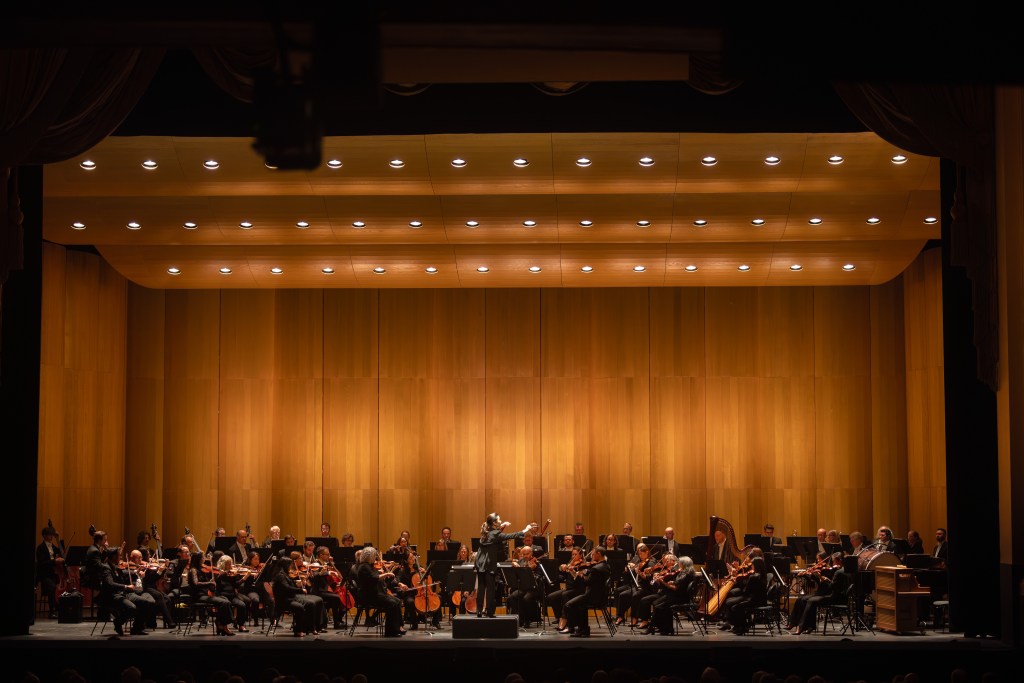
    This year marked the 50th Opera in the Park performance from San Francisco Opera. The proceedings yesterday were delightful. Music Director Eun Sun Kim conducted with vim and clarity, starting with the National Anthem followed by Strauss’ Radatzky March. Later in the afternoon we heard San Francisco Opera bassist Shinji Eshima’s composition Butterfly YY which showcased the orchestra well.

    As expected, we heard many of the singers from the current run of Rigoletto that premiered last Friday. Tenor Yongzhao Yu sang the famous “La donna è mobile.” which did sound better in this context than at the opera house. Baritone Amartuvshin Enkhbat impressed in “Cortigiani, vil razza dannata” and his exchange with soprano Adela Zaharia “Mio padre…Tutte le feste al tempio…Si, vendetta” was moving, and convinced me to go hear this opera again. The quartet “Bella figlia dell’amore” from Act III was also performed with vigor, with mezzo-soprano J’nai Bridges as Maddalena.

    The other big production coming up is Dead Man Walking, which opens next Sunday. Therefore we heard many singers from this cast, including soprano Brittany Renee; mezzo-sopranos Nikola Printz, Susan Graham, and Jamie Barton, and baritone Rod Gilfry. Especially impressive were Graham singing “Ombra mai fu” and Printz singing “Where shall I fly?” both by Handel. Rod Gilfly was charming in “Some Enchanted Evening,” which I always associate with the late John Lindstrom.

    Bass and Adler Fellow Peixin Chen was very funny in “La calumnia” and did a fine job with Adler soprano Olivia Smith in “Quanto amore!”

    * Tattling *

    There was a bit of talking and in the second half of the performance the man in front of me even took a short call during the music. There were the usual phone rings and other electronic noise. Many people used their mobile phones to take videos of the afternoon, including the mom of one of the singers.

    Many champagne corks flew around the VIP section of Robin Williams Meadow, since they were part of the lunch. This occasionally happened during the music, which was disorienting at times.


    This post also appears on https://substack.com/home/post/p-173131385

    Leave a comment

  • Rigolleto-2025* Notes * 
    A new season of opened at San Francisco Opera with a brilliantly played Rigoletto last night. Maestra Eun Sun Kim had the orchestra sounding beautifully clear and there was much gorgeous and evocative singing.

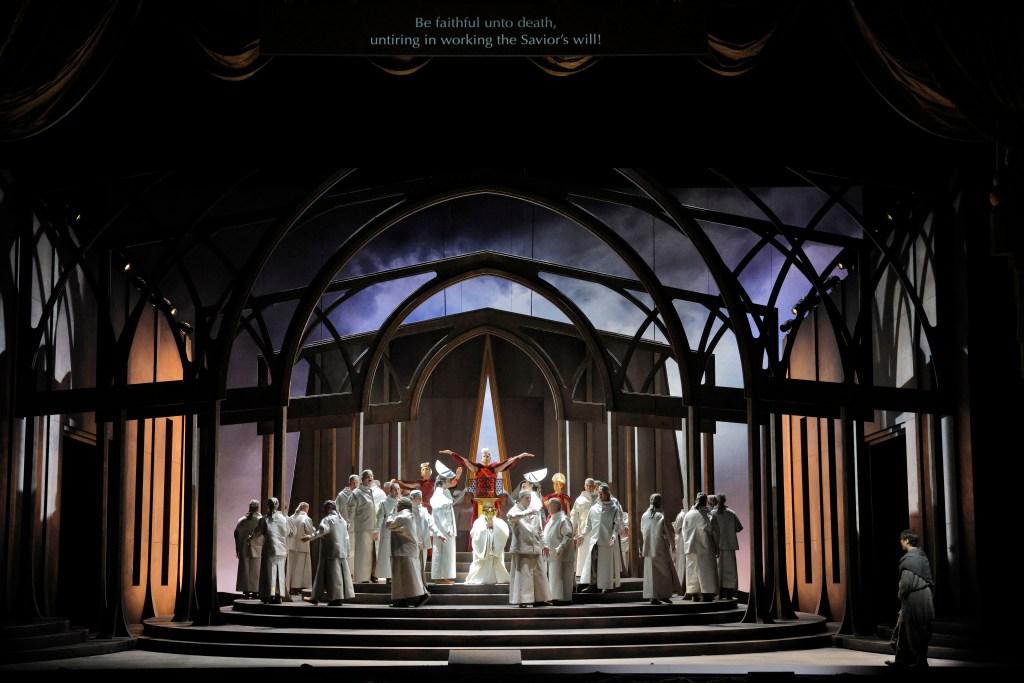
    This 1997 production is inspired by the italian painter Giorgio de Chirico. The set, from Michael Yeargan, is simple and elegant, but it would have been nice not to have the two pauses to change settings between the first two scenes and the last two acts. The interest of the audience dips noticeably and there is a lot of chatter while we are waiting.

    The orchestra has an intense clarity under the baton of Music Director Kim. I found myself listening closely to the score, which I don’t normally do for Verdi. Kim has a strong point of view and it was a joy to hear.

    The depth and strength of the cast was evident from the beginning. Baritone Aleksey Bogdanov sang Monterone with pathos. Bass Peixin Chen sounded very strong as Sparafacile, his voice is very attractive and warm. Mezzo-soprano J’Nai Bridges gave Maddalena all the sultry limpidness that could be wanted for this role.

    The one weak link of the opera is tenor Yongzhao Yu as the Duke of Mantua. His voice is plaintive and bright but sounds constrained, as if it is coming out of a very small aperture. His show pieces did not sparkle, and were all the more noticeable given how good the rest of the cast is.

    Soprano Adela Zaharia is sympathetic as Gilda, her notes are pure and glittery. Her sound is powerful, and one feels that she has taken her life in her own hands, it feels like she has agency rather than being a duped, silly girl. Her “Caro nome” was very lovely. Baritone Amartuvshin Enkhbat (pictured with Zaharia, photograph by Cory Weaver) was an ideal Rigoletto, there is so much nuance in his rich sound. He is able to convey the different emotions of this piece from mocking to fearful to vengeful with perfect ease.

    * Tattling *
    As with last year, opening night started with a video rather than having the General Director, President and Chair of the Board on stage. This did keep the evening from going very late, even with Maestra Kim leading us in the National Anthem.

    The opening night flower garlands on the boxes were shaped like jester heads. There were also elaborate projections on the proscenium. It was all exceedingly gaudy.

    The audience was badly behaved as expected. There was audible giggling from my companion over the “Addio, addio” duet between Gilda and the Duke. When Rigoletto is singing “Cortigiani, vil razza dannata” in Act II there was a loud electronic disturbance. I also kicked over my metal water bottle during this act, causing a loud clatter.

    Leave a comment

  • Merola-2025-barber* Notes *
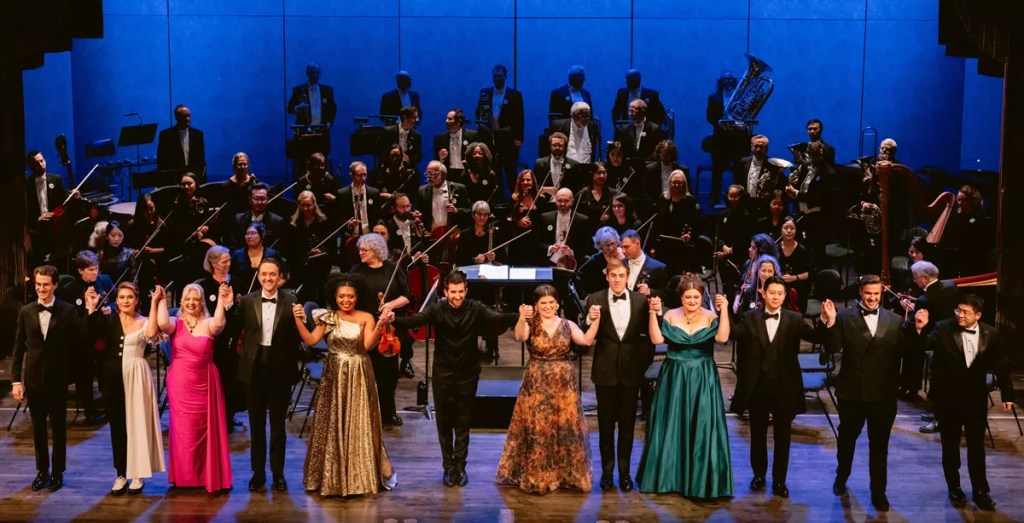
    The 2025 class of Merola is quite strong. The Grand Finale for the program was held last night at the War Memorial Opera House in San Francisco. Conducted by Maestro Kelly Kuo, the lively orchestra was not always perfectly synchronized with the singers, but for the most part everyone sounded great.

    The set was perhaps for The Monkey King, as there are screens for vertical titles. Most of the action happened downstage right behind the orchestra. Elio Bucky’s direction was very funny, the choreography exaggerated and there were so many laughs throughout.

    The ensembles were strong, especially “Don Basilio!… Cosa veggo! Buona sera, mio signore” from Il barbiere di Siviglia (pictured, photograph by Kristen Loken). Baritone Joeavian Rivera has a nice, light tone for Figaro, mezzo-soprano Ariana Maubach likewise sounded very pretty as Rosina. Tenor Minghao Liu was completely charming as Almaviva and bass-baritone Justice Yates was a fine Bartolo. Bass-baritone Wanchun Liang was humorous as Basilio. The motivation of money was featured prominently, and Basilio comes back for a dropped pouch, which makes his return make more sense.

    The ensemble from Falstaff, “Alice! Meg! Nannetta!,” was likewise hilarious. So many pretty and strong female voices. Including mezzo-soprano Meg Brilleslyper (Meg), soprano Alexa Frankian (Alice), soprano Chea Kang (Nanetta), and mezzo-soprano Sadie Cheslak (Quickly).

    The most beautiful music was certainly the duet “Madre! Mia vita… Son nata a lagrimar” from Giulio Cesare with mezzo-sopranos Sadie Cheslak and Ariana Maubach. Both sounded so pure and lovely. The duet from Don Pasquale (“Don Pasquale… Cheti, cheti immantinente”) was a good counterpoint in the second half, baritone Joeavian Rivera and bass John Mburu had a nice quick patter.

    There was the inclusion of art song and numbers from more contemporary pieces such as” Lonely House” and “Old Man River.” Both of these particular pieces were great, tenor Tristan Tournaud convinced in the Weill and as did bass John Mburu in the Kern.

    The biggest problem I had with the performance was the use of microphones. Soprano Charlotte Siegel and bass-baritone Justice Yates sang "Wheels of a Dream" from Flaherty/McNally's Ragtime. The amplification was jarring.

    There were some star turns as far as arias go. Bass-baritone Wanchun Liang was nearly heroic as the scheming Gianni Schicchi in “Era equal la voce.” Mezzo-soprano Meg Brilleslyper was sassy and charming in “Qui j’aime les militaires” from La Grande Duchesse de Gerolstein. Best of all was tenor Minghao Liu who really showed off in “Ah, mes amis… Pour mon ame” from La fille du régiment. His full range is so smooth without any breaks, and he sings his high notes with a ridiculous ease.

    *Tattling * 
    For the third year running instead of an overture we had talking, this time from Executive Director of Merola Sean Waugh and Director of Membership & Engagement Alek Shrader.

    The audience was quiet and engaged. I did note one person in the middle of Row H of the orchestra level that spoke at full volume, but it appeared to at least be about the performance.

    Leave a comment

  • Wozzeck-2025* Notes *
    Alban Berg's Wozzeck (ovation pictured, photograph by author) opened at West Edge Opera on Saturday in Oakland. The impressive production has the same director and conductor as the excellent Lulu from this company held at the Oakland 16th Street train station a decade ago and the same lead soprano.

    Director Elkhanah Pulitzer stays true to the opera. The action all takes place in a tiered round theater with a circular depression in the middle and antiseptic green seats. Many of the characters seem unhoused and lie about the floor or under the raised platforms. The effect is nightmarish and creepy. The stylized choreography involves lots of crawling and creating awkward shapes with the body.

    The singing was all at a high level from top to bottom. Soprano Alicia “Ash” Hurtado was haunting as the Fool, their voice is unsettling. Tenors Chad Somers (Andres) and C. Michael Belle (Drum Major) were very distinct, Somers on the lighter side and Belle brash and strong.

    Tenor Spencer Hamlin was sinister as the Captain, as was bass-baritone Philip Skinner as the Doctor. Best of all was Emma McNairy, her beautiful high soprano is steely and powerful, her Marie is quite frightening. Baritone Hadleigh Adams is also imposing in the title role. His sound is light and lyrical, which is all the more disturbing as he loses his mind and completely breaks down.

    Conducted by Maestro Jonathan Khuner the orchestra sounded square and neat, never overwhelming the singers or upstaging them. I especially loved hearing the viola and the harp.

    * Tattling *
    Like David and Jonathan, the performance had a content warning of "This production contains mature themes, including sexual situations, nudity, depictions of violence, and references to mental health struggles. Viewer discretion is advised." However, this opera very much has this explicitly in the text, so it was harder to be scandalized by the production.

    The audience was focused and silent, I did not note electronic noise or talking during the music.

    Leave a comment

  • David-jonathan-2025* Notes *
    A new production of Marc-Antoine Charpentier’s David et Jonathas (ovation pictured, photograph by author) opened at West Edge Opera on Sunday afternoon in Oakland. This French Baroque opera is based on the friendship between David and Jonathan in Old Testament and has some utterly beautiful music.

    Director Mark Streshinsky takes the love between the two title characters and makes it into a more romantic situation. The production has a content warning that reads “contains mature themes, including sexual situations, nudity, depictions of violence, and references to mental health struggles.”

    There is a lot of ballet music in this piece, much of it is quite sensual, as are the vocal lines, so this isn’t coming out of nowhere. The four male dancers are bare-chested and otherwise scantily clad, but do move very elegantly. An enormous puppet and a dancer are also used to depict the fight between David and Goliath, and the proceedings are definitely not for children.

    The orchestra sounded robust under Adam Pearl, though the ensemble was rather small, only 15 musicians. The flute and recorder kept the strings from sounding too acerbic. It was great to hear this lovely music that is rarely done. 

    Both David and Jonathan are cast as tenors in this production, though the roles were written for haute-contre and boy soprano. Both have lovely sounds, but nicely distinct from each other. Tenor Aaron Sheehan is light and sparkling as Jonathan., while tenor Derek Chester is more full-bodied. Both had a lot of ease, especially Chester with his high notes.

    Baritone Matthew Worth was suitably tormented as Saul, and showed a range of different negative emotions ranging from jealous to angry to sad. There were a few moments when his voice did not cut through the orchestration in the beginning but he did very well the rest of the opera.

    Mezzo-soprano Laurel Semerdjian was suitably spooky as the Witch of Endor, her rich voice added another layer to the piece, and it was nice to have some feminine energy in a work that is very dominated by masculinity. Likewise it was a fine contrast to have bass-baritone Wilford Kelly on hand with a resonant depth as Achis, since there are so many high voices featured.

    The cast was completed by bass Richard Mix in a small part as the Ghost of Samuel and tenor Benjamin Pattison as Joebel.

    * Tattling *
    I was a bit scandalized by the sex in the first half of the production but more comfortable with violence and death in the second part, which I am sure says something about me that is alarming.

    The production was successful in that the audience was engaged and interested.

    Leave a comment

  • Hms-pinafore-2025* Notes * 
    Lamplighters Music Theatre began a charming run of Gilbert and Sullivan's H.M.S. Pinafore (ovation pictured, photograph by the author) yesterday at the Lesher Center for the Arts in Walnut Creek. The production is polished and entertaining.

    The plot is somewhat similar to Verdi's Il Trovatore, but on a ship in England. There are babies switched at birth, fortune telling, and a love triangle.

    Maestro Brett Strader kept the music light and jaunty.  The singing and acting were likewise frothy and amusing. Baritone Noah Evans was impressive as Dick Deadeye, contorting his body into a triangle for most of the evening. Soprano Sarah Szeibel had a lot of warmth as Buttercup, a Portsmouth bumboat woman.

    Baritone Tony DeLousia has a bright and light voice as Captain Corcoran and soprano Syona Ayyankeril has an attractive and agile sound as his daughter Josephine. Tenor Max Ary makes for plaintive, sweet-voiced Ralph Rackstraw and mezzo-soprano Carly Ozard is very strong and extremely amusing as Sir Joseph Porter.

    Jane Erwin's direction is cute. The sets and costumes look perfectly Victorian and the choreography was in keeping with the very silly proceedings. There was much hilarity happening in the background projections, and there was always something to look at.

    * Tattling * 
    The audience was enthusiastic and attentive.

    Leave a comment

  • Dolores-2025* Notes *
    West Edge Opera gave the world premiere of Nicolás Lell Benavides' Dolores yesterday in Oakland. Set in 1968, the opera is about labor leader Dolores Huerta during the Delano Grape Strike. The piece is timely, moving, and, at times quite funny.

    The music has a lot of interesting textures, and Maestra Mary Chun kept everyone together. There was a particularly lovely viola solo near the end of Act I with the title character singing alone. The pacing is good, everything moves at a fine clip.

    Octavio Cardenas' direction is clear and direct, and there are some pleasant flights of fancy, especially with Tricky Dick (a version of Richard Nixon). The set has lots of screens of different sizes, benches, and a set of movable stairs. There were many historical images used, and this worked well to ground the action.

    Mezzo-soprano Kelly Guerra is convincing as Dolores, her strong voice has an incisive vibrato at the top and some very warm, rich low notes. Bass-baritone Philip Lopez embodied Cesar Chavez, as soon as he came out on stage it was clear who he was. Lopez has a powerful, round voice.

    Baritone Rolfe Dauz (Larry Itliong) gave us both seriousness and humor, singing about "Talk, talk, talk" was quite hilarious. Tenor Alex Boyer (Senator Robert F. Kennedy) was charismatic, as was tenor Sam Faustine as Tricky Dick. Faustine moves sleekly, and practically oozed unctuousness.

    The cast is rounded out  by soprano Chelsea Hollow, who plays both Chavez's wife Helen in Act I and Kennedy's wife Ethel in Act II, and tenor Sergio Gonzalez as busboy Juan Romero, who holds Kennedy as he is shot and bleeding. Hollow has an icy voice that cuts through the orchestration with ease. Gonzalez did a splendid job with his small role.

    The opera ends with a rousing "Sí, se puede," which works so well and is rather poignant. Dolores Huerta herself was there to receive an ovation, and she spoke about how we need to keep fighting for justice.

    * Tattling *
    There were a few instances of electronic noise, but I was most distracted by the person next to me who kept falling asleep and startling awake many times.

    I teared up at the end of this opera, and felt happy that Huerta was there to be acknowledged.

    Leave a comment

  • Merola-comte-ory-2025 * Notes *
    Merola Opera Program opened a delightful production of Le Comte Ory (Eva Rae Martinez as Comtesse Adèle and Minghao Liu as Le Comte Ory in Act II pictured left, photograph by Kristen Loken) last night at the San Francisco Conservatory of Music Caroline H. Hume Concert Hall. This funny Rossini rarity has much challenging music but featured a splendid cast that took it on with aplomb.

    Director Garnett Bruce gave us a straightforward production, there was some cheekiness in the tone but very much in keeping with this silly comedy with an incomprehensible plot. Basically Le Comte Ory disguises himself in order to somehow seduce Comtesse Adèle, antics ensue. The stage has a lot of French windows and arches with pretty botanical details to define the space. The costumes are attractive and look of the time period in which the opera takes place.

    Maestro Pierre Vallet conducted a rather enormous orchestra that took up much of the first rows of Hume Concert Hall. There were some issues keeping everyone perfectly together but the humor and beauty of the score came through.

    As always with Merola, best of all were the singers. Tenor Minghao Liu was unreal in the title role, his high notes seemed impossibly easy and his voice is so smooth. It was truly a joy to hear him. As his love interest Comtesse Adèle, soprano Eva Rae Martinez was brilliant and sprightly, she has a strong voice. Le Comte Ory's page and rival, Isolier, was played by mezzo-soprano Meg Brilleslyper whose sound is pure and icy. Ariana Maubach (Ragonde) has a contrasting warm, rich mezzo-soprano and one is curious to hear more of her as well.

    Bass-baritone Wanchun Liang sounded agile as Gouverneur and his physicality was amusing. Baritone Benjamin Dickerson (Raimbaud) was pleasing and when he steals wine for himself and his companions all dressed as nuns, it's very buoyant and fun.

    * Tattling *
    A phone rang just before the start of the overture, but since we were basically in the orchestra pit, it was hard to hear anything else once the music started. A person in Row F Seat 8 was noisy with cellophane at the beginning of Act II, but again, it was easily ignored.

    Leave a comment

  • Walkure-OD2-Curtis-Brown-Photography-2025-10* Notes *
    The company premiere of Die Walküre (Back: Vida Miknevičiūtė as Sieglinde, Jamez McCorkle as Siegmund; Front: Ryan Speedo Green as Wotan, Sarah Saturnino as Fricka, photo by Curtis Brown for the Santa Fe Opera) at Santa Fe Opera last night has spectacular singing. Director Melly Still's production is busy and frentic.

    The cast is exceedingly strong. The Valkyries all sang well, sounding powerful and unified in Act III. Bass Soloman Howard was menacing as Hunding, I found him only the slightest bit grainy at first, but he did well. Mezzo-soprano Sarah Saturnino made Fricka very sympathetic, she did not come off as shrill or hysterical, and seemed quite reasonable.

    Soprano Vida Miknevičiūtė is stunning as Sieglinde, it is a bit ridiculous that so much sound can project from such a tiny person, Her voice is sweet and brilliant, and her last words in Act III gave me chills. Her Siegmund, tenor Jamez McCorkle, has a lovely baritonal sound that has pleasant brightness but perhaps not quite enough weight.

    Soprano Tamara Wilson is a forceful. fierce Brünnhilde and bass-baritone Ryan Speedo Green is likewise a potent Wotan. Both have a lot of volume but are able to convey so much emotion in their voices. It would be so interesting to hear these two in a full Ring Cycle, and Green in particular is one of the best Wotans I have heard.

    The staging has a lot going on at all times. There are many dancers that play characters from Das Rheingold and it might have been confusing for those not as familiar with the plot. The costumes did not seem to be from one particular period, so this did not help the audience guess which dancer was which character. The set did use the space well, including the vertical space, and there was much layering above and behind the main action.

    I enjoyed hearing Maestro James Gaffigan conduct, as I haven't heard him much since he was at San Francisco Symphony years ago. His take is stately and elegant, and there were times when the tempi could have been more propulsive. The orchestra was quite moving in Act III, especially at the very end.

    * Tattling * 
    There was much poor-behavior on display in the audience. Someone's cellular phone rang for at least a minute when Siegmund was singing to Hunding in Act I. At the beginning of Act II a man was eating nuts out of cellophane, he made a lot of noise for several minutes and my companion asked him to stop.

    The audience did seem engaged, and they clapped with excitement at the beginning of Acts II and III. People stayed for the entire opera, but we ducked out early before the ovations, as the parking stressed people out and we noticed lots of yelling on our way to the theater.

    Leave a comment

  • Merola-shwabacher2025* Notes*
    The Merola Opera Program presented the first of two Schwabacher Summer Concerts (Baritone Joeavian Rivera as Dr. Malatesta, bass John Mburu as Don Pasquale, soprano Chea Kang as Norina, and tenor Tristan Tournaud pictured, photograph by Kristen Loken ) last night at San Francisco Conservatory of Music. The singers who do not fit into the opera production — this year it’s Le Comte Ory —  do scenes from operas at this concert. All these singers were strong and the Donizetti-heavy performance was delightful.

    Maestro William Long conducted the orchestra behind the stage, the singers used monitors to stay synchronized. The music sounded sprightly and together. The staging was directed by former Merolini Omer Ben Seadia and Elio Bucky. There were video projections and doors to make the set, and other furniture was brought on stage as the scenes changed.

    The first half of the evening was entirely Donizetti. Il campanello seems like it is over-the-top with silliness, it’s hard to fathom coping with much more than the Act I, Scene 4 that we did see. Enrico, sung here by baritone Gabriel Natal Báez, disrupts the wedding night of his former love and the pharmacist Don Annibale (bass-baritone Justice Yates). Both singers are superb actors. Natal Báez’s voice is very loud and rich, while Yates has an appealing warmth.

    Both singers appear again in Act I, Scene 9 and 10 of Anna Bolena, with Natal Báez as Anna’s brother Rochefort and Yates as Enrico. It was impressive how well they embodied such different characters. It was good to hear soprano Charlotte Siegel as Anna, her voice is icy and dramatic.

    In the second half we had two scenes from non-Donizetti operas. Both Suor Angelica and Il trovatore were rousing and beautifully sung. Soprano Alexa Frankian was moving as Suor Angelica and soprano Ariane Cossette sang Leonora with ease.

    We ended the evening with Act II of Don Pasquale. Bass John Mburu was very well-suited to the title role, as was the light pretty tenor of Tristan Tournaud (Ernesto). Soprano Chea Kang makes for a sassy Norina, she also seemed perfect for her role. The acting was all spot on and amusing.

    *Tattling * 
    It was fun attending this performance, we knew quite a few people there. No electronic noise was noticed nor was any talking during the music.

    Leave a comment