* Notes * San Francisco Opera ends 2016 with yet another run of Madama Butterfly after only two years, but with a very fine soprano in the title role that makes it worth the time to hear again.
I am not a big fan of Puccini or of this opera with its Orientalist theme, however, Lianna Haroutounian (Cio-Cio-San) had me right away. She is completely emotionally engaged and her brilliant, flexible voice is never seems strained or constricted. The support of the orchestra, which was a little fast in Act I under Yves Abel, was wonderful in Act II.
The rest of the cast is likewise strong, as has been the case all season. Tenor Vincenzo Costanzo's US debut as Pinkerton was notable, his voice is plaintive, with much vibrato at the top, but not at all unpleasant. His duet with Butterfly at the end of Act I seemed quite heartfelt and lovely. In his San Francisco Opera debut, Anthony Clark Evans was a warm Sharpless.
Zanda Švēde (Suzuki) was not her usual self, as she was ill, but she did fairly well and certainly hit all her marks as far as acting is concerned. Julius Ahn was an unctuous Goro whose sliminess reads with perfect clarity even from the very back of the house. Raymond Aceto made for a convincing Bonze.
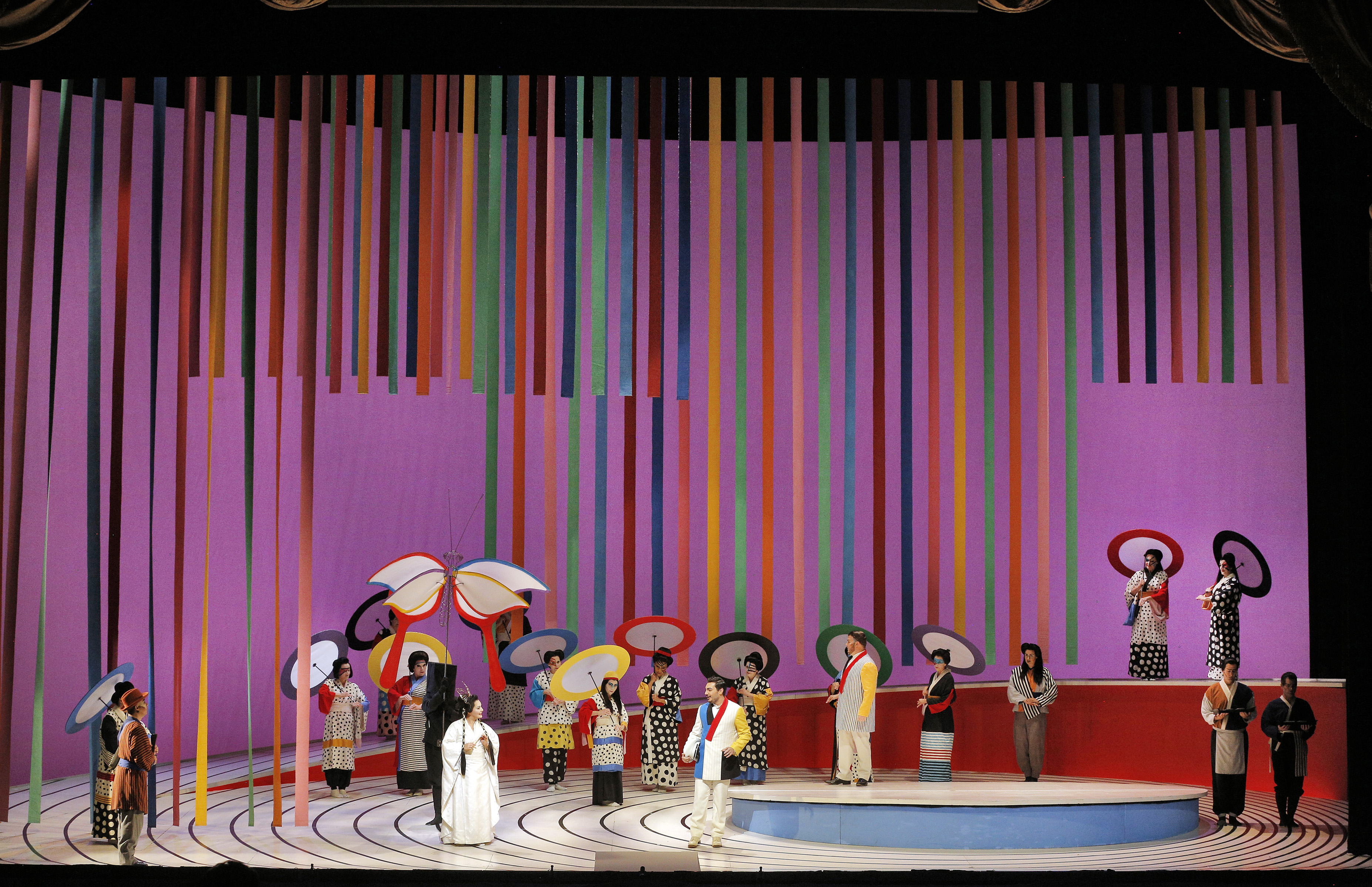
The revival production (Act I pictured above, photograph by Cory Weaver), designed by Jun Kaneko and directed by Leslie Swackhamer, has much appeal in its spiraling circular stage filled with concentric circles and off center round platform. The set forces a certain kind of movement to navigate, which is more apparent from above, and keeps the staging from ever feeling static.
This is helped also by the many screens raised and lowered for moving projections and by the four stagehands dressed in black (kurogo). The scenes keep moving without having to stop the drama or music.
* Tattling * A group of six sat near me in Row L Seats 118 to 128, and they chattered a lot when Haroutounian was not singing. I was able to ignore them, especially since I kept crying during Act II.
* Notes * The most spectacular part of San Francisco Opera's newAida is undoubtedly the singing, with the orchestra coming in as a close second. Last night's opening performance features the elegant work of contemporary artist RETNA but Francesca Zambello's production is stark and static.
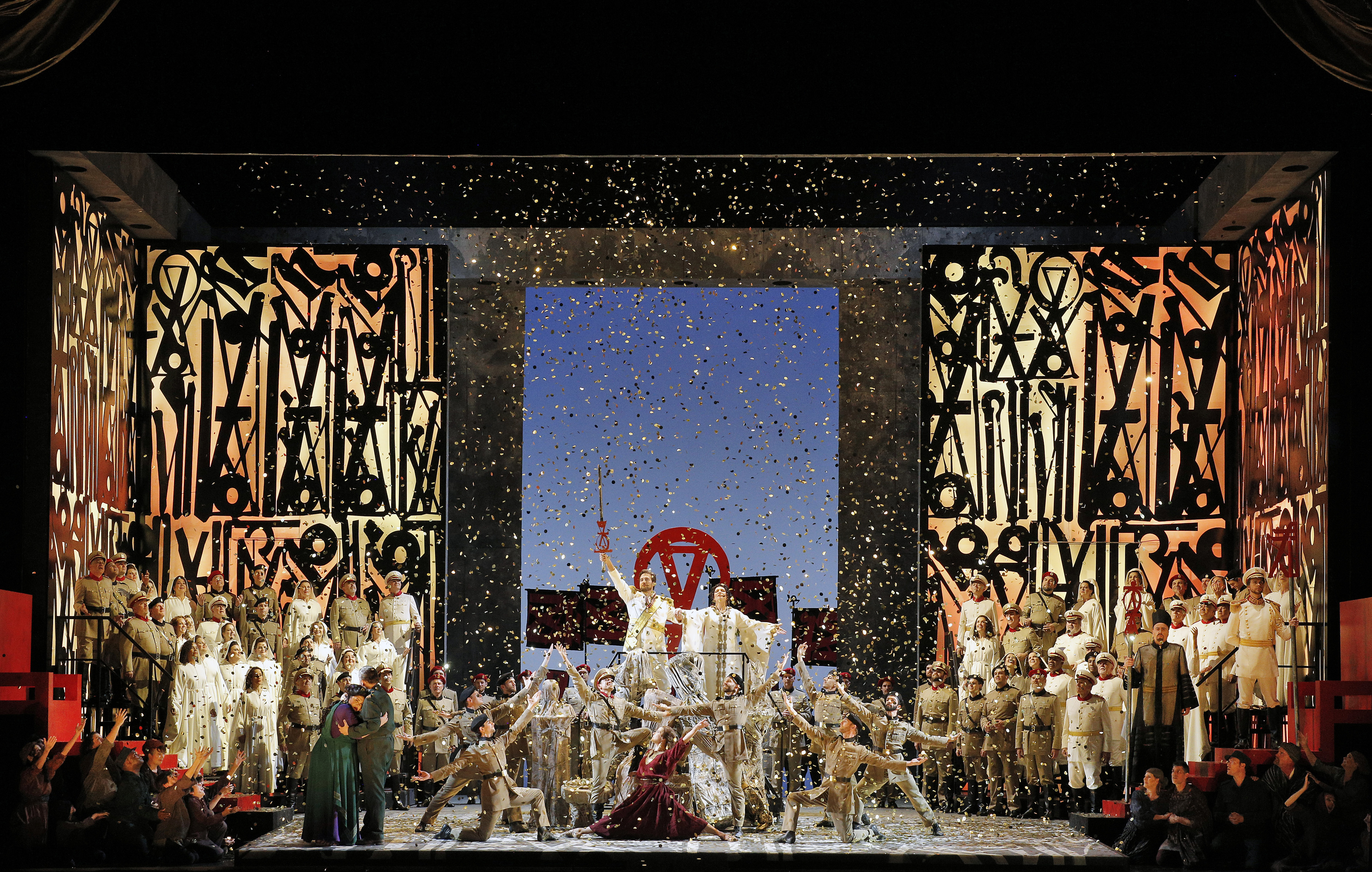
RETNA's art is clearly influenced by calligraphy and graffiti, and it is heartening to see San Francisco Opera engage a younger and more diverse scenic designer than usual. Some of the scenes are quite striking while others are less so. There are a lot of grey walls, monumental painted designs, and bold lighting choices in blocks of color. The triumphal march scene of Act II Scene 2 (pictured above, photograph by Cory Weaver) is disappointing, except for the final flash of glitter, while Act III, which features a huge moon swirled with clouds, three enormous calligraphic cutouts, and lovely blue lighting was much more visually arresting.
The first half did not have pauses to switch the four scenes but the second had two after both scene changes. The energy level always goes down in these moments, people turn on their cell phones or start talking, the music starts again, and it takes at least a minute to get back into the world of the opera again.
Zambello focuses on the human dramas of the piece, and eschews the cliches of elephants and sphinxes. The ballet was embarrassingly uncool, soldiers hopped around cheerfully as they threw around a lady captive in the triumphal march scene. The boy acrobats in the scene before in the chamber of Amneris was much more on point.
There was quite a bit of simple standing and singing, Zambello never gets in the way of the singers, and this cast is vocally powerful. It was gratifying to hear former Adlers Leah Crocetto and Brian Jadge in the two lead roles of Aida and Radames, they've come so far in the last few years and watching them develop over time has been great. Crocetto has a gorgeous legato and her voice commands attention, even though her acting does leave something to be desired. Jadge sounded strong throughout. The duet at the end, with the two of them sitting in front of a grey yet iridescent wall was the high point of the evening, both singers sounding beautifully sweet.
Ekaterina Semenchuk made for a fine Amneris, her voice is more delicate than Crocetto's, but has both rich creaminess and brilliance. Her appearance at the end of the opera above the protagonists — she is shown through the scrim — was decidedly odd. George Gagnidze gave a commanding performance as Amonasro, while Raymond Aceto's Ramfis sounded a bit shaky, at least at first.
The three small solo roles were taken by current Adlers. The King of Egypt seemed to sit a little low for Anthony Reed, Toni Marie Palmertree sounded more comfortable as a Priestess, and Pene Pati sounded wonderful as a Messenger. One looks forward to hearing these emerging talents in more meaty roles in the years to come.
* Tattling * The orchestra level of the opera house and the boxes looked completely full. It was relatively quiet, someone around Row Z Seat 124 had a mishap with Siri on his phone, she couldn't understand what the overture was saying, apparently.
* Notes * Alonzo King Lines Ballet opened a new season at Yerba Buena Center for the Arts last night. Though I enjoy contemporary dance and have walked past the Lines Ballet space countless times on 7th Street, I had not seen this company until now. It took an opera singer, of course, to get me to this performance. Despite the "ballet" in the name, there was not a tutu in sight, and the dancing eschewed mere prettiness, and it was well worth the effort to experience.
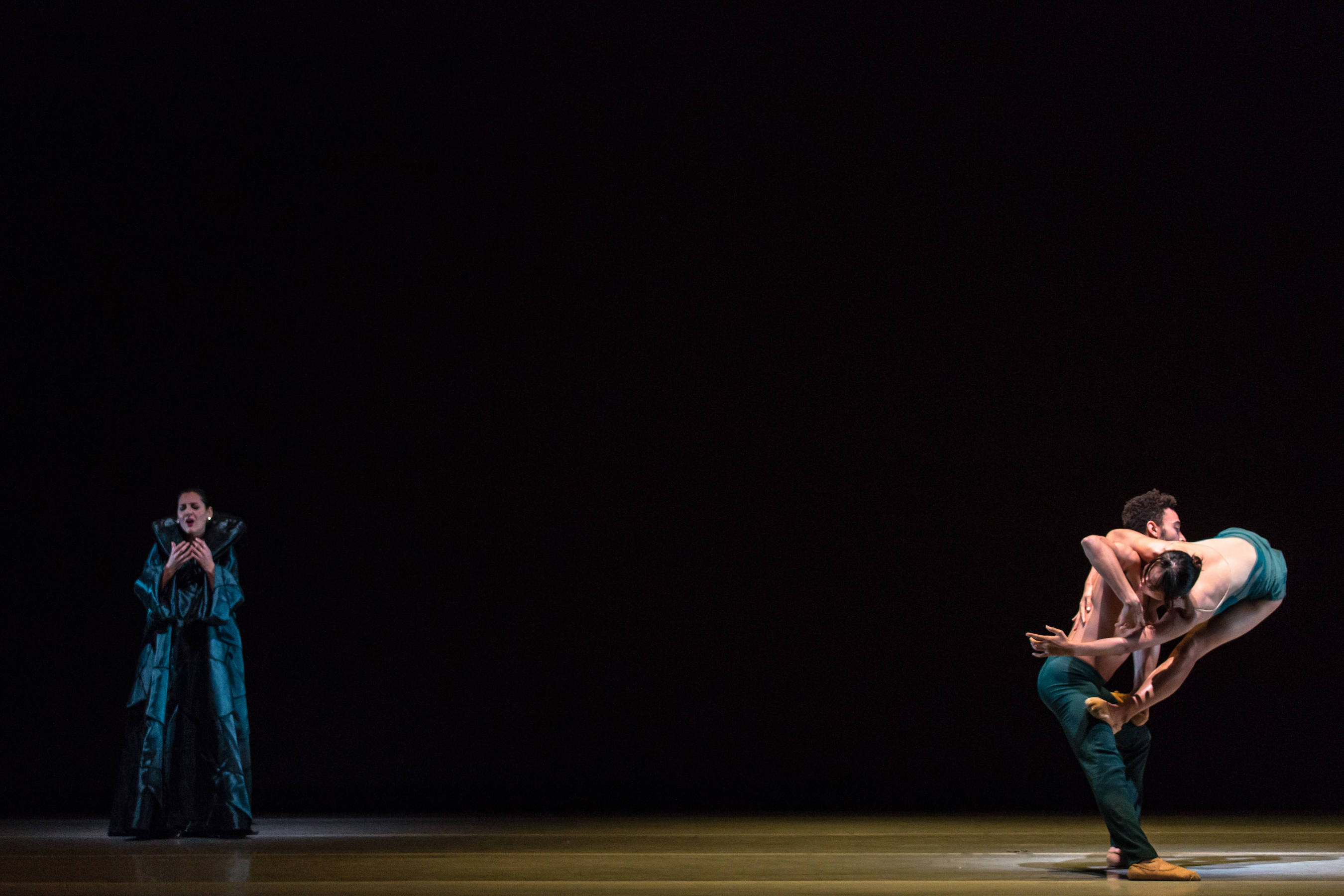
The opening piece, Art Songs, is a world premiere and features live music sung by mezzo-soprano Maya Lahyani (pictured left with Yujin Kim and Michael Montgomery, photograph by Quinn B. Wharton) with accompaniment from pianist Efrat Levy and violinist Lisa Lee. The songs include three Baroque pieces — a Bach cantata and arias by Handel and Purcell — plus Schumann's "Stille Tränen." It isn't rep I associate with Lahyani, who was an Adler at San Francisco Opera in 2010 and 2011 and is a regular at the Met these days. But she sounded fine, especially in the Dido's Lament that ends the piece. There were a few tiny froggy moments in a low note or two, but Lahyani was ill, and did remarkably well considering.
The choreography has a raw, exposed quality to it that works really nicely with the singer on stage. I loved that there were no supertitles and there was no escaping the music or the dancing. The dancers are alive in the movement, even if they are only standing or walking. The piece was even disturbing, particularly the fourth part with soloists Yujin Kim and Michael Montgomery, there was much falling, and the pair looked more like an awkwardly beautiful many-limbed creature than ballet dancers engaged in a duet.
The second piece was Meyer, with recorded music from bassist/composer Edgar Meyer, and again the dancing had a wonderful brutality at odds with classical ballet. The female dancers wore pointe shoes, yet there were many times when they were not en pointe, or flexed their feet when their legs were aloft. The piece features an elaborate water machine with streaming jets in the background which was used to great effect. It was hard to look away from this one, even when images turned dark, as with the fifth part "Cards," in which a rather frantic dancer piles and moves pieces of paper, at times licking one or two.
* Tattling * The audience was quiet. Some of my opera fanatic friends left at intermission after hearing Maya, as they were much more interesting in the music rather than the dancing.
By Charlise Tiee Oct 28 2016 | Updated Sep 19, 2024
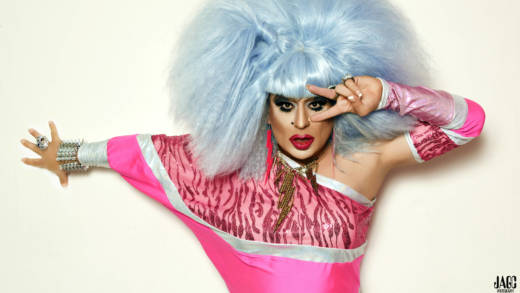
Heklina, host of SF Opera Lab’s ‘Drag Queen of the Opera’ pop-up event at Oasis. (Photo: José Guzman-Colon)
A spectacularly-adorned creature — all glitter, lashes, hair, and curves — commands the stage with her bearing alone. Watching Trannyshack founder Heklina open her mouth and unleash a booming sound that can’t be ignored as she belts out an anthem she wrote about self-expression entitled “Live My Life,” one can’t help but notice how the famed San Francisco drag queen so effortlessly captures the essence of many an opera diva.
So it seems fitting that Heklina is hosting Drag Queen of the Opera at her club, Oasis, in collaboration with singers from San Francisco Opera (SF Opera). Appealing to the “opera-curious,” the Sunday, Oct. 30 offering from the company’s hip new audience outreach arm SF Opera Lab promises to be popular among fans of both drag and opera, as well as newbies. Heklina is encouraging audience members to come in costume, drink cocktails, and enjoy arias performed by young singers. And there’s a DJ dance party afterwards.
The lineup includes Julie Adams (who aced the U.S. opera world’s biggest competition in 2014, the Metropolitan Opera National Council Auditions) and Brenton Ryan, hot off his acclaimed SF Opera debut in The Makropulos Case, as well as additional vocalists and a pianist. There’ll be ample gender-role bending. And in keeping with the onrush of Halloween, looming large will be witches, devils, and coming back from the dead. The ringmistress of all of this operatic mayhem, of course, is Heklina, setting up the scenes and keeping the audience focused with the sharp and bawdy humor for which she’s known.
San Francisco Opera has hosted two previous pop-ups at Public Works and The Chapel. (Photo: Kristen Loken/San Francisco Opera)
Popping her opera cherry
Heklina herself is no opera insider. She’s never actually experienced an opera performed live on stage, though she’s going to get a chance to pop her opera cherry when she goes to see SF Opera’s Madame Butterfly next month. “I’m not sure why I’ve never been, maybe I thought it would not resonate,” Heklina says. “Like most people who aren’t familiar with opera, the word conjures images of a heavyset man belting out songs in Italian or Bugs Bunny dressed up like a valkyrie.”
But Heklina has been enjoying her nascent relationship with the young, classically-trained singers she’s collaborating with at Oasis. “After working with these guys for the past few weeks, I am very intrigued,” she says. “For the uninitiated, the pop-up will be a great intro to the opera world.”
Opera and the queer community
Opera has a huge fan base among the Bay Area’s queer community. SF Opera even has a subscription program dubbed the “Rainbow Series” for LGBT patrons, complete with rainbow colored lights and exclusive receptions.
“For me, a part of the intersection of queerness and opera definitely came out of a feeling of ‘otherness’ I had growing up,” says soprano Emma McNairy, who identifies as a lesbian. “This related to me feeling queer in some way, as well as me being so obsessed with opera as a child and teenager. My peers did not really understand this about me, but opera gave me such an amazing world and outlet for intellectual endeavors, languages, and then just plain emotion.”
With the mass popularity of TV shows like Transparent and the once-niche but now prime-time RuPaul’s Drag Race, gender fluidity is much more out in the open in our culture at large. This makes it a good time for the traditionalist, institutional art form of opera and the free-flowing, underground world of drag to finally get a joint coming-out party.
For its part, SF Opera hopes the show at Oasis will engage a younger, more diverse crowd — just like the two other more experimental events the Lab has put on since being founded last season. “Drag shows and opera are similar in melodrama, grandness, and the pomp and circumstance,” says Sean Waugh, the artistic planning manager at SF Opera and the producer of all of the company’s pop-up events thus far. “I like pushing us more and more out of our comfort zone, especially the performers. We are hoping to find a connection to the drag and LGBT community, especially the younger people.”
Cross-dressing not new to opera
Cross-dressing in opera is as old as the art form itself. Women’s roles were originally sung by castrati — male singers whose testicles were removed before puberty — as seen in the 1994 movie Farinelli. These days castrated singers are hard to come by, so the parts in 17th and 18th century operas are sometimes taken by male countertenors who sing in falsetto — or just as often, if not more often, by pants-wearing female performers.
Opera’s gender fluidity isn’t just part of ancient history. You can trace a clear line from Mozart’s casting of a woman in the role of the boy Cherubino in The Marriage of Figaro, through Richard Strauss’ making Octavian a female part in Der Rosenkavalier, and on to Thomas Adès using a soprano for the gender-neutral spirit Ariel in his 2004 version of The Tempest.
Fans get their opera on at a recent SF Opera Lab event in San Francisco. (Photo: Kristen Loken/San Francisco Opera)
While less common, men occasionally take on female roles in opera, most notably the Gingerbread Witch in 19th century composer Engelbert Humperdinck’s Hansel and Gretel. Though the role was originally written for a mezzo-soprano, the witch is also routinely sung by a tenor, as in the Metropolitan Opera’s high-def film production in 2008.
“Queer culture and opera have been inextricably intertwined since the days of Monteverdi,” says Michael Strickland, a gay opera fan and cultural blogger who lives in San Francisco. “Why are so many queers into musical theater? I really don’t have a clue, other than they have an inclination towards escape, art, and fabulousness.”
‘Drag Queen of the Opera’ gets underway on Sunday, Oct. 30, at Oasis in San Francisco. Tickets and information here.
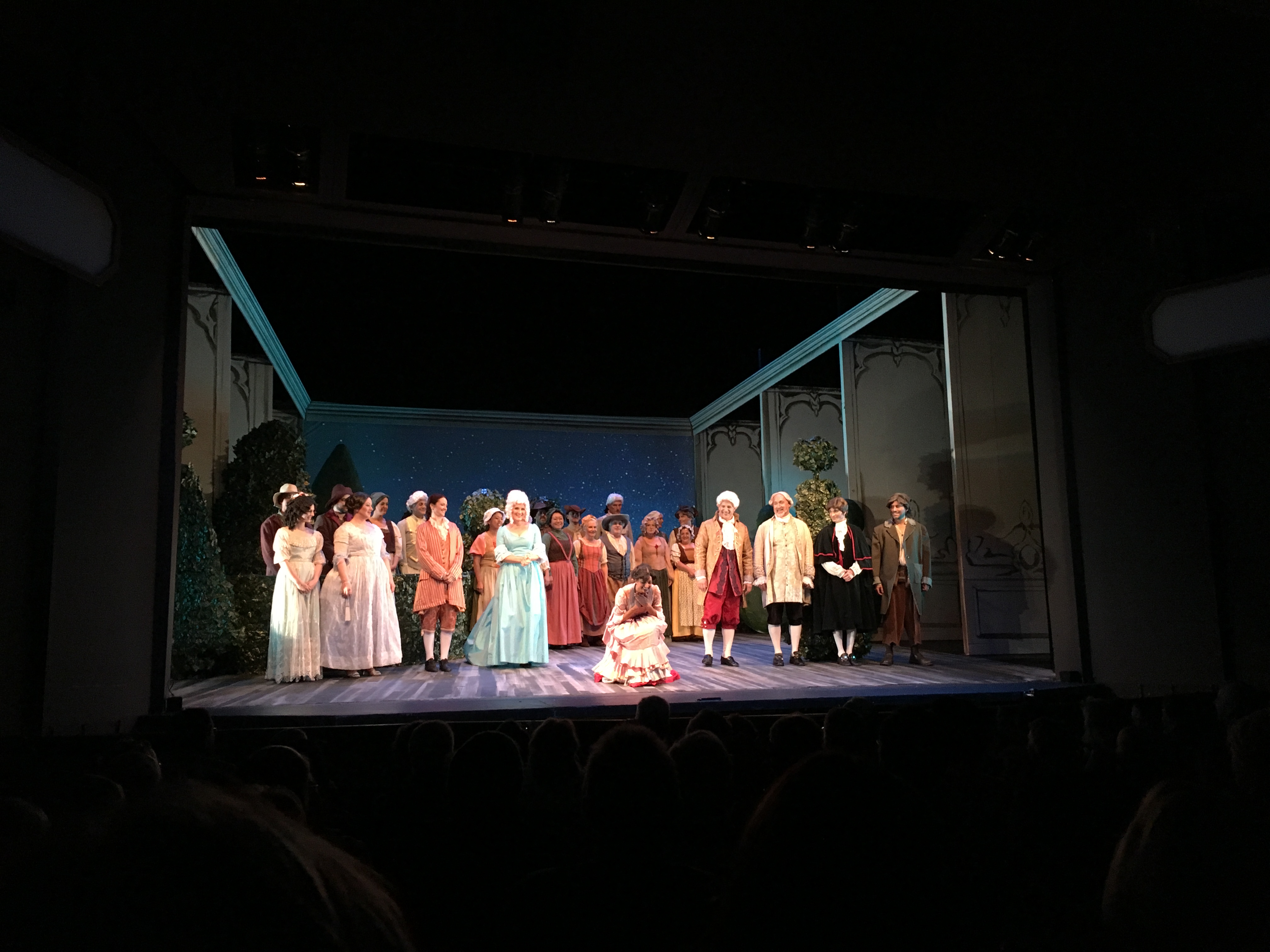
Tattling * The audience was very enthusiastic about the performance. On the other hand, my opera companion insists that he won't go to another Mozart opera at West Bay.
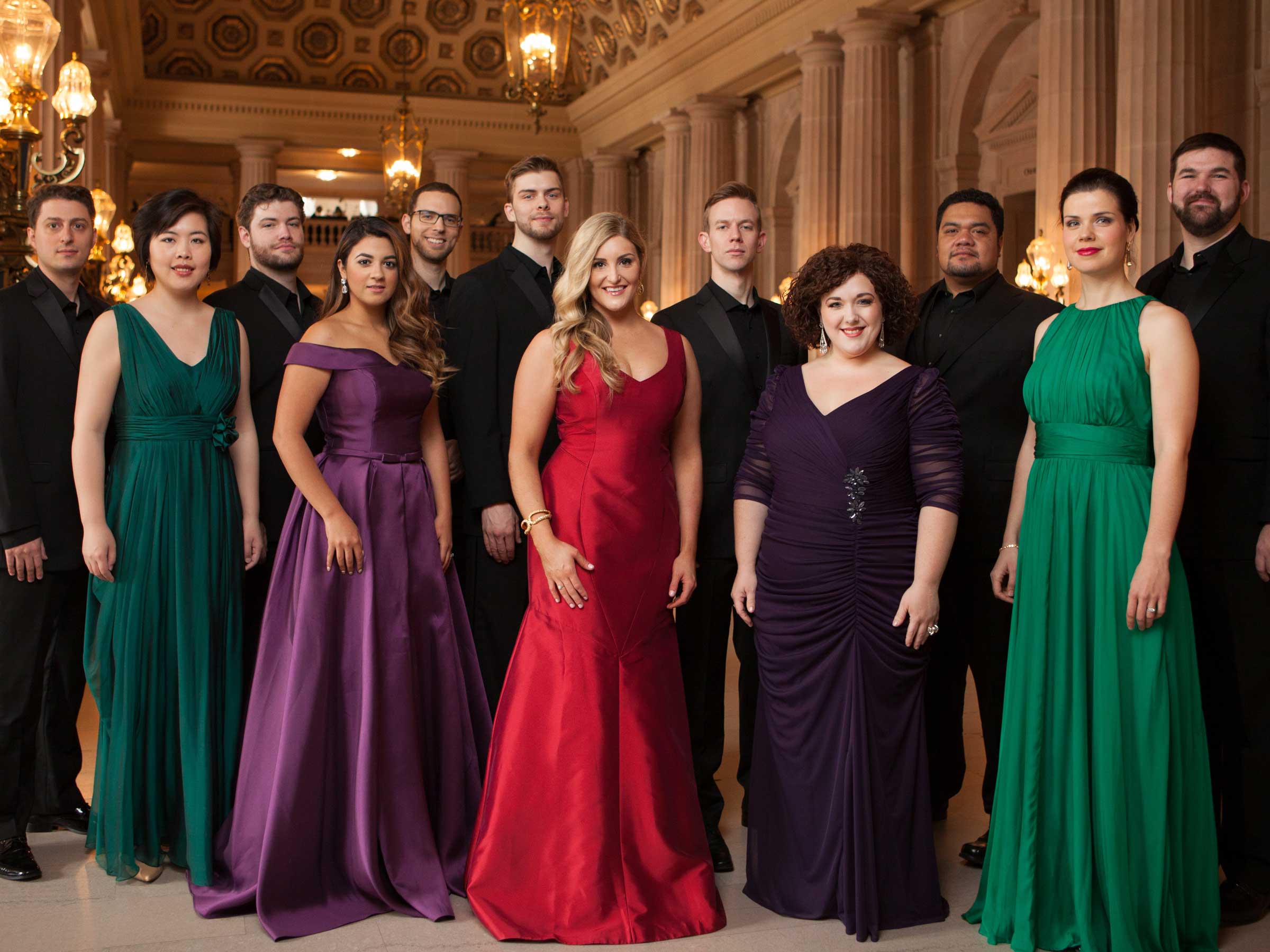
The incoming 2017 Adler Fellows are soprano Sarah Cambidge; tenor Amitai Pati and Kyle van Schoonhoven; baritone Andrew Manea; stage director Aria Umezawa; and apprentice coaches John Elam and Jennifer Szeto. They join current Adlers Amina Idris, Toni Marie Palmertree, Pene Pati, Brad Walker, and Ronny Michael Greenberg. The outgoing 2016 Adler Fellows are Julie Adams, Zanda Švēde, Nian Wang, Edward Nelson, Matthew Stump, Anthony Reed, and Noah Lindquist.
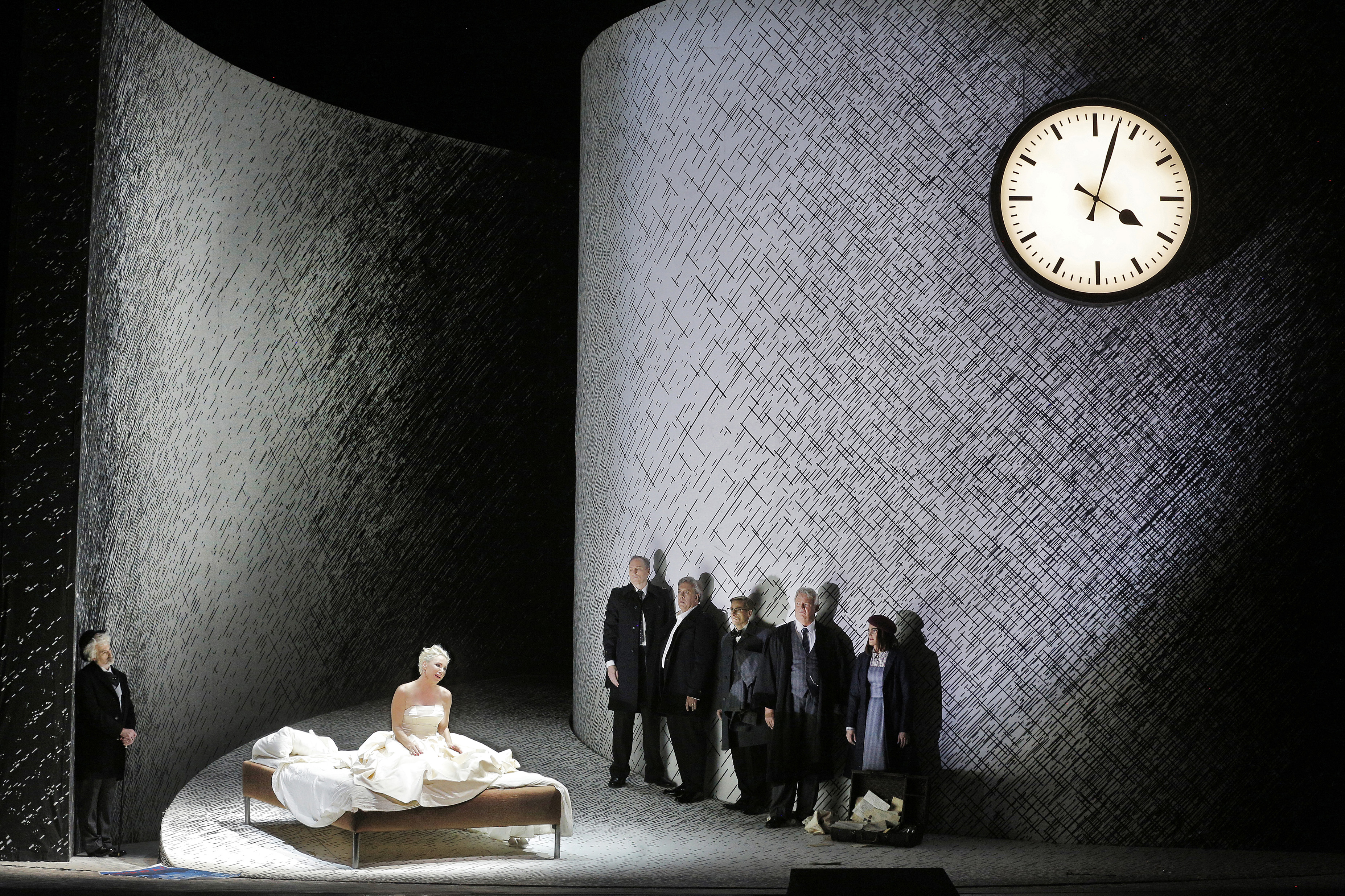
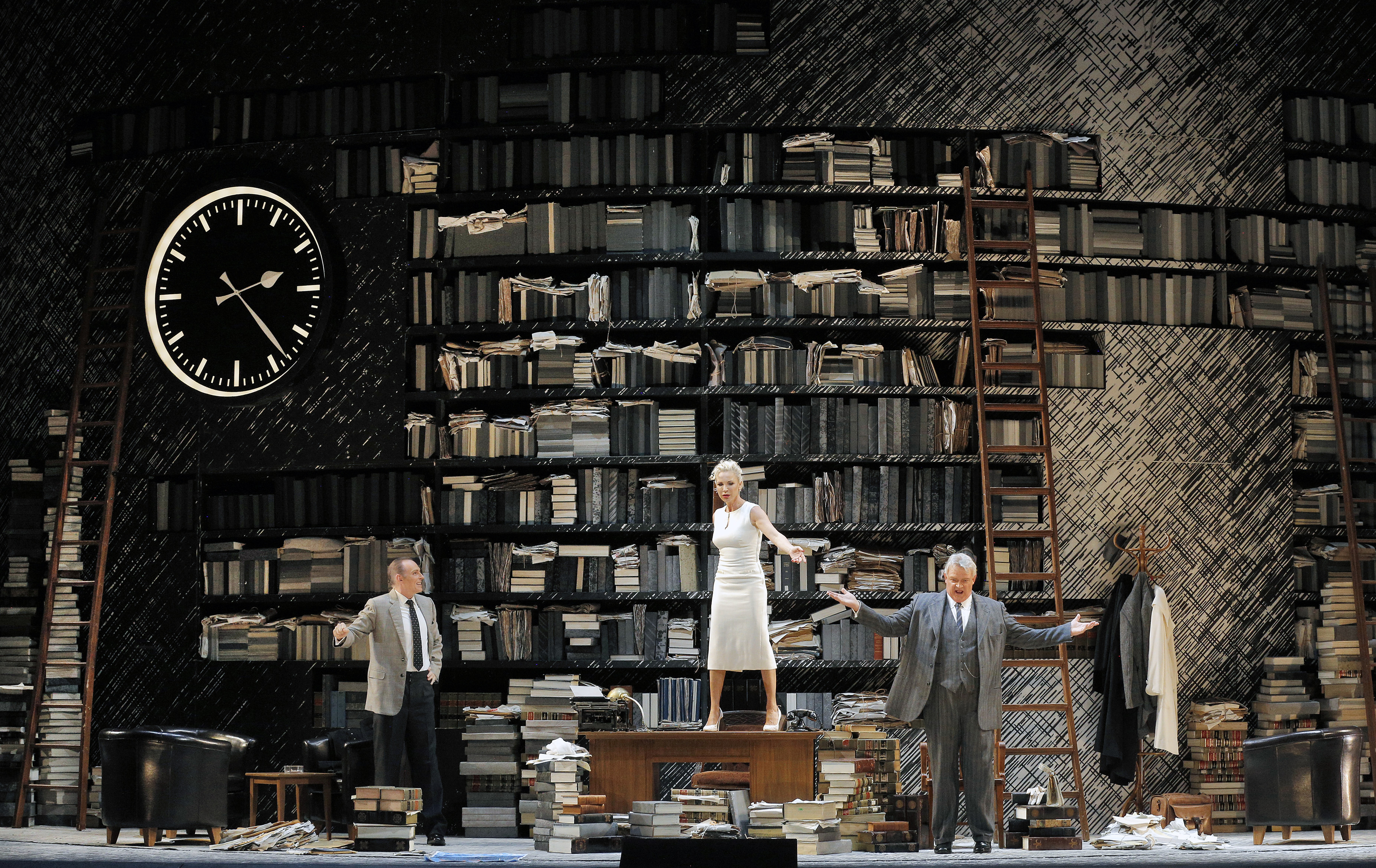
* Notes * With a monstrous but charismatic narcissist as protagonist, last night's revival of San Francisco Opera's The Makropulos Case felt timely. It was difficult to not compare our lead, soprano Nadja Michael, with the previous star in the role, Karita Mattila, especially since the latter was so recently here in the nearly perfect Jenůfa over the summer.
Michael's Emilia Marty was certainly very frightening, as befits a jaded person who has had 300 years of youth and cannot find meaning in anything. The soprano has a powerful voice but lacks an ethereal quality that was so impressive in Mattila's performance six years ago. Michael's movements are also very floppy, one would expect more of a cat-like slinkiness from the libertine Marty, though Michael is certainly flexible.
The rest of the cast was fine. Adler Julie Adams was a sweet Kristina, the aspiring opera singing daughter of Kolenatý's clerk. Matthew O'Neill ably reprised his role as Count Hauk-Šendorf as did Dale Travis as Dr. Kolenatý.
Baritone Stephen Powell's Baron Prus was not as subtly drawn as Gerd Grochowski's the last time around. In his San Francisco Opera debut, tenor Charles Workman had a squeaky start as Albert Gregor, but he recovered well and his voice has a lovely timbre.
Mikhail Tatarnikov's conducting was straightforward, there were slight mishaps in the brass at the beginning, but nothing terrible. The orchestra, however, did not achieve the unearthly beauty that we heard over the summer and in 2010 when playing Janáček.
* Tattling * The house was not full, and there were lots of seats in the back of the balcony, which is ideal for standing room but not great for the opera company. It's a shame since the piece is gorgeous and the stylish staging, with its rotating set and looming clocks, is elegant.
 Production Web Site | SF Opera's Blog


 The Opera Tattler
Leave a comment