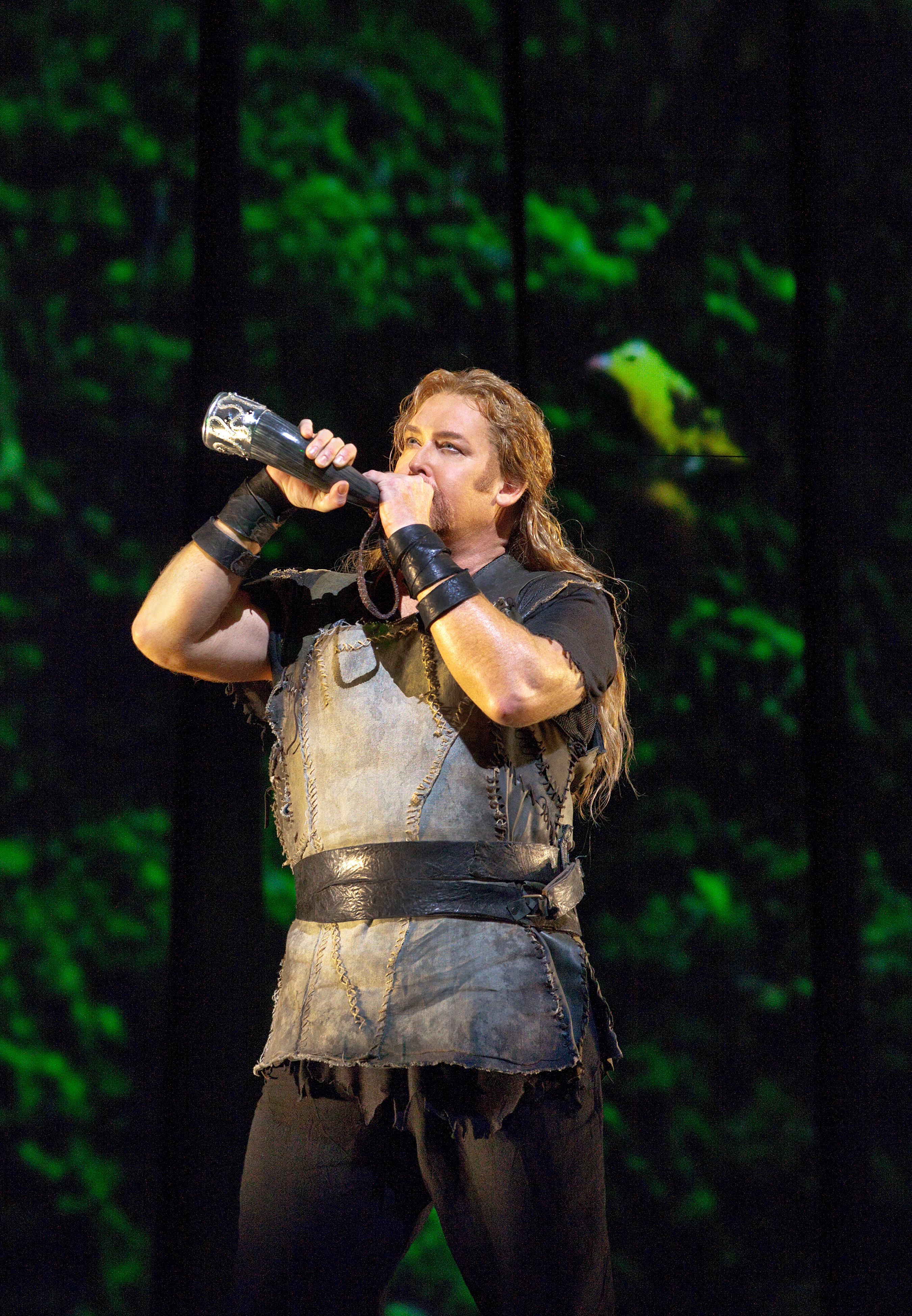
 Jay Hunter Morris (pictured left, photograph by Ken Howard) in the title role of the Metropolitan Opera’s Siegfried, on April 21 and 30, 2012, as part of Ring Cycles 1 and 2. Morris will also sing Siegfried in Götterdämmerung for the second RingCycle on May 3, 2012. Lehman has withdrawn due to illness.
The Opera Tattler
Reviews of Performances and their Audiences
-
-
 * Notes *
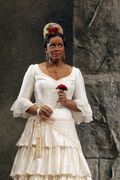
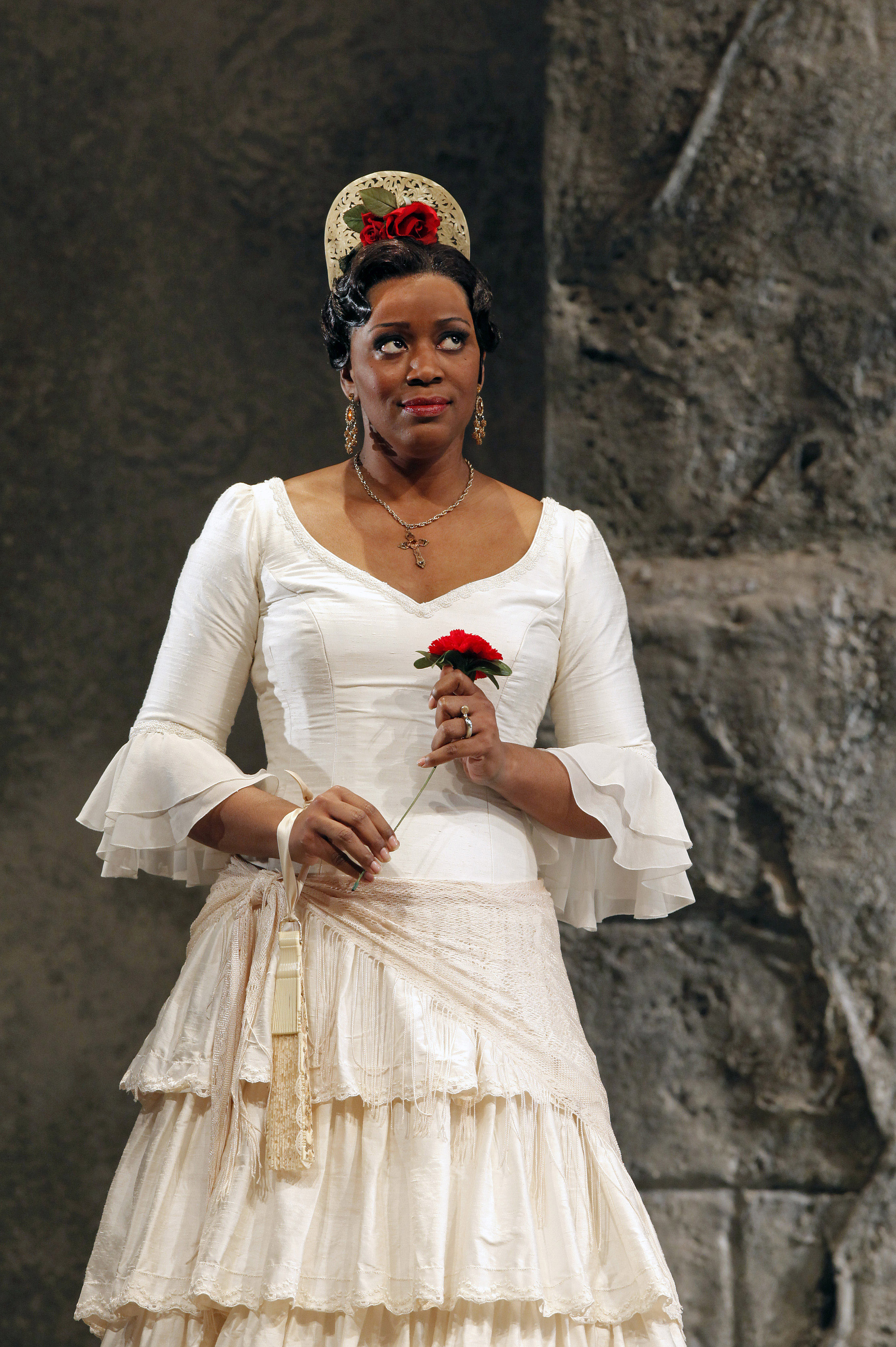
Anita Rachvelishvili (pictured left, photograph by Cory Weaver) is singing five performances as the leading lady in Carmen at San Francisco Opera this month. Rachvelishvili has an arresting voice, resonant and earthy. Her pronunciation of French may have been imperfect, but she seemed fully committed to her role. Rachvelishvili never looked like she was doing something simply because the director asked her to. Though not a graceful dancer, she moved with confidence.The orchestra, conducted by Nicola Luisotti, was a bit more restrained on last Tuesday's performance than the opening matinée. The chorus sounded fine and together. Paulo Szot was still difficult to hear as Escamillo in Act II, perhaps because of his location upstage. Szot did sound rather pretty later in Act III. Susannah Biller's bell-like tone as Frasquita was pleasing. Thiago Arancam's Don José was a bit wooden, but his voice is not without appeal.
* Tattling *
The audience was relatively quiet, no one around me talked, and I heard no watch alarms from my favorite standing room spot at the back of the balcony.Leave a comment
-
 Production Web Site | SF Opera's Blog
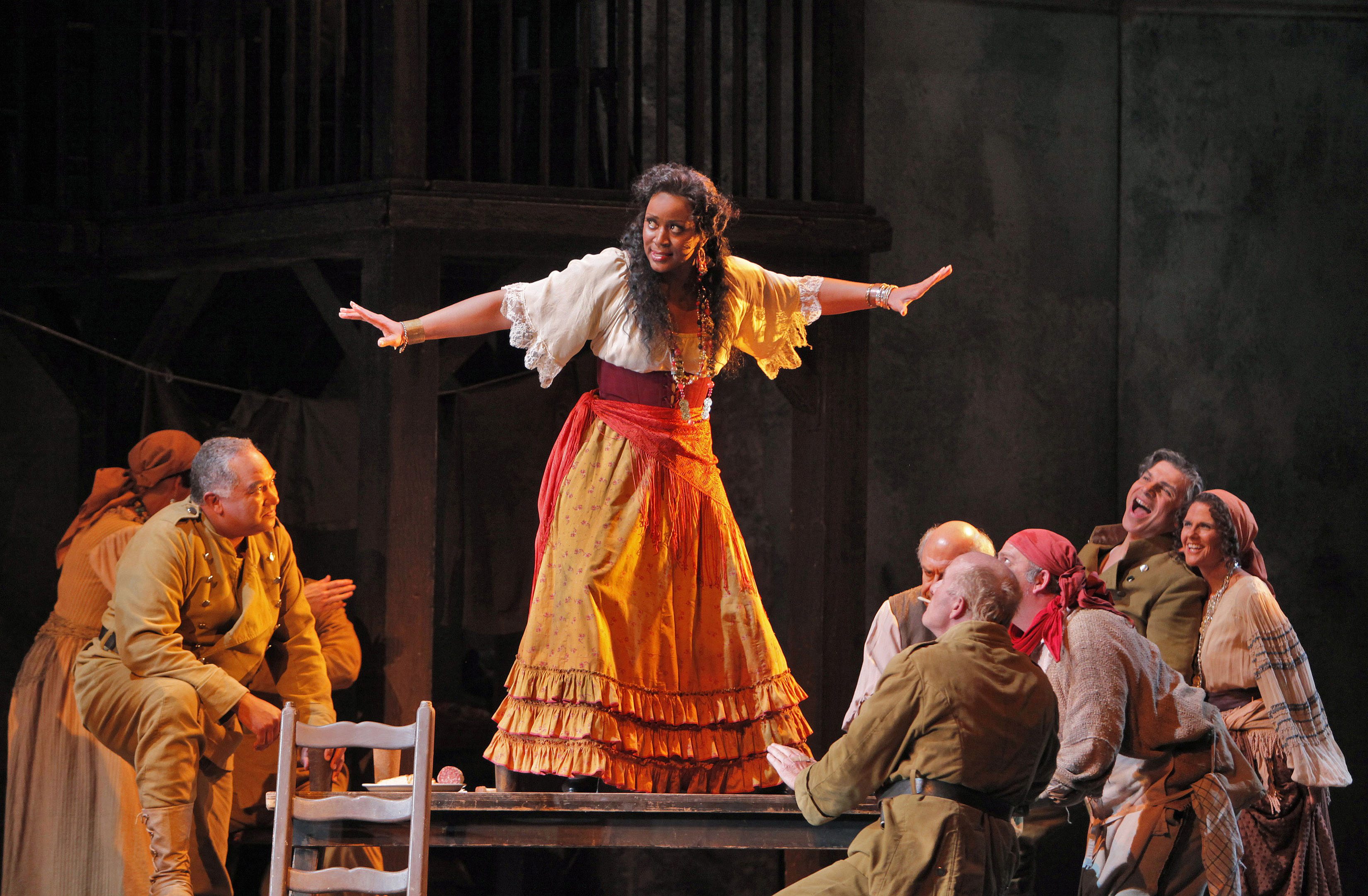
Reviews of San Francisco Opera's Carmen (Act II pictured left with Kendall Gladen as Carmen and members of the San Francisco Opera Chorus, and supernumeraries; photograph by Cory Weaver) are trickling in.
Performance Reviews: San Francisco Chronicle (Kendall Gladen) | San Francisco Chronicle (Anita Rachvelishvili) | San Francisco Classical Voice | San Francisco Examiner
Leave a comment
-
 * Notes *
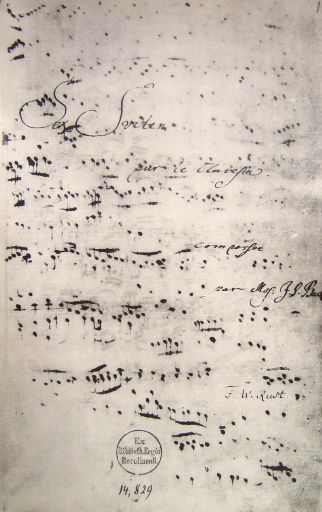
Cal Performances presented a recital of Bach's French Suites played by Davitt Moroney yesterday afternoon. There were three harpsichords on stage: one from UC Berkeley's music department, one belonging to Davitt Moroney himself, and one lent by Peter and Cynthia Hibbert of Palo Alto. All three were made by John Phillips from 1995 to 2010, based on historical models. It was interesting to compare the three instruments, each so different. Moroney played Suites No. 1 and 5 on the third harpsichord, based on a instrument made by Johann Heinrich Gräbner from Dresden in 1722; Suites No. 2 and 4 on the first, modeled after Andreas Ruckers (Antwerp, 1646) but enlarged by François-Étienne Blanchet in 1756, and reworked by Pascal Taskin in 1780; and Suites No. 3 and 6 on his own instrument, based on a harpsichord by Nicolas Dumont from Paris in 1707.The Gräbner harpsichord was cleanest, Moroney's playing came off as elegant and refined. His playing is restrained and not terribly expressive. Personally, I have an irrational affection for this Ruckers-Taskin, as it was likely the first harpsichord I ever heard in person. The instrument has more of a rich muddiness, not entirely appropriate for the French Suites, perhaps, but not unpleasant. The Dumont right in the middle of the stage had a sound that was more subtle than the Ruckers-Taskin but not as neat as the Gräbner.
Moroney spoke quite charmingly between the pieces. His favorite movement is the Allemande of Suite No. 4. Mine may have been the Sarabande of Suite No. 3. I enjoyed Moroney's dry playing, though I occasionally wished for just a bit more capering.
* Tattling *
Many of the attendees read the score during the performance. There was only slight whispering and no electronic noise.Leave a comment
-
 * Notes *
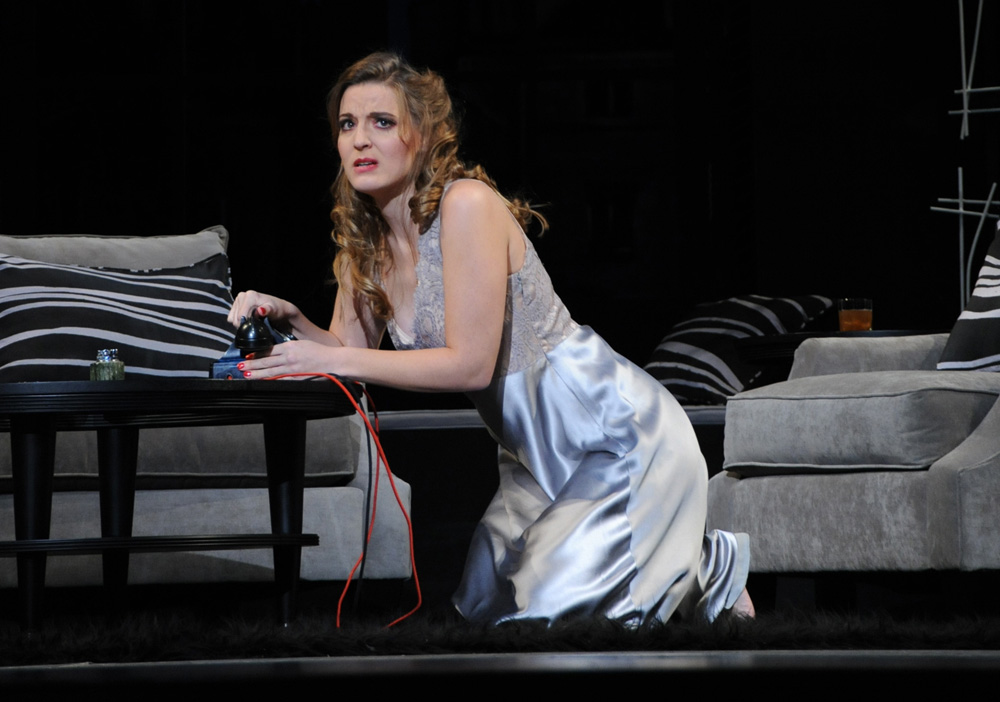
Last night a double bill of La voix humaine (pictured left, photograph by P. Kirk) and Pagliacci opened at Opera San José. It is something of an odd juxtaposition, one imagines it is based on the duration of these two operas and the fact that it would be difficult to present the Poulenc on its own.La voix humaine is an unsettling piece, a one-act opera featuring one rather unhinged, needy woman on a telephone with a bad connection. The music is spare and the singing is speech-like. Mezzo-soprano Betany Coffland gave a nuanced, controlled vocal performance. The orchestra, conducted by Bryan Nies, supported her well. Coffland was only slightly overwhelmed at a few points when she did not face out to the audience because of her blocking. Her acting is strong, she looked completely distraught and devastated. J.B. Wilson’s set is descriptive without being entirely literal. The silver nightgown designed by Alyssa Oania is elegant, but satin can be unforgiving.
Pagliacci was performed with an appealing immediacy. The playing was not always together but clean. The singing was straightforward, the acting again here was formidable. Evan Brummel (Tonio) has a hearty, warm voice. Jasmina Halimic made for an attractive Nedda, she has a fine command of her facial expressions. Her voice was not particularly pretty in this role, it has some grit to it at the bottom, but she was convincing regardless. Alexander Boyer (Canio) was slightly tentative, and could have sung his big aria with more anguish. Boyer has a lovely sound, his performance seemed neat and correct. The set for this opera, also by J.B. Wilson, is simple. The Commedia dell’arte costumes looked like perfect historical replicas as seen in paintings.
* Tattling *
The person in Row G Seat 106 helpfully pointed out that the intermezzo of Pagliacci was “very dark.”Leave a comment
-
 * Notes *
Soprano Nadine Sierra gave a recital with pianist Tamara Sanikidze for the Salons at the Rex series Wednesday evening. The two Adler Fellows created a genial atmosphere, speaking to the audience at length about the pieces and about how they first met at Music Academy of the West. The short program included "Je veux vivre," "Summertime," "A Sleeping Bee," "Vilja," Grieg's "Ein Traum," "Beautiful Dreamer," and "O mio babbino caro." Sierra's voice is pretty and doesn't betray a bit of strain. Sanikidze played gamely. The encore was "Les chemins de l'amour."* Tattling *
It was pretty amusing to hear that Sierra assumed Sanikidze was a singer, not a pianist, because of her outgoing, lively personality.Leave a comment
-
15. October 2011: Opening
Opera Tattler Review18. October 2011: From the Orchestra
* Had a brief discussion about the cuts to the opera with Maestro Luisotti before the performance. When asked why the epilogue was cut, he simply answered that it was thus in the Vienna version. He also explained how the continuo was divided between his fortepiano playing and Bryndon Hassman's harpsichord.
* The overture was much more together, as was pretty much all the playing, except for the end of Act I.
* Shawn Mathey was more confident as Don Ottavio. He can always be heard, but his performance was not particularly nuanced. Some of the voiceless alveolar stops either had aspiration or were subsituted with alveolar flaps.
* Ellie Dehn unraveled during her first aria, "Or sai chi l'onore." She seems terrified of making mistake.
* Vocally, Kate Lindsey (Zerlina) is quite contained.
* Serena Farnocchia's breath control is lacking, but for Elvira, it seems fine.
* Marco Vinco's patter as Leporello is nearly perfect.
* There was some talking from certain audience members.21. October 2011: From the Balcony
* Luisotti's fortepiano playing is charming and comic.
* A latecomer stuck in standing room saw fit to sit next to me for "Dalla su pace." She turned on her cellular phone, whose buttons intoned high pitches to indicate they were being pressed. She clapped for the tenor even though she spent the entire aria either on her phone or reading the program.
* The first cellist played "Batti, batti" beautifully.
* The audience clapped in before the music was over three times.
* Either the mechanism that is used for Don Giovanni's descent or the smoke machine makes a buzzing that is obvious from the back of the balcony.23. October 2011: From the Balcony
* Everyone sounded more together and less frightened.
* The end of Act I was less chaotic.
* Lucas Meacham's voice is incredibly pretty. There was a point near the end of the Champagne aria where he sounds out of breath.
* Ellie Dehn's intonation was better.
* Serena Farnocchia swallowed fewer of her low notes at the ends of phrases.
* There were a lot of children at this performance. The smaller ones are invariably better behaved than the larger ones. This seems counterintuitive, shouldn't younger children have poorer impulse control?26. October 2011: From the Orchestra
* Someone sounded squeaky during "Ho capito! Signor, sì."
* The orchestra was ahead of the singers at the beginning of "Là ci darem la mano."
* The two onstage orchestras for the Act I finale stood whilst playing, a detail I had missed before.
* Someone unfastened his or her shoes during the opera. The velcro straps were noisy.29. October 2011: From the Boxes
* Quite a lot of fun watching the orchestra and Maestro Luisotti.
* The screens in the corners of the box level were not in use.
* From up close, Kate Lindsey's cartwheel during "Giovinette che fate all'amore" and Ryan Kuster's somersault in Act I Scene 19 were even more impressive.
* The French horns were clear in "Ho capito," and only one note in "Non mi dir" was less than perfect.
* The box subscribers were uncharacteristically silent, there was almost no talking in Boxes W, X, or Y. A bottle of carbonated water was opened during "Ah, fuggi il traditor."
* Ellie Dehn had a very good night, less pitchy and generally stronger.2. November 2011: From the Balcony
* Pleased to note that the person sharing the bench with me in the balcony was also reading the score.
* Someone collapsed at the north doors of the balcony just before "Dalla su pace." It seemed quite serious, as the person was unconscious and the nurse was called to attend to him.5. November 2011: From the Balcony
* There was an earthquake measuring 3.2 at 2:52pm. The epicenter was in Piedmont.
* Ellie Dehn sounded fragile during "Or sai chi l'onore." She seemed on the verge of cracking on the penultimate D of the aria.
* The flute, clarinet, and bassoon sounded particularly lovely in "Dalla su pace" this afternoon.10. November 2011: From the Balcony
* The last performance was consistent with the previous few.
* The horns played cleanly.
* Luisotti was occasionally visible in some of the mirrors. One wonders why the director did not really make use of the mirrors, except to change the scenes.Leave a comment
-
 Kate Aldrich has withdrawn from San Francisco Opera's Carmen. Kendall Gladen (pictured left in Act IV of Carmen, photograph by Cory Weaver), who already sang the prima yesterday, and will sing the second performance on Wednesday, will also take over from November 26 through December 4.
Leave a comment
-
 * Notes *
Jean-Pierre Ponnelle’s beloved production of Carmen (Thiago Arancam as Don José and Kendall Gladen as Carmen in Act I pictured left, photograph by Cory Weaver) was revived at San Francisco Opera yesterday afternoon. Nicola Luisotti used his lush, hazy style to good effect on the orchestra. The volume was occasionally overwhelming, mostly in Acts II and III. The string soli were strong. The bassoon and harp also made fine contributions.The children’s chorus was quite adorable, but seemed to rush a little at first. The San Francisco Opera chorus was robust as usual. The principal singers all very much looked their roles. Wayne Tigges was a convincing enough Zuniga. Cybele Gouverneur did not dance confidently as Mercédès, but sang adequately. Frasquita did not seem like Susannah Biller’s best role either, but she does have a lovely sweetness, and moved nicely.
Paulo Szot may have looked dashing as Escamillo, but he was all but inaudible in Act II, even from the back of the balcony, where the sound is best in the War Memorial. In contrast, Sara Gartland’s Micaëla could always be heard. Gartland never sounded vulnerable or näive, perhaps because her voice is so hearty and piercing. Her facial expressions read clearly in her close-ups for OperaVision, and she seems prepared for high-definition film. Thiago Arancam also cut a fine figure as Don José, and his volume was impressive, especially in Act I. Overall, he was a bit bland, but the pain in his voice in the last scene came through. Kendall Gladen made for a languid, dangerous Carmen. Her dancing lacked fire, but her voice is attractive. There were some snags here and there in her singing, but for the most part she acquitted herself well. Her low notes are beautiful.
* Tattling *
There were the requisite watch alarms and light talking from the audience. A woman left her child during the 5 minute pause between Acts III and IV, but did not make it back in time to take her seat. She whispered over me as the orchestra played the beginning of “À deux cuartos!” to inform the child of her location.Leave a comment
-
 * Notes *
Voices of Music opens the 2011-2012 season with delightful concerts that feature tenor Thomas Cooley (pictured left, photograph by Michael Schilhansl) this weekend in the Bay Area. At Saturday's San Francisco performance the small ensemble consisted of only five musicians: Lisa Grodin (violin), Carla Moore (violin), Elizabeth Reed (viola da gamba), David Tayler (archlute), and Hanneke van Proosdij (organ, harpsichord, and recorder). The program began with John Blow's rather apropos "Welcome, welcome, e'vry guest." All the other pieces that followed were from Purcell. Cooley sang "If music be the food of love," "If love's a sweet passion," "Now That the Sun Hath Veiled His Light," "Strike the viol," "See, see my many colour'd fields," "Musick for a while," "Fly, swift, ye hours," "Oh! Fair Cedaria," and "Fairest Isle." This was, of course, interspersed with instrumental music, in this case seven more Purcell pieces. Cooley's voice is bright and pretty. His diction is clear and easily comprehensible. The playing never detracted from his voice, and was precise throughout. The violins were especially lively, even strident when necessary. The encore was "Strike the viol."* Tattling *
The audience was silent and no electronic noise was noted. A service dog in the front row would stand up and wag its tail whenever there was applause.Leave a comment




 The Opera Tattler
Leave a comment